Close Menu
TechCentralTechCentral

    Subscribe to the newsletter

    Get the best South African technology news and analysis delivered to your e-mail inbox every morning.

    Facebook X (Twitter) YouTube LinkedIn
    WhatsApp Facebook X (Twitter) LinkedIn YouTube
    TechCentralTechCentral
    • News
      Cabinet hands the Post Office a board, but not a bailout

      Cabinet hands the Post Office a board, but not a bailout

      5 June 2026
      Bash powers TFG online sales as group profit tumbles

      Bash powers TFG online sales as group profit tumbles

      5 June 2026
      Surplus groceries, straight from the browser - Still Good co-founders Lorenzo Parisi and Nabeel Gool

      Surplus groceries, straight from the browser

      5 June 2026
      In South Africa, the bundle is the new battleground

      In South Africa, the bundle is the new battleground

      5 June 2026
      What happens when AI no longer needs us to improve

      What happens when AI no longer needs us to improve

      5 June 2026
    • World
      Meta takes on OpenAI and Anthropic in enterprise AI

      Meta takes on OpenAI and Anthropic in enterprise AI

      4 June 2026
      AI demand sparks 'chipflation' warning

      AI demand sparks ‘chipflation’ warning

      4 June 2026
      Astronomers discover exoplanets with magnetic fields

      Strange winds reveal magnetic fields on distant ‘hot Jupiters’

      2 June 2026
      AI giant Anthropic files for landmark US listing

      AI giant Anthropic files for landmark US listing

      1 June 2026
      Dell guns for MacBook Neo with low-cost laptop

      Dell guns for MacBook Neo with low-cost laptop

      1 June 2026
    • In-depth
      What Wi-Fi 8 will mean for wireless networks

      What Wi-Fi 8 will mean for wireless networks

      1 June 2026
      Alfa's electric rebel - Alfa Romeo Junior Elettrica Veloce

      Alfa’s electric rebel

      29 April 2026
      Africa switches on as Europe dims the lights

      Africa switches on as Europe dims the lights

      9 April 2026
      The biggest untapped EV market on Earth is hiding in plain sight

      The biggest untapped EV market on Earth is hiding in plain sight

      1 April 2026
      AI, cybersecurity power standout year for Datatec - Jens Montanana

      The R16-billion tech giant hiding in plain sight

      26 March 2026
    • TCS
      TCS | Charge's R1.8-billion bet on an off-grid EV future - Charge chairman Joubert Roux

      TCS | Charge’s R1.8-billion bet on an off-grid EV future

      18 May 2026
      TCS+ | The Up&Up Group on the hidden cost of AI - Jason Harrison

      TCS+ | The Up&Up Group on the hidden cost of AI

      13 May 2026
      Michael Rossouw

      TCS+ | The retirement decision most South Africans get wrong

      6 May 2026
      TCS | The Cape Town start-up listening for TB with AI - Braden van Breda

      TCS | The Cape Town start-up listening for TB with AI

      4 May 2026

      TCS+ | ‘The ISP for ISPs’: Vox’s shift to wholesale aggregator

      20 April 2026
    • Opinion

      Clashing judgments leave South Africa’s crypto law unsettled

      2 June 2026
      The author, Pambos Soteriades

      The trap inside South Africa’s banking MVNO boom

      1 June 2026
      The hidden cost of social media age bans is everyone's privacy - Petrus Potgieter

      The hidden cost of social media age bans is everyone’s privacy

      29 May 2026
      Treasury's crypto crackdown is a betrayal of Mandela's promise - Duncan McLeod

      Treasury’s crypto crackdown is a betrayal of Mandela’s promise

      22 May 2026
      South Africa is sleepwalking into another AI policy failure - Celeste Labuschagne

      South Africa is sleepwalking into another AI policy failure

      20 May 2026
    • Company Hubs
      • 1Stream
      • Africa Data Centres
      • AfriGIS
      • Altron Digital Business
      • Altron Document Solutions
      • Altron Group
      • Arctic Wolf
      • Ascent Technology
      • AvertITD
      • BBD
      • Braintree
      • CallMiner
      • CambriLearn
      • CM Telecom
      • Contactable
      • CYBER1 Solutions
      • Digicloud Africa
      • Digimune
      • Domains.co.za
      • ESET
      • Euphoria Telecom
      • HOSTAFRICA
      • Incredible Business
      • iONLINE
      • IQbusiness
      • Iris Network Systems
      • Kaspersky
      • LSD Open
      • Mitel
      • NEC XON
      • Netstar
      • Network Platforms
      • Next DLP
      • Ovations
      • Paracon
      • Paratus
      • Q-KON
      • SevenC
      • SkyWire
      • Solid8 Technologies
      • Telit Cinterion
      • Telviva
      • Tenable
      • Vertiv
      • Videri Digital
      • Vodacom Business
      • Wipro
      • Workday
      • XLink
    • Sections
      • AI and machine learning
      • Banking
      • Broadcasting and Media
      • Cloud services
      • Contact centres and CX
      • Cryptocurrencies
      • Education and skills
      • Electronics and hardware
      • Energy and sustainability
      • Enterprise software
      • Financial services
      • HealthTech
      • Information security
      • Internet and connectivity
      • Internet of Things
      • Investment
      • IT services
      • Lifestyle
      • Motoring
      • Policy and regulation
      • Public sector
      • Retail and e-commerce
      • Satellite communications
      • Science
      • SMEs and start-ups
      • Social media
      • Talent and leadership
      • Telecoms
    • Events
    • Advertise
    TechCentralTechCentral
    Home » In-depth » How miniaturisation will transform computing

    How miniaturisation will transform computing

    By The Conversation29 June 2015
    Twitter LinkedIn Facebook WhatsApp Email Telegram Copy Link
    News Alerts
    WhatsApp

    intel-compute-stick-640-1

    Lenovo, the Chinese firm that has bought IBM’s cast-off PC business, has announced a miniaturised computer not much larger than a smartphone, which can be connected to any screen via an HDMI connection.

    Advances in electronic components manufacturing processes and integration have resulted in large-scale miniaturisation of computer systems. This has enabled the latest system-in-package and system-on-a-chip approaches, where the processor and other necessary functionality usually provided by many microchips can be incorporated into a single silicon chip package.

    Lenovo’s Ideacenter Stick 300 runs Windows 8 or Linux, is powered by a micro USB connector and comes fitted with a new Intel Bay Trail CPU, 2GB RAM, 32GB flash storage, an SD card reader, Wi-Fi — even speakers.

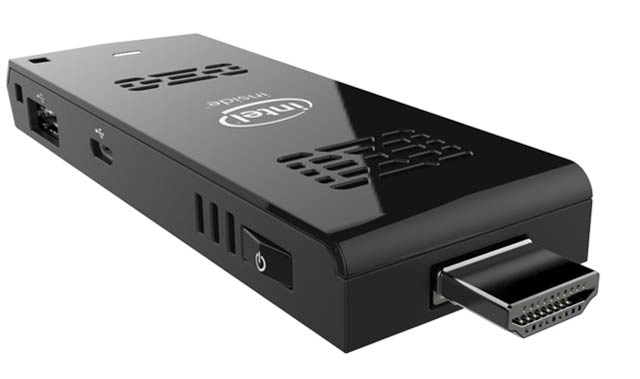
    Lenovo isn’t the first to shrink the PC down to pocket size. Intel’s Compute Stick is another dongle-sized computer with similar specs released this year.

    The Raspberry Pi, now upgraded to its second major release, was probably the first to provide the functionality of a desktop or laptop computer in a credit card-sized electronic board. Over 5m Raspberry Pi computers have been sold since launch in 2012.

    Google has used its stripped-down Chrome OS, based on its Chrome browser, to reduce a Chromebook (Chrome OS-powered laptop) down to the Chromebit. While the Chromebit is no larger than a USB flash drive, it’s markedly less powerful than Intel’s offering, as it is powered by the Rockchip RK3288, an ARM processor, which makes it comparable in power to a smartphone.

    There are other stick-sized, computers running low-power ARM processors capable of running Android, such as Cotton Candy or Google Chromecast. These plug into a digital television to play video directly to the TV or from Internet streaming services such as Netflix — but not much else.

    Computers this small are attractive for many organisations, such as schools and universities who need to equip functional computer laboratories at minimum cost while taking up as little space as possible. Low-power devices also consume less power, which keeps costs down.

    A typical desktop computer uses about 65-250W (plus 20-40W for an LCD monitor) — considerably higher than a typical PC-on-a-stick at about 10W. There are obvious business uses, such as digital signage and advertising when connected to screens or projectors.
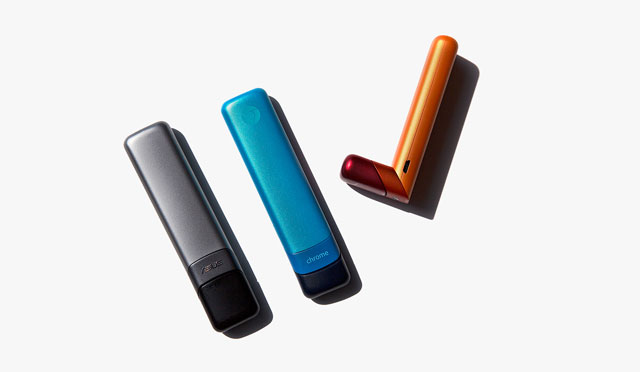
    The Google Chromebit
    The Google Chromebit

    This new round of computer miniaturisation marks a third wave of computerisation. First there were room-sized computers, shared between many users — the mainframe era. These time-sharing systems gradually disappeared as computers were miniaturised, replaced by the one computer per user of the PC era.

    Today, one person could have many computers, whether recognisable as desktop and laptop PCs or smartphones or compute sticks, but which are accessible everywhere and anywhere. Known as ubiquitous or pervasive computing, this is the third wave in computing.

    As all computing devices grow smaller, the aim is that they are more connected and more integrated into our environment. The computing technology fades into our surroundings until only the user interface remains perceptible to users. It is an emerging discipline that brings computing to our living environments, makes those environments sensitive to us and have them adapt to the user’s needs. By enriching an environment with appropriate interconnected computing devices, the environment would be able to sense changes and support decisions that benefit its users.

    There is a growing interest in these smart spaces using miniaturised computing technologies to support our daily lives more effectively. For example, smart offices, classrooms and homes that allow computers to monitor and control what is happening in the environment.

    Apple’s HomeKit and Google’s Nest are a start in this direction, providing the hardware and software to allow home automation. A smart home that monitors temperature and movement could allow elderly to remain self-sufficient and independent in their own home, for example, and voice activated devices could help everyday tasks such as ordering the shopping. A smart office could remind staff of information such as meeting reminders. It could turn the lights on and off, or control heating and cooling efficiently. A smart hospital ward will monitor patients and warn doctors and nurses of any potential problem or human errors.

    The Smart Anything Everywhere vision of the European Commission drives research and development in this area. The evolution and disruptive innovation across the field of computing, from the Internet of things, smart cities and smart spaces down to nanoelectronics — the applications and benefits of greater miniaturisation of computers are endless.The Conversation

    • Ahmad Lotfi is reader in computational intelligence at Nottingham Trent University
    • This article was originally published on The Conversation

    Follow TechCentral on Google News Add TechCentral as your preferred source on Google


    Ahmad Lotfi Intel Lenovo Raspberry Pi
    WhatsApp YouTube
    Share. Facebook Twitter LinkedIn WhatsApp Telegram Email Copy Link
    Previous ArticleCisco sees jump in SA Internet traffic
    Next Article Seven megatrends shaping SA telecoms

    Related Posts

    Nvidia storms the Windows PC market with RTX Spark - Jensen Huang

    Nvidia storms the Windows PC market with RTX Spark

    1 June 2026
    Dell guns for MacBook Neo with low-cost laptop

    Dell guns for MacBook Neo with low-cost laptop

    1 June 2026
    Nvidia's first CPUs to debut in Windows laptops this week

    Nvidia CPUs to debut in Windows laptops this week

    31 May 2026
    Company News
    The real cloud challenge isn't adoption – it's doing it well

    The real cloud challenge isn’t adoption – it’s doing it well

    5 June 2026
    The real hurdle for South Africa's AI voicebots isn't the AI - 1Stream

    The real hurdle for South Africa’s AI voicebots isn’t the AI

    5 June 2026
    Payments Live returns to Johannesburg for 2nd edition

    Payments Live returns to Johannesburg for 2nd edition

    4 June 2026
    Opinion

    Clashing judgments leave South Africa’s crypto law unsettled

    2 June 2026
    The author, Pambos Soteriades

    The trap inside South Africa’s banking MVNO boom

    1 June 2026
    The hidden cost of social media age bans is everyone's privacy - Petrus Potgieter

    The hidden cost of social media age bans is everyone’s privacy

    29 May 2026

    Subscribe to Updates

    Get the best South African technology news and analysis delivered to your e-mail inbox every morning.

    Latest Posts
    Cabinet hands the Post Office a board, but not a bailout

    Cabinet hands the Post Office a board, but not a bailout

    5 June 2026
    Bash powers TFG online sales as group profit tumbles

    Bash powers TFG online sales as group profit tumbles

    5 June 2026
    Surplus groceries, straight from the browser - Still Good co-founders Lorenzo Parisi and Nabeel Gool

    Surplus groceries, straight from the browser

    5 June 2026
    In South Africa, the bundle is the new battleground

    In South Africa, the bundle is the new battleground

    5 June 2026
    © 2009 - 2026 NewsCentral Media
    • Cookie policy (ZA)
    • TechCentral – privacy and Popia

    Type above and press Enter to search. Press Esc to cancel.

    Manage consent

    TechCentral uses cookies to enhance its offerings. Consenting to these technologies allows us to serve you better. Not consenting or withdrawing consent may adversely affect certain features and functions of the website.

    Functional Always active
    The technical storage or access is strictly necessary for the legitimate purpose of enabling the use of a specific service explicitly requested by the subscriber or user, or for the sole purpose of carrying out the transmission of a communication over an electronic communications network.
    Preferences
    The technical storage or access is necessary for the legitimate purpose of storing preferences that are not requested by the subscriber or user.
    Statistics
    The technical storage or access that is used exclusively for statistical purposes. The technical storage or access that is used exclusively for anonymous statistical purposes. Without a subpoena, voluntary compliance on the part of your Internet Service Provider, or additional records from a third party, information stored or retrieved for this purpose alone cannot usually be used to identify you.
    Marketing
    The technical storage or access is required to create user profiles to send advertising, or to track the user on a website or across several websites for similar marketing purposes.
    • Manage options
    • Manage services
    • Manage {vendor_count} vendors
    • Read more about these purposes
    View preferences
    • {title}
    • {title}
    • {title}