

Close Menu
TechCentralTechCentral

    Subscribe to the newsletter

    Get the best South African technology news and analysis delivered to your e-mail inbox every morning.

    Facebook X (Twitter) YouTube LinkedIn
    WhatsApp Facebook X (Twitter) LinkedIn YouTube
    TechCentralTechCentral
    • News
      Cell C cleans up its balance sheet but faces tough trading reality

      Cell C cleans up its balance sheet but faces tough trading reality

      13 February 2026
      MVNO business shines in Cell C's first post-listing results - Jorges Mendes

      MVNO business shines in Cell C’s first post-listing results

      13 February 2026
      Ramaphosa presses ahead with Eskom break-up - Cyril Ramaphosa

      Ramaphosa presses ahead with Eskom break-up

      13 February 2026
      The key technology takeaways from Ramaphosa's 2026 Sona - Cyril Ramaphosa

      The key technology takeaways from Ramaphosa’s 2026 Sona

      13 February 2026
      Toyota SA CEO: NEV inaction will cost South Africa its motoring industry - Andrew Kirby

      Toyota SA CEO: NEV inaction will cost South Africa its motoring industry

      12 February 2026
    • World
      Russia bans WhatsApp

      Russia bans WhatsApp

      12 February 2026
      EU regulators take aim at WhatsApp

      EU regulators take aim at WhatsApp

      9 February 2026
      Musk hits brakes on Mars mission

      Musk hits brakes on Mars mission

      9 February 2026
      Crypto firm accidentally sends R700-billion in bitcoin to its users

      Crypto firm accidentally sends R700-billion in bitcoin to its users

      8 February 2026
      AI won't replace software, says Nvidia CEO amid market rout - Jensen Huang

      AI won’t replace software, says Nvidia CEO amid market rout

      4 February 2026
    • In-depth
      How liberalisation is rewiring South Africa's power sector

      How liberalisation is rewiring South Africa’s power sector

      21 January 2026
      The top-performing South African tech shares of 2025

      The top-performing South African tech shares of 2025

      12 January 2026
      Digital authoritarianism grows as African states normalise internet blackouts

      Digital authoritarianism grows as African states normalise internet blackouts

      19 December 2025
      TechCentral's South African Newsmakers of 2025

      TechCentral’s South African Newsmakers of 2025

      18 December 2025
      Black Friday goes digital in South Africa as online spending surges to record high

      Black Friday goes digital in South Africa as online spending surges to record high

      4 December 2025
    • TCS
      Watts & Wheels S1E4: 'We drive an electric Uber'

      Watts & Wheels S1E4: ‘We drive an electric Uber’

      10 February 2026
      TCS+ | How Cloud On Demand is helping SA businesses succeed in the cloud - Xhenia Rhode, Dion Kalicharan

      TCS+ | Cloud On Demand and Consnet: inside a real-world AWS partner success story

      30 January 2026
      Watts & Wheels S1E4: 'We drive an electric Uber'

      Watts & Wheels S1E3: ‘BYD’s Corolla Cross challenger’

      30 January 2026
      Watts & Wheels S1E4: 'We drive an electric Uber'

      Watts & Wheels S1E2: ‘China attacks, BMW digs in, Toyota’s sublime supercar’

      23 January 2026

      TCS+ | Why cybersecurity is becoming a competitive advantage for SA businesses

      20 January 2026
    • Opinion
      A million reasons monopolies don't work - Duncan McLeod

      A million reasons monopolies don’t work

      10 February 2026
      Eskom unbundling U-turn threatens to undo hard-won electricity gains - Busi Mavuso

      Eskom unbundling U-turn threatens to undo hard-won electricity gains

      9 February 2026
      South Africa's skills advantage is being overlooked at home - Richard Firth

      South Africa’s skills advantage is being overlooked at home

      29 January 2026
      Why Elon Musk's Starlink is a 'hard no' for me - Songezo Zibi

      Why Elon Musk’s Starlink is a ‘hard no’ for me

      26 January 2026
      A million reasons monopolies don't work - Duncan McLeod

      South Africa’s new fibre broadband battle

      20 January 2026
    • Company Hubs
      • Africa Data Centres
      • AfriGIS
      • Altron Digital Business
      • Altron Document Solutions
      • Altron Group
      • Arctic Wolf
      • AvertITD
      • Braintree
      • CallMiner
      • CambriLearn
      • CYBER1 Solutions
      • Digicloud Africa
      • Digimune
      • Domains.co.za
      • ESET
      • Euphoria Telecom
      • Incredible Business
      • iONLINE
      • IQbusiness
      • Iris Network Systems
      • LSD Open
      • Mitel
      • NEC XON
      • Netstar
      • Network Platforms
      • Next DLP
      • Ovations
      • Paracon
      • Paratus
      • Q-KON
      • SevenC
      • SkyWire
      • Solid8 Technologies
      • Telit Cinterion
      • Tenable
      • Vertiv
      • Videri Digital
      • Vodacom Business
      • Wipro
      • Workday
      • XLink
    • Sections
      • AI and machine learning
      • Banking
      • Broadcasting and Media
      • Cloud services
      • Contact centres and CX
      • Cryptocurrencies
      • Education and skills
      • Electronics and hardware
      • Energy and sustainability
      • Enterprise software
      • Financial services
      • Information security
      • Internet and connectivity
      • Internet of Things
      • Investment
      • IT services
      • Lifestyle
      • Motoring
      • Public sector
      • Retail and e-commerce
      • Satellite communications
      • Science
      • SMEs and start-ups
      • Social media
      • Talent and leadership
      • Telecoms
    • Events
    • Advertise
    TechCentralTechCentral
    Home » Sections » Science » The kilogram is being redefined – a physicist explains

    The kilogram is being redefined – a physicist explains

    By The Conversation19 November 2018
    Twitter LinkedIn Facebook WhatsApp Email Telegram Copy Link
    News Alerts
    WhatsApp

    How much is a kilogram? A thousand grams. Or 2.20462 pounds. Or 0.0685 slugs based on the old Imperial gravitational system. But where does this amount come from and how can everyone be sure they are using the same measurement?

    Since 1889, countries who are members of the General Conference on Weights and Measures have agreed to use a standard block of metal — kept near Paris — to define the kilogram. But although the modern block is stored in a highly controlled environment, its weight can change by tiny amounts as wear and tear causes it to lose mass and dirt causes it to increase. To address this problem, scientists around the world have spent nearly two decades discussing how the kilogram could instead be defined in relation to constant measurements of nature. And now they have finally reached a decision.

    The first kilogram (originally called a grave) was defined in 1793 by a commission of the French Academy of Sciences, who wanted a better standard than the fixed amounts of grain that had traditionally been used. The commission decided that the new measure would be the mass of one cubic decimetre of distilled water at 4℃ (the temperature at which water has its highest density under standard conditions). This had the advantage in that most properly equipped labs would be able to reproduce this standard. Subsequently, a prototype of this mass was cast in brass.

    The first kilogram (originally called a grave) was defined in 1793 by a commission of the French Academy of Sciences

    Unfortunately, this definition of mass depended upon another variable measurement, the metre. At this point, the metre was only provisionally defined as part of the distance from the North Pole to the equator. Once the value of the metre and the temperature of water at its densest were more accurately defined, the kilogram also had to be replaced. And a new prototype was cast in platinum to represent this mass.

    Eventually, this was replaced with the international prototype kilogram (IKP) used today, cast from a mixture of platinum and iridium to make it very hard and prevent it reacting with oxygen. The IPK and six copies are kept by the International Bureau of Weights and Measures in the Pavillon de Breteuil, Saint-Cloud, near Paris in France to act as a reference to measure against. Copies of the IPK are transported across the world to ensure all participating countries use the same standard.

    Overhauled definitions

    But even the modern IPK can gradually change in mass. Radically, the answer from the International Bureau of Weights and Measures is to overhaul the definitions of a kilogram, as well as all the other basic units of measurement used in science (known as SI units, from the French for international system).

    Instead of measuring the kilogram against a block stored in a vault, we can define it based on precise values of constants of nature. Agreeing a definition has taken a long time because we needed to be able to measure these constants to exacting standards with an uncertainty of 30 parts per billion (meaning the measurements are accurate to 0.00000003 of a unit).

    Scientists have actually already done this for time and length. A second is no longer a fraction of the time it takes the Earth to revolve, which can change as the globe speeds up or slows down. Instead, a second is now defined by the time it takes for a certain amount of energy to be released as radiation from atoms of Caesium-133. Specifically, one second equals 9 192 631 770 transitions in the hyperfine ground state levels of Caesium-133. This is the same no matter when or where it is measured.
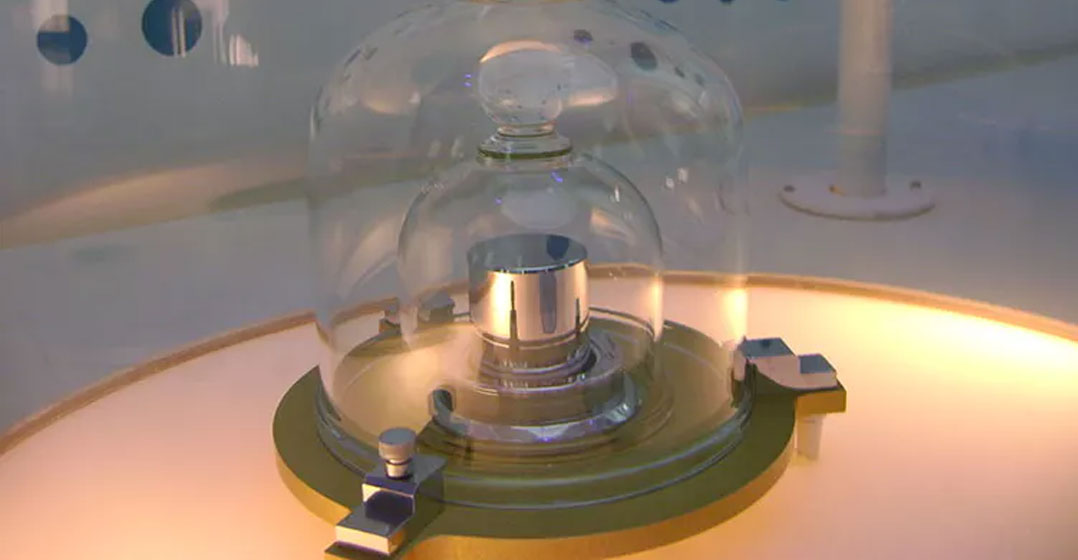
    A copy of the international prototype kilogram. Japs88/Wikimedia Commons, CC BY-SA

    Scientists were then able to redefine the metre in relation to the second and another natural constant, the speed of light in a vacuum (c), which scientists have calculated as 299 792 458 metres per second. So, one metre is now the length travelled by light in 1/c seconds.

    The new definition of the kilogram uses a measurement from another fixed value from nature, Planck’s constant (h), which will be defined as 6.62607015×10⁻³⁴ joule seconds. Planck’s constant can be found by dividing the amount of energy a particle of light or “photon” carries by its electromagnetic frequency.

    The constant is usually measured in joule seconds but this can also be expressed as kilogram square metres per second. We know what a second and a metre is from the other definitions. So, by adding these measurements, along with an exact knowledge of Planck’s constant, we can get a new, very precise definition of the kilogram.

    Other units

    Part of the reason creating the new definition has taken so long is because scientists have had to create very precise devices to measure Planck’s constant with a high enough degree of accuracy. The method has also been controversial because it will break the link that the kilogram has to other base SI units, particularly the mole, which measures the amount of a substance in terms of the number of particles it’s made from. Some scientists have proposed alternative methods as a result.

    But following a symbolic vote, the new definition of the kilogram will be used by the International Bureau of Weights and Measures and national measurement institutes around the world, along with new definitions of the remaining base SI units, the mole, the kelvin (temperature), the ampere (current) and the candela (luminous intensity).

    For most people, everyday life will carry on as normal despite the redefinitions. One standard bag of sugar will contain as much sugar as it ever did. But some of these changes, for example to the kelvin, will mean practical advantages for scientists making very precise measurements. And to answer the question “how much is a kilogram”, we will no longer have to compare blocks of platinum or worry about scratching them.The Conversation

    • Written by Kevin Pimbblet, senior lecturer in physics, University of Hull
    • This article is republished from The Conversation under a Creative Commons licence


    Kevin Pimbblet
    WhatsApp YouTube Follow on Google News Add as preferred source on Google
    Share. Facebook Twitter LinkedIn WhatsApp Telegram Email Copy Link
    Previous ArticleImpressive growth in .za domains
    Next Article Fintech start-up FinChatBot secures R7-million funding
    Company News
    Cell C delivers maiden results with growth momentum, financial flexibility - Jorges Mendes

    Cell C delivers maiden results with growth momentum, financial flexibility

    13 February 2026
    Start-up king joins Paratus Rwanda - Innocent Mutimura

    Start-up king joins Paratus Rwanda

    13 February 2026
    How NEC XON tackled identity risk for a major telco - Michael de Neuilly Rice

    How NEC XON tackled identity risk for a major telco

    11 February 2026
    Opinion
    A million reasons monopolies don't work - Duncan McLeod

    A million reasons monopolies don’t work

    10 February 2026
    Eskom unbundling U-turn threatens to undo hard-won electricity gains - Busi Mavuso

    Eskom unbundling U-turn threatens to undo hard-won electricity gains

    9 February 2026
    South Africa's skills advantage is being overlooked at home - Richard Firth

    South Africa’s skills advantage is being overlooked at home

    29 January 2026

    Subscribe to Updates

    Get the best South African technology news and analysis delivered to your e-mail inbox every morning.

    Latest Posts
    Cell C cleans up its balance sheet but faces tough trading reality

    Cell C cleans up its balance sheet but faces tough trading reality

    13 February 2026
    MVNO business shines in Cell C's first post-listing results - Jorges Mendes

    MVNO business shines in Cell C’s first post-listing results

    13 February 2026
    Ramaphosa presses ahead with Eskom break-up - Cyril Ramaphosa

    Ramaphosa presses ahead with Eskom break-up

    13 February 2026
    The key technology takeaways from Ramaphosa's 2026 Sona - Cyril Ramaphosa

    The key technology takeaways from Ramaphosa’s 2026 Sona

    13 February 2026
    © 2009 - 2026 NewsCentral Media
    • Cookie policy (ZA)
    • TechCentral – privacy and Popia

    Type above and press Enter to search. Press Esc to cancel.

    Manage consent

    TechCentral uses cookies to enhance its offerings. Consenting to these technologies allows us to serve you better. Not consenting or withdrawing consent may adversely affect certain features and functions of the website.

    Functional Always active
    The technical storage or access is strictly necessary for the legitimate purpose of enabling the use of a specific service explicitly requested by the subscriber or user, or for the sole purpose of carrying out the transmission of a communication over an electronic communications network.
    Preferences
    The technical storage or access is necessary for the legitimate purpose of storing preferences that are not requested by the subscriber or user.
    Statistics
    The technical storage or access that is used exclusively for statistical purposes. The technical storage or access that is used exclusively for anonymous statistical purposes. Without a subpoena, voluntary compliance on the part of your Internet Service Provider, or additional records from a third party, information stored or retrieved for this purpose alone cannot usually be used to identify you.
    Marketing
    The technical storage or access is required to create user profiles to send advertising, or to track the user on a website or across several websites for similar marketing purposes.
    • Manage options
    • Manage services
    • Manage {vendor_count} vendors
    • Read more about these purposes
    View preferences
    • {title}
    • {title}
    • {title}