
Close Menu
TechCentralTechCentral

    Subscribe to the newsletter

    Get the best South African technology news and analysis delivered to your e-mail inbox every morning.

    Facebook X (Twitter) YouTube LinkedIn
    WhatsApp Facebook X (Twitter) LinkedIn YouTube
    TechCentralTechCentral
    • News
      AI chatbots are coming to Apple CarPlay

      AI chatbots are coming to Apple CarPlay

      8 February 2026
      South Africa's stablecoin silence is becoming a policy failure

      South Africa’s stablecoin silence is becoming a policy failure

      6 February 2026
      Every electric car you can buy in South Africa in early 2026, ranked by price

      Every electric car you can buy in South Africa in early 2026, ranked by price

      6 February 2026
      From stocks to crypto, markets reel as AI doubts grow

      From stocks to crypto, markets reel as AI doubts grow

      6 February 2026
      South Africa deepens China ties as US trade tensions escalate

      South Africa deepens China ties as US trade tensions escalate

      6 February 2026
    • World
      AI won't replace software, says Nvidia CEO amid market rout - Jensen Huang

      AI won’t replace software, says Nvidia CEO amid market rout

      4 February 2026
      Apple acquires audio AI start-up Q.ai

      Apple acquires audio AI start-up Q.ai

      30 January 2026
      SpaceX IPO may be largest in history

      SpaceX IPO may be largest in history

      28 January 2026
      Nvidia throws AI at the weather

      Nvidia throws AI at weather forecasting

      27 January 2026
      Debate erupts over value of in-flight Wi-Fi

      Debate erupts over value of in-flight Wi-Fi

      26 January 2026
    • In-depth
      How liberalisation is rewiring South Africa's power sector

      How liberalisation is rewiring South Africa’s power sector

      21 January 2026
      The top-performing South African tech shares of 2025

      The top-performing South African tech shares of 2025

      12 January 2026
      Digital authoritarianism grows as African states normalise internet blackouts

      Digital authoritarianism grows as African states normalise internet blackouts

      19 December 2025
      TechCentral's South African Newsmakers of 2025

      TechCentral’s South African Newsmakers of 2025

      18 December 2025
      Black Friday goes digital in South Africa as online spending surges to record high

      Black Friday goes digital in South Africa as online spending surges to record high

      4 December 2025
    • TCS
      TCS+ | How Cloud On Demand is helping SA businesses succeed in the cloud - Xhenia Rhode, Dion Kalicharan

      TCS+ | Cloud On Demand and Consnet: inside a real-world AWS partner success story

      30 January 2026
      Watts & Wheels S1E3: 'BYD's Corolla Cross challenger'

      Watts & Wheels S1E3: ‘BYD’s Corolla Cross challenger’

      30 January 2026
      Watts & Wheels S1E3: 'BYD's Corolla Cross challenger'

      Watts & Wheels S1E2: ‘China attacks, BMW digs in, Toyota’s sublime supercar’

      23 January 2026

      TCS+ | Why cybersecurity is becoming a competitive advantage for SA businesses

      20 January 2026
      Watts & Wheels S1E3: 'BYD's Corolla Cross challenger'

      Watts & Wheels: S1E1 – ‘William, Prince of Wheels’

      8 January 2026
    • Opinion
      South Africa's skills advantage is being overlooked at home - Richard Firth

      South Africa’s skills advantage is being overlooked at home

      29 January 2026
      Why Elon Musk's Starlink is a 'hard no' for me - Songezo Zibi

      Why Elon Musk’s Starlink is a ‘hard no’ for me

      26 January 2026
      South Africa's new fibre broadband battle - Duncan McLeod

      South Africa’s new fibre broadband battle

      20 January 2026
      AI moves from pilots to production in South African companies - Nazia Pillay SAP

      AI moves from pilots to production in South African companies

      20 January 2026
      South Africa's new fibre broadband battle - Duncan McLeod

      ANC’s attack on Solly Malatsi shows how BEE dogma trumps economic reality

      14 December 2025
    • Company Hubs
      • Africa Data Centres
      • AfriGIS
      • Altron Digital Business
      • Altron Document Solutions
      • Altron Group
      • Arctic Wolf
      • AvertITD
      • Braintree
      • CallMiner
      • CambriLearn
      • CYBER1 Solutions
      • Digicloud Africa
      • Digimune
      • Domains.co.za
      • ESET
      • Euphoria Telecom
      • Incredible Business
      • iONLINE
      • IQbusiness
      • Iris Network Systems
      • LSD Open
      • NEC XON
      • Netstar
      • Network Platforms
      • Next DLP
      • Ovations
      • Paracon
      • Paratus
      • Q-KON
      • SevenC
      • SkyWire
      • Solid8 Technologies
      • Telit Cinterion
      • Tenable
      • Vertiv
      • Videri Digital
      • Vodacom Business
      • Wipro
      • Workday
      • XLink
    • Sections
      • AI and machine learning
      • Banking
      • Broadcasting and Media
      • Cloud services
      • Contact centres and CX
      • Cryptocurrencies
      • Education and skills
      • Electronics and hardware
      • Energy and sustainability
      • Enterprise software
      • Financial services
      • Information security
      • Internet and connectivity
      • Internet of Things
      • Investment
      • IT services
      • Lifestyle
      • Motoring
      • Public sector
      • Retail and e-commerce
      • Satellite communications
      • Science
      • SMEs and start-ups
      • Social media
      • Talent and leadership
      • Telecoms
    • Events
    • Advertise
    TechCentralTechCentral
    Home » Sections » Motoring » Electrical tape fooled a Tesla into speeding in test

    Electrical tape fooled a Tesla into speeding in test

    By Agency Staff20 February 2020
    Twitter LinkedIn Facebook WhatsApp Email Telegram Copy Link
    News Alerts
    WhatsApp

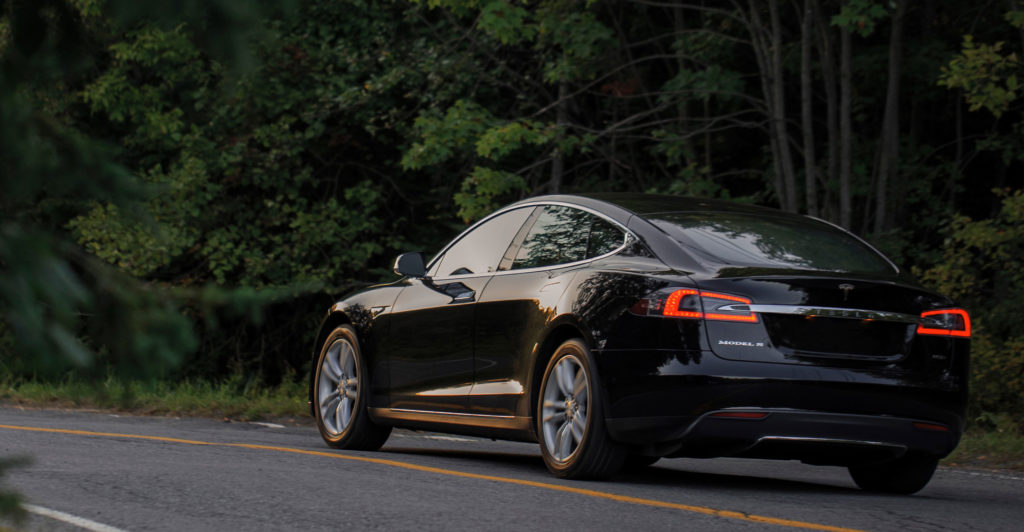
    Researchers were able to trick a Tesla vehicle into speeding by putting a strip of electrical tape over a speed limit sign, spotlighting the kinds of potential vulnerabilities facing automated driving systems.

    Technicians at McAfee placed the piece of tape horizontally across the middle of the “3” on a 35mph (56km/h) speed limit sign. The change caused the vehicle to read the limit as 85mph (137km/h), and its cruise control system automatically accelerated, according to research released by McAfee on Wednesday.

    McAfee says the issue isn’t a serious risk to motorists. No one was hurt and the researcher behind the wheel was able to safely slow the car.

    It’s quite improbable that we’ll ever see this in the wild or that attackers will try to leverage this until we have truly autonomous vehicles

    But the findings, from 18 months of research that ended last year, illustrate a weakness of machine-learning systems used in automated driving, according to Steve Povolny, head of advanced threat research at McAfee. Other research has shown how changes in the physical world can confuse such systems.

    The tests involved a 2016 Model S and Model X that used camera systems supplied by Mobileye, now a unit of Intel. Mobileye systems are used by several car makers though Tesla stopped using them in 2016.

    Tests on Mobileye’s latest camera system didn’t reveal the same vulnerability, and Tesla’s latest vehicles apparently don’t depend on traffic sign recognition, according to McAfee.

    Tesla didn’t respond to e-mails seeking comment on the research.

    ‘Blind spots’

    “Manufacturers and vendors are aware of the problem and they’re learning from the problem,” Povolny said. “But it doesn’t change the fact that there are a lot of blind spots in this industry.”

    To be sure, the real-world threats of such an occurrence today are limited. For one, self-driving cars are still in the development phase, and most are being tested with safety drivers behind the wheel. Vehicles with advanced driver-assist systems that are available now still require the human to be attentive.

    And the McAfee researchers were only able to trick the system by duplicating a certain sequence involving when a driver-assist function was turned on and encountered the altered speed limit sign. Manufacturers are also integrating mapping technology into systems that reflect the proper speed limit.
    “It’s quite improbable that we’ll ever see this in the wild or that attackers will try to leverage this until we have truly autonomous vehicles, and by that point we hope that these kinds of flaws are addressed earlier on,” Povolny said.

    In a statement, Mobileye said human drivers can also be fooled by such a modification and that the system tested by the researchers was designed to assist a human driver and not to support autonomous driving.

    “Autonomous vehicle technology will not rely on sensing alone, but will also be supported by various other technologies and data, such as crowd-sourced mapping, to ensure the reliability of the information received from the camera sensor and offer more robust redundancies and safety,” the company said.

    The issue isn’t specific to Tesla or Mobileye, but is a broader weakness inherent in the advanced systems powering self-driving cars

    The McAfee research follows similar academic work in what’s known as adversarial machine learning, a relatively new field that studies how computer-based learning systems can be manipulated. Researchers in 2017 found that placing four black and white stickers in specific locations on a stop sign could “trick” a computer vision system into seeing a 45mph speed limit sign, for example.

    The issue isn’t specific to Tesla or Mobileye, but is a broader weakness inherent in the advanced systems powering self-driving cars, said Missy Cummings, a Duke University robotics professor and autonomous vehicle expert, and researchers have shown that potentially serious malfunctions can be caused by changing the physical environment without accessing the system itself.

    “And that’s why it’s so dangerous, because you don’t have to access the system to hack it, you just have to access the world that we’re in,” she said.

    Cummings said McAfee’s findings illustrate why autonomous cars should be subjected to a “vision test” to evaluate whether self-driving systems can safely detect and respond to real-world situations created by other vehicles, pedestrians and other road users.  — Reported by Ryan Beene, (c) 2020 Bloomberg LP



    Intel McAfee Mobileye Tesla top
    WhatsApp YouTube Follow on Google News Add as preferred source on Google
    Share. Facebook Twitter LinkedIn WhatsApp Telegram Email Copy Link
    Previous ArticleUS judge dismisses Huawei lawsuit over government contracts ban
    Next Article Get a competitive edge with iOCO multi-cloud management

    Related Posts

    A single Musk super-company may be taking shape - Elon Musk

    A single Musk super-company may be taking shape

    30 January 2026
    Tesla abandons traditional EV growth for a high-stakes AI future

    Tesla abandons traditional EV growth for a high-stakes AI future

    29 January 2026
    Intel takes another hit - Intel CEO Lip-Bu Tan. Laure Andrillon/Reuters

    Intel takes another hit

    23 January 2026
    Company News
    The skills gap is a thinking gap: why South African employers can't find problem solvers

    The skills gap is a thinking gap: why SA employers can’t find problem solvers

    6 February 2026
    Vox Kiwi Wireless: fibre-like broadband for South African homes

    Vox Kiwi Wireless: fibre-like broadband for South African homes

    5 February 2026
    NEC XON achieves an African first with full Fortinet accreditation - Ian Kruger

    NEC XON achieves an African first with full Fortinet accreditation

    5 February 2026
    Opinion
    South Africa's skills advantage is being overlooked at home - Richard Firth

    South Africa’s skills advantage is being overlooked at home

    29 January 2026
    Why Elon Musk's Starlink is a 'hard no' for me - Songezo Zibi

    Why Elon Musk’s Starlink is a ‘hard no’ for me

    26 January 2026
    South Africa's new fibre broadband battle - Duncan McLeod

    South Africa’s new fibre broadband battle

    20 January 2026

    Subscribe to Updates

    Get the best South African technology news and analysis delivered to your e-mail inbox every morning.

    Latest Posts
    AI chatbots are coming to Apple CarPlay

    AI chatbots are coming to Apple CarPlay

    8 February 2026
    South Africa's stablecoin silence is becoming a policy failure

    South Africa’s stablecoin silence is becoming a policy failure

    6 February 2026
    Every electric car you can buy in South Africa in early 2026, ranked by price

    Every electric car you can buy in South Africa in early 2026, ranked by price

    6 February 2026
    From stocks to crypto, markets reel as AI doubts grow

    From stocks to crypto, markets reel as AI doubts grow

    6 February 2026
    © 2009 - 2026 NewsCentral Media
    • Cookie policy (ZA)
    • TechCentral – privacy and Popia

    Type above and press Enter to search. Press Esc to cancel.

    Manage consent

    TechCentral uses cookies to enhance its offerings. Consenting to these technologies allows us to serve you better. Not consenting or withdrawing consent may adversely affect certain features and functions of the website.

    Functional Always active
    The technical storage or access is strictly necessary for the legitimate purpose of enabling the use of a specific service explicitly requested by the subscriber or user, or for the sole purpose of carrying out the transmission of a communication over an electronic communications network.
    Preferences
    The technical storage or access is necessary for the legitimate purpose of storing preferences that are not requested by the subscriber or user.
    Statistics
    The technical storage or access that is used exclusively for statistical purposes. The technical storage or access that is used exclusively for anonymous statistical purposes. Without a subpoena, voluntary compliance on the part of your Internet Service Provider, or additional records from a third party, information stored or retrieved for this purpose alone cannot usually be used to identify you.
    Marketing
    The technical storage or access is required to create user profiles to send advertising, or to track the user on a website or across several websites for similar marketing purposes.
    • Manage options
    • Manage services
    • Manage {vendor_count} vendors
    • Read more about these purposes
    View preferences
    • {title}
    • {title}
    • {title}