Close Menu
TechCentralTechCentral

    Subscribe to the newsletter

    Get the best South African technology news and analysis delivered to your e-mail inbox every morning.

    Facebook X (Twitter) YouTube LinkedIn
    WhatsApp Facebook X (Twitter) LinkedIn YouTube
    TechCentralTechCentral
    • News
      South Africa's stablecoin silence is becoming a policy failure

      South Africa’s stablecoin silence is becoming a policy failure

      6 February 2026
      Every electric car you can buy in South Africa in early 2026, ranked by price

      Every electric car you can buy in South Africa in early 2026, ranked by price

      6 February 2026
      From stocks to crypto, markets reel as AI doubts grow

      From stocks to crypto, markets reel as AI doubts grow

      6 February 2026
      South Africa deepens China ties as US trade tensions escalate

      South Africa deepens China ties as US trade tensions escalate

      6 February 2026
      Big changes at Lesaka as Bank Zero deal nears completion - Lincoln Mali

      Big changes at Lesaka as Bank Zero deal nears completion

      6 February 2026
    • World
      AI won't replace software, says Nvidia CEO amid market rout - Jensen Huang

      AI won’t replace software, says Nvidia CEO amid market rout

      4 February 2026
      Apple acquires audio AI start-up Q.ai

      Apple acquires audio AI start-up Q.ai

      30 January 2026
      SpaceX IPO may be largest in history

      SpaceX IPO may be largest in history

      28 January 2026
      Nvidia throws AI at the weather

      Nvidia throws AI at weather forecasting

      27 January 2026
      Debate erupts over value of in-flight Wi-Fi

      Debate erupts over value of in-flight Wi-Fi

      26 January 2026
    • In-depth
      How liberalisation is rewiring South Africa's power sector

      How liberalisation is rewiring South Africa’s power sector

      21 January 2026
      The top-performing South African tech shares of 2025

      The top-performing South African tech shares of 2025

      12 January 2026
      Digital authoritarianism grows as African states normalise internet blackouts

      Digital authoritarianism grows as African states normalise internet blackouts

      19 December 2025
      TechCentral's South African Newsmakers of 2025

      TechCentral’s South African Newsmakers of 2025

      18 December 2025
      Black Friday goes digital in South Africa as online spending surges to record high

      Black Friday goes digital in South Africa as online spending surges to record high

      4 December 2025
    • TCS
      TCS+ | How Cloud On Demand is helping SA businesses succeed in the cloud - Xhenia Rhode, Dion Kalicharan

      TCS+ | Cloud On Demand and Consnet: inside a real-world AWS partner success story

      30 January 2026
      Watts & Wheels S1E3: 'BYD's Corolla Cross challenger'

      Watts & Wheels S1E3: ‘BYD’s Corolla Cross challenger’

      30 January 2026
      Watts & Wheels S1E3: 'BYD's Corolla Cross challenger'

      Watts & Wheels S1E2: ‘China attacks, BMW digs in, Toyota’s sublime supercar’

      23 January 2026

      TCS+ | Why cybersecurity is becoming a competitive advantage for SA businesses

      20 January 2026
      Watts & Wheels S1E3: 'BYD's Corolla Cross challenger'

      Watts & Wheels: S1E1 – ‘William, Prince of Wheels’

      8 January 2026
    • Opinion
      South Africa's skills advantage is being overlooked at home - Richard Firth

      South Africa’s skills advantage is being overlooked at home

      29 January 2026
      Why Elon Musk's Starlink is a 'hard no' for me - Songezo Zibi

      Why Elon Musk’s Starlink is a ‘hard no’ for me

      26 January 2026
      South Africa's new fibre broadband battle - Duncan McLeod

      South Africa’s new fibre broadband battle

      20 January 2026
      AI moves from pilots to production in South African companies - Nazia Pillay SAP

      AI moves from pilots to production in South African companies

      20 January 2026
      South Africa's new fibre broadband battle - Duncan McLeod

      ANC’s attack on Solly Malatsi shows how BEE dogma trumps economic reality

      14 December 2025
    • Company Hubs
      • Africa Data Centres
      • AfriGIS
      • Altron Digital Business
      • Altron Document Solutions
      • Altron Group
      • Arctic Wolf
      • AvertITD
      • Braintree
      • CallMiner
      • CambriLearn
      • CYBER1 Solutions
      • Digicloud Africa
      • Digimune
      • Domains.co.za
      • ESET
      • Euphoria Telecom
      • Incredible Business
      • iONLINE
      • IQbusiness
      • Iris Network Systems
      • LSD Open
      • NEC XON
      • Netstar
      • Network Platforms
      • Next DLP
      • Ovations
      • Paracon
      • Paratus
      • Q-KON
      • SevenC
      • SkyWire
      • Solid8 Technologies
      • Telit Cinterion
      • Tenable
      • Vertiv
      • Videri Digital
      • Vodacom Business
      • Wipro
      • Workday
      • XLink
    • Sections
      • AI and machine learning
      • Banking
      • Broadcasting and Media
      • Cloud services
      • Contact centres and CX
      • Cryptocurrencies
      • Education and skills
      • Electronics and hardware
      • Energy and sustainability
      • Enterprise software
      • Financial services
      • Information security
      • Internet and connectivity
      • Internet of Things
      • Investment
      • IT services
      • Lifestyle
      • Motoring
      • Public sector
      • Retail and e-commerce
      • Satellite communications
      • Science
      • SMEs and start-ups
      • Social media
      • Talent and leadership
      • Telecoms
    • Events
    • Advertise
    TechCentralTechCentral
    Home » Editor's pick » Windows 10 one year on

    Windows 10 one year on

    By The Conversation1 August 2016
    Twitter LinkedIn Facebook WhatsApp Email Telegram Copy Link
    News Alerts
    WhatsApp

    windows-10-640

    This week marks one year since the launch of what is arguably Microsoft’s most ambitious — and possibly most controversial — operating system: Windows 10.

    Windows 10 represents a fundamentally different approach compared to the earlier versions of Windows that many of us have used, such as the highly popular Windows 7.

    With Windows 7, Microsoft understood what desktop users wanted and delivered a product to satisfy their demands. Windows 7 loaded quickly, it made media sharing easy, it was more secure than the earlier Windows XP, gamers loved it, it used less power and Windows Media Centre was a useful interface for watching media.

    But rather than being exclusively for desktop PCs, Windows 10 aimed to service three different platforms: PC, tablet and smartphone.

    In many ways, Windows 10 is an evolution of its previous iteration, Windows 8 (there was no Windows 9). Microsoft has taken the same cross-platform philosophy and refined it to remove some of the issues that proved unpopular with users.

    But Microsoft’s first attempt to appeal to the desktop and mobile market in a single OS failed badly in two ways.

    Firstly, Windows 8 never gained a significant market share in the mobile space. Secondly, it compromised the experience for desktop users by forcing them to use an interface system designed with touchscreen tablets in mind.

    The Start menu — a fixture since Windows 95 — was removed in favour of a start screen, which proved to be a disastrous move.

    Even experienced Windows users could not find the common functionality they regularly used. Microsoft’s app store was launched to compete with Apple and Google, but it failed to attract quality developers. This had a flow-on effect on the mobile/tablet market as many apps that people used were not available on Windows 8.

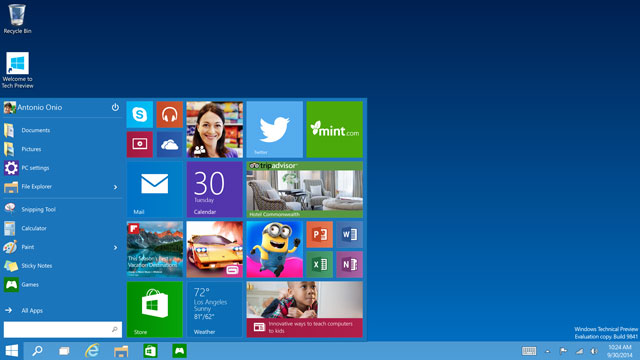
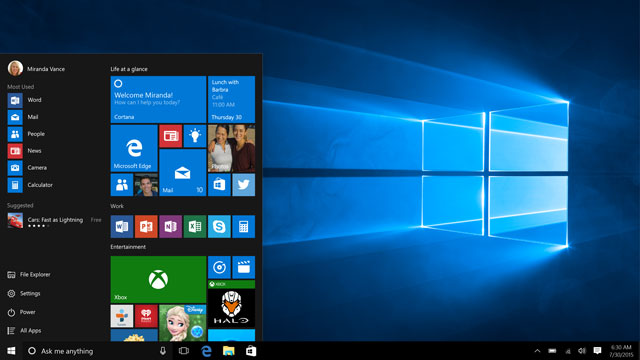
    Windows 10 was a result of the learning experience from Windows 8. The user interface is significantly improved as part of the “Continuum” concept, which senses the device you are using and adjusts itself accordingly.

    The Start button was back with the addition of Live Tiles, which display information at a glance without opening an app or program.

    Microsoft also introduced Cortana, which is couched as a virtual personal assistant, and a new Web browser, Edge.
    windows-10-640-2

    Who’s watching?

    However, one of the features that drew the most attention, and the most controversy, was the way Windows 10 tracked user data and provided targeted advertising in return.

    This was one way that Microsoft could afford to offer Windows 10 as a free upgrade from Windows 7 and 8 until July 2016.

    But many users did not welcome the tracking of their personal information. As some have said, Microsoft used to monetise its operating systems by offering it as a product and charging money for it, but with Windows 10, Microsoft is monetising its customers by gathering their data and turning that into a product to sell to advertisers.

    While many companies, such as Google and Amazon, regularly gather user data and target advertising at them through their online portals, many people objected to Microsoft using their entire operating system to track them.

    The feeling of your desktop tracking your actions and sending out this information is disturbing to many people. People strongly feel that their desktop belongs to them because they paid for it (even though Windows 10 was offered free to most users), unlike websites for which they did not.

    Microsoft has also had legal trouble in France over Windows 10 practices regarding privacy, security and user data collection. This may be the first case, but likely won’t be the last one.

    Out of 10?

    Despite the privacy concerns, Windows 10’s features have expanded over its first year. Cortana now shares maps, tracks lost phones and sends photos from phone to PC with voice commands.

    Edge now uses less power, allows note taking on Web pages and provides a reading view for distraction-free reading of Web content.

    In August 2015, Microsoft launched an Internet of things (IoT) framework to offer support for developing IoT apps on Windows 10 using Raspberry Pi, which is a miniature low-cost computer.

    In terms of security, Microsoft added Device Guard, which can ensure only permitted programs will run.

    It also disabled the controversial Wi-Fi Sense, which was included at launch and allowed shared users’ Wi-Fi passwords with Outlook and Skype contacts.

    Microsoft’s mobile strategy progressed further with Continuum, which now allows any monitor to be used as a computer by plugging in a Windows 10-enabled smartphone.

    Another change to Microsoft’s strategy is that there won’t be new standalone versions of Windows, but rather incremental functional updates to Windows 10.

    Overall, Windows 10 was a successful strategic move by Microsoft to leverage its desktop user base and guide them to tablets, mobiles and then to the cloud. It learnt from the mistakes of Windows 8 and developed an OS platform that has shown potential to be successful.The Conversation

    • Vidyasagar Potdar is senior research fellow, School of Information Systems, Curtin University
    • This article was originally published on The Conversation


    Microsoft Vidyasagar Potdar Windows 10
    WhatsApp YouTube Follow on Google News Add as preferred source on Google
    Share. Facebook Twitter LinkedIn WhatsApp Telegram Email Copy Link
    Previous ArticleUber, Didi to merge to create $35bn firm
    Next Article It’s official: sitting is killing you

    Related Posts

    From stocks to crypto, markets reel as AI doubts grow

    From stocks to crypto, markets reel as AI doubts grow

    6 February 2026
    SABC Plus to flight Microsoft AI training videos

    SABC Plus to flight Microsoft AI training videos

    30 January 2026
    Cloud adoption the weak link in SA's digital government push: Microsoft - Vukani Mngxati

    Cloud adoption the weak link in SA’s digital government push: Microsoft

    29 January 2026
    Company News
    The skills gap is a thinking gap: why South African employers can't find problem solvers

    The skills gap is a thinking gap: why SA employers can’t find problem solvers

    6 February 2026
    Vox Kiwi Wireless: fibre-like broadband for South African homes

    Vox Kiwi Wireless: fibre-like broadband for South African homes

    5 February 2026
    NEC XON achieves an African first with full Fortinet accreditation - Ian Kruger

    NEC XON achieves an African first with full Fortinet accreditation

    5 February 2026
    Opinion
    South Africa's skills advantage is being overlooked at home - Richard Firth

    South Africa’s skills advantage is being overlooked at home

    29 January 2026
    Why Elon Musk's Starlink is a 'hard no' for me - Songezo Zibi

    Why Elon Musk’s Starlink is a ‘hard no’ for me

    26 January 2026
    South Africa's new fibre broadband battle - Duncan McLeod

    South Africa’s new fibre broadband battle

    20 January 2026

    Subscribe to Updates

    Get the best South African technology news and analysis delivered to your e-mail inbox every morning.

    Latest Posts
    South Africa's stablecoin silence is becoming a policy failure

    South Africa’s stablecoin silence is becoming a policy failure

    6 February 2026
    Every electric car you can buy in South Africa in early 2026, ranked by price

    Every electric car you can buy in South Africa in early 2026, ranked by price

    6 February 2026
    From stocks to crypto, markets reel as AI doubts grow

    From stocks to crypto, markets reel as AI doubts grow

    6 February 2026
    South Africa deepens China ties as US trade tensions escalate

    South Africa deepens China ties as US trade tensions escalate

    6 February 2026
    © 2009 - 2026 NewsCentral Media
    • Cookie policy (ZA)
    • TechCentral – privacy and Popia

    Type above and press Enter to search. Press Esc to cancel.

    Manage consent

    TechCentral uses cookies to enhance its offerings. Consenting to these technologies allows us to serve you better. Not consenting or withdrawing consent may adversely affect certain features and functions of the website.

    Functional Always active
    The technical storage or access is strictly necessary for the legitimate purpose of enabling the use of a specific service explicitly requested by the subscriber or user, or for the sole purpose of carrying out the transmission of a communication over an electronic communications network.
    Preferences
    The technical storage or access is necessary for the legitimate purpose of storing preferences that are not requested by the subscriber or user.
    Statistics
    The technical storage or access that is used exclusively for statistical purposes. The technical storage or access that is used exclusively for anonymous statistical purposes. Without a subpoena, voluntary compliance on the part of your Internet Service Provider, or additional records from a third party, information stored or retrieved for this purpose alone cannot usually be used to identify you.
    Marketing
    The technical storage or access is required to create user profiles to send advertising, or to track the user on a website or across several websites for similar marketing purposes.
    • Manage options
    • Manage services
    • Manage {vendor_count} vendors
    • Read more about these purposes
    View preferences
    • {title}
    • {title}
    • {title}