Close Menu
TechCentralTechCentral

    Subscribe to the newsletter

    Get the best South African technology news and analysis delivered to your e-mail inbox every morning.

    Facebook X (Twitter) YouTube LinkedIn
    WhatsApp Facebook X (Twitter) LinkedIn YouTube
    TechCentralTechCentral
    • News
      Cell C cleans up its balance sheet but faces tough trading reality

      Cell C cleans up its balance sheet but faces tough trading reality

      13 February 2026
      MVNO business shines in Cell C's first post-listing results - Jorges Mendes

      MVNO business shines in Cell C’s first post-listing results

      13 February 2026
      Ramaphosa presses ahead with Eskom break-up - Cyril Ramaphosa

      Ramaphosa presses ahead with Eskom break-up

      13 February 2026
      The key technology takeaways from Ramaphosa's 2026 Sona - Cyril Ramaphosa

      The key technology takeaways from Ramaphosa’s 2026 Sona

      13 February 2026
      Toyota SA CEO: NEV inaction will cost South Africa its motoring industry - Andrew Kirby

      Toyota SA CEO: NEV inaction will cost South Africa its motoring industry

      12 February 2026
    • World
      Russia bans WhatsApp

      Russia bans WhatsApp

      12 February 2026
      EU regulators take aim at WhatsApp

      EU regulators take aim at WhatsApp

      9 February 2026
      Musk hits brakes on Mars mission

      Musk hits brakes on Mars mission

      9 February 2026
      Crypto firm accidentally sends R700-billion in bitcoin to its users

      Crypto firm accidentally sends R700-billion in bitcoin to its users

      8 February 2026
      AI won't replace software, says Nvidia CEO amid market rout - Jensen Huang

      AI won’t replace software, says Nvidia CEO amid market rout

      4 February 2026
    • In-depth
      How liberalisation is rewiring South Africa's power sector

      How liberalisation is rewiring South Africa’s power sector

      21 January 2026
      The top-performing South African tech shares of 2025

      The top-performing South African tech shares of 2025

      12 January 2026
      Digital authoritarianism grows as African states normalise internet blackouts

      Digital authoritarianism grows as African states normalise internet blackouts

      19 December 2025
      TechCentral's South African Newsmakers of 2025

      TechCentral’s South African Newsmakers of 2025

      18 December 2025
      Black Friday goes digital in South Africa as online spending surges to record high

      Black Friday goes digital in South Africa as online spending surges to record high

      4 December 2025
    • TCS
      Watts & Wheels S1E4: 'We drive an electric Uber'

      Watts & Wheels S1E4: ‘We drive an electric Uber’

      10 February 2026
      TCS+ | How Cloud On Demand is helping SA businesses succeed in the cloud - Xhenia Rhode, Dion Kalicharan

      TCS+ | Cloud On Demand and Consnet: inside a real-world AWS partner success story

      30 January 2026
      Watts & Wheels S1E4: 'We drive an electric Uber'

      Watts & Wheels S1E3: ‘BYD’s Corolla Cross challenger’

      30 January 2026
      Watts & Wheels S1E4: 'We drive an electric Uber'

      Watts & Wheels S1E2: ‘China attacks, BMW digs in, Toyota’s sublime supercar’

      23 January 2026

      TCS+ | Why cybersecurity is becoming a competitive advantage for SA businesses

      20 January 2026
    • Opinion
      A million reasons monopolies don't work - Duncan McLeod

      A million reasons monopolies don’t work

      10 February 2026
      Eskom unbundling U-turn threatens to undo hard-won electricity gains - Busi Mavuso

      Eskom unbundling U-turn threatens to undo hard-won electricity gains

      9 February 2026
      South Africa's skills advantage is being overlooked at home - Richard Firth

      South Africa’s skills advantage is being overlooked at home

      29 January 2026
      Why Elon Musk's Starlink is a 'hard no' for me - Songezo Zibi

      Why Elon Musk’s Starlink is a ‘hard no’ for me

      26 January 2026
      A million reasons monopolies don't work - Duncan McLeod

      South Africa’s new fibre broadband battle

      20 January 2026
    • Company Hubs
      • Africa Data Centres
      • AfriGIS
      • Altron Digital Business
      • Altron Document Solutions
      • Altron Group
      • Arctic Wolf
      • AvertITD
      • Braintree
      • CallMiner
      • CambriLearn
      • CYBER1 Solutions
      • Digicloud Africa
      • Digimune
      • Domains.co.za
      • ESET
      • Euphoria Telecom
      • Incredible Business
      • iONLINE
      • IQbusiness
      • Iris Network Systems
      • LSD Open
      • Mitel
      • NEC XON
      • Netstar
      • Network Platforms
      • Next DLP
      • Ovations
      • Paracon
      • Paratus
      • Q-KON
      • SevenC
      • SkyWire
      • Solid8 Technologies
      • Telit Cinterion
      • Tenable
      • Vertiv
      • Videri Digital
      • Vodacom Business
      • Wipro
      • Workday
      • XLink
    • Sections
      • AI and machine learning
      • Banking
      • Broadcasting and Media
      • Cloud services
      • Contact centres and CX
      • Cryptocurrencies
      • Education and skills
      • Electronics and hardware
      • Energy and sustainability
      • Enterprise software
      • Financial services
      • Information security
      • Internet and connectivity
      • Internet of Things
      • Investment
      • IT services
      • Lifestyle
      • Motoring
      • Public sector
      • Retail and e-commerce
      • Satellite communications
      • Science
      • SMEs and start-ups
      • Social media
      • Talent and leadership
      • Telecoms
    • Events
    • Advertise
    TechCentralTechCentral
    Home » Sections » Science » Particle physics could be about to get super weird

    Particle physics could be about to get super weird

    By The Conversation6 November 2018
    Twitter LinkedIn Facebook WhatsApp Email Telegram Copy Link
    News Alerts
    WhatsApp
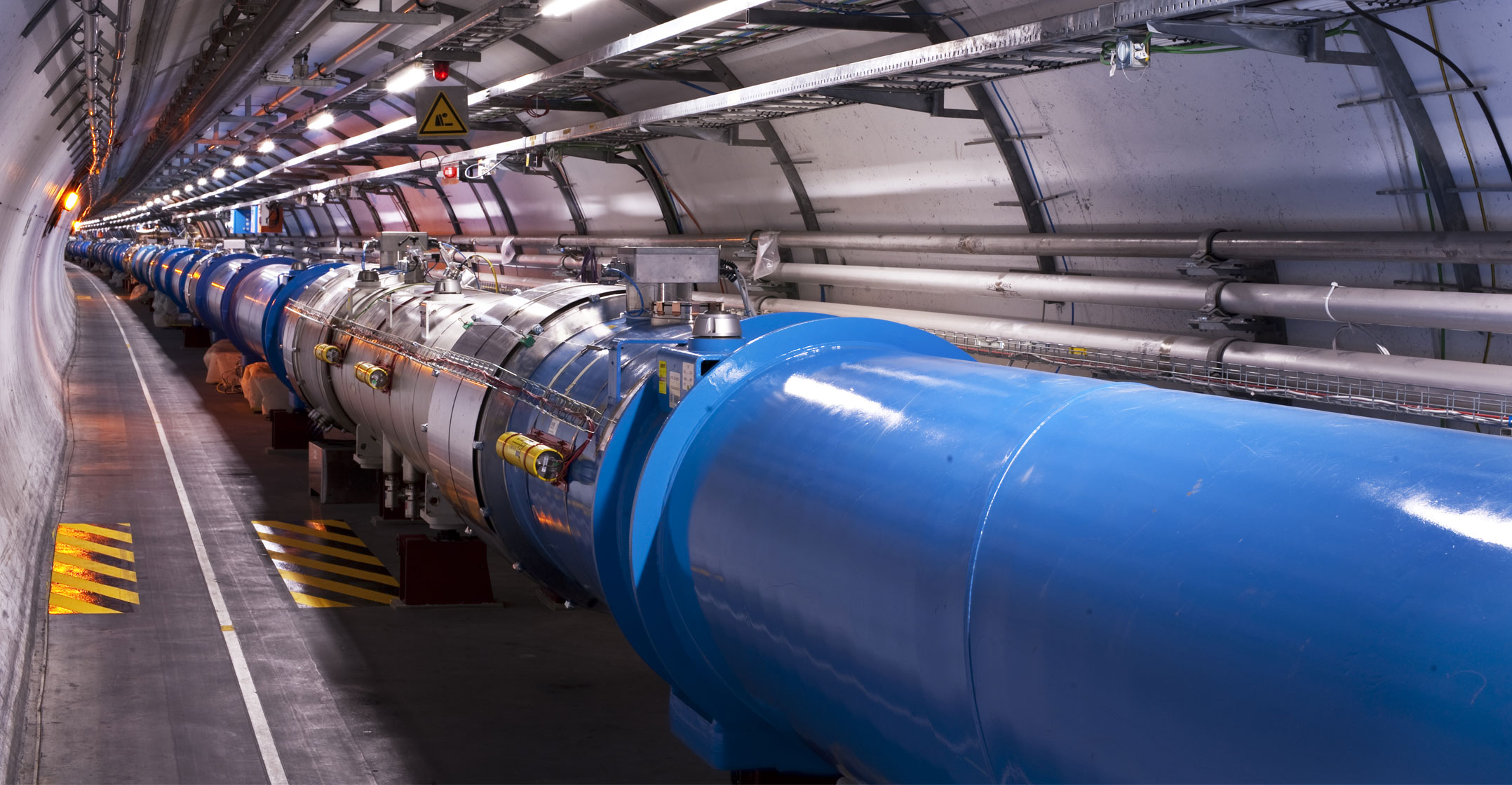
    A section of the Large Hadron Collider. Image: Maximilien Brice/Cern

    There was a huge amount of excitement when the Higgs boson was first spotted back in 2012 — a discovery that bagged the Nobel Prize for Physics in 2013. The particle completed the so-called standard model, our current best theory of understanding nature at the level of particles.

    Now scientists at the Large Hadron Collider (LHC) at Cern think they may have seen another particle, detected as a peak at a certain energy in the data, although the finding is yet to be confirmed. Again there’s a lot of excitement among particle physicists, but this time it is mixed with a sense of anxiety. Unlike the Higgs particle, which confirmed our understanding of physical reality, this new particle seems to threaten it.

    The new result — consisting of a mysterious bump in the data at 28GeV (a unit of energy) — has been published as a preprint on ArXiv. It is not yet in a peer-reviewed journal — but that’s not a big issue. The LHC collaborations have very tight internal review procedures, and we can be confident that the authors have done the sums correctly when they report a “4.2 standard deviation significance”. That means that the probability of getting a peak this big by chance — created by random noise in the data rather than a real particle — is only 0.0013%. That’s tiny — 13 in a million. So it seems like it must a real event rather than random noise — but nobody’s opening the champagne yet.

    Again there’s a lot of excitement among particle physicists, but this time it is mixed with a sense of anxiety

    Many LHC experiments, which smash beams of protons (particles in the atomic nucleus) together, find evidence for new and exotic particles by looking for an unusual build-up of known particles, such as photons (particles of light) or electrons. That’s because heavy and “invisible” particles such as the Higgs are often unstable and tend to fall apart (decay) into lighter particles that are easier to detect. We can therefore look for these particles in experimental data to work out whether they are the result of a heavier particle decay. The LHC has found many new particles by such techniques, and they have all fitted into the standard model.

    The new finding comes from an experiment involving the CMS detector, which recorded a number of pairs of muons – well known and easily identified particles that are similar to electrons, but heavier. It analysed their energies and directions and asked: if this pair came from the decay of a single parent particle, what would the mass of that parent be?

    Different sources

    In most cases, pairs of muons come from different sources — originating from two different events rather than the decay of one particle. If you try to calculate a parent mass in such cases it would therefore spread out over a wide range of energies rather than creating a narrow peak specifically at 28GeV (or some other energy) in the data. But in this case, it certainly looks like there’s a peak. Perhaps. You can look at the figure and you can judge for yourself.

    Is this a real peak or is it just a statistical fluctuation due to the random scatter of the points about the background (the dashed curve)? If it’s real, that means that a few of these muon pairs did indeed come from just a large parent particle that decayed by emitting muons — and no such 28GeV particle has ever been seen before.

    So it is all looking rather intriguing, but history has taught us caution. Effects this significant have appeared in the past, only to vanish when more data is taken. The Digamma(750) anomaly is a recent example from a long succession of false alarms — spurious “discoveries” due to equipment glitches, over-enthusiastic analysis or just bad luck.
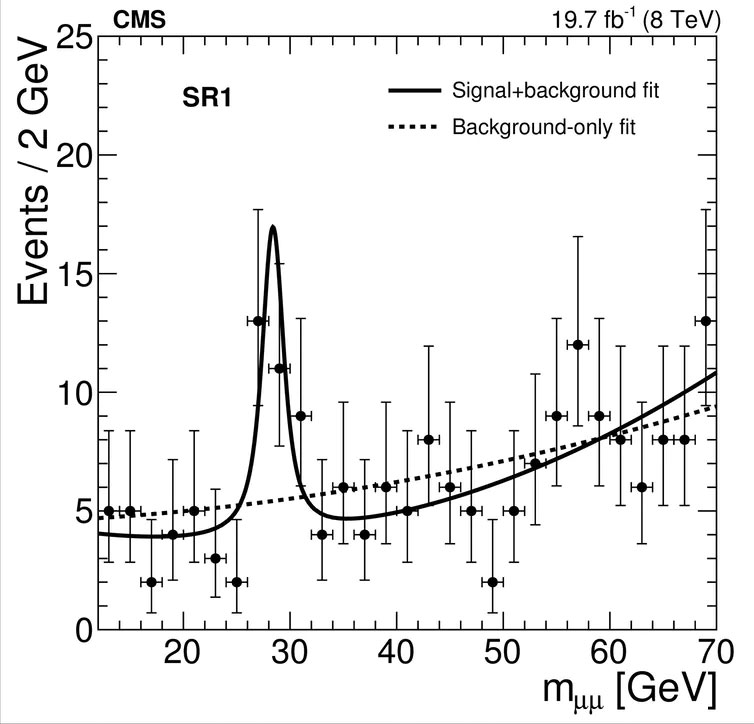
    New data. CMS Collaboration

    This is partly due to something called the “look elsewhere effect”: although the probability of random noise producing a peak if you look specifically at a value of 28GeV may be 13 in a million, such noise could give a peak somewhere else in the plot, maybe at 29GeV or 16GeV. The probabilities of these being due to chance are also tiny when considered respectively, but the sum of these tiny probabilities is not so tiny (though still pretty small). That means it is not impossible for a peak to be created by random noise.

    And there are some puzzling aspects. For example, the bump appeared in one LHC run but not in another, when the energy was doubled. One would expect any new phenomena to get bigger when the energy is higher. It may be that there are reasons for this, but at the moment it’s an uncomfortable fact.

    New physical reality?

    The theory is even more incongruous. Just as experimental particle physicists spend their time looking for new particles, theorists spend their time thinking of new particles that it would make sense to look for: particles that would fill in the missing pieces of the standard model, or explain dark matter (a type of invisible matter), or both. But no one has suggested anything like this.

    For example, theorists suggest we could find a lighter version of the Higgs particle. But anything of that ilk would not decay to muons. A light Z boson or a heavy photon have also been talked about, but they would interact with electrons. That means we should have probably discovered them already as electrons are easy to detect. The potential new particle does not match the properties of any of those proposed.

    If this particle really exists, then it is not just outside the standard model but outside it in a way that nobody anticipated

    If this particle really exists, then it is not just outside the standard model but outside it in a way that nobody anticipated. Just as Newtonian gravity gave way to Einstein’s general relativity, the standard model will be superseded. But the replacement will not be any of the favoured candidates that has already been proposed to extend standard model: including supersymmetry, extra dimensions and grand unification theories. These all propose new particles, but none with properties like the one we might have just seen. It will have to be something so weird that nobody has suggested it yet.

    Luckily, the other big LHC experiment, Atlas, has similar data from their experiments The team is still analysing it, and will report in due course. Cynical experience says that they will report a null signal, and this result will join the gallery of statistical fluctuations. But maybe — just maybe — they will see something. And then life for experimentalists and theorists will suddenly get very busy and very interesting. The Conversation

    • Written by Roger Barlow, research professor and director of the International Institute for Accelerator Applications, University of Huddersfield
    • This article is republished from The Conversation under a Creative Commons licence

    Large Hadron Collider Roger Barlow top
    WhatsApp YouTube Follow on Google News Add as preferred source on Google
    Share. Facebook Twitter LinkedIn WhatsApp Telegram Email Copy Link
    Previous ArticleTim Berners-Lee’s plan to fix the Web is unworkable
    Next Article Bill Gates gets serious about crap

    Related Posts

    As Cern turns 70, it looks for ways to finance next big thing

    As Cern turns 70, it looks for ways to finance next big thing

    29 September 2024
    As Cern turns 70, it looks for ways to finance next big thing

    What comes after the Large Hadron Collider?

    13 May 2024

    Wits researchers pioneer new way to search for dark matter

    28 November 2023
    Company News
    Cell C delivers maiden results with growth momentum, financial flexibility - Jorges Mendes

    Cell C delivers maiden results with growth momentum, financial flexibility

    13 February 2026
    Start-up king joins Paratus Rwanda - Innocent Mutimura

    Start-up king joins Paratus Rwanda

    13 February 2026
    How NEC XON tackled identity risk for a major telco - Michael de Neuilly Rice

    How NEC XON tackled identity risk for a major telco

    11 February 2026
    Opinion
    A million reasons monopolies don't work - Duncan McLeod

    A million reasons monopolies don’t work

    10 February 2026
    Eskom unbundling U-turn threatens to undo hard-won electricity gains - Busi Mavuso

    Eskom unbundling U-turn threatens to undo hard-won electricity gains

    9 February 2026
    South Africa's skills advantage is being overlooked at home - Richard Firth

    South Africa’s skills advantage is being overlooked at home

    29 January 2026

    Subscribe to Updates

    Get the best South African technology news and analysis delivered to your e-mail inbox every morning.

    Latest Posts
    Cell C cleans up its balance sheet but faces tough trading reality

    Cell C cleans up its balance sheet but faces tough trading reality

    13 February 2026
    MVNO business shines in Cell C's first post-listing results - Jorges Mendes

    MVNO business shines in Cell C’s first post-listing results

    13 February 2026
    Ramaphosa presses ahead with Eskom break-up - Cyril Ramaphosa

    Ramaphosa presses ahead with Eskom break-up

    13 February 2026
    The key technology takeaways from Ramaphosa's 2026 Sona - Cyril Ramaphosa

    The key technology takeaways from Ramaphosa’s 2026 Sona

    13 February 2026
    © 2009 - 2026 NewsCentral Media
    • Cookie policy (ZA)
    • TechCentral – privacy and Popia

    Type above and press Enter to search. Press Esc to cancel.

    Manage consent

    TechCentral uses cookies to enhance its offerings. Consenting to these technologies allows us to serve you better. Not consenting or withdrawing consent may adversely affect certain features and functions of the website.

    Functional Always active
    The technical storage or access is strictly necessary for the legitimate purpose of enabling the use of a specific service explicitly requested by the subscriber or user, or for the sole purpose of carrying out the transmission of a communication over an electronic communications network.
    Preferences
    The technical storage or access is necessary for the legitimate purpose of storing preferences that are not requested by the subscriber or user.
    Statistics
    The technical storage or access that is used exclusively for statistical purposes. The technical storage or access that is used exclusively for anonymous statistical purposes. Without a subpoena, voluntary compliance on the part of your Internet Service Provider, or additional records from a third party, information stored or retrieved for this purpose alone cannot usually be used to identify you.
    Marketing
    The technical storage or access is required to create user profiles to send advertising, or to track the user on a website or across several websites for similar marketing purposes.
    • Manage options
    • Manage services
    • Manage {vendor_count} vendors
    • Read more about these purposes
    View preferences
    • {title}
    • {title}
    • {title}