
Close Menu
TechCentralTechCentral

    Subscribe to the newsletter

    Get the best South African technology news and analysis delivered to your e-mail inbox every morning.

    Facebook X (Twitter) YouTube LinkedIn
    WhatsApp Facebook X (Twitter) LinkedIn YouTube
    TechCentralTechCentral
    • News
      Big Microsoft 365 price increases coming next year

      Big Microsoft price increases coming next year

      5 December 2025
      Vodacom to take control of Safaricom in R36-billion deal - Shameel Joosub

      Vodacom to take control of Safaricom in R36-billion deal

      4 December 2025
      Black Friday goes digital in South Africa as online spending surges to record high

      Black Friday goes digital in South Africa as online spending surges to record high

      4 December 2025
      BYD takes direct aim at Toyota with launch of sub-R500 000 Sealion 5 PHEV

      BYD takes direct aim at Toyota with launch of sub-R500 000 Sealion 5 PHEV

      4 December 2025
      'Get it now': Takealot in new instant deliveries pilot

      ‘Get it now’: Takealot in new instant deliveries pilot

      4 December 2025
    • World
      Amazon and Google launch multi-cloud service for faster connectivity

      Amazon and Google launch multi-cloud service for faster connectivity

      1 December 2025
      Google makes final court plea to stop US breakup

      Google makes final court plea to stop US breakup

      21 November 2025
      Bezos unveils monster rocket: New Glenn 9x4 set to dwarf Saturn V

      Bezos unveils monster rocket: New Glenn 9×4 set to dwarf Saturn V

      21 November 2025
      Tech shares turbocharged by Nvidia's stellar earnings

      Tech shares turbocharged by stellar Nvidia earnings

      20 November 2025
      Config file blamed for Cloudflare meltdown that disrupted the web

      Config file blamed for Cloudflare meltdown that disrupted the web

      19 November 2025
    • In-depth
      Jensen Huang Nvidia

      So, will China really win the AI race?

      14 November 2025
      Valve's Linux console takes aim at Microsoft's gaming empire

      Valve’s Linux console takes aim at Microsoft’s gaming empire

      13 November 2025
      iOCO's extraordinary comeback plan - Rhys Summerton

      iOCO’s extraordinary comeback plan

      28 October 2025
      Why smart glasses keep failing - no, it's not the tech - Mark Zuckerberg

      Why smart glasses keep failing – it’s not the tech

      19 October 2025
      BYD to blanket South Africa with megawatt-scale EV charging network - Stella Li

      BYD to blanket South Africa with megawatt-scale EV charging network

      16 October 2025
    • TCS
      TCS+ | How Cloud on Demand helps partners thrive in the AWS ecosystem - Odwa Ndyaluvane and Xenia Rhode

      TCS+ | How Cloud On Demand helps partners thrive in the AWS ecosystem

      4 December 2025
      TCS | MTN Group CEO Ralph Mupita on competition, AI and the future of mobile

      TCS | Ralph Mupita on competition, AI and the future of mobile

      28 November 2025
      TCS | Dominic Cull on fixing South Africa's ICT policy bottlenecks

      TCS | Dominic Cull on fixing South Africa’s ICT policy bottlenecks

      21 November 2025
      TCS | BMW CEO Peter van Binsbergen on the future of South Africa's automotive industry

      TCS | BMW CEO Peter van Binsbergen on the future of South Africa’s automotive industry

      6 November 2025
      TCS | Why Altron is building an AI factory - Bongani Andy Mabaso

      TCS | Why Altron is building an AI factory in Johannesburg

      28 October 2025
    • Opinion
      Your data, your hardware: the DIY AI revolution is coming - Duncan McLeod

      Your data, your hardware: the DIY AI revolution is coming

      20 November 2025
      Zero Carbon Charge founder Joubert Roux

      The energy revolution South Africa can’t afford to miss

      20 November 2025
      It's time for a new approach to government IT spend in South Africa - Richard Firth

      It’s time for a new approach to government IT spend in South Africa

      19 November 2025
      How South Africa's broken Rica system fuels murder and mayhem - Farhad Khan

      How South Africa’s broken Rica system fuels murder and mayhem

      10 November 2025
      South Africa's AI data centre boom risks overloading a fragile grid - Paul Colmer

      South Africa’s AI data centre boom risks overloading a fragile grid

      30 October 2025
    • Company Hubs
      • Africa Data Centres
      • AfriGIS
      • Altron Digital Business
      • Altron Document Solutions
      • Altron Group
      • Arctic Wolf
      • AvertITD
      • Braintree
      • CallMiner
      • CambriLearn
      • CYBER1 Solutions
      • Digicloud Africa
      • Digimune
      • Domains.co.za
      • ESET
      • Euphoria Telecom
      • Incredible Business
      • iONLINE
      • IQbusiness
      • Iris Network Systems
      • LSD Open
      • NEC XON
      • Netstar
      • Network Platforms
      • Next DLP
      • Ovations
      • Paracon
      • Paratus
      • Q-KON
      • SevenC
      • SkyWire
      • Solid8 Technologies
      • Telit Cinterion
      • Tenable
      • Vertiv
      • Videri Digital
      • Vodacom Business
      • Wipro
      • Workday
      • XLink
    • Sections
      • AI and machine learning
      • Banking
      • Broadcasting and Media
      • Cloud services
      • Contact centres and CX
      • Cryptocurrencies
      • Education and skills
      • Electronics and hardware
      • Energy and sustainability
      • Enterprise software
      • Financial services
      • Information security
      • Internet and connectivity
      • Internet of Things
      • Investment
      • IT services
      • Lifestyle
      • Motoring
      • Public sector
      • Retail and e-commerce
      • Satellite communications
      • Science
      • SMEs and start-ups
      • Social media
      • Talent and leadership
      • Telecoms
    • Events
    • Advertise
    TechCentralTechCentral
    Home » Opinion » Malawi leaps ahead with telecoms pilot

    Malawi leaps ahead with telecoms pilot

    By Steve Song8 October 2013
    Twitter LinkedIn Facebook WhatsApp Email Telegram Copy Link
    News Alerts
    WhatsApp

    Steve-Song-180Malawi is not a country that often makes the international news, particularly not in the realm of connectivity. Economically poor and landlocked, it faces significant challenges in achieving affordable access for all. Although both the incumbent telcommunications operator, MTL, and the electricity parastatal, Escom, have national fibre backbone networks, achieving affordable Internet access in rural areas remains a huge obstacle.

    That could all be changing thanks to the vision of Chomora Mikeka, a lecturer at the physics department at Chancellor College of the University of Malawi. Chomora has forged a partnership between his department and the Malawi Communications Regulatory Authority (Macra) to establish a white-spaces pilot project in Zomba. The pilot also enjoys the support and collaboration of the Marconi Wireless Lab (T/ICT4D) at the International Centre for Theoretical Physics (ICTP) in Trieste, Italy. ICTP have a long history of supporting wireless access research in Africa.

    On behalf of the Network Startup Resource Center (NSRC), I was able to join the pilot deployment team as they set up the first connections for the pilot. I met with Chomora recently, along with the ICTP team of Marco Zennaro, Ermanno Pietrosemoli, Carlo Fonda, and Andrés Arcia-Moret. ICTP have extensive experience in the deployment of wireless networks around the world and are an ideal technical partner for Chancellor College and Macra.  The pilot is designed to connect a number of different institutions including a school, a hospital, an airport and a research facility.

    The first step in setting up the network was establishing that the base station equipment was functioning correctly.  Like the white-spaces trial in South Africa, the pilot is using equipment from Carlson Wireless. At the time of procurement, Carlson was the only company ready to supply white-spaces equipment. This is changing slowly. The base station depends on an Internet connection in order to validate and download any updates to the system from Carlson. Having verified that the base station could communicate with Carlson’s server from behind the university’s firewall, it was time to move to the next step, setting up the main antenna.

    The pilot is using a unique omni-directional antenna produced by Carlson, which is designed to offer performance across a wide range of UHF frequencies. It looks like a big mailer tube and is pretty hefty. Arrangements were made with the nearby Chancellor College community radio station to use their FM tower to mount the antenna.

    The FM tower is a tall guyed-mast affair that looked a little dubious when it came to supporting the weight of an installer and the antenna. However, the experienced ICTP team were able to get the white-spaces antenna in place along with a 5GHz backhaul link in a matter of hours. The antenna was mounted at a height of 23m, which, according to the initial spectrum measurements carried out by ICTP, should provide a range of up to 20km. Having a ready-made high site in the form of the FM radio tower to mount the antenna on saved both time and expense in the deployment.

    This is the first deployment, to my knowledge, of a point-to-multipoint omni-directional white-spaces antenna in Africa. One of the interesting questions to explore will be how many white-spaces clients can be supported connecting to a single omni antenna. At the other end of the link, the white spaces client devices use a different kind of antenna known as Yagi-Uda or more commonly Yagi antenna. A Yagi antenna looks a bit like the business end of a swordfish and is designed to focus a radio signal for maximum range. Typical Yagi antennas are very limited in the bandwidth range they can operate over. The ones deployed in the pilot are a significant modification of the original Yagi design, offering a gain between 9 and 11 dBi over the frequency range from 400MHz to 800MHz.
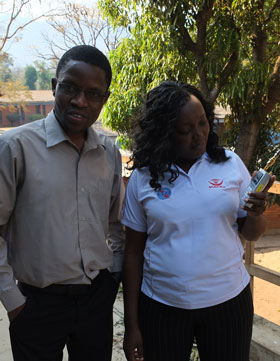
    Chomora Mikeka of the University of Malawi and Tryness Kantedza of Macra check readings on a spectrum analyser (image: Marco Zennaro)
    Chomora Mikeka of the University of Malawi and Tryness Kantedza of Macra check readings on a spectrum analyser (image: Marco Zennaro)

    One of the best things about the pilot deployment was that it wasn’t just the technical team of Chomora and ICTP involved in the deployment. Chomora had a number of his students from the physics department involved and they were able to learn from the experts at each stage of deployment. Equally interesting was the involvement of Macra, which sent spectrum planning officers Stan Chimgoga and Tryness Kantedza to participate in the deployment. It bodes well for this pilot that there is such involvement and commitment. Indeed, Lloyd Momba, director of telecommunications at Macra, and Jonathan Pinifolo, deputy director for spectrum management, have been pivotal in the bringing the project to fruition.

    The pilot connected a number of different types of institutions. I wasn’t able to stay for the entire deployment but was able to get the full story afterwards from Marco and Ermanno. First, a girls school was connected. St Mary’s Girls Secondary School serves about 480 pupils and is only 2,4km away from the FM tower. Connecting schools is a strategic issue for Macra as they hope through white-spaces technology they may be able to aggregate demand and provide a less expensive connectivity option for schools than the current option of ADSL. They also hope that white spaces will reach schools beyond the range of copper wire networks.
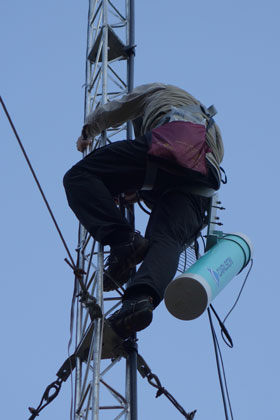
    Carlo Fonda of ICTP deploying the white-spaces antenna
    Carlo Fonda of ICTP deploying the white-spaces antenna

    Next came Pirimiti Community Hospital. This is one of the more interesting and challenging links for the pilot as it is about 20km from the FM tower. Unfortunately, an initial site for the Yagi antenna had to be changed and the deployment there was delayed to allow for the construction of an independent 12m mast for the antenna. Other sites included the seismology department of the government of Malawi, which is a research node and partner in the continental AfricaArray project and and, finally, a link to the Malawi defense force’s airwing (airforce maintenance department).

    The pilot deployment team has installed monitoring appliances in the form of Alix boards at each site to run performance measurements, the results of which will be openly shared.

    Almost more challenging than the white-spaces links was the Internet uplink for the project. Initially, there was to have been a fibre connection to the FM radio station itself. Unfortunately, this link had not been built in time for the pilot deployment. As a backup plan, the Chancellor College offered to share its connectivity with the project. This was implemented via a 5GHz point-to-point link between the college and the FM radio tower. Unfortunately, the entire university campus in Zomba is limited to 5,5Mbit/s of service — 4Mbit/s from MTL (fibre) and 1,5Mbit/s from Astrium (VSat). As the white spaces pilot came online, the additional bandwidth use caused the university IT managers some concern and ultimately they were obliged to withdraw bandwidth support for the pilot.

    It is a tribute to the Malawian regulator that, in the face of this obstacle, they have committed to providing a dedicated 2Mbit/s link at their own expense for the pilot for a full year. It is inspiring to see the support and leadership that Macra have brought to this pilot. Their plans are to run the pilot until December and then make an assessment.

    In contrast with other white spaces pilots/trials, less emphasis has been put on the idea of a geo-location spectrum authentication database. Geo-location databases, while not part of the original concept of television white-spaces spectrum, have emerged in the US and UK as a compromise between white-spaces advocates and opponents of the technology from the broadcast and wireless microphone industry who have expressed concern about interference. A geo-location database would force white spaces devices to authenticate first to confirm what channels were available prior to commencing operation.

    A brief video interview about the pilot with Chomora Mikeka:

    The pilot proponents take as their starting position the fact that television spectrum is significantly unused in Malawi, especially in rural areas. This may mean that it is feasible to develop white-spaces technology initially in Malawi without the overhead of a geo-location database. On the other hand, they recognise the benefits that a spectrum database can offer in terms of creating a knowledge base of spectrum occupancy, of being able to vary power output levels for differing contexts, and in potentially extending dynamic spectrum use beyond the VHF/UHF bands. Their perspective is that a geo-location database can be a natural evolution in developing white spaces regulation but not a requirement to get initial regulation in place.

    All of this above makes Malawi an absolutely fascinating place to watch white-spaces technology and regulation evolve. It is possible we may see an African model for white-spaces regulation emerge from Malawi that may be better suited to the sparse spectrum occupancy of the TV bands in the region. The fact that this initiative is owned equally by the University of Malawi and Macra bodes well for the development of regulation that is appropriate to the problem at hand, rural access. Malawi may well be the first African country to establish white-spaces regulation.

    • Thanks to Chomora Mikeka, Marco Zennaro, and Ermanno Pietrosemoli for invaluable additions and corrections
    • This piece was first published on Steve Song’s website, Many Possibilities
    • Song is founder of Village Telco


    Andrés Arcia-Moret Carlo Fonda Chomora Mikeka Ermanno Pietrosemoli Jonathan Pinifolo Lloyd Momba Macra Marco Zennaro Stan Chimgoga Steve Song Tryness Kantedza
    Subscribe to TechCentral Subscribe to TechCentral
    Share. Facebook Twitter LinkedIn WhatsApp Telegram Email Copy Link
    Previous ArticleGov’t still mulling access control
    Next Article Kenya threatens to arrest operator CEOs

    Related Posts

    South Africa is rapidly becoming a hyperconnected country

    South Africa is rapidly becoming a hyperconnected country

    2 October 2025
    Bandwidth bonanza: the undersea cables that connect SA to the world

    Bandwidth bonanza: the undersea cables that connect South Africa to the world

    12 July 2024
    World Bank to back R27-billion Malawi hydropower project

    DStv quits Malawi after price hikes rejected

    10 August 2023
    Company News
    AI is not a technology problem - iqbusiness

    AI is not a technology problem – iqbusiness

    5 December 2025
    Telcos are sitting on a data gold mine - but few know what do with it - Phillip du Plessis

    Telcos are sitting on a data gold mine – but few know what do with it

    4 December 2025
    Unlock smarter computing with your surface Copilot+ PC

    Unlock smarter computing with your Surface Copilot+ PC

    4 December 2025
    Opinion
    Your data, your hardware: the DIY AI revolution is coming - Duncan McLeod

    Your data, your hardware: the DIY AI revolution is coming

    20 November 2025
    Zero Carbon Charge founder Joubert Roux

    The energy revolution South Africa can’t afford to miss

    20 November 2025
    It's time for a new approach to government IT spend in South Africa - Richard Firth

    It’s time for a new approach to government IT spend in South Africa

    19 November 2025

    Subscribe to Updates

    Get the best South African technology news and analysis delivered to your e-mail inbox every morning.

    Latest Posts
    Big Microsoft 365 price increases coming next year

    Big Microsoft price increases coming next year

    5 December 2025
    AI is not a technology problem - iqbusiness

    AI is not a technology problem – iqbusiness

    5 December 2025
    Vodacom to take control of Safaricom in R36-billion deal - Shameel Joosub

    Vodacom to take control of Safaricom in R36-billion deal

    4 December 2025
    Black Friday goes digital in South Africa as online spending surges to record high

    Black Friday goes digital in South Africa as online spending surges to record high

    4 December 2025
    © 2009 - 2025 NewsCentral Media
    • Cookie policy (ZA)
    • TechCentral – privacy and Popia

    Type above and press Enter to search. Press Esc to cancel.

    Manage consent

    TechCentral uses cookies to enhance its offerings. Consenting to these technologies allows us to serve you better. Not consenting or withdrawing consent may adversely affect certain features and functions of the website.

    Functional Always active
    The technical storage or access is strictly necessary for the legitimate purpose of enabling the use of a specific service explicitly requested by the subscriber or user, or for the sole purpose of carrying out the transmission of a communication over an electronic communications network.
    Preferences
    The technical storage or access is necessary for the legitimate purpose of storing preferences that are not requested by the subscriber or user.
    Statistics
    The technical storage or access that is used exclusively for statistical purposes. The technical storage or access that is used exclusively for anonymous statistical purposes. Without a subpoena, voluntary compliance on the part of your Internet Service Provider, or additional records from a third party, information stored or retrieved for this purpose alone cannot usually be used to identify you.
    Marketing
    The technical storage or access is required to create user profiles to send advertising, or to track the user on a website or across several websites for similar marketing purposes.
    • Manage options
    • Manage services
    • Manage {vendor_count} vendors
    • Read more about these purposes
    View preferences
    • {title}
    • {title}
    • {title}