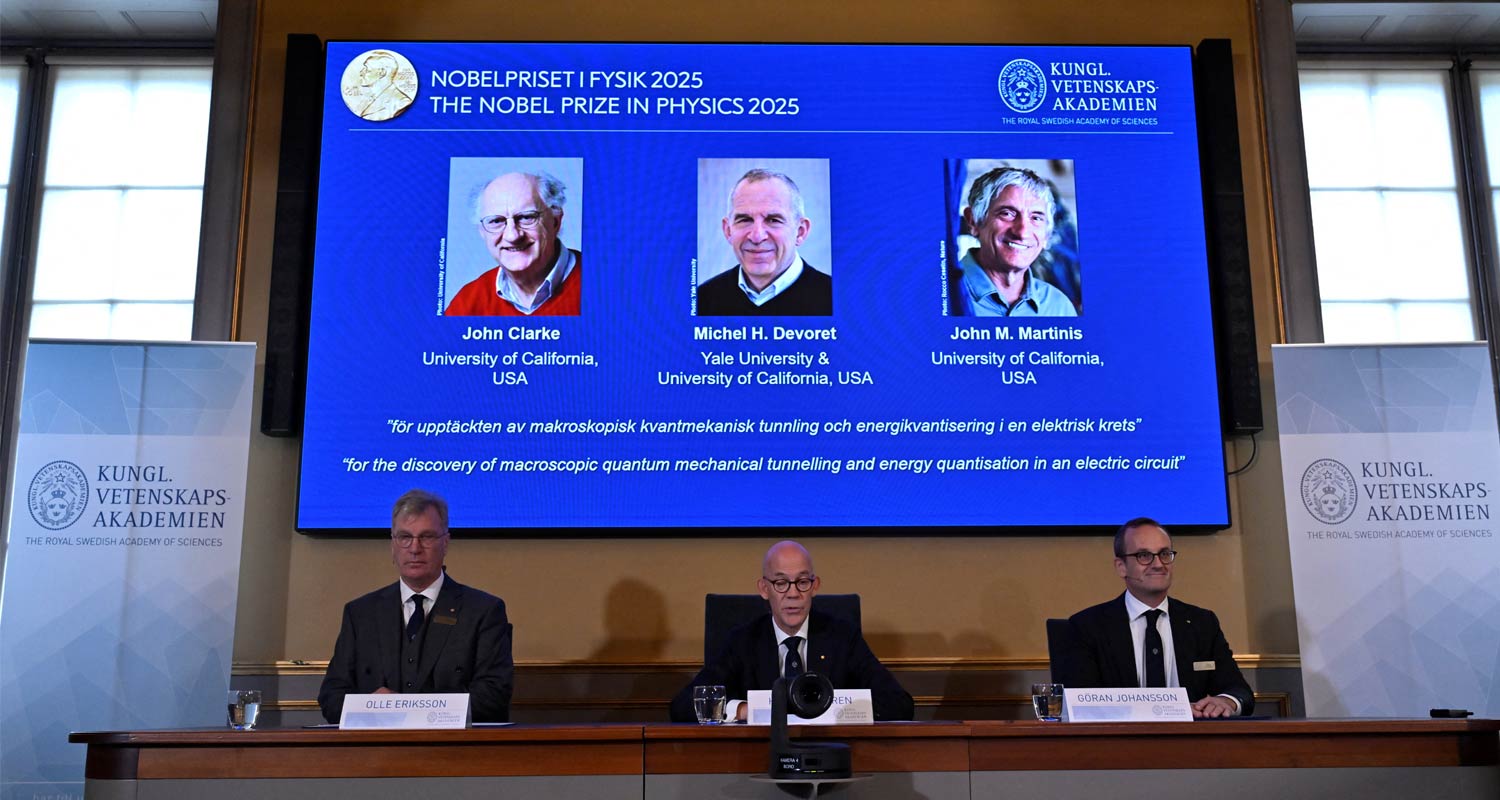
US-based scientists John Clarke, Michel Devoret and John Martinis have won the 2025 Nobel Prize in Physics for “experiments that revealed quantum physics in action”, paving the way for the development of the next generation of digital technologies.
“My feelings are that I’m completely stunned. Of course it had never occurred to me in any way that this might be the basis of a Nobel Prize,” Clarke told the Nobel press conference by telephone on Tuesday.
“I’m speaking on my cellphone and I suspect that you are, too, and one of the underlying reasons that the cellphone works is because of all this work.”
Quantum mechanical behaviours are well studied at the level of the incredibly small — atoms and subatomic particles — but are often seen as bizarre and unintuitive compared with classical physics and its far larger scale.
The Nobel winners carried out experiments in the mid-1980s with an electronic circuit built of superconductors and demonstrated that quantum mechanics could also influence everyday objects under certain conditions.
“It is wonderful to be able to celebrate the way that century-old quantum mechanics continually offers new surprises. It is also enormously useful, as quantum mechanics is the foundation of all digital technology,” Olle Eriksson, chair of the Nobel Committee for Physics, said.
Quantum technology is already ubiquitous, with transistors in computer microchips an everyday example.
Quantum technology
“This year’s Nobel Prize in Physics has provided opportunities for developing the next generation of quantum technology, including quantum cryptography, quantum computers and quantum sensors,” the Royal Swedish Academy of Sciences, which awards the prize, said in a statement.
British-born Clarke is a professor at the University of California, Berkeley, in the US.
Devoret, born in France, is a professor at Yale University and the University of California, Santa Barbara, also in the US, where Martinis is also a professor.
Read: IBM sets sights on practical quantum computing by 2029
Martinis, an American, headed Google’s Quantum Artificial Intelligence Lab until 2020. At Google, Martinis was part of the research team who in 2019 said they had achieved “quantum supremacy”, in which a computer harnessing the properties of subatomic particles did a far better job of solving a problem than the world’s most powerful supercomputer.
Devoret, besides his professorship, is also the chief scientist of Google Quantum AI.
The Nobel physics prize is awarded by the Royal Swedish Academy of Sciences and includes a prize sum totalling 11 million Swedish crowns (R20.6-million) that is shared among the winners if there are several, as is often the case.

The Nobel prizes were established through the will of Alfred Nobel, who amassed a fortune from his invention of dynamite. Since 1901, with occasional interruptions, the prizes have annually recognised achievements in science, literature and peace. Economics was a later addition.
Physics was the first category mentioned in Nobel’s will, likely reflecting the prominence of the field during his time. Today, the Nobel Prize in Physics remains widely regarded as the most prestigious award in the discipline.
Past winners of the Nobel physics prize include some of the most influential figures in the history of science, such as Albert Einstein, Pierre and Marie Curie, Max Planck, and Niels Bohr, himself a pioneer of quantum theory.
Last year’s prize was won by US scientist John Hopfield and British-Canadian Geoffrey Hinton for breakthroughs in machine learning that spurred the artificial intelligence boom, a development about which both have also expressed concerns.
In keeping with tradition, physics is the second Nobel to be awarded this week, after two American and one Japanese scientist won the medicine prize for breakthroughs in understanding the immune system. The chemistry prize is due next, on Wednesday.
The science, literature and economics prizes are presented to the laureates by the Swedish king at a ceremony in Stockholm on 10 December, the anniversary of Alfred Nobel’s death, followed by a lavish banquet at city hall.
Read: From Beijing to Stellenbosch: quantum signal travels 12 900km
The peace prize, which will be announced on Friday, is awarded in a separate ceremony in Oslo. — Niklas Pollard, Simon Johnson and Johan Ahlander, with Marie Mannes, Greta Rosen Fondahn, Supantha Mukherjee and Terje Solsvik, (c) 2025 Reuters
Get breaking news from TechCentral on WhatsApp. Sign up here.