The department of electricity & energy has “categorically” denied that its public consultation on 5.2GW of new nuclear is a charade, after energy analyst Chris Yelland, a long-time critic of new nuclear build, suggested that minister Kgosientsho Ramokgopa had already made up his mind.
Yelland put the question to Zizamele Mbambo, the department’s deputy director-general for nuclear energy, at an EE Business Intelligence webinar he moderated on Thursday. Two days earlier, at the Nuclear and Clean Energy Conference, Ramokgopa had said: “We are going to build nuclear in this country. Take us to court.” He also said publishing a case for nuclear, to head off the litigation that dogged earlier procurement attempts, was needed “so that we make it very easy for the judges to resolve”.
“I get the impression, having read his speech in detail, that this is a charade, and that the decision has already been made in the minister’s mind,” Yelland said.
“I must put it categorically that this is not a charade. There is no predetermined decision that has been made,” Mbambo replied. “Rest assured, this process is done in good faith. The minister is determined to consider public input before taking a decision.”
Rest assured, this process is done in good faith. The minister is determined to consider public input before taking a decision.
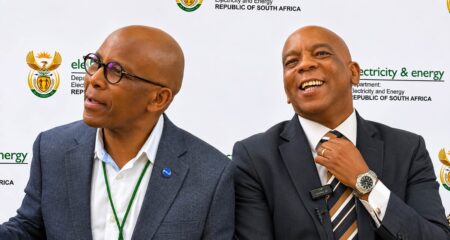
Energy department deputy director-general Zizamele Mbambo
Mbambo said Ramokgopa would publish his intention to make a section 34 determination under the Electricity Regulation Act by the end of November, with 60 days for comment, then provincial roadshows. A decision is due in April 2027. Ramokgopa’s prepared speech says the act requires consulting energy regulator Nersa and the finance minister, and gives “before June 2027” as the outer bound.
Eskom has submitted a feasibility report, and its indicative road map has the first new unit online in 2036, Mbambo said. The 5.2GW is a first phase of a programme that could grow to 10GW, the scale he said is needed to justify local nuclear fuel cycle facilities. Nuclear technologies, he said, “provide reliable baseload power whilst complementing intermittent renewable energy generation and energy storage”.
Closing the webinar, Yelland said he took Mbambo at his word, but warned: “We’re going to hold you to it.”
The missing panel
Yelland also pressed the department on the expert panel Ramokgopa announced in September 2024 to advise on the pace and scale of nuclear the country can afford. “We want to know what these experts said, if they said anything. We want to know who these experts are,” he said.
Mbambo said the panel had been appointed and had advised the minister, but that its term had expired. Rob Adam, a former CEO of the South African Nuclear Energy Corporation (Necsa), said he had been consulted only once and attended only one meeting.
The panel’s chairman, North-West University vice-chancellor and former National Nuclear Regulator CEO Bismark Tyobeka, was named in July 2025, and in October that year hailed the government’s new Integrated Resource Plan (IRP) as “bold” and “progressive”. Yelland said its full membership and advice had never been made public. He may lodge a Promotion of Access to Information Act request.
Grové Steyn, MD of Meridian Economics, said the reference case in the 2025 Integrated Resource Plan builds no new nuclear. Of the final “balanced plan”, he said: “Let me be 100% clear about this. It is not the result of modelling analysis.”
He said Koeberg had run both units for only about a third of the hours since April 2017, and that megaprojects typically overrun their budgets by 120% or more.
Government’s planners respond
Sonwabo Damba, whom Prudence Madiba, CEO of the South African National Energy Development Institute, introduced as “our planner” and who has previously appeared as a department energy planning specialist, rejected suggestions that modellers had been pressured, citing independent peer review. He said the balanced plan “may not necessarily be the cheapest plan” but best addressed security of supply, cost and emissions.
The IRP’s nuclear scenario called for more than 15GW by 2050, he said, of which 5.2GW is about a third. That long-range scenario differs from Mbambo’s 10GW industrialisation target. In a parliamentary reply, Ramokgopa acknowledged that the IRP “does not disclose the system cost of the Balanced Plan”, but said independent analysis indicates that including nuclear “carries only a modest system-cost premium” over the least-cost reference case.
Asked how 5GW of steady nuclear could complement some 80GW of variable renewables, Madiba, formerly Eskom’s general manager for research, testing and development, pointed to the risk that planned gas would not materialise as coal stations close. “We have proven with Koeberg and Koeberg’s performance that nuclear can provide a stable baseload,” she said.
Stellenbosch University’s Mark Swilling said Madiba, Damba and Mbambo had “responded to quite reasoned arguments by simply asserting what’s required without any logical substantiation”.
Thyspunt fears
Makoma Lekalakala, director of Earthlife Africa Johannesburg, said communities had not been properly informed, and warned of the impact on biodiversity, water, tourism and fishing livelihoods around Thyspunt in the Eastern Cape. It is one of Eskom’s two chosen sites.
With Liz McDaid of the Southern African Faith Communities’ Environment Institute, Lekalakala led the 2017 court challenge that set aside South Africa’s nuclear agreements with Russia, the US and South Korea, along with the ministerial determinations of 2013 and 2016.
“Nuclear is not clean. Nuclear is dirty. Nuclear is dangerous,” she said. Answering Adam, she said the fuel chain, from mining to construction, is “carbon intensive”.
Adam, a nuclear physicist who led Necsa from 2006 to 2012 and was president of the Nuclear Industry Association of South Africa for almost a decade, pushed back. “If you replace a coal-fired power station with a nuclear power station, you obviously decarbonise,” he said.
Every minister of energy since 2010 has announced the revival of pebble bed. It’s almost like saying all protocols observed.
Former Necsa CEO Rob Adam
But he challenged government’s industrial ambitions, calling the push for a local fuel cycle “a bit of a red herring” because the value lies in building reactors, not in fuel. On his numbers, a 5.2GW build at a low US$6 000/kW ($31.2-billion) comes to about more than R500-billion. Localising 20% would mean R100-billion of work, requiring R30-billion or more in guarantees, which he said was twice the market capitalisation of South Africa’s listed construction industry. “Some of us who push localisation should sober up a little bit,” he said.
He was equally sceptical of the revived pebble bed modular reactor. “Every minister of energy since 2010 has announced the revival of pebble bed. It’s almost like saying all protocols observed.”
He proposed a build, own, operate and transfer model, with the vendor sharing the financial risk, to avoid a repeat of the 2008 tender, which he said collapsed once the treasury saw the numbers. – (c) 2026 NewsCentral Media