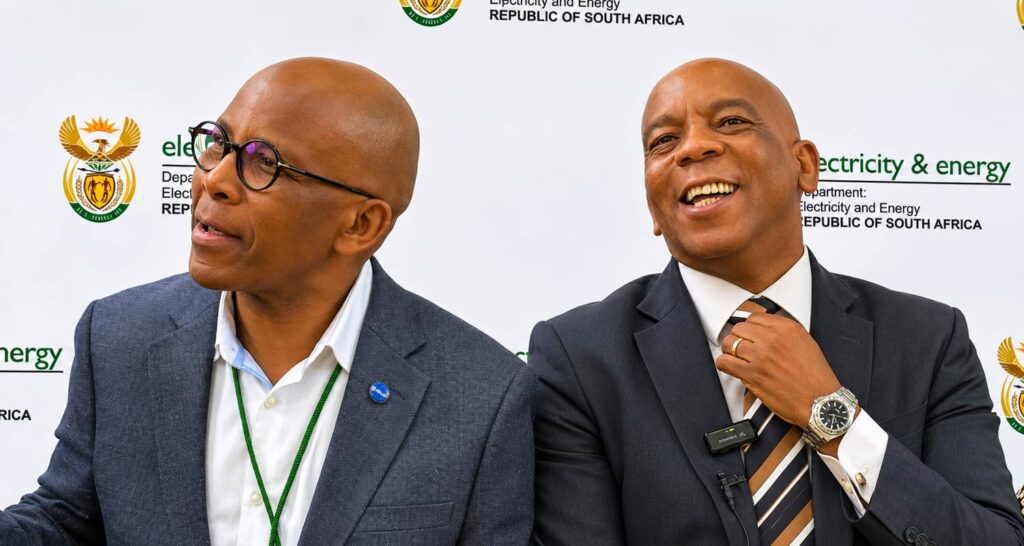
Energy minister Kgosientsho Ramokgopa has set out how government will take its 5.2GW nuclear build programme to market – and has dared opponents to try to stop it, saying the evidence for nuclear is settled.
Opening the Nuclear and Clean Energy Conference in Irene, Pretoria, on Tuesday, Ramokgopa said government would publish a position paper setting out the “case for nuclear” alongside the proposed section 34 determination under the Electricity Regulation Act. The extra step is meant to head off the litigation that has dogged earlier attempts to procure new reactors.
“It will be an extraordinary feat of achievement if no one takes us to court for the planned 5.2GW. If they don’t take us to court, I’m going to be very suspicious,” he joked. He said there was work to be done to change the prevailing ideology about nuclear, which he said is largely based on misconceptions.
At a media briefing afterwards, Ramokgopa said the position paper would be published at the end of November for public participation, with 60 days allowed for comment, and that he was aiming for a determination in April 2027. In his speech, he said he intended to publish the final document “before June of 2027”.
It will be an extraordinary feat of achievement if no one takes us to court for the planned 5.2GW. If they don’t take us to court, I’m going to be very suspicious.
Energy minister Kgosientsho Ramokgopa
The 5.2GW provided for in the 2025 Integrated Resource Plan (IRP) is the first phase of a nuclear industrialisation plan that Ramokgopa wants to expand to 10GW. “To be able to build our energy future on the back of nuclear, we will need to expand to 10GW,” he told reporters.
Ramokgopa called South Africa “a litigious environment” with people who are “ideologically opposed to nuclear as an energy source”. In August 2024, he withdrew a ministerial determination for 2.5GW of new nuclear capacity to allow for further public consultation, after the DA launched a legal challenge against it. Two non-governmental organisations had also gone to court. The DA has since joined the government of national unity.
The position paper, he said, is “anchored on science and evidence” and draws on experience in other countries, as well as Koeberg’s 40 years of operation. He conceded the exercise would add four to six months to the programme, but said it was needed “so that we make it very easy for the judges to resolve”.
“We are going to build nuclear in this country. Take us to court,” he said.
Sites and timelines
Eskom group CEO Dan Marokane confirmed that two sites had been selected: Duynefontein, next to Koeberg in the Western Cape, and Thyspunt in the Eastern Cape.
It was a DA minister who cleared the way at Duynefontein. In August 2025, Dion George, then environment minister, upheld an environmental authorisation for a 4GW plant there, which Ramokgopa said in November 2025 paved the way for the first 2.4GMW of the programme.
At Thyspunt, the environmental process covers a station of up to 5.2GW on its own. The final scoping report, which the environment department has accepted, makes the case for Thyspunt as the preferred site, though the department wants Eskom to show that dropping the alternative, Bantamsklip, is defensible. Eskom has not said how the 5.2GW will be divided between the two sites.

Thyspunt carries legal risk of its own. The site holds provisional Grade I cultural landscape protection from the South African Heritage Resources Agency until 1 February 2027, and that protection can be renewed. Makoma Lekalakala, director of Earthlife Africa Johannesburg, has said opposition has been building for nearly two decades and that Thyspunt is not a suitable location for a nuclear facility, Green Building Africa reported on Sunday.
Marokane said the determination would be followed by procurement. “We’re working on roughly a 10-year timeline, so potentially by 2036 the first reactor could come online.” Ramokgopa said it would take at least seven to 10 years.
State ownership, open financing
Asked whether small modular reactors (SMRs) could be privately owned, Ramokgopa said anything nuclear would stay in state hands. SMRs already feature in the programme: in May, Eskom said it was proposing 4.8GW from conventional pressurised water reactors and 400MW from SMRs.
“Eskom is 100% owned by the state. So, by definition, the state remains the sole owner and operator of nuclear in this country, and this is per legislation. So, there is no room for the privatisation of the space,” he said.
Ownership is not the same as funding, however. In a parliamentary reply, Ramokgopa said programme planning is examining funding mechanisms that “could include private-sector participation”, such as public-private partnerships and project finance. In May, Eskom group executive for generation Bheki Nxumalo said the utility was “in exploratory discussions with most of the potential funders”. Options under consideration include vendor financing, in which a developer builds and funds a plant.
What it will all cost is still unknown. In the same reply, Ramokgopa said funding and risk allocation had not been finalised, and that these “materially affect both the overnight capital cost and the total financed project cost”. The effect on electricity tariffs “has not yet been finally determined”, he said.
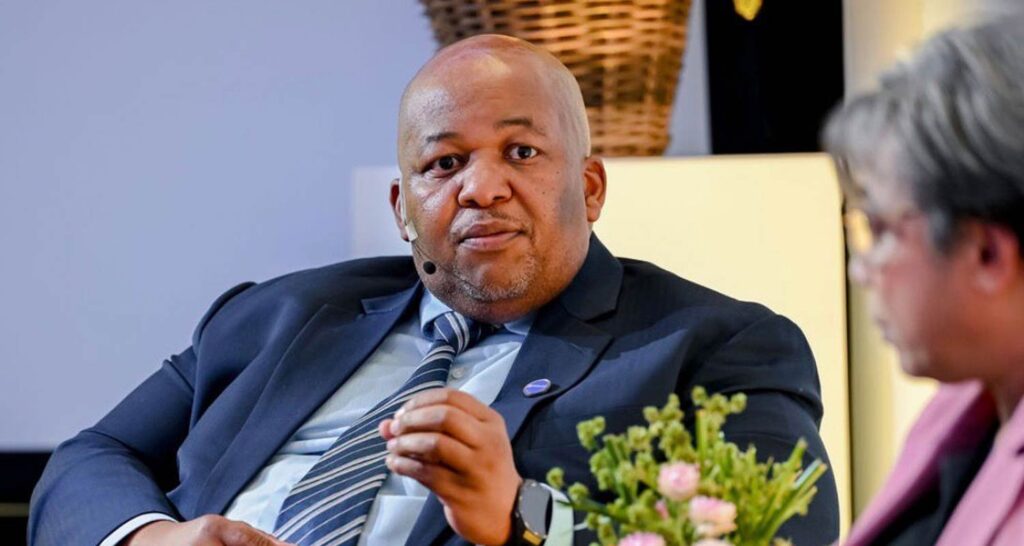
Ramokgopa held up Medupi and Kusile as “an excellent example of how not to execute a major project” and admitted a skills gap. “One of the biggest inherent risks in this programme is that we have not built a nuclear power plant in the past 50 years or so.”
He also lamented the decision to halt the Pebble Bed Modular Reactor in 2010: “We abandoned a perfectly working programme.” Government is reviving the PBMR and transferring it from Eskom to the South African Nuclear Energy Corporation, which Marokane said is talking to partners about building an SMR pilot plant.
Coal is ‘not the problem’
Introducing the minister, Eskom chairman Mteto Nyati said that with load shedding behind it, Eskom’s next task was to deliver affordable electricity to fuel economic growth. Of annual economic growth of around 1%, he said: “That to me is not growth. I like to call that the survival rate.”
Nyati said South Africa should resist pressure to abandon coal quickly. “Coal is not the problem. The problem is emissions,” he said, adding that the country could not retire a power station “that still has maybe another 10 years of life”.
Ramokgopa struck the same note, describing coal as a strategic mineral and his policy as one of “additionality”. “We’ll continue to exploit coal. We’ll exploit it responsibly, and there will be an exponential increase of renewable energy onto our grid,” he said. He argued that the IRP’s plan to take wind and solar beyond 60% of the mix within 20 years assumes nuclear is part of the system and would collapse without it. – (c) 2026 NewsCentral Media