
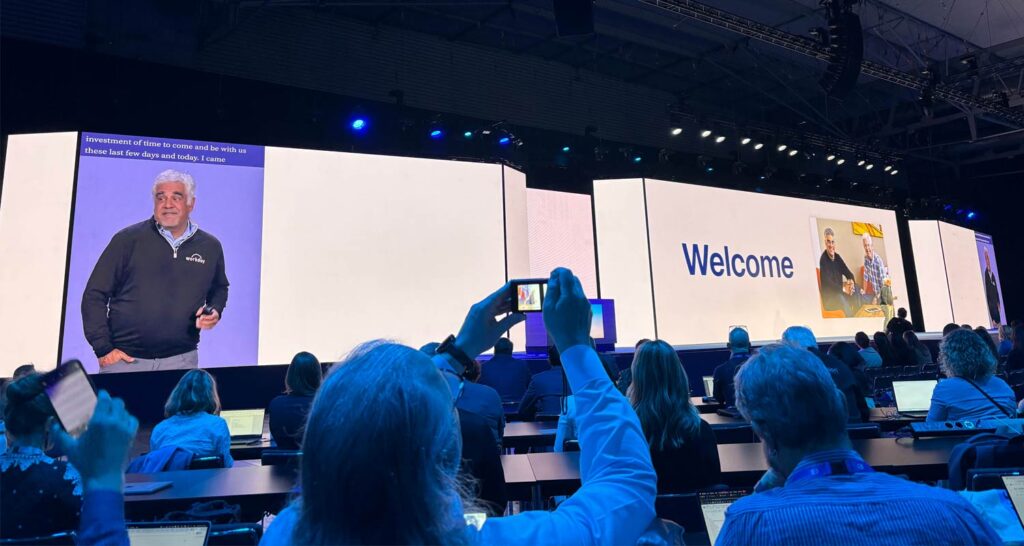
Workday wants to be the AI company that plays by the rules. At the innovation keynote of Workday Rising Emea in Barcelona on Wednesday, which TechCentral is attending this week, the HR and finance software giant’s executives kept returning to one idea: in systems that pay people and close the books, AI must stay inside the guardrails a company has already set.
“You can’t close books or run payroll on probabilities,” said co-founder and CEO Aneel Bhusri, who returned to the top job in February. “Finance and HR are inherently deterministic. You can’t get payroll 90% right, and maybe the 90% changes every time you do it.”
Bhusri argued that Workday’s rules-based processes and governance make it safe to pair them with probabilistic AI. “Our AI is lawful; it’s grounded in the business rules that you trust and that are embedded in your system,” he said.
Gerrit Kazmaier, Workday’s president of product and technology, took a swipe at grander visions. “Another company just announced their vision for autonomous enterprise. Doesn’t that sound like a cold and soulless place to you?” he asked.
Our AI is lawful; it’s grounded in the business rules that you trust and that are embedded in your system.
Workday CEO Aneel Bhusri
He did not name the company, but SAP made the “autonomous enterprise” the centrepiece of its Sapphire conference in May, outlined the strategy to South African partners in Kyalami in July and repeated it at its TechEd developer event this month.
Integration and control were the other selling points. Workday is taking Sana, the AI interface it gained when it bought the Swedish start-up of the same name last year, into other companies’ tools. Sana’s self-service agent already works in Microsoft Copilot and Teams, Slack and Google’s Gemini Enterprise, and is in early access in Anthropic’s Claude Cowork. In Barcelona, Workday announced early access to a Copilot plug-in that connects Sana to its wider set of agents. Developers can build Workday agents in tools such as Claude Code, Cursor and OpenAI’s Codex.
Workday also plans to buy Honeydew, whose “semantic layer” lets every AI tool apply a company’s own definitions of metrics such as headcount consistently.
On control, Workday demonstrated identity governance from C1.ai, formerly ConductorOne, which it agreed to buy in October. Each agent had to request time-limited access to data, and every action was checked as it happened, with high-risk requests such as extracting candidate profiles denied. Workday also showed its Flex Credit Estimator, which lets companies estimate what agents will cost before they commit.
Its new “autopilot” agents, such as a recruiting agent that monitors vacancies around the clock, are meant to leave the final call to people. “We decide what the agent can act on and what should remain human-led,” said Alet Blanken, Workday’s vice-president of AI engineering.
“AI should augment people, not replace people,” Bhusri said.
A sceptical market
That message may resonate locally. The SA AI Index 2026 found that only 1% of large South African organisations actively use AI agents and 71% have no plans to. Accuracy and reliability topped the list of barriers, cited by two-thirds of respondents.
Uptake among Workday’s own customers is uneven. Kazmaier said more than 6 000 customers run Workday agents in production, but Workday told analysts in October that only 850-plus had bought its agentic AI products in the 12 months to July, and about 300 had signed up for Flex Credits, its consumption-based pricing. The figures measure different things: the first counts customers running any Workday agent, while the second counts those who have paid extra for its agentic AI products, such as HiredScore, Paradox and Sana.
Rivals are making similar promises. Oracle, which has run a cloud region in Johannesburg since 2022, says its agentic HR applications, launched in April, operate within existing security and approval rules. SAP unveiled new Joule assistants for SuccessFactors in May under an “autonomous HCM” (human capital management) banner, though Dan Beck, then SuccessFactors’ chief product officer, wrote that “humans must remain firmly at the centre”.
Workday is pitching at a delicate moment for enterprise software providers. Software shares slumped this year on fears AI could make them obsolete, and private equity firm Silver Lake was reported in August to be in talks to take Workday private. No deal has been announced. – (c) 2026 NewsCentral Media
- The writer travelled to Spain as a guest of Workday