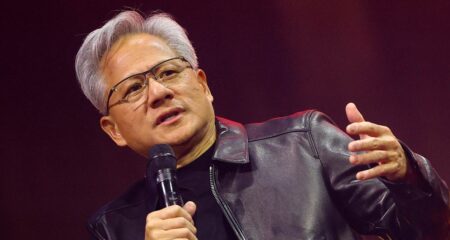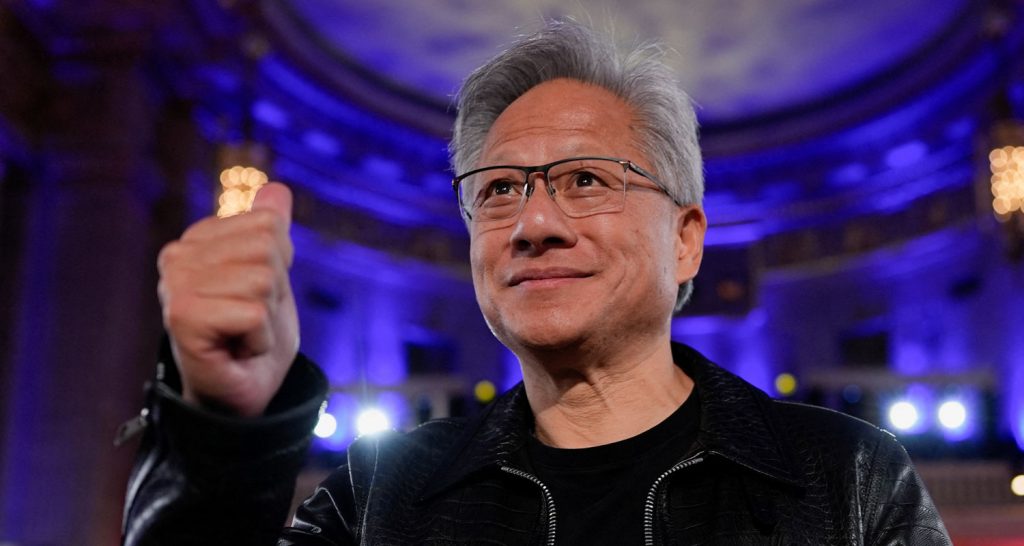
Jensen Huang is considering a comeback as Nvidia’s CEO and has discussed the possibility of returning with confidants, the Financial Times reported on Sunday, citing people familiar with the matter.
One Huang ally told the FT they were putting together a “war room” of Silicon Valley executives to lobby for the former Nvidia chief’s return and would try to win support from the White House.
“Everyone that matters in tech outside the frontier labs loves Jensen,” the person said, adding that the effort had Huang’s backing.
The report comes days after the FT reported that Nvidia’s board had approached Rene Haas, CEO of British chip designer ARM Holdings, in its search for a successor to Huang.
The scandal has plunged the chip maker into crisis and sent shockwaves across an AI industry he helped bankroll.
Nvidia did not immediately respond to a request for comment outside regular business hours.
Huang stepped down on Thursday after revelations of extramarital affairs, including one involving a businesswoman alleged to be a Chinese spy, which raised questions over exports of the company’s advanced AI chips to China. The scandal has plunged the chip maker into crisis and sent shockwaves across an AI industry he helped bankroll.
A week that ended a 33-year run
Huang’s fall took less than a week. On 8 November, he acknowledged in a memo to staff that he had been unfaithful to his wife, and Nvidia’s board launched an internal investigation into whether he had been targeted by a foreign intelligence operation.
The probe followed a New York Times report that Huang had a relationship with Alice Huang, a former executive of Singapore-based company Megaspeed, who is not related to him. US authorities had investigated her and concluded she was a Chinese intelligence asset, the newspaper reported. China’s foreign ministry called the spy accusations “groundless”.
The next day, US President Donald Trump, who counted Huang among his closest allies in Silicon Valley, said the FBI was looking into it. Nvidia then lost about US$430-billion in market value in two trading sessions, amid allegations that the relationship had aided at least $7.5-billion in Nvidia chip shipments to China. Republican senator Kevin Cramer called on Huang to step down.
On 11 November, the New York Times reported that Huang had also had an affair with Kimberly Powell, Nvidia’s vice-president of healthcare, who reported to him, and the board met to decide whether to oust him. He resigned the next day as president, CEO and director, ending a 33-year run at the head of the company he co-founded in 1993.

Any comeback would need the board’s approval. Huang owns about 3.6% of Nvidia but, unlike Mark Zuckerberg at Meta Platforms, has no dual-class shares giving him voting control. Under Nvidia’s bylaws, its CEO can be removed “with or without cause” by a majority of its directors, all of whom except Huang were considered independent.
CFO Colette Kress is serving as interim CEO while keeping her finance role, and Harvey Jones, a former CEO of Synopsys and an Nvidia director since 1993, has become the board’s first chair. The board has said it will consider internal and external candidates for a permanent successor. — Disha Mishra, (c) 2026 Reuters, with additional reporting (c) 2026 NewsCentral Media