
Close Menu
TechCentralTechCentral

    Subscribe to the newsletter

    Get the best South African technology news and analysis delivered to your e-mail inbox every morning.

    Facebook X (Twitter) YouTube LinkedIn
    WhatsApp Facebook X (Twitter) LinkedIn YouTube
    TechCentralTechCentral
    • News
      MTN lobs a grenade into SA's mobile market with Pi launch

      MTN lobs a grenade into SA’s mobile market with Pi launch

      30 March 2026
      Standard Bank moved R164-trillion in payments in 2025

      Standard Bank moved R164-trillion in payments in 2025

      30 March 2026
      WTO showdown looms over e-commerce tariff moratorium

      WTO showdown looms over e-commerce tariff moratorium

      30 March 2026
      The real reason Absa wrote off R2.4-billion in software - Johnson Idesoh

      The real reason Absa wrote off R2.4-billion in software

      27 March 2026
      MTN Group shakes up board with five new directors

      MTN Group shakes up board with five new directors

      27 March 2026
    • World

      Apple plans to open Siri to rival AI services

      27 March 2026
      It's official: ads are coming to ChatGPT

      It’s official: ads are coming to ChatGPT

      23 March 2026
      Mystery Chinese AI model revealed to be Xiaomi's

      Mystery Chinese AI model revealed to be Xiaomi’s

      19 March 2026
      A mystery AI model has developers buzzing

      A mystery AI model has developers buzzing

      18 March 2026
      Samsung's trifold gamble ends in retreat

      Samsung’s trifold gamble ends in retreat

      17 March 2026
    • In-depth
      The R18-billion tech giant hiding in plain sight - Jens Montanana

      The R16-billion tech giant hiding in plain sight

      26 March 2026
      The last generation of coders

      The last generation of coders

      18 February 2026
      Sentech is in dire straits

      Sentech is in dire straits

      10 February 2026
      How liberalisation is rewiring South Africa's power sector

      How liberalisation is rewiring South Africa’s power sector

      21 January 2026
      The top-performing South African tech shares of 2025

      The top-performing South African tech shares of 2025

      12 January 2026
    • TCS
      Anoosh Rooplal

      TCS | Anoosh Rooplal on the Post Office’s last stand

      27 March 2026
      Meet the CIO | HealthBridge CTO Anton Fatti on the future of digital health

      Meet the CIO | Healthbridge CTO Anton Fatti on the future of digital health

      23 March 2026
      TCS+ | Arctic Wolf unpacks the evolving threat landscape for SA businesses - Clare Loveridge and Jason Oehley

      TCS+ | Arctic Wolf unpacks the evolving threat landscape for SA businesses

      19 March 2026
      TCS+ | Vox Kiwi: a wireless solution promising a fibre-like experience - Theo van Zyl

      TCS+ | Vox Kiwi: a wireless solution promising a fibre-like experience

      13 March 2026
      TCS+ | Flipping the narrative on AI in the Global South - Josefin Rosén

      TCS+ | Flipping the narrative on AI in the Global South

      13 March 2026
    • Opinion
      The conflict of interest at the heart of PayShap's slow adoption - Cheslyn Jacobs

      The conflict of interest at the heart of PayShap’s slow adoption

      26 March 2026
      South Africa's energy future hinges on getting wheeling right - Aishah Gire

      South Africa’s energy future hinges on getting wheeling right

      10 March 2026
      Hold the doom: the case for a South African comeback - Duncan McLeod

      Apple just dropped a bomb on the Windows world

      5 March 2026
      VC's centre of gravity is shifting - and South Africa is in the frame - Alison Collier

      VC’s centre of gravity is shifting – and South Africa is in the frame

      3 March 2026
      Hold the doom: the case for a South African comeback - Duncan McLeod

      Hold the doom: the case for a South African comeback

      26 February 2026
    • Company Hubs
      • 1Stream
      • Africa Data Centres
      • AfriGIS
      • Altron Digital Business
      • Altron Document Solutions
      • Altron Group
      • Arctic Wolf
      • Ascent Technology
      • AvertITD
      • Braintree
      • CallMiner
      • CambriLearn
      • CYBER1 Solutions
      • Digicloud Africa
      • Digimune
      • Domains.co.za
      • ESET
      • Euphoria Telecom
      • HOSTAFRICA
      • Incredible Business
      • iONLINE
      • IQbusiness
      • Iris Network Systems
      • LSD Open
      • Mitel
      • NEC XON
      • Netstar
      • Network Platforms
      • Next DLP
      • Ovations
      • Paracon
      • Paratus
      • Q-KON
      • SevenC
      • SkyWire
      • Solid8 Technologies
      • Telit Cinterion
      • Telviva
      • Tenable
      • Vertiv
      • Videri Digital
      • Vodacom Business
      • Wipro
      • Workday
      • XLink
    • Sections
      • AI and machine learning
      • Banking
      • Broadcasting and Media
      • Cloud services
      • Contact centres and CX
      • Cryptocurrencies
      • Education and skills
      • Electronics and hardware
      • Energy and sustainability
      • Enterprise software
      • Financial services
      • HealthTech
      • Information security
      • Internet and connectivity
      • Internet of Things
      • Investment
      • IT services
      • Lifestyle
      • Motoring
      • Policy and regulation
      • Public sector
      • Retail and e-commerce
      • Satellite communications
      • Science
      • SMEs and start-ups
      • Social media
      • Talent and leadership
      • Telecoms
    • Events
    • Advertise
    TechCentralTechCentral
    Home » Sections » Investment » Should you be buying MultiChoice shares?

    Should you be buying MultiChoice shares?

    By Renier de Bruyn2 April 2019
    Twitter LinkedIn Facebook WhatsApp Email Telegram Copy Link
    News Alerts
    WhatsApp

    February saw Africa’s largest pay-television operator, MultiChoice, unbundled from its parent company Naspers and listed as a separate entity on the JSE. Opinions vary on whether going it alone is a blessing or a curse for the digital entertainment pioneer — and whether investors should throw out or add to these odd-lot shares in their portfolios.

    Despite some short-term potential headwinds, there may be a long-term investment case to be made for the group.

    There are few long-established companies in the world that have been able to keep transforming over the years to the extent global Internet and media behemoth Naspers has. From its humble beginnings as a newspaper business in the early 20th century, the group branched out into pay TV in 1986. The first pay-TV operator to be launched outside the US, MultiChoice, in turn, planted the seeds for the Naspers group’s impressive portfolio of consumer Internet businesses, including China’s Tencent and OLX Group.

    For many years, Naspers relied on the cash flows from MultiChoice to allow the group’s Internet ventures to grow in scale

    The Naspers share price has grown exponentially on the back of its successful investments. However, over the past decade, the share has failed to keep up with the growth in the value of its investments, resulting in a large discount to intrinsic net asset value.

    For many years, Naspers relied on the cash flows from MultiChoice to allow the group’s Internet ventures to grow in scale. Tencent has been profitable, but it has paid a relatively small dividend to Naspers while the rest of the Internet businesses have made a loss in aggregate. Then, in 2018, Naspers suddenly found itself with a US$10-billion pile of cash following the sale of 6% of the group’s Tencent shares and the disposal of Indian online retailer Flipkart. At the same time, the group’s next growth engine, online classifieds, was starting to achieve profitability.

    Unbundled

    For the first time, Naspers was able to live without MultiChoice, and the pay-TV operator could now be unbundled to shareholders as part of a wider strategy to unlock the discount in the share price. The MultiChoice Group was listed as a separate entity on the JSE on 27 February, with Naspers shareholders each receiving one MultiChoice share for every one Naspers share owned.

    Let’s consider the profile of the newly listed broadcaster. Since Naspers launched its pay-TV operation 32 years ago, MultiChoice has built its success on quality content that includes a leading local offering, sports broadcasting rights and access to top international studios. It has a fully invested network that can provide a high-quality and fully encrypted signal to a large number of households in sub-Saharan Africa via satellite dish or digital terrestrial network in key major cities.

    Scale provides an important competitive advantage in this business, as it enables operators to spread the cost of content over a larger subscriber base. As the largest player in its various markets, MultiChoice has a key competitive advantage over potential rivals with regard to content.

    In addition, while pay-TV penetration across Africa is growing, it remains low compared to international norms. Boosted by a growing and urbanising population, this provides plenty of room for long-term subscriber growth across the continent.

    We have valued the MultiChoice Group at around R200/share. However, a number of factors lead us to believe that the share may trade well below its intrinsic value in the near future.

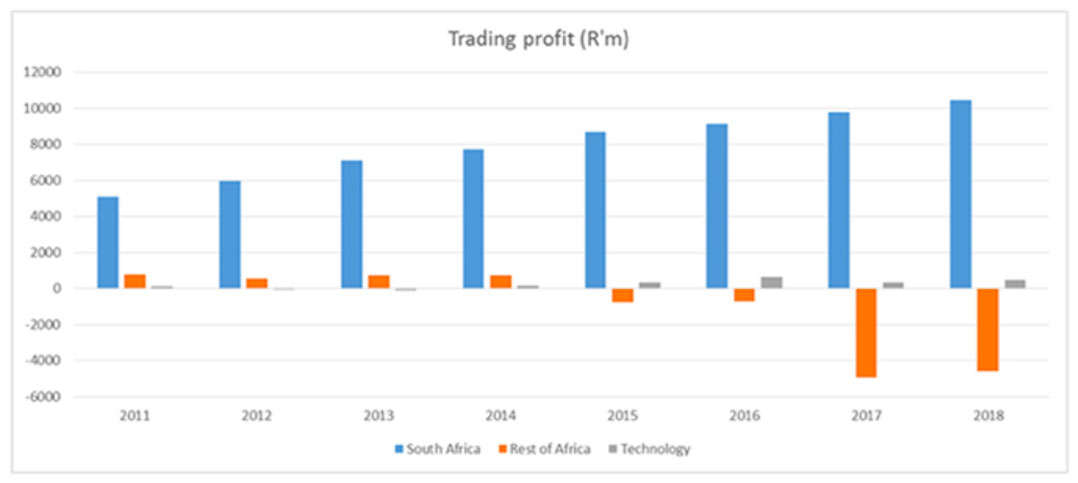
    While the MultiChoice South Africa business has seen consistent profitability and cash generation, fairly large losses have occurred in the rest of the African operations over the past few years.
    Source: MultiChoice

    With the sizeable losses in the rest of Africa, and accounting for the 25% black economic empowerment minority holding in the South African business, together with fully taxed South African profits and revenue tax in certain African countries, the result is a relatively depressed earnings base for the group. For example, in the 2018 financial year, MultiChoice South Africa earned R10.5-billion in trading profit, but only R1.3-billion in core earnings was reported at group level (adjusted for the further 5% transfer to BEE shareholders in the South African business).

    On the other hand, if the group can successfully turn around profitability in the rest of Africa, it should be able to report strong future earnings growth from the current low base.

    Another factor that may lead to a depressed MultiChoice Group share price is the potential for indiscriminate selling of shares by current Naspers shareholders who may not wish to own the broadcaster following the unbundling.

    Restricted

    To comply with local broadcasting requirements, foreign shareholders have restricted voting rights. The disruptive impact of streaming players like Netflix may also deter foreign investors, even though low penetration and poor access to affordable Internet broadband in the markets MultiChoice serves as a large barrier to entry in Africa for such competitors.

    Despite the potential short-term overhang on MultiChoice, we believe there is a long-term investment case for the group.

    It has a strong portfolio of video content and sports broadcasting rights. There has been much focus on the creation of local content, which differentiates it from its international competitors. It also has the largest scale in its markets, which helps it to acquire better content as it can spread the cost over a larger subscriber base.

    Subscriber growth has been strong over recent years, although this has been driven by lower-end packages carrying a lower monthly subscription. Pay-TV subscription penetration in Africa is still very low compared to international standards, which provides plenty of runway for growth.
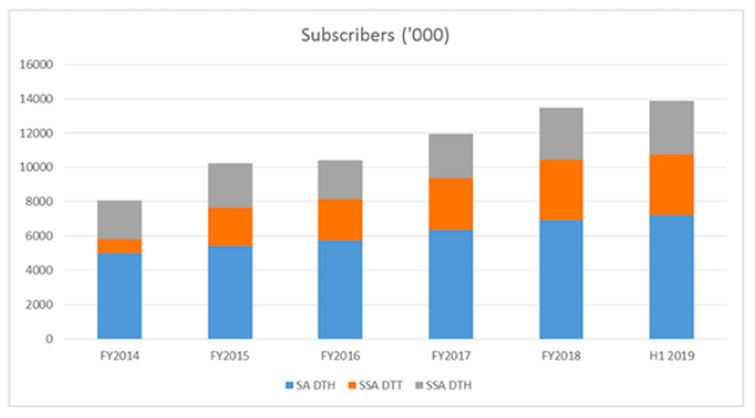
    Source: MultiChoice. DTH: direct to home (via satellite); DTT: digital terrestrial television (via multiplex transmitters in key cities)

    MultiChoice is mainly a fixed-cost business, with the acquisition of content the biggest single cost item. The sharp depreciation of currencies in the countries in which it operates has been the biggest contributor to rising trading losses in its rest-of-African operations.

    In addition, the group has had to acquire a large portion of its content in US dollars and has struggled to pass on cost increases to subscribers in local currencies. The rest-of-Africa strategy is to now focus primarily on mass-market subscriber growth in more affordable packages. While quick-win cost savings are being made by optimising content costs, the return to profitability in the rest of Africa will be driven by operating scale over time.

    The rest-of-Africa strategy is to now focus primarily on mass-market subscriber growth in more affordable packages

    The strong growth in subscriber numbers does bring some short-term earnings headwinds since MultiChoice provides generous subsidies to consumers for the installation of set-top boxes, costing the group around R3-billion/year (almost 50% of trading profit). The capex requirement on the network has declined over recent years, as the group’s network is now largely set up for its growth requirements. Operating leverage should therefore be quite favourable over the coming years if MultiChoice can keep the subscriber growth up.

    Taking a conservative route, if we put a negative value of R15-billion on the non-South African operations, the current share price implies an 8.5 times price-to-earnings ratio (for South Africa). This is attractive given the resilience and cash-generative nature of MultiChoice South Africa. If we value the rest of Africa in line with its medium-term potential at R10.7-billion, the market-implied value for the South African operations is only 4.5 times. The share price may remain under pressure while the shareholder base stabilises, but with MultiChoice trading at around R95 at the timing of writing, we believe it is offering good value.

    • Renier de Bruyn is an investment analyst at Sanlam Private Wealth. This piece was originally on Moneyweb and is used here with permission

    Follow TechCentral on Google News Add TechCentral as your preferred source on Google


    DStv MultiChoice Renier de Bruyn top
    WhatsApp YouTube
    Share. Facebook Twitter LinkedIn WhatsApp Telegram Email Copy Link
    Previous ArticleBitcoin’s 20% surge doesn’t mean an end to the crypto winter
    Next Article Interview: Dominic Cull on the Films and Publications Amendment Bill

    Related Posts

    MTN and Vodacom dwarf South Africa's listed tech sector

    MTN and Vodacom dwarf South Africa’s listed tech sector

    20 March 2026
    Showmax Originals find a new home on DStv Stream

    Showmax Originals find a new home on DStv Stream

    19 March 2026
    Showmax kill date confirmed

    Showmax kill date confirmed

    19 March 2026
    Company News
    Durban's finance leaders are done with AI theatre - Sage Intacct

    Durban’s finance leaders are done with AI theatre

    26 March 2026
    Defend your cloud with Altron Digital Business

    Defend your cloud with Altron Digital Business

    26 March 2026
    Why most Cisco partners leave money on the table at renewal time - Westcon-Comstor

    Why most Cisco partners leave money on the table at renewal time

    25 March 2026
    Opinion
    The conflict of interest at the heart of PayShap's slow adoption - Cheslyn Jacobs

    The conflict of interest at the heart of PayShap’s slow adoption

    26 March 2026
    South Africa's energy future hinges on getting wheeling right - Aishah Gire

    South Africa’s energy future hinges on getting wheeling right

    10 March 2026
    Hold the doom: the case for a South African comeback - Duncan McLeod

    Apple just dropped a bomb on the Windows world

    5 March 2026

    Subscribe to Updates

    Get the best South African technology news and analysis delivered to your e-mail inbox every morning.

    Latest Posts
    MTN lobs a grenade into SA's mobile market with Pi launch

    MTN lobs a grenade into SA’s mobile market with Pi launch

    30 March 2026
    Standard Bank moved R164-trillion in payments in 2025

    Standard Bank moved R164-trillion in payments in 2025

    30 March 2026
    WTO showdown looms over e-commerce tariff moratorium

    WTO showdown looms over e-commerce tariff moratorium

    30 March 2026
    The real reason Absa wrote off R2.4-billion in software - Johnson Idesoh

    The real reason Absa wrote off R2.4-billion in software

    27 March 2026
    © 2009 - 2026 NewsCentral Media
    • Cookie policy (ZA)
    • TechCentral – privacy and Popia

    Type above and press Enter to search. Press Esc to cancel.

    Manage consent

    TechCentral uses cookies to enhance its offerings. Consenting to these technologies allows us to serve you better. Not consenting or withdrawing consent may adversely affect certain features and functions of the website.

    Functional Always active
    The technical storage or access is strictly necessary for the legitimate purpose of enabling the use of a specific service explicitly requested by the subscriber or user, or for the sole purpose of carrying out the transmission of a communication over an electronic communications network.
    Preferences
    The technical storage or access is necessary for the legitimate purpose of storing preferences that are not requested by the subscriber or user.
    Statistics
    The technical storage or access that is used exclusively for statistical purposes. The technical storage or access that is used exclusively for anonymous statistical purposes. Without a subpoena, voluntary compliance on the part of your Internet Service Provider, or additional records from a third party, information stored or retrieved for this purpose alone cannot usually be used to identify you.
    Marketing
    The technical storage or access is required to create user profiles to send advertising, or to track the user on a website or across several websites for similar marketing purposes.
    • Manage options
    • Manage services
    • Manage {vendor_count} vendors
    • Read more about these purposes
    View preferences
    • {title}
    • {title}
    • {title}