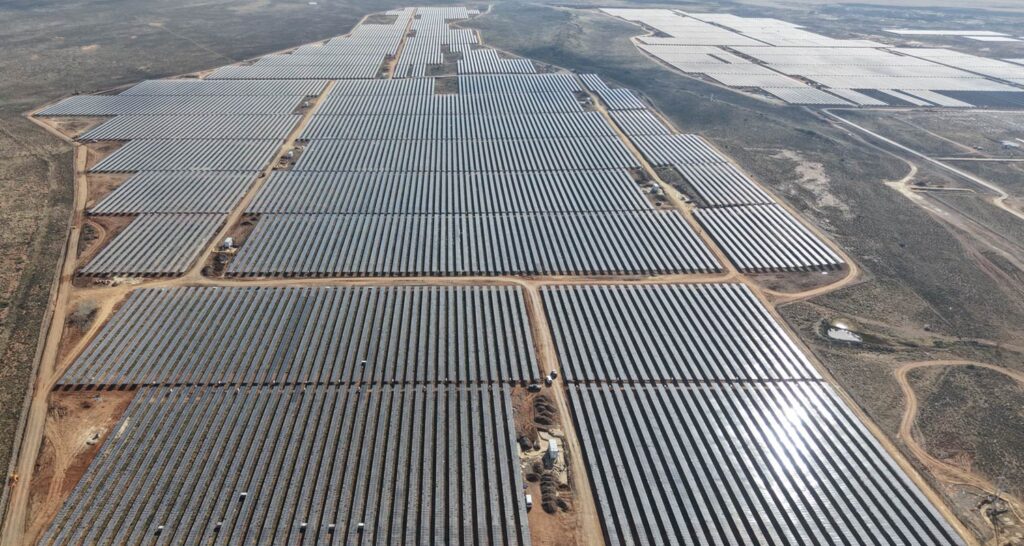
SolarAfrica is taking wheeled solar power to smaller businesses. The next two plants in its SunCentral development in the Northern Cape will split their output among 42 customers, against three for the first, which began supplying power over Eskom’s grid in September.
“Wheeling isn’t reserved for the large power users any more: we sell it on a one-to-many basis with flexible agreements, which gives more businesses of all sizes the opportunity to get wheeling,” SolarAfrica COO Vincent Labuschagne told TechCentral.
SolarAfrica and its licensed electricity-trading subsidiary, Energy Market SA (EMSA), have 45 customers between them across SunCentral 1, 2 and 3, he said. The three plants make up the 342MW first phase of SolarAfrica’s planned 1GW SunCentral development. Only SunCentral 1 is operating. SunCentral 2 is in the later stages of construction, and work on SunCentral 3 is expected to begin shortly, according to Open Access Energy (OAE), the Cape Town start-up whose Energypro software runs SunCentral 1’s settlement.
Some customers are contracted through EMSA, Labuschagne said, though he did not say how many or whether all 45 have signed supply agreements.
Energisation is the milestone everyone sees, but a wheeling deal is proven at every month-end, when each customer’s bill has to match what was promised.
OAE CEO Gerjo Hoffman
SunCentral 1, between Hanover and De Aar, reached commercial operation on 16 September. It is rated at 114MWp, its peak direct-current capacity, and can export 100MW of alternating current to the grid.
The plant produced 23.4GWh in October, its first full month of supply, Labuschagne said. OAE said output for 16-30 September was 7.57GWh, based on Eskom’s readings.
SunCentral 1’s three customers have received their first bills, according to OAE. OAE’s chairman, James Irons, co-founded SolarAfrica, according to OAE’s website.
Neither company would name the buyers. “We are not able to share specific customer names, out of respect for customer confidentiality,” Labuschagne said. OAE CEO Gerjo Hoffman said SunCentral 1’s customers are commercial and industrial businesses, including property management companies and data centres, and that each contracts directly with SolarAfrica. The power is physically wheeled across Eskom’s national grid, OAE said.
Not the only multi-buyer plant
“Most wheeling arrangements link one plant to one buyer,” OAE said in a statement last month. But other large plants also sell to several buyers.
Sola Group’s 195MWp Springbok plant in Virginia in the Free State launched in October 2025 with at least nine buyers, including Amazon, Vodacom, Sibanye-Stillwater and Sasol.
The 155MW first phase of Seriti Green’s Ummbila Emoyeni wind farm in Mpumalanga, which entered commercial operation at the end of July, sends about a third of its output to Seriti Resources’ mines. The rest goes to corporate customers through private traders, including Energy Exchange of Southern Africa, Etana and Noa, Green Building Africa reported.
The month-end test
Every extra buyer adds to the accounting. Each month, according to OAE, Energypro takes in the plant’s generation, each customer’s consumption at its delivery points and the terms of each customer’s power purchase agreement (PPA). It allocates the output, honouring firm commitments first, and prepares the nomination information SolarAfrica submits to Eskom. At month-end, it produces the settlement data used to bill each customer.
“Energisation is the milestone everyone sees, but a wheeling deal is proven at every month-end, when each customer’s bill has to match what was promised,” Hoffman said.
OAE describes SunCentral 1 as the first utility-scale, multi-buyer wheeling project in Africa to be settled on locally developed, purpose-built software – a claim about the software rather than the plant.
OAE would not disclose pricing or how the power compares with Eskom’s tariff, saying prices are set in each customer’s PPA with SolarAfrica. “We’re paid for the platform, not on the energy price,” Hoffman said. – (c) 2026 NewsCentral Media