Close Menu
TechCentralTechCentral

    Subscribe to the newsletter

    Get the best South African technology news and analysis delivered to your e-mail inbox every morning.

    Facebook X (Twitter) YouTube LinkedIn
    WhatsApp Facebook X (Twitter) LinkedIn YouTube
    TechCentralTechCentral
    • News
      Estonia's digital ID lesson for South Africa

      Estonia’s digital ID lesson for South Africa

      4 February 2026
      Vodacom's real growth story isn't mobile

      Vodacom’s real growth story isn’t mobile

      4 February 2026
      Why stablecoins are booming in Africa - Yellow Card MD Lasbery Oludimu

      Why stablecoins are booming in Africa

      4 February 2026
      Prosus inks three-year AWS deal to scale AI across its global portfolio

      Prosus inks three-year AWS deal to scale AI across its global portfolio

      4 February 2026
      South African fintech Lula lands R340m to scale SME working capital - Trevor Gosling

      South African fintech Lula lands R340m to scale SME working capital

      4 February 2026
    • World
      AI won't replace software, says Nvidia CEO amid market rout - Jensen Huang

      AI won’t replace software, says Nvidia CEO amid market rout

      4 February 2026
      Apple acquires audio AI start-up Q.ai

      Apple acquires audio AI start-up Q.ai

      30 January 2026
      SpaceX IPO may be largest in history

      SpaceX IPO may be largest in history

      28 January 2026
      Nvidia throws AI at the weather

      Nvidia throws AI at weather forecasting

      27 January 2026
      Debate erupts over value of in-flight Wi-Fi

      Debate erupts over value of in-flight Wi-Fi

      26 January 2026
    • In-depth
      How liberalisation is rewiring South Africa's power sector

      How liberalisation is rewiring South Africa’s power sector

      21 January 2026
      The top-performing South African tech shares of 2025

      The top-performing South African tech shares of 2025

      12 January 2026
      Digital authoritarianism grows as African states normalise internet blackouts

      Digital authoritarianism grows as African states normalise internet blackouts

      19 December 2025
      TechCentral's South African Newsmakers of 2025

      TechCentral’s South African Newsmakers of 2025

      18 December 2025
      Black Friday goes digital in South Africa as online spending surges to record high

      Black Friday goes digital in South Africa as online spending surges to record high

      4 December 2025
    • TCS
      TCS+ | How Cloud On Demand is helping SA businesses succeed in the cloud - Xhenia Rhode, Dion Kalicharan

      TCS+ | Cloud On Demand and Consnet: inside a real-world AWS partner success story

      30 January 2026
      Watts & Wheels S1E3: 'BYD's Corolla Cross challenger'

      Watts & Wheels S1E3: ‘BYD’s Corolla Cross challenger’

      30 January 2026
      Watts & Wheels S1E3: 'BYD's Corolla Cross challenger'

      Watts & Wheels S1E2: ‘China attacks, BMW digs in, Toyota’s sublime supercar’

      23 January 2026

      TCS+ | Why cybersecurity is becoming a competitive advantage for SA businesses

      20 January 2026
      Watts & Wheels S1E3: 'BYD's Corolla Cross challenger'

      Watts & Wheels: S1E1 – ‘William, Prince of Wheels’

      8 January 2026
    • Opinion
      South Africa's skills advantage is being overlooked at home - Richard Firth

      South Africa’s skills advantage is being overlooked at home

      29 January 2026
      Why Elon Musk's Starlink is a 'hard no' for me - Songezo Zibi

      Why Elon Musk’s Starlink is a ‘hard no’ for me

      26 January 2026
      South Africa's new fibre broadband battle - Duncan McLeod

      South Africa’s new fibre broadband battle

      20 January 2026
      AI moves from pilots to production in South African companies - Nazia Pillay SAP

      AI moves from pilots to production in South African companies

      20 January 2026
      South Africa's new fibre broadband battle - Duncan McLeod

      ANC’s attack on Solly Malatsi shows how BEE dogma trumps economic reality

      14 December 2025
    • Company Hubs
      • Africa Data Centres
      • AfriGIS
      • Altron Digital Business
      • Altron Document Solutions
      • Altron Group
      • Arctic Wolf
      • AvertITD
      • Braintree
      • CallMiner
      • CambriLearn
      • CYBER1 Solutions
      • Digicloud Africa
      • Digimune
      • Domains.co.za
      • ESET
      • Euphoria Telecom
      • Incredible Business
      • iONLINE
      • IQbusiness
      • Iris Network Systems
      • LSD Open
      • NEC XON
      • Netstar
      • Network Platforms
      • Next DLP
      • Ovations
      • Paracon
      • Paratus
      • Q-KON
      • SevenC
      • SkyWire
      • Solid8 Technologies
      • Telit Cinterion
      • Tenable
      • Vertiv
      • Videri Digital
      • Vodacom Business
      • Wipro
      • Workday
      • XLink
    • Sections
      • AI and machine learning
      • Banking
      • Broadcasting and Media
      • Cloud services
      • Contact centres and CX
      • Cryptocurrencies
      • Education and skills
      • Electronics and hardware
      • Energy and sustainability
      • Enterprise software
      • Financial services
      • Information security
      • Internet and connectivity
      • Internet of Things
      • Investment
      • IT services
      • Lifestyle
      • Motoring
      • Public sector
      • Retail and e-commerce
      • Satellite communications
      • Science
      • SMEs and start-ups
      • Social media
      • Talent and leadership
      • Telecoms
    • Events
    • Advertise
    TechCentralTechCentral
    Home » In-depth » Windows 10: what’s in a number?

    Windows 10: what’s in a number?

    By The Conversation1 October 2014
    Twitter LinkedIn Facebook WhatsApp Email Telegram Copy Link
    News Alerts
    WhatsApp
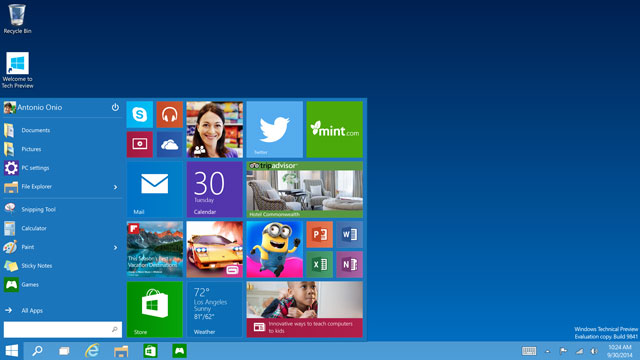
    It's back! The Windows Start button returns in the next version of the operating system
    It’s back! The Windows Start menu returns in the next version of the operating system

    The name came as a surprise, although it wasn’t the surprise watchers had been expecting: the latest version of Microsoft Windows had been codenamed Threshold, and it was thought this would become its official name, rather than the more predictable Windows 9. As it happened, Microsoft jumped straight to a round number and called it Windows 10.

    But what’s in a name, anyway? Presumably the world’s most overwhelmingly popular computer operating system can bring more to the table.

    The first taste of Windows 10, as is often the case with yet-to-be-released products, focuses more on the superficial than how the operating system handles the computer’s processor, memory, input/output and other hardware devices. Such matters were quietly ignored for the time being, although the technical preview of Windows 10, which will soon be available for those who sign up to the Windows Insider programme, will reveal more about what’s changed under the hood.

    Superficial or not, what every Windows user wants to know is whether the sweeping changes to the interface introduced in Windows 8 in 2012 have been dealt with to their satisfaction.

    The Windows 8 interface built around large tiles was designed with touchscreen computers in mind, perhaps under the impression that they would be commonplace in years to come. Not so. And so the familiar Start menu introduced with Windows 95 and which disappeared in Windows 8 returns. Hardly a revolutionary act, but one that will have many breathing a sigh of relief. At least some users will now know where to start.

    Microsoft was boldly chasing cutting-edge design with Windows 8, with its design language (originally called Metro) stripping away the embossed edges and drop shadows from windows ahead of rivals, including Apple. The flat design remains — from the background icons to the start bar, Windows 10 is flatter than ever.

    While the tile-based look of Windows 8 is gone, it has not been entirely removed. Instead it emerges from the side of the Start menu, combining the two approaches, like a blend of Windows 7 and Windows 8. The app-based approach of Windows 8 is also retained, with apps launching in windows as would any program. The alerts that apps can produce have been collected into a central Notification Centre.

    Microsoft has attempted to replicate the multiple desktops approach possible with other operating systems such as Mac OS X and Linux. Windows 10 will introduce this approach, calling them virtual desktops, with a range of customisation options available for each.

    Early rumours suggested Windows 10 would do away with the unpopular Charms bar altogether, but it seems it rather be hidden further. The Charms bar was an innovation of Windows 8 that aimed to help users quickly access common, context-dependent actions available to them on any given screen, such as for searching and sharing. Useful for touchscreen users, it got in the way for those using keyboard and mouse that make up the vast majority of Windows users.

    Perhaps one of the biggest changes is the effort to finally deliver on Windows 8’s promise to combine the many versions of Windows that exist for different platforms — smartphones, tablets, touchscreens, laptops and desktops, running different processor architectures such as Intel x86 and ARM.

    Microsoft is aiming squarely for that with an ambitious feature called Continuum, which will detect the processor architecture and device characteristics such as screen size and peripherals and change the interface accordingly. Unplug a keyboard, and touchscreen buttons to help navigate appear. Plug it back in, and the familiar Start button and menu reappears.

    An even more substantial step-change is Microsoft’s decision to move away from producing monolithic, periodic updates, released as point versions (Windows 8 to Windows 8.1, for example) or as service packs. Instead, it seems the company will adopt the “release early, release often” approach of the open-source movement and introduce regular, rolling upgrades. In one sense — as Microsoft itself has alluded to — this will be the final “version” of Windows, one that is perpetually updated. Windows as a service, if you like.

    Is it worth it?
    Windows 10’s announcement comes with all the usual claims of improved stability, higher security, better power management, more personalisation, and so on. All this is yet to be seen. Windows 10 must offer something for desktop and laptop users, and especially for the enterprise corporate users who make up much of the company’s profits. Certainly, the promise of design once, run on all platforms that a unified Windows architecture offers will be great news for developers.

    As operating systems for mobile and desktop devices converge, feature lists become harder to differentiate. If Microsoft follows through and delivers a unified Windows architecture across multiple platforms, it may well turn out to be a better prediction than those that led to the design choices in Windows 8.The Conversation

    • Hongji Yang is professor and deputy director at the Centre of Creative Computing at Bath Spa University
    • This article was originally published on The Conversation


    Microsoft Windows 10
    WhatsApp YouTube Follow on Google News Add as preferred source on Google
    Share. Facebook Twitter LinkedIn WhatsApp Telegram Email Copy Link
    Previous ArticleReserve Bank must pay Shuttleworth R250m
    Next Article Trust to get Shuttleworth’s R250m

    Related Posts

    SABC Plus to flight Microsoft AI training videos

    SABC Plus to flight Microsoft AI training videos

    30 January 2026
    Cloud adoption the weak link in SA's digital government push: Microsoft - Vukani Mngxati

    Cloud adoption the weak link in SA’s digital government push: Microsoft

    29 January 2026
    Elon Musk

    Elon Musk demands billions from OpenAI in explosive lawsuit

    18 January 2026
    Company News
    Most business owners don't worry about IT, until they have to - Graeme Millar SevenC

    Most business owners don’t worry about IT – until they have to

    4 February 2026
    Why cloud projects fail - and how three days can fix it - LSD Open

    Why cloud projects fail – and how three days can fix this

    4 February 2026
    Zero downtime, 12 months: XLink raises the bar for mission-critical networks

    Zero downtime, 12 months: XLink raises the bar for mission-critical networks

    4 February 2026
    Opinion
    South Africa's skills advantage is being overlooked at home - Richard Firth

    South Africa’s skills advantage is being overlooked at home

    29 January 2026
    Why Elon Musk's Starlink is a 'hard no' for me - Songezo Zibi

    Why Elon Musk’s Starlink is a ‘hard no’ for me

    26 January 2026
    South Africa's new fibre broadband battle - Duncan McLeod

    South Africa’s new fibre broadband battle

    20 January 2026

    Subscribe to Updates

    Get the best South African technology news and analysis delivered to your e-mail inbox every morning.

    Latest Posts
    Estonia's digital ID lesson for South Africa

    Estonia’s digital ID lesson for South Africa

    4 February 2026
    Vodacom's real growth story isn't mobile

    Vodacom’s real growth story isn’t mobile

    4 February 2026
    Why stablecoins are booming in Africa - Yellow Card MD Lasbery Oludimu

    Why stablecoins are booming in Africa

    4 February 2026
    Prosus inks three-year AWS deal to scale AI across its global portfolio

    Prosus inks three-year AWS deal to scale AI across its global portfolio

    4 February 2026
    © 2009 - 2026 NewsCentral Media
    • Cookie policy (ZA)
    • TechCentral – privacy and Popia

    Type above and press Enter to search. Press Esc to cancel.

    Manage consent

    TechCentral uses cookies to enhance its offerings. Consenting to these technologies allows us to serve you better. Not consenting or withdrawing consent may adversely affect certain features and functions of the website.

    Functional Always active
    The technical storage or access is strictly necessary for the legitimate purpose of enabling the use of a specific service explicitly requested by the subscriber or user, or for the sole purpose of carrying out the transmission of a communication over an electronic communications network.
    Preferences
    The technical storage or access is necessary for the legitimate purpose of storing preferences that are not requested by the subscriber or user.
    Statistics
    The technical storage or access that is used exclusively for statistical purposes. The technical storage or access that is used exclusively for anonymous statistical purposes. Without a subpoena, voluntary compliance on the part of your Internet Service Provider, or additional records from a third party, information stored or retrieved for this purpose alone cannot usually be used to identify you.
    Marketing
    The technical storage or access is required to create user profiles to send advertising, or to track the user on a website or across several websites for similar marketing purposes.
    • Manage options
    • Manage services
    • Manage {vendor_count} vendors
    • Read more about these purposes
    View preferences
    • {title}
    • {title}
    • {title}