Close Menu
TechCentralTechCentral

    Subscribe to the newsletter

    Get the best South African technology news and analysis delivered to your e-mail inbox every morning.

    Facebook X (Twitter) YouTube LinkedIn
    WhatsApp Facebook X (Twitter) LinkedIn YouTube
    TechCentralTechCentral
    • News
      ANC's attack on Solly Malatsi shows how BEE dogma trumps economic reality

      ANC’s attack on Solly Malatsi shows how BEE dogma trumps economic reality

      14 December 2025
      Political war erupts over BEE in the ICT sector - Solly Malatsi

      Political war erupts over BEE in the ICT sector

      13 December 2025
      Icasa told to align on BEE in move that will favour Starlink - Solly Malatsi

      Icasa told to align on BEE in move that will favour Starlink

      12 December 2025
      South African solar industry faces a reality check

      South African solar industry faces a reality check

      12 December 2025
      OpenAI launches GPT-5.2 after 'code red' push to counter Google. Shelby Tauber/Reuters

      OpenAI launches GPT-5.2 after ‘code red’ push to counter Google

      12 December 2025
    • World
      Oracle’s AI ambitions face scrutiny on earnings miss

      Oracle’s AI ambitions face scrutiny on earnings miss

      11 December 2025
      China will get Nvidia H200 chips - but not without paying Washington first

      China will get Nvidia H200 chips – but not without paying Washington first

      9 December 2025
      IBM reportedly close to $11-billion deal to buy Confluent - Arvind Krishna

      IBM reportedly close to $11-billion deal to buy Confluent

      8 December 2025
      Amazon and Google launch multi-cloud service for faster connectivity

      Amazon and Google launch multi-cloud service for faster connectivity

      1 December 2025
      Google makes final court plea to stop US breakup

      Google makes final court plea to stop US breakup

      21 November 2025
    • In-depth
      Black Friday goes digital in South Africa as online spending surges to record high

      Black Friday goes digital in South Africa as online spending surges to record high

      4 December 2025
      Canal+ plays hardball - and DStv viewers feel the pain

      Canal+ plays hardball – and DStv viewers feel the pain

      3 December 2025
      Jensen Huang Nvidia

      So, will China really win the AI race?

      14 November 2025
      Valve's Linux console takes aim at Microsoft's gaming empire

      Valve’s Linux console takes aim at Microsoft’s gaming empire

      13 November 2025
      iOCO's extraordinary comeback plan - Rhys Summerton

      iOCO’s extraordinary comeback plan

      28 October 2025
    • TCS
      TCS+ | Africa's digital transformation - unlocking AI through cloud and culture - Cliff de Wit Accelera Digital Group

      TCS+ | Cloud without culture won’t deliver AI: Accelera’s Cliff de Wit

      12 December 2025
      TCS+ | How Cloud on Demand helps partners thrive in the AWS ecosystem - Odwa Ndyaluvane and Xenia Rhode

      TCS+ | How Cloud On Demand helps partners thrive in the AWS ecosystem

      4 December 2025
      TCS | MTN Group CEO Ralph Mupita on competition, AI and the future of mobile

      TCS | Ralph Mupita on competition, AI and the future of mobile

      28 November 2025
      TCS | Dominic Cull on fixing South Africa's ICT policy bottlenecks

      TCS | Dominic Cull on fixing South Africa’s ICT policy bottlenecks

      21 November 2025
      TCS | BMW CEO Peter van Binsbergen on the future of South Africa's automotive industry

      TCS | BMW CEO Peter van Binsbergen on the future of South Africa’s automotive industry

      6 November 2025
    • Opinion
      Netflix, Warner Bros deal raises fresh headaches for MultiChoice - Duncan McLeod

      Netflix, Warner Bros deal raises fresh headaches for MultiChoice

      5 December 2025
      BIN scans, DDoS and the next cybercrime wave hitting South Africa's banks - Entersekt Gerhard Oosthuizen

      BIN scans, DDoS and the next cybercrime wave hitting South Africa’s banks

      3 December 2025
      Your data, your hardware: the DIY AI revolution is coming - Duncan McLeod

      Your data, your hardware: the DIY AI revolution is coming

      20 November 2025
      Zero Carbon Charge founder Joubert Roux

      The energy revolution South Africa can’t afford to miss

      20 November 2025
      It's time for a new approach to government IT spend in South Africa - Richard Firth

      It’s time for a new approach to government IT spend in South Africa

      19 November 2025
    • Company Hubs
      • Africa Data Centres
      • AfriGIS
      • Altron Digital Business
      • Altron Document Solutions
      • Altron Group
      • Arctic Wolf
      • AvertITD
      • Braintree
      • CallMiner
      • CambriLearn
      • CYBER1 Solutions
      • Digicloud Africa
      • Digimune
      • Domains.co.za
      • ESET
      • Euphoria Telecom
      • Incredible Business
      • iONLINE
      • IQbusiness
      • Iris Network Systems
      • LSD Open
      • NEC XON
      • Netstar
      • Network Platforms
      • Next DLP
      • Ovations
      • Paracon
      • Paratus
      • Q-KON
      • SevenC
      • SkyWire
      • Solid8 Technologies
      • Telit Cinterion
      • Tenable
      • Vertiv
      • Videri Digital
      • Vodacom Business
      • Wipro
      • Workday
      • XLink
    • Sections
      • AI and machine learning
      • Banking
      • Broadcasting and Media
      • Cloud services
      • Contact centres and CX
      • Cryptocurrencies
      • Education and skills
      • Electronics and hardware
      • Energy and sustainability
      • Enterprise software
      • Financial services
      • Information security
      • Internet and connectivity
      • Internet of Things
      • Investment
      • IT services
      • Lifestyle
      • Motoring
      • Public sector
      • Retail and e-commerce
      • Satellite communications
      • Science
      • SMEs and start-ups
      • Social media
      • Talent and leadership
      • Telecoms
    • Events
    • Advertise
    TechCentralTechCentral
    Home » Sections » Science » How AI is helping in the search for intelligent alien life

    How AI is helping in the search for intelligent alien life

    Scientists have found eight strange new signals they can’t yet explain, while South Africa’s MeerKAT has been enlisted in the search for ET.
    By The Conversation1 February 2023
    Twitter LinkedIn Facebook WhatsApp Email Telegram Copy Link
    News Alerts
    WhatsApp
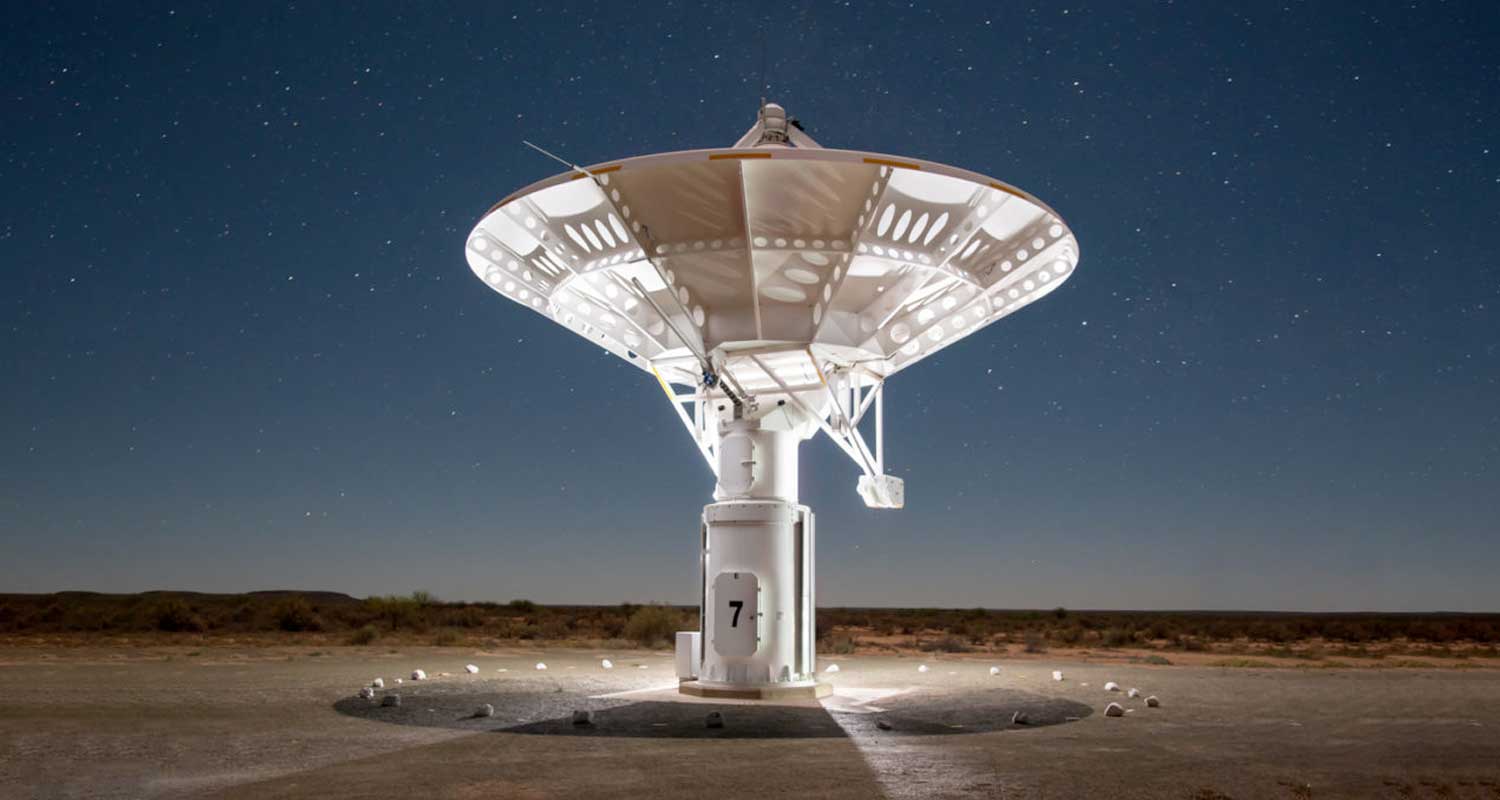
    One of 64 dishes that constitute the MeerKAT telescope in South Africa

    Some 540 million years ago, diverse life forms suddenly began to emerge from the muddy ocean floors of planet Earth. This period is known as the Cambrian Explosion, and these aquatic critters are our ancient ancestors.

    All complex life on Earth evolved from these underwater creatures. Scientists believe all it took was an ever-so-slight increase in ocean oxygen levels above a certain threshold.

    We may now be in the midst of a Cambrian Explosion for artificial intelligence (AI). In the past few years, a burst of incredibly capable AI programs like Midjourney, Dall-E 2 and ChatGPT have showcased the rapid progress we’ve made in machine learning.

    Our team recently deployed a powerful signal processor on the MeerKAT telescope in South Africa

    AI is now used in virtually all areas of science to help researchers with routine classification tasks. It’s also helping our team of radio astronomers broaden the search for extra-terrestrial life, and results so far have been promising.

    As scientists searching for evidence of intelligent life beyond Earth, we have built an AI system that beats classical algorithms in signal detection tasks. Our AI was trained to search through data from radio telescopes for signals that couldn’t be generated by natural astrophysical processes.

    When we fed our AI a previously studied dataset, it discovered eight signals of interest the classic algorithm missed. To be clear, these signals are probably not from extra-terrestrial intelligence, and are more likely rare cases of radio interference.

    Nonetheless, our findings – published in Nature Astronomy – highlight how AI techniques are sure to play a continued role in the search for extra-terrestrial intelligence.

    Not so intelligent

    AI algorithms do not “understand” or “think”. They do excel at pattern recognition, and have proven exceedingly useful for tasks such as classification – but they don’t have the ability to problem-solve. They only do the specific tasks they were trained to do.

    So, although the idea of an AI detecting extra-terrestrial intelligence sounds like the plot of an exciting science-fiction novel, both terms are flawed: AI programs are not intelligent, and searches for extra-terrestrial intelligence can’t find direct evidence of intelligence.

    Instead, radio astronomers look for radio “techno-signatures”. These hypothesised signals would indicate the presence of technology and, by proxy, the existence of a society with the capability to harness technology for communication.

    For our research, we created an algorithm that uses AI methods to classify signals as being either radio interference, or a genuine techno-signature candidate. And our algorithm is performing better than we’d hoped.

    What our AI algorithm does

    Techno-signature searches have been likened to looking for a needle in a cosmic haystack. Radio telescopes produce huge volumes of data, and in it are huge amounts of interference from sources such as phones, Wi-Fi and satellites.

    Search algorithms need to be able to sift out real techno-signatures from “false positives”, and do so quickly. Our AI classifier delivers on these requirements.

    It was devised by Peter Ma, a University of Toronto student and the lead author on our paper. To create a set of training data, Ma inserted simulated signals into real data, and then used this dataset to train an AI algorithm called an autoencoder. As the autoencoder processed the data, it “learnt” to identify salient features in the data.

    In a second step, these features were fed to an algorithm called a random forest classifier. This classifier creates decision trees to decide if a signal is noteworthy, or just radio interference – essentially separating the techno-signature “needles” from the haystack.

    After training our AI algorithm, we fed it more than 150TB of data (480 observing hours) from the Green Bank Telescope in West Virginia in the US. It identified 20 515 signals of interest, which we then had to manually inspect. Of these, eight signals had the characteristics of techno-signatures, and couldn’t be attributed to radio interference.

    Eight signals, no re-detections

    To try and verify these signals, we went back to the telescope to re-observe all eight signals of interest. Unfortunately, we were not able to re-detect any of them in our follow-up observations.

    We’ve been in similar situations before. In 2020 we detected a signal that turned out to be pernicious radio interference. While we will monitor these eight new candidates, the most likely explanation is they were unusual manifestations of radio interference, not aliens.

    Sadly, the issue of radio interference isn’t going anywhere. But we will be better equipped to deal with it as new technologies emerge.

    Narrowing the search

    Our team recently deployed a powerful signal processor on the MeerKAT telescope in South Africa. MeerKAT uses a technique called interferometry to combine its 64 dishes to act as a single telescope. This technique is better able to pinpoint where in the sky a signal comes from, which will drastically reduce false positives from radio interference.

    If astronomers do manage to detect a techno-signature that can’t be explained away as interference, it would strongly suggest humans aren’t the sole creators of technology within the galaxy. This would be one of the most profound discoveries imaginable.

    At the same time, if we detect nothing, that doesn’t necessarily mean we’re the only technologically capable “intelligent” species around. A non-detection could also mean we haven’t looked for the right type of signals, or our telescopes aren’t yet sensitive enough to detect faint transmissions from distant exoplanets.

    We may need to cross a sensitivity threshold before a Cambrian Explosion of discoveries can be made. Alternatively, if we really are alone, we should reflect on the unique beauty and fragility of life here on Earth.The Conversation

    • The author, Danny C Price, is senior research fellow, Curtin University
    • This article is republished from The Conversation under a Creative Commons licence.


    MeerKAT
    Subscribe to TechCentral Subscribe to TechCentral
    Share. Facebook Twitter LinkedIn WhatsApp Telegram Email Copy Link
    Previous ArticleTelecoms giants gear up to take on Google, Meta in digital ads
    Next Article The power crisis is widening South Africa’s digital divide

    Related Posts

    SA scientists want Musk’s Starlink out of their space

    SA scientists want Musk’s Starlink out of their space

    2 June 2025
    South Africa's MeerKAT used to discover giant galaxy

    South Africa’s MeerKAT in ‘extraordinary’ discovery

    27 January 2025
    The South African telescope that transformed our understanding of the cosmos MeerKAT

    The South African telescope that transformed our understanding of the cosmos

    23 April 2024
    Company News
    When the physical world goes online: the new front line of cyber risk - Snode Technologies

    When the physical world goes online: the new front line of cyber risk

    12 December 2025
    Endless possibilities with Adapt IT Telecoms' unified VAS platform - Matthew Seabrook

    Endless possibilities with Adapt IT Telecoms’ unified VAS platform

    11 December 2025
    Securing IoT connectivity: how MSB Micro Systems keeps devices in check

    Securing IoT connectivity: how MSB Micro Systems keeps devices in check

    11 December 2025
    Opinion
    Netflix, Warner Bros deal raises fresh headaches for MultiChoice - Duncan McLeod

    Netflix, Warner Bros deal raises fresh headaches for MultiChoice

    5 December 2025
    BIN scans, DDoS and the next cybercrime wave hitting South Africa's banks - Entersekt Gerhard Oosthuizen

    BIN scans, DDoS and the next cybercrime wave hitting South Africa’s banks

    3 December 2025
    Your data, your hardware: the DIY AI revolution is coming - Duncan McLeod

    Your data, your hardware: the DIY AI revolution is coming

    20 November 2025

    Subscribe to Updates

    Get the best South African technology news and analysis delivered to your e-mail inbox every morning.

    Latest Posts
    ANC's attack on Solly Malatsi shows how BEE dogma trumps economic reality

    ANC’s attack on Solly Malatsi shows how BEE dogma trumps economic reality

    14 December 2025
    Political war erupts over BEE in the ICT sector - Solly Malatsi

    Political war erupts over BEE in the ICT sector

    13 December 2025
    Icasa told to align on BEE in move that will favour Starlink - Solly Malatsi

    Icasa told to align on BEE in move that will favour Starlink

    12 December 2025
    South African solar industry faces a reality check

    South African solar industry faces a reality check

    12 December 2025
    © 2009 - 2025 NewsCentral Media
    • Cookie policy (ZA)
    • TechCentral – privacy and Popia

    Type above and press Enter to search. Press Esc to cancel.

    Manage consent

    TechCentral uses cookies to enhance its offerings. Consenting to these technologies allows us to serve you better. Not consenting or withdrawing consent may adversely affect certain features and functions of the website.

    Functional Always active
    The technical storage or access is strictly necessary for the legitimate purpose of enabling the use of a specific service explicitly requested by the subscriber or user, or for the sole purpose of carrying out the transmission of a communication over an electronic communications network.
    Preferences
    The technical storage or access is necessary for the legitimate purpose of storing preferences that are not requested by the subscriber or user.
    Statistics
    The technical storage or access that is used exclusively for statistical purposes. The technical storage or access that is used exclusively for anonymous statistical purposes. Without a subpoena, voluntary compliance on the part of your Internet Service Provider, or additional records from a third party, information stored or retrieved for this purpose alone cannot usually be used to identify you.
    Marketing
    The technical storage or access is required to create user profiles to send advertising, or to track the user on a website or across several websites for similar marketing purposes.
    • Manage options
    • Manage services
    • Manage {vendor_count} vendors
    • Read more about these purposes
    View preferences
    • {title}
    • {title}
    • {title}