

Close Menu
TechCentralTechCentral

    Subscribe to the newsletter

    Get the best South African technology news and analysis delivered to your e-mail inbox every morning.

    Facebook X (Twitter) YouTube LinkedIn
    WhatsApp Facebook X (Twitter) LinkedIn YouTube
    TechCentralTechCentral
    • News
      Logistics start-up Shiprazor pulls in R44-million seed round

      Logistics start-up Shiprazor pulls in R44-million seed round

      30 April 2026
      Why big IT projects in South Africa keep drifting off course

      Why big IT projects in South Africa keep drifting off course

      30 April 2026
      Memory-chip crisis to deepen further, Samsung warns

      Samsung sees no respite as memory shortage set to worsen

      30 April 2026
      Goodbye, Showmax

      Goodbye, Showmax

      30 April 2026
      Record R99-million payday for MTN CEO Ralph Mupita

      Record R99-million payday for MTN CEO Ralph Mupita

      29 April 2026
    • World
      Pivotal week for US tech stocks

      Pivotal week for US tech stocks

      28 April 2026
      Taylor Swift trademarks her voice to fight AI fakes

      Taylor Swift trademarks her voice to fight AI fakes

      28 April 2026
      DeepSeek's long-awaited V4 model enters preview

      DeepSeek’s long-awaited V4 model enters preview

      24 April 2026
      More organic compounds detected on Mars - Nasa Curiosity rover

      More organic compounds detected on Mars

      21 April 2026
      Adobe bets on AI agents to fend off cheaper rivals

      Adobe bets on AI agents to fend off cheaper rivals

      16 April 2026
    • In-depth
      Africa switches on as Europe dims the lights

      Africa switches on as Europe dims the lights

      9 April 2026
      The biggest untapped EV market on Earth is hiding in plain sight

      The biggest untapped EV market on Earth is hiding in plain sight

      1 April 2026
      The R18-billion tech giant hiding in plain sight - Jens Montanana

      The R16-billion tech giant hiding in plain sight

      26 March 2026
      The last generation of coders

      The last generation of coders

      18 February 2026
      Sentech is in dire straits

      Sentech is in dire straits

      10 February 2026
    • TCS

      TCS+ | ‘The ISP for ISPs’: Vox’s shift to wholesale aggregator

      20 April 2026
      TCS | Werner Lindemann on how AI is rewriting the infosec rulebook

      TCS | Werner Lindemann on how AI is rewriting the infosec rulebook

      15 April 2026
      TCS | Donovan Marsh on AI and the future of filmmaking

      TCS | Donovan Marsh on AI and the future of filmmaking

      7 April 2026
      TCS+ | Vodacom Business moves to crack the SME tech gap - Andrew Fulton, Sannesh Beharie

      TCS+ | Vodacom Business moves to crack the SME tech gap

      7 April 2026
      TCS | MTN's Divysh Joshi on the strategy behind Pi - Divyesh Joshi

      TCS | MTN’s Divyesh Joshi on the strategy behind Pi

      1 April 2026
    • Opinion
      Free calls, dead voice and Shameel Joosub's Spanish ghost - Duncan McLeod

      Free calls, dead voice and Shameel Joosub’s Spanish ghost

      22 April 2026
      The conflict of interest at the heart of PayShap's slow adoption - Cheslyn Jacobs

      The conflict of interest at the heart of PayShap’s slow adoption

      26 March 2026
      South Africa's energy future hinges on getting wheeling right - Aishah Gire

      South Africa’s energy future hinges on getting wheeling right

      10 March 2026
      Free calls, dead voice and Shameel Joosub's Spanish ghost - Duncan McLeod

      Apple just dropped a bomb on the Windows world

      5 March 2026
      R230-million in the bag for Endeavor's third Harvest Fund - Alison Collier

      VC’s centre of gravity is shifting – and South Africa is in the frame

      3 March 2026
    • Company Hubs
      • 1Stream
      • Africa Data Centres
      • AfriGIS
      • Altron Digital Business
      • Altron Document Solutions
      • Altron Group
      • Arctic Wolf
      • Ascent Technology
      • AvertITD
      • BBD
      • Braintree
      • CallMiner
      • CambriLearn
      • Contactable
      • CYBER1 Solutions
      • Digicloud Africa
      • Digimune
      • Domains.co.za
      • ESET
      • Euphoria Telecom
      • HOSTAFRICA
      • Incredible Business
      • iONLINE
      • IQbusiness
      • Iris Network Systems
      • Kaspersky
      • LSD Open
      • Mitel
      • NEC XON
      • Netstar
      • Network Platforms
      • Next DLP
      • Ovations
      • Paracon
      • Paratus
      • Q-KON
      • SevenC
      • SkyWire
      • Solid8 Technologies
      • Telit Cinterion
      • Telviva
      • Tenable
      • Vertiv
      • Videri Digital
      • Vodacom Business
      • Wipro
      • Workday
      • XLink
    • Sections
      • AI and machine learning
      • Banking
      • Broadcasting and Media
      • Cloud services
      • Contact centres and CX
      • Cryptocurrencies
      • Education and skills
      • Electronics and hardware
      • Energy and sustainability
      • Enterprise software
      • Financial services
      • HealthTech
      • Information security
      • Internet and connectivity
      • Internet of Things
      • Investment
      • IT services
      • Lifestyle
      • Motoring
      • Policy and regulation
      • Public sector
      • Retail and e-commerce
      • Satellite communications
      • Science
      • SMEs and start-ups
      • Social media
      • Talent and leadership
      • Telecoms
    • Events
    • Advertise
    TechCentralTechCentral
    Home » Sections » Energy and sustainability » Africa switches on as Europe dims the lights
    Africa switches on as Europe dims the lights

    Africa switches on as Europe dims the lights

    By Agency Staff9 April 2026

    Daily satellite observations have revealed a continued nighttime brightening globally due to artificial lighting, with important regional variations including a surge in sub-Saharan Africa and Southeast Asia alongside a deliberate dimming in Europe driven by concerns over energy conservation and light pollution.

    Researchers documented a 16% net increase in global nighttime light from 2014 to 2022, but showed it was not a steady brightening but rather a patchwork of increasing and decreasing regional brightness shaped by numerous factors. The US in 2022 had by far the highest total luminosity of any country, followed by China, India, Canada and Brazil.

    Brightening was found to be propelled mainly by rapid urbanisation, infrastructure expansion and rural electrification.

    Important regional variations including a surge in sub-Saharan Africa and Southeast Asia

    Dimming, however, had two very different drivers. Abrupt dimming was usually caused by natural disasters, power grid failures and armed conflicts. Gradual dimming was often deliberate, guided by government regulations, transitions to energy-efficient LED lights and efforts to cut light pollution.

    “For decades, we’ve held a simplified view that the Earth at night is just getting steadily brighter as human population and economies grow,” said Zhe Zhu, a professor of remote sensing and director of the University of Connecticut’s Global Environmental Remote Sensing Laboratory, senior author of the study published on Wednesday in the journal Nature.

    “We discovered that the Earth’s nightscape is actually highly volatile,” Zhu said. “The planet’s lighting footprint is constantly expanding, contracting and shifting.”

    ‘Massive expansion’

    The researchers used more than a million daily images obtained by a US government Earth-observation satellite and processed by Nasa. Previous global studies relied mostly on annual or monthly composite satellite images.

    The most dramatic brightening occurred in emerging economies, particularly in sub-Saharan Africa and Southeast Asia. It was led by Somalia, Burundi and Cambodia, followed by several African nations including Ghana, Guinea and Rwanda.

    Read: South Africa’s energy future hinges on getting wheeling right

    “This isn’t just urbanisation. It is a massive expansion of energy access,” Zhu said. “These numbers represent a profound shift as entire regions transition from near-total darkness to becoming part of the global electric network.”

    Massive light loss occurred in countries such as Lebanon, Ukraine, Yemen and Afghanistan, where light was a casualty of armed conflict and infrastructure collapse. Similar declines were observed in Haiti and Venezuela, where dimming was more closely associated with prolonged economic crises and unreliable energy supply.
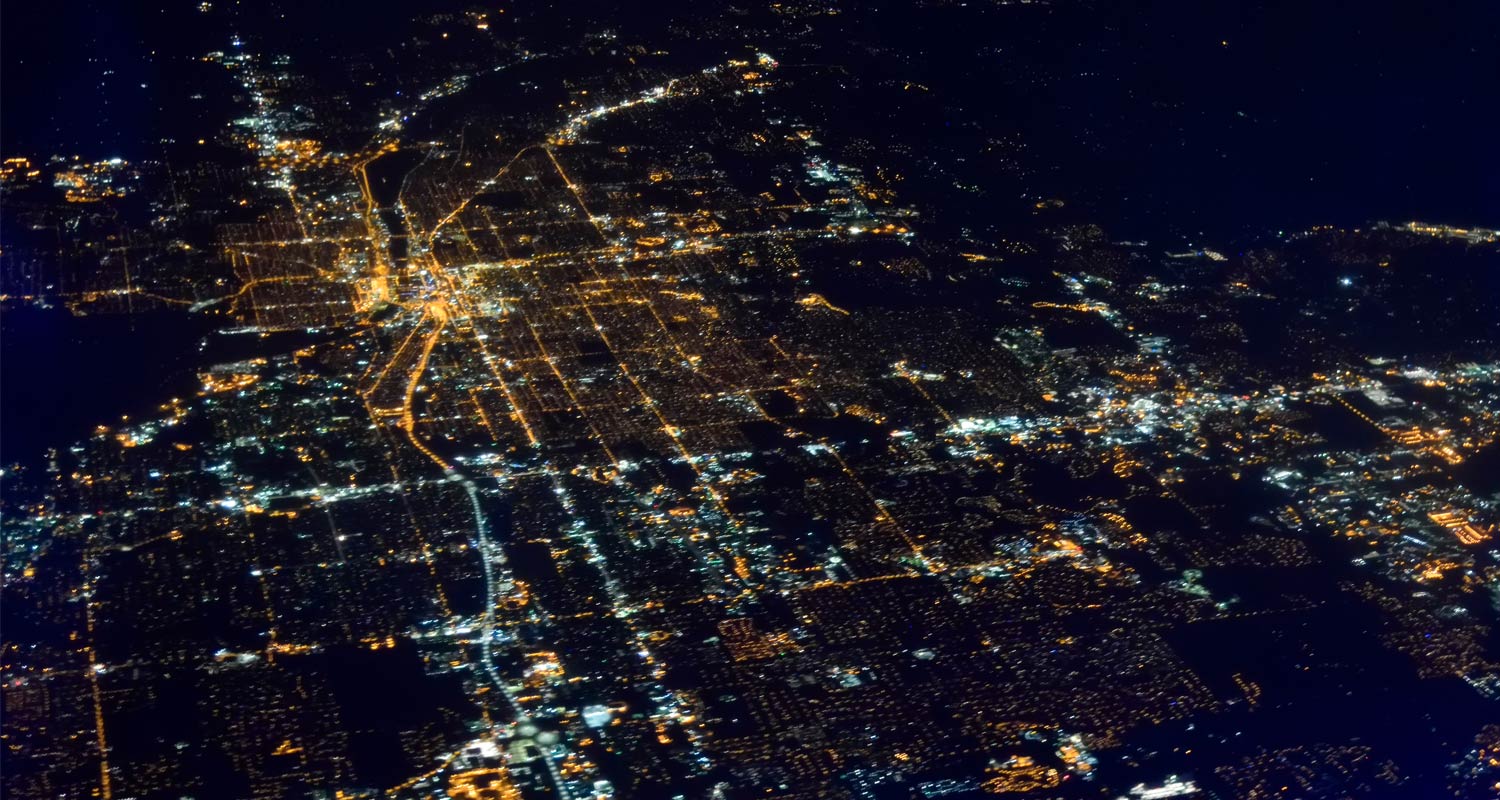
    earth at night

    “In Ukraine, we observed a sharp, sustained decrease in light that aligned perfectly with the escalation of the conflict in February 2022,” when Russia launched a large-scale invasion, Zhu said. “We see similar abrupt darkness falling over regions in the Middle East during periods of conflict.”

    Europe experienced a 4% net decrease in nighttime light radiance, largely due to technological advances and environmental policies.

    “It is driven by a widespread shift from older, less-efficient streetlights like high-pressure sodium lamps to newer, directional LED systems, as well as strict national energy-efficiency mandates and dark-sky conservation efforts,” Zhu said. “Europe is fascinating because it presents a very structured dimming pattern.”

    Light pollution has profound ecological consequences, disrupting nocturnal ecosystems…

    Zhu called France a world leader in dark-sky conservation and energy-efficiency mandates.

    Study co-author Christopher Kyba, a professor of nighttime light remote sensing at the Ruhr University Bochum in Germany, added: “The dimming in France that took place because of deliberate decisions to turn streetlights off late at night when there is no longer any activity on the streets is extraordinary. It will be very interesting to see how this develops over time, and whether this practice expands beyond France.”

    The US registered a 6% net light increase during the study period.

    ‘Microcosm’

    “Geographically, the US offers a microcosm of this global light complexity. The west coast largely brightened, consistent with population growth and vibrant tech economies. However, much of the east coast and midwest actually dimmed. This was driven by de-densification in older urban cores, the decline of certain manufacturing sectors, and aggressive adoption of smart, energy-efficient city lighting programmes like those in Washington, DC and Chicago,” Zhu said.

    Large-scale illumination began with gaslights in cities in the early 19th century, followed by electric lights later that century — and a relentless increase since. Cities and towns glow at night, obscuring most of the stars that once shone above.

    Read: Batteries to move to the centre of South Africa’s energy transition

    “Light pollution has profound ecological consequences, disrupting nocturnal ecosystems, animal migrations and human circadian rhythms,” Zhu said.  — Will Dunham, (c) 2026 Reuters

    Get breaking news from TechCentral on WhatsApp. Sign up here.

    Follow TechCentral on Google News Add TechCentral as your preferred source on Google


    earth at night
    WhatsApp YouTube
    Share. Facebook Twitter LinkedIn WhatsApp Telegram Email Copy Link
    Previous ArticleMajor boost for Starlink
    Next Article Why South Africa’s EV market is going nowhere slowly
    Company News
    Hospitality sector embraces Google Workspace and Gemini to cut admin - Digicloud Africa, Rand Data Systems

    Hospitality sector embraces Google Workspace and Gemini to cut admin

    30 April 2026
    Vodacom Business beefs up advisory board with three key appointments

    Vodacom Business beefs up advisory board with three key appointments

    29 April 2026
    What defines a top software development company today? BBD

    What defines a top software development company today?

    29 April 2026
    Opinion
    Free calls, dead voice and Shameel Joosub's Spanish ghost - Duncan McLeod

    Free calls, dead voice and Shameel Joosub’s Spanish ghost

    22 April 2026
    The conflict of interest at the heart of PayShap's slow adoption - Cheslyn Jacobs

    The conflict of interest at the heart of PayShap’s slow adoption

    26 March 2026
    South Africa's energy future hinges on getting wheeling right - Aishah Gire

    South Africa’s energy future hinges on getting wheeling right

    10 March 2026

    Subscribe to Updates

    Get the best South African technology news and analysis delivered to your e-mail inbox every morning.

    Latest Posts
    Logistics start-up Shiprazor pulls in R44-million seed round

    Logistics start-up Shiprazor pulls in R44-million seed round

    30 April 2026
    Why big IT projects in South Africa keep drifting off course

    Why big IT projects in South Africa keep drifting off course

    30 April 2026
    Hospitality sector embraces Google Workspace and Gemini to cut admin - Digicloud Africa, Rand Data Systems

    Hospitality sector embraces Google Workspace and Gemini to cut admin

    30 April 2026
    Memory-chip crisis to deepen further, Samsung warns

    Samsung sees no respite as memory shortage set to worsen

    30 April 2026
    © 2009 - 2026 NewsCentral Media
    • Cookie policy (ZA)
    • TechCentral – privacy and Popia

    Type above and press Enter to search. Press Esc to cancel.

    Manage consent

    TechCentral uses cookies to enhance its offerings. Consenting to these technologies allows us to serve you better. Not consenting or withdrawing consent may adversely affect certain features and functions of the website.

    Functional Always active
    The technical storage or access is strictly necessary for the legitimate purpose of enabling the use of a specific service explicitly requested by the subscriber or user, or for the sole purpose of carrying out the transmission of a communication over an electronic communications network.
    Preferences
    The technical storage or access is necessary for the legitimate purpose of storing preferences that are not requested by the subscriber or user.
    Statistics
    The technical storage or access that is used exclusively for statistical purposes. The technical storage or access that is used exclusively for anonymous statistical purposes. Without a subpoena, voluntary compliance on the part of your Internet Service Provider, or additional records from a third party, information stored or retrieved for this purpose alone cannot usually be used to identify you.
    Marketing
    The technical storage or access is required to create user profiles to send advertising, or to track the user on a website or across several websites for similar marketing purposes.
    • Manage options
    • Manage services
    • Manage {vendor_count} vendors
    • Read more about these purposes
    View preferences
    • {title}
    • {title}
    • {title}

