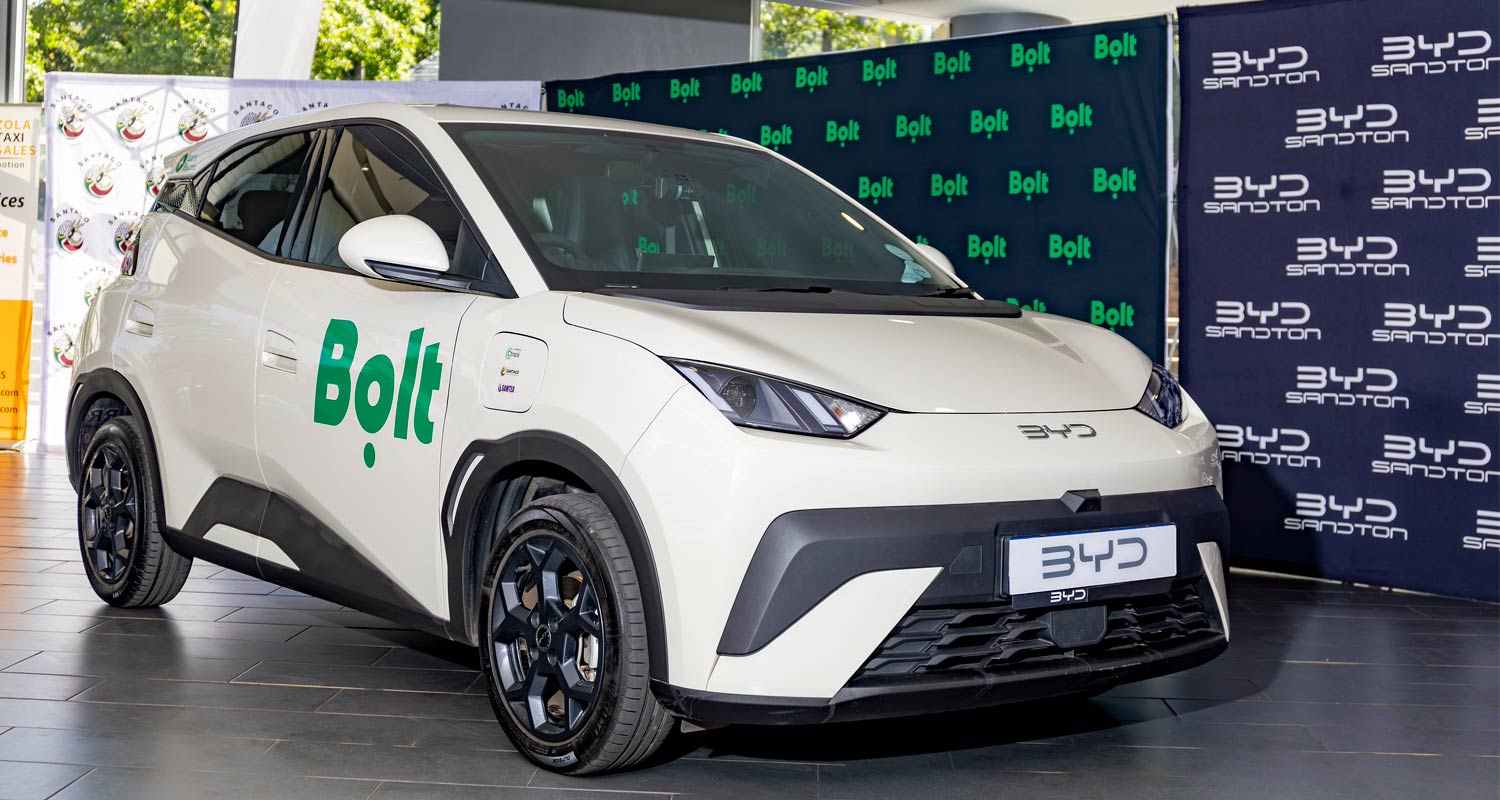
Bolt has extended its electric vehicle ride category to Johannesburg, five months after launching it in Cape Town, and the cars will be owned by an association that represents meter taxi and e-hailing operators.
The ride-hailing company said on Wednesday it was rolling out the service with the South African Meter Taxi and E-Hailing Association (Samtea), which it described as an affiliate of the South African National Taxi Council (Santaco), and BYD, along with unnamed “other industry stakeholders”. It is targeting 500 EVs in South Africa by December 2026.
Samtea “will own and manage the EV fleet operating on the Bolt platform”, Bolt spokeswoman Romaana Sutton told TechCentral. “The association will also invest in expanding the fleet over time, supporting the wider adoption of electric mobility and creating further opportunities for its members and drivers.” In Cape Town, fleet partner YugoRide supplies and manages the vehicles.
The Johannesburg cars are BYD Dolphin Surfs, which were launched locally in September 2025 from R339 900. The category is already running in Sandton, on routes to and from OR Tambo International Airport and in parts of Johannesburg East, and rides are “priced slightly above Bolt’s Standard category”, Sutton said.
Bolt would not say how many electric cars it has on the road. “We do not disclose fleet numbers by city, but the roll-out is being expanded in partnership with local fleet operators,” said Sutton.
Bolt, which started in South Africa as Taxify in 2016, said in May it had invested R3-billion in the country over the past decade. Sutton said drivers had earned more than R42.3-billion on the platform since 2016.
From enemies to partners
Samtea chairman Sibongiseni Shange acknowledged the history between the two sectors.
“There was a time when meter taxis and e-hailing were viewed as competitors, particularly as the market was disrupted and different parts of the sector responded in different ways. But through continued engagement, we have begun to find one another and recognise that many of the challenges facing the industry affect all of us, including our drivers,” said Shange.
Samtea itself is not new to Bolt. EWN reported in October 2025 that the association “represents Bolt, Teksi Ride and Shuma Ride”. In July 2025, when Samtea and Gauteng E-hailing Services joined forces to push for formalisation, Shange said of the two sectors: “Previously, we were known as enemies.”
The wider history is worse than “competitors” suggests. In 2016, a group of meter taxi drivers assaulted then Gauteng transport MEC Ismail Vadi after he announced that Uber drivers would be licensed. In 2017, meter taxi drivers blocked highways around OR Tambo International Airport in protest against Uber.

The hostility has not disappeared. In August 2025, two e-hailing drivers were shot at and their cars torched, and the taxi industry was suspected. Santaco denied involvement but committed in October 2025 to working “harmoniously” with e-hailing drivers, after the National Land Transport Amendment Act recognised e-hailing as a mode of public transport.
On Wednesday, Shange said: “For the sector to be more sustainable and offer stronger protections, operators need to be part of a formalised industry.”
Uber launched its electric service in Johannesburg in November 2025 with 70 cars from Valternative Energy and promised 350 by the end of January. By the end of March, it had more than 120. Uber declined to give TechCentral a current figure this month, but said the service is “currently available in Sandton and surrounding areas”. – © 2026 NewsCentral Media