
Close Menu
TechCentralTechCentral

    Subscribe to the newsletter

    Get the best South African technology news and analysis delivered to your e-mail inbox every morning.

    Facebook X (Twitter) YouTube LinkedIn
    WhatsApp Facebook X (Twitter) LinkedIn YouTube
    TechCentralTechCentral
    • News
      Nedbank hires MTN's former tech chief as group CIO - Nikos Angelopoulos

      Nedbank hires MTN’s former tech chief as group CIO

      31 July 2026
      Eskom's diesel bill falls 86% as breakdowns hit eight-year low

      Eskom’s diesel bill falls 86% as breakdowns hit eight-year low

      31 July 2026
      Ramaphosa signs off on taking the grid away from Eskom

      Ramaphosa signs off on taking the grid away from Eskom

      31 July 2026
      Microsoft just had the biggest day in stock market history

      Microsoft just had the biggest day in stock market history

      31 July 2026
      MTN Nigeria's growth engine stalled in second quarter - Karl Toriola

      MTN Nigeria’s growth engine stalled in second quarter

      31 July 2026
    • World
      Meta AI will now tell parents if their teen is in crisis

      Meta AI will now tell parents if their teen is in crisis

      17 July 2026
      IBM shares crash 25% as AI upends software spending - Arvind Krishna

      IBM shares crash 25% as AI upends software spending

      15 July 2026
      Jony Ive's first OpenAI device: an AI smart speaker - Jony Ive and Sam Altman

      Jony Ive’s first OpenAI device: an AI smart speaker

      15 July 2026
      Stripe, Advent in talks to buy PayPal for $53-billion

      Stripe, Advent in talks to buy PayPal for $53-billion

      15 July 2026
      Memory crisis sends smartphone market into steep decline

      Memory crisis sends smartphone market into steep decline

      13 July 2026
    • In-depth
      The plan to stop AI from breaking the world - Google DeepMind CEO Demis Hassabis. Image: John Sears

      The plan to stop AI from breaking the world

      16 July 2026
      The internet has a Strait of Hormuz problem

      The internet has a Strait of Hormuz problem

      15 July 2026
      AI boom sparks rally, frenzy and fear

      AI boom sparks rally, frenzy and fear

      11 June 2026
      Every plug-in hybrid on sale in South Africa, ranked by price - Lamborghini Temerario

      Every plug-in hybrid on sale in South Africa, ranked by price

      7 June 2026
      What Wi-Fi 8 will mean for wireless networks

      What Wi-Fi 8 will mean for wireless networks

      1 June 2026
    • TCS
      TCS+ | Why South African workers must become supervisors of digital labour - Accelera Digital Group Cliff de Wit

      TCS+ | Why South African workers must become supervisors of digital labour

      31 July 2026
      TCS | Rapid deployment rules can't work without municipalities: ACT - Nomvuyiso Batyi

      TCS | Icasa’s rules skip the real bottleneck: ACT

      30 July 2026
      TCS+ | iStore Business on why Apple makes sense for SMEs - Sudesh Pillay and Tamia Nontsikelelo

      TCS+ | iStore Business on why Apple makes sense for SMEs

      30 July 2026
      TCS+ | A smarter approach to cloud for South African businesses - Joel Chacko and Jonathan Oaker

      TCS+ | A smarter approach to cloud for South African businesses

      28 July 2026
      TCS | How Optasia lends billions to people banks can't see - Salvador Anglada

      TCS | How Optasia lends billions to people banks can’t see

      23 July 2026
    • Opinion
      The author, Jannie van Zyl

      Selling vapour is corporate suicide in slow motion

      16 July 2026
      Brazil's online gambling crackdown is a lesson for South Africa

      How Amazon outmanoeuvred Starlink in South Africa

      15 July 2026
      The Popia problem with agentic AI - Herman Haasbroek

      The Popia problem with agentic AI

      14 July 2026
      The author, Fanie van Rooyen

      South Africa can still catch the AI wave – here’s how

      7 July 2026
      The author, Fanie van Rooyen

      The AI utopia South Africa can’t afford

      1 July 2026
    • Company Hubs
      • 1Stream
      • Africa Data Centres
      • AfriGIS
      • Altron Digital Business
      • Altron Document Solutions
      • Altron Group
      • Arctic Wolf
      • Ascent Technology
      • AvertITD
      • BBD
      • Braintree
      • CallMiner
      • CambriLearn
      • CM Telecom
      • Contactable
      • CYBER1 Solutions
      • Digicloud Africa
      • Digimune
      • Domains.co.za
      • ESET
      • Euphoria Telecom
      • HOSTAFRICA
      • Incredible Business
      • iONLINE
      • IQbusiness
      • Iris Network Systems
      • Kaspersky
      • LSD Open
      • Mitel
      • NEC XON
      • Netstar
      • Network Platforms
      • Next DLP
      • Ovations
      • Paracon
      • Paratus
      • Q-KON
      • SevenC
      • SkyWire
      • Solid8 Technologies
      • Telit Cinterion
      • Telviva
      • Tenable
      • Vertiv
      • Videri Digital
      • Vodacom Business
      • Vox
      • Wipro
      • Workday
      • XLink
    • Sections
      • AI and machine learning
      • Banking
      • Broadcasting and Media
      • Cloud services
      • Contact centres and CX
      • Cryptocurrencies
      • Education and skills
      • Electronics and hardware
      • Energy and sustainability
      • Enterprise software
      • Financial services
      • HealthTech
      • Information security
      • Internet and connectivity
      • Internet of Things
      • Investment
      • IT services
      • Lifestyle
      • Policy and regulation
      • Public sector
      • Retail and e-commerce
      • Satellite communications
      • Science
      • SMEs and start-ups
      • Social media
      • Talent and leadership
      • Telecoms
      • Watts & Wheels
    • Events
    • Advertise
    TechCentralTechCentral
    Home » Sections » Internet and connectivity » Houthi-sunk ship likely snapped Red Sea internet cables

    Houthi-sunk ship likely snapped Red Sea internet cables

    The anchor of a cargo ship that was attacked by Houthi militants was the most likely cause of damage to three undersea cables.
    By Agency Staff7 March 2024
    Twitter LinkedIn Facebook WhatsApp Email Telegram Copy Link
    News Alerts
    WhatsApp
    Seacom’s Prenesh Padayachee

    The anchor of a cargo ship that was attacked by Houthi militants was the most likely cause of damage to three telecommunications cables in the Red Sea in late February, according to a subsea cable trade group that includes companies operating in the region.

    “It’s generally accepted that the Rubymar dropped an anchor when fired upon and as a result it damaged cables in proximity,” said Ryan Wopschall, GM of the International Cable Protection Committee, the group representing subsea cable operators.

    The Rubymar, a Belize-flagged commercial ship loaded with 41 000t of fertiliser, was hit by ballistic missiles in mid-February off the west coast of Yemen. Days later, the cables were damaged in the same area. The crew abandoned the 172m-long ship after dropping one of its anchors, and the vessel drifted for almost two weeks through an area of the Red Sea that’s densely populated with cables, before sinking on Saturday.

    An early report alleged that the cables were sabotaged by Houthi militants, without providing any evidence

    The Houthis have been attacking merchant and military ships in and around the southern Red Sea since mid-November, ostensibly in support of Hamas as it wages war against Israel in Gaza. The strikes have forced many merchant vessels to sail around Southern Africa instead of through the Red Sea and Suez Canal — sending freight rates soaring and raising concerns about the security of a network of underwater cables that help transmit data across the world. The Rubymar was the first ship the Houthis have sunk.

    Three out of more than a dozen cables that run through the Red Sea, a critical route for connecting Europe’s internet infrastructure to Asia’s, have been knocked offline as a result of the attacks: Seacom, AAE-1 and EIG. These cables carry about 25% of traffic in the region, according to estimates from Hong Kong-based internet provider HGC Global Communications, which uses the cables.

    Although the telecoms data that passes along the damaged cables has been rerouted, the incident highlights how vulnerable critical subsea infrastructure can be, particularly in relatively shallow waters with lots of cables.

    Repair challenges

    The location also poses significant challenges to the cable repair process, and operators are scrambling to determine what kind of insurance and security their maintenance companies require to work in a conflict zone. The Houthis have said they won’t stop attacking vessels until Israel stops fighting.

    An early report by Israeli news site Globes alleged that the cables were sabotaged by Houthi militants, without providing any supporting evidence. Representatives for the Houthi government, which is not recognised by the international community, have denied targeting the cables. On Tuesday, Mohammed Ali Al-Houthi, a member of the Houthi ruling political council, said on X that the US was responsible, without further explanation.

    Read: Seacom is down in the Red Sea

    Moammar al-Eryani, the minister of information, culture & tourism at Yemen’s internationally recognised government, said on Wednesday that even if the Houthis didn’t directly target the cables, they were to blame for the damage because of their “terrorist activities” in the Red Sea.

    Data from the Rubymar’s location tracking device before the ship lost power indicates that it travelled close to the cables that were damaged. “The anchor would have scraped along the sea floor as it drifted and damaged the cables,” said Roderick Beck, a consultant who sources network capacity on subsea cables for telecoms clients.
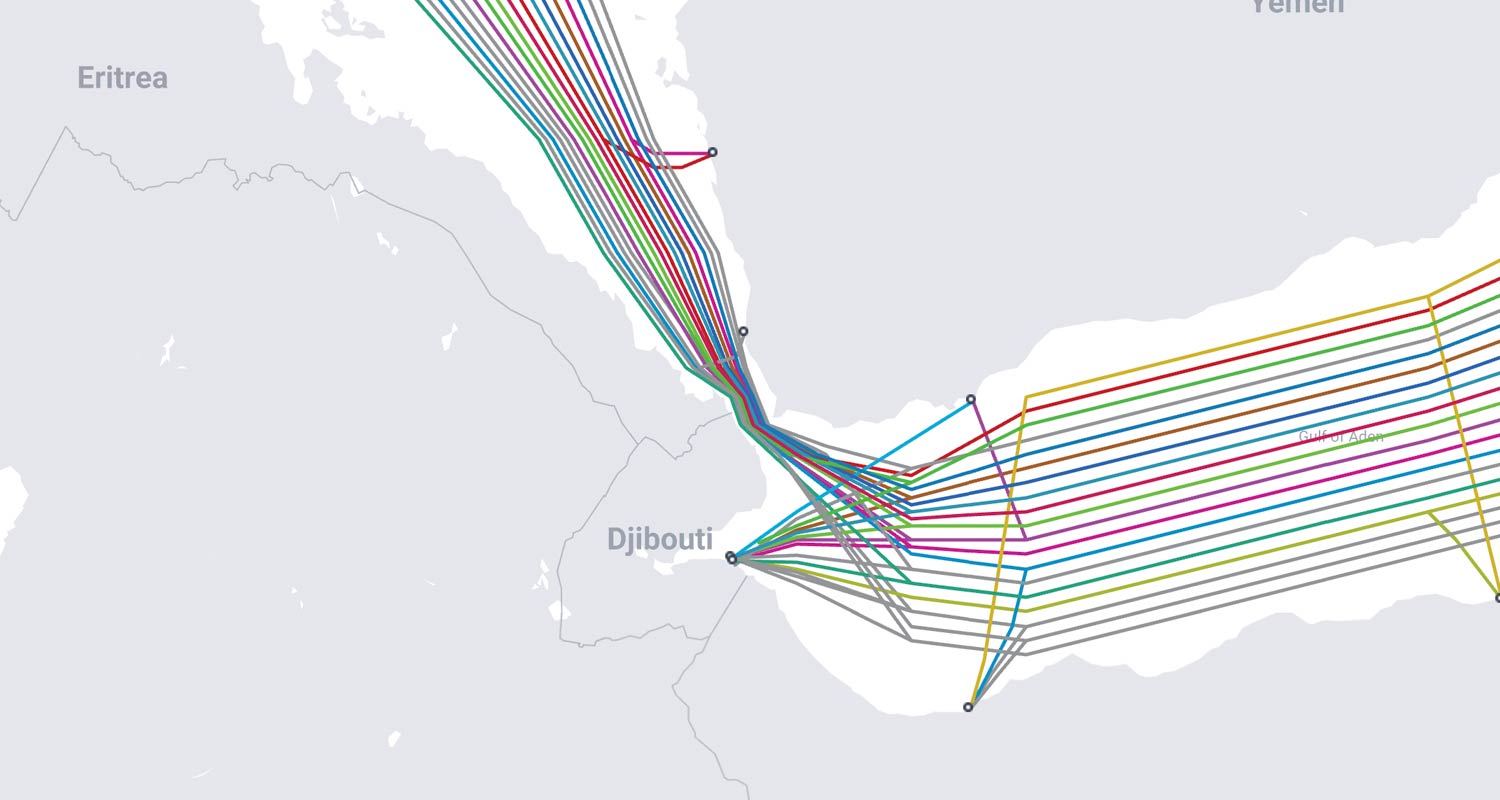
    Subsea cables are packed densely together in the Red Sea between Yemen and Djibouti. Image: TeleGeography

    Under normal circumstances, ships have access to maps of subsea cables and avoid dropping their anchors in those areas. There are 14 in-service cables running through the Red Sea, with a further six planned, according to TeleGeography, which maintains a comprehensive map of the infrastructure.

    Some reports have mentioned a fourth damaged cable, known as Tata TGN-Eurasia, but this is another name for the Seacom system, according to Tim Stronge, vice president of research at TeleGeography.

    Read: Fears of Red Sea attack on internet cables

    South Africa’s Seacom controls the Seacom cable and chief digital officer Prenesh Padayachee previously said the company couldn’t determine the cause of the damage until it had inspected it. But a dragged anchor seemed likely, he said.

    The company expects to start repairs “early during Q2”, but the schedule depends on getting a permit to work in Yemeni waters, Seacom said in a statement.  — Olivia Solon and Mohammed Hatem, with Sankalp Phartiyal, (c) 2024 Bloomberg LP

    Get breaking news alerts from TechCentral on WhatsApp

    Follow TechCentral on Google News Add TechCentral as your preferred source on Google


    Prenesh Padayachee Seacom Tim Stronge
    WhatsApp YouTube
    Share. Facebook Twitter LinkedIn WhatsApp Telegram Email Copy Link
    Previous ArticleCIPC system shutdown ‘not due to data breach’
    Next Article The EU is squaring up to Big Tech – and the fallout will be huge

    Related Posts

    South Africa's fibre underdogs are beating the giants

    South Africa’s fibre underdogs are beating the giants

    30 June 2026
    DDoS attacks expose South Africa's cyber response gap

    DDoS attacks expose South Africa’s cyber response gap

    24 May 2026
    Troubling questions over South African internet infrastructure attacks

    Troubling questions over South African internet infrastructure attacks

    19 May 2026
    Company News
    Domains.co.za launches self-hosted n8n VPS hosting

    Domains.co.za launches self-hosted n8n VPS hosting

    31 July 2026
    Smarter.tech '26 shows why smarter technology begins with context - Obsidian Systems

    Context is the missing piece in enterprise AI: Obsidian

    31 July 2026
    Huawei launches 12 intelligent transport solutions in South Africa - Sam Tang

    Huawei launches 12 intelligent transport solutions in South Africa

    30 July 2026
    Opinion
    The author, Jannie van Zyl

    Selling vapour is corporate suicide in slow motion

    16 July 2026
    Brazil's online gambling crackdown is a lesson for South Africa

    How Amazon outmanoeuvred Starlink in South Africa

    15 July 2026
    The Popia problem with agentic AI - Herman Haasbroek

    The Popia problem with agentic AI

    14 July 2026

    Subscribe to Updates

    Get the best South African technology news and analysis delivered to your e-mail inbox every morning.

    Latest Posts
    Nedbank hires MTN's former tech chief as group CIO - Nikos Angelopoulos

    Nedbank hires MTN’s former tech chief as group CIO

    31 July 2026
    Eskom's diesel bill falls 86% as breakdowns hit eight-year low

    Eskom’s diesel bill falls 86% as breakdowns hit eight-year low

    31 July 2026
    Ramaphosa signs off on taking the grid away from Eskom

    Ramaphosa signs off on taking the grid away from Eskom

    31 July 2026
    TCS+ | Why South African workers must become supervisors of digital labour - Accelera Digital Group Cliff de Wit

    TCS+ | Why South African workers must become supervisors of digital labour

    31 July 2026
    © 2009 - 2026 NewsCentral Media
    Built and maintained by Chronon
    • Cookie policy (ZA)
    • TechCentral – privacy and Popia

    Type above and press Enter to search. Press Esc to cancel.

    Manage consent

    TechCentral uses cookies to enhance its offerings. Consenting to these technologies allows us to serve you better. Not consenting or withdrawing consent may adversely affect certain features and functions of the website.

    Functional Always active
    The technical storage or access is strictly necessary for the legitimate purpose of enabling the use of a specific service explicitly requested by the subscriber or user, or for the sole purpose of carrying out the transmission of a communication over an electronic communications network.
    Preferences
    The technical storage or access is necessary for the legitimate purpose of storing preferences that are not requested by the subscriber or user.
    Statistics
    The technical storage or access that is used exclusively for statistical purposes. The technical storage or access that is used exclusively for anonymous statistical purposes. Without a subpoena, voluntary compliance on the part of your Internet Service Provider, or additional records from a third party, information stored or retrieved for this purpose alone cannot usually be used to identify you.
    Marketing
    The technical storage or access is required to create user profiles to send advertising, or to track the user on a website or across several websites for similar marketing purposes.
    • Manage options
    • Manage services
    • Manage {vendor_count} vendors
    • Read more about these purposes
    View preferences
    • {title}
    • {title}
    • {title}