Close Menu
TechCentralTechCentral

    Subscribe to the newsletter

    Get the best South African technology news and analysis delivered to your e-mail inbox every morning.

    Facebook X (Twitter) YouTube LinkedIn
    WhatsApp Facebook X (Twitter) LinkedIn YouTube
    TechCentralTechCentral
    • News
      Openserve launches its own ISP, rattling wholesale partners

      Openserve launches its own ISP, rattling wholesale partners

      13 July 2026
      Why eMedia's Openview Stream is skipping South Africa - for now - Khalik Sherrif

      Why eMedia’s Openview Stream is skipping South Africa – for now

      13 July 2026
      Trading rules near as Eskom tools up to compete - Dan Marokane

      Trading rules near as Eskom tools up to compete

      13 July 2026
      Memory crisis sends smartphone market into steep decline

      Memory crisis sends smartphone market into steep decline

      13 July 2026
      Meet the SA software house behind Pick n Pay's Penny - Iain Mackenzie

      Meet the SA software house behind Pick n Pay’s Penny

      13 July 2026
    • World
      Swingeing jobs cuts at Microsoft's Xbox unit

      Swingeing jobs cuts at Microsoft’s Xbox unit

      6 July 2026

      SK Hynix ends Samsung’s 26-year reign at the top

      22 June 2026
      Google on the hook for what its AI tells users, court rules

      Google on the hook for what its AI tells users, court rules

      15 June 2026
      How Russians juggle VPNs to outwit the Kremlin

      How Russians juggle VPNs to outwit the Kremlin

      15 June 2026
      Amazon CEO flagged Anthropic AI risks to Washington - Andy Jassy

      Amazon CEO flagged Anthropic AI risks to Washington

      14 June 2026
    • In-depth
      AI boom sparks rally, frenzy and fear

      AI boom sparks rally, frenzy and fear

      11 June 2026
      Every plug-in hybrid on sale in South Africa, ranked by price - Lamborghini Temerario

      Every plug-in hybrid on sale in South Africa, ranked by price

      7 June 2026
      What Wi-Fi 8 will mean for wireless networks

      What Wi-Fi 8 will mean for wireless networks

      1 June 2026
      Alfa's electric rebel - Alfa Romeo Junior Elettrica Veloce

      Alfa’s electric rebel

      29 April 2026
      Africa switches on as Europe dims the lights

      Africa switches on as Europe dims the lights

      9 April 2026
    • TCS
      Watts & Wheels S1E7: 'Ferrari's EV breaks the internet'

      Watts & Wheels S1E7: ‘Ferrari’s EV breaks the internet’

      8 July 2026
      TCS+ | How Tracker is turning vehicle data into business strategy - Silvia Schollenberger

      TCS+ | How Tracker is turning vehicle data into business strategy

      1 July 2026
      TCS+ | IBM Bob: an AI-powered 'development partner' for the enterprise - David Spurway

      TCS+ | IBM Bob: an AI-powered development partner for the enterprise

      30 June 2026
      Watts & Wheels S1E6: 'A flawless Alfa and a bakkie that divides'

      Watts & Wheels S1E6: ‘A flawless Alfa and a bakkie that divides’

      17 June 2026
      Watts & Wheels S1E6: 'A flawless Alfa and a bakkie that divides'

      Watts & Wheels S1E5: ‘A Bentley of the bush and a car that swims’

      8 June 2026
    • Opinion
      The author, Fanie van Rooyen

      South Africa can still catch the AI wave – here’s how

      7 July 2026
      The author, Fanie van Rooyen

      The AI utopia South Africa can’t afford

      1 July 2026
      The author, Jannie van Zyl

      South Africa’s broadband future is being decided in orbit, not in Pretoria

      30 June 2026
      The author, Pambos Soteriades

      The pivot South Africa’s MVNOs cannot afford to miss

      23 June 2026
      Brazil's online gambling crackdown is a lesson for South Africa

      Brazil’s online gambling crackdown is a lesson for South Africa

      22 June 2026
    • Company Hubs
      • 1Stream
      • Africa Data Centres
      • AfriGIS
      • Altron Digital Business
      • Altron Document Solutions
      • Altron Group
      • Arctic Wolf
      • Ascent Technology
      • AvertITD
      • BBD
      • Braintree
      • CallMiner
      • CambriLearn
      • CM Telecom
      • Contactable
      • CYBER1 Solutions
      • Digicloud Africa
      • Digimune
      • Domains.co.za
      • ESET
      • Euphoria Telecom
      • HOSTAFRICA
      • Incredible Business
      • iONLINE
      • IQbusiness
      • Iris Network Systems
      • Kaspersky
      • LSD Open
      • Mitel
      • NEC XON
      • Netstar
      • Network Platforms
      • Next DLP
      • Ovations
      • Paracon
      • Paratus
      • Q-KON
      • SevenC
      • SkyWire
      • Solid8 Technologies
      • Telit Cinterion
      • Telviva
      • Tenable
      • Vertiv
      • Videri Digital
      • Vodacom Business
      • Wipro
      • Workday
      • XLink
    • Sections
      • AI and machine learning
      • Banking
      • Broadcasting and Media
      • Cloud services
      • Contact centres and CX
      • Cryptocurrencies
      • Education and skills
      • Electronics and hardware
      • Energy and sustainability
      • Enterprise software
      • Financial services
      • HealthTech
      • Information security
      • Internet and connectivity
      • Internet of Things
      • Investment
      • IT services
      • Lifestyle
      • Policy and regulation
      • Public sector
      • Retail and e-commerce
      • Satellite communications
      • Science
      • SMEs and start-ups
      • Social media
      • Talent and leadership
      • Telecoms
      • Watts & Wheels
    • Events
    • Advertise
    TechCentralTechCentral
    Home » In-depth » Electric cars could change everything in SA

    Electric cars could change everything in SA

    By Dirk de Vos17 February 2017
    Twitter LinkedIn Facebook WhatsApp Email Telegram Copy Link
    News Alerts
    WhatsApp
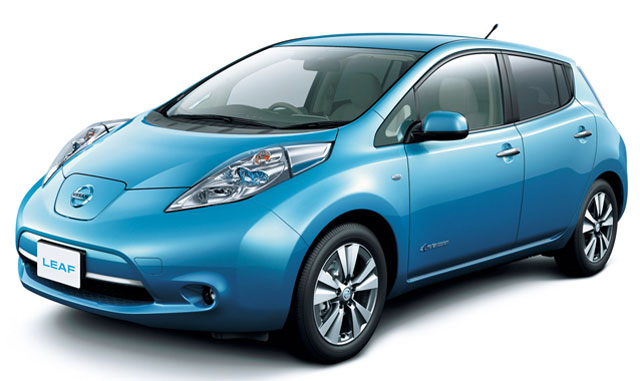
    Nissan Leaf EV

    South Africa’s energy planning revolves around two interrelated but separate processes, the Integrated Energy Plan (IEP) and the Integrated Resource Plan (IRP). The IEP covers all energy, including liquid fuels/transport and the IRP covers just electricity. Having failed to keep these plans properly updated as mandated, both the IEP and IRP are running in parallel. As one is supposed to feed into the other, this is probably not a good idea.

    Anyway, the department of energy has been running roadshows on draft plans and a recent update in parliament is that the department is now tabulating and responding to oral submissions and will release response reports by the end of March 2017. Further opportunities to provide input is scheduled to be completed in May or June with a final IEP and IRP being released in August or September. These documents will sketch out likely future scenarios which will inform what kind of investments need to be made over the next few years and decades.

    The energy system is huge and change happens at glacial speed. Small changes have tended to come from policy changes on a top-down basis. For a long time, this was the position of the telecommunications sector. But the introduction of the Internet protocol and cellphones upended everything. What is significant is that almost every innovation in telecoms over the last two decades has come from outside the industry and change has been driven in a bottom-up process. Regulators and state-owned incumbent operators have been forced to adapt to the immense changes that they had no part in bringing about.

    One energy scenario, which is unlikely to get much attention as it is still early days, is the impact of electricity storage. For now, batteries are a small detail in the electricity system. Almost all electricity storage today is in the form of pumped water storage such as the recently completed Ingula project. Things might change quite quickly. The price of lithium-ion batteries, using a set measure, has fallen by 70% since 2010 — from over US$1 000/kWh to around $350/kWh, but prices might drop to as low as $120 by 2030. The holy grail is to get prices below $100/kWh because then, storage starts to displace gas fired peakers that operate in times of peak demand.

    However, even before any of that happens, electric vehicles (EV) could have a profound effect on the whole energy system. The reason for this is that, purely on an energy consumption basis, cars are highly inefficient: a car is a lump of metal weighing a ton or more built to move, say, a 70kg human body (or a few of them) from A to B, but which can do so at high speeds (traffic permitting).

    Let’s then work out the existing EV value proposition because the basic building blocks, commercially available EVs, are already being sold. In South Africa, there are two pure EVs on sale: the Nissan Leaf and the BMW i3.

    The Leaf, the cheaper option, is the one with more mass market appeal. How then does it stack up to an internal combustion engine car? For the purposes of the exercise, let’s use a similarly sized Nissan equivalent, the Sentra. The model selected is a 1,8l petrol version (not available in this market). Any other mass market equivalent where data is widely available would serve the purposes of the comparison just as well:
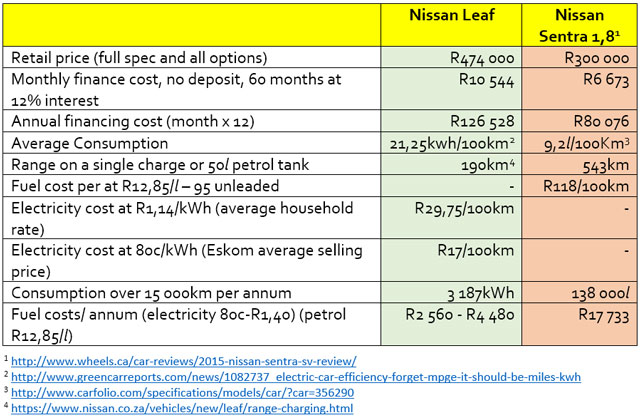
    Against a R300 000 car, the Leaf is still more expensive to own, but not by a big distance. Further, fully a quarter of the cost of the Leaf is in the battery and batteries are falling in price quicker than expected.

    The environmental benefit of driving a Leaf over an internal combustion engine car is the matter of some debate. Looking only at CO2 emissions, the Leaf would be using electricity generated by Eskom and Eskom with its low-grade coal dependence, is one of the dirtiest utilities around. Eskom’s own figures say that emitted 223MT per annum to generate 226 300GWh or 0,98kg/kWh. Then there are transmission/distribution losses along the way of 8,8%, so the final figure at the socket would be 1,06kg of CO2 per kilowatt-hour. The Leaf would, on this basis, be responsible for 22,52kg of CO2 emissions per 100km. The rough equivalent for internal combustion engines is about 2,3kg per litre. The Nissan Sentra would be emitting 21,06kg of CO2 per annum.
    Electric vehicles’ dirty little secret

    However, the CO2 calculation has a number of other variables. The mining of coal results in more CO2 but petrol has to be extracted in far-away places, it has to be transported, refined and then delivered to petrol stations and so on. In South Africa, a third of all petrol is derived from coal in a process that is also very CO2 intensive. Further, as we now know, Eskom has surplus generating capacity and therefore operates sub-optimally. Additional generation to charge EVs would likely reduce the CO2/kWh that Eskom generates. The increasing contribution of renewables in the mix will also see the CO2 emissions per kWh generated decline.

    Obviously, just a few EVs means little. But that could change quickly. Norway, which provides various subsidies and incentives for EVs, is now seeing full EVs and plug-in hybrids representing 37% of all new car sales. It is worth remembering that South Africa once underwent a big energy transition of sorts.

    Two apartheid era behemoths are the result of this transition. Sasol was formed in the 1950s using the Fischer-Tropsch process developed in Nazi Germany to convert coal into liquid fuels to reduce dependence on oil imports from an increasingly hostile world. Eskom’s massive power station build was also partially directed at converting all industrial processes that had used oil to electricity generated from coal mined from within the borders.

    According to e-Natis, the South African car population is 7 010 757 cars (65% of all vehicles) and 2 440 998 bakkies (22,6% of all vehicles). Naamsa, the vehicle industry body, says that between 35 000 and 43 000 cars are sold per month (say an average 39 000) and between 12 000 and 17 000 bakkies are sold per month (say an average 14 500). In a year, about 642 000 vehicles are sold. If we could get to where Norway is now and EV sales reached 30% of the total or just under 200 000 EVs per annum, then at the end of five years, there would be a million of them on our roads.

    This is where things become interesting: using the Nissan Leaf figures again, if a million EVs each use 3,2MWh/annum, then all of them together would be using 3,2TWh. This is significantly less than Eskom’s current surplus capacity, which could probably generate about 10TWh more per annum. Still, if EV drivers are paying Eskom 80c/kWh, Eskom will make more than R2,5bn/year more than it otherwise would do.
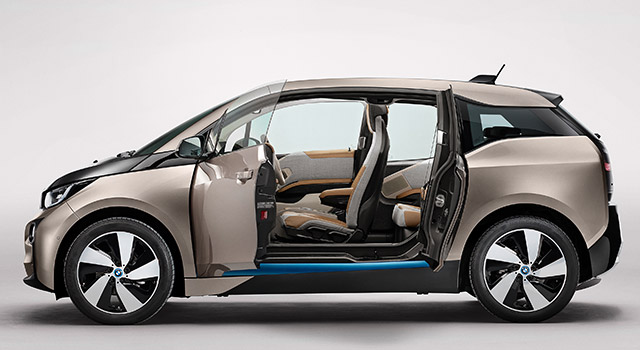
    BMW’s i3

    There would be another benefit. Fuel savings (using the Nissan Sentra again and assuming 15 000km/year) would be 1,38bn litres (one million x 9,2l/100km (0,092l/km) x 15 000km) or more than 10% of the 11,34bn litres of oil-based fuel that South Africa consumes every year. South Africa imports 21,3m metric tons of oil (or 156m barrels) per annum.

    A 1,38bn litres no longer required equates to 8,7m barrels of oil. At US$50/barrel, our forex savings would be $434m/year and at a R13,50/$ exchange rate would amount to almost R5,9bn. If other countries did this as well, the global oil market could not sustain itself. This would present some problems for national treasury though. Government taxes petrol at about R2,85/l so this would reduce the tax take by about R3,9bn/year.

    The potential benefits don’t end there. A new Nissan Leaf battery can supply 90kW of power instantly and store 30kWh. If a million EVs could be connected to the grid in some way, EV owners could sell grid management services to the grid. If all EVs were charged in off-peak times (in the middle of the night), there would be significant unused storage capacity waiting to be employed. Connecting EVs to the local grid would assist with peak shaving, load-shedding or frequency support. For this service, EV owners could be compensated. Once again, and in theory, a third of a million EVs configured in this was could provide 30GW of instantaneous power, which is just less than Eskom’s total capacity at any one time. Ingula, built at R36bn, can run all its generators to produce 1,3GW and can do so for about eight hours on weekdays (generating 10,7GWh/week). This capacity could be mirrored by 350 000 EVs connected to a smart grid. In the absence of a smart grid, EVs discharging power during peak times might be used to support huge investments in variable renewables.

    Of course, much of this appears to be far-fetched. It is not going to be part of any IEP and IRP scenarios processes. But it is also not pure fantasy because it does not require future technologies and the financial assumptions are not based on unrealistic future projections.

    There is another reason to give it another thought. It does not require too much top-down planning which is a feature of much of the electricity or energy systems anywhere. As EVs start to make sense on a pure financial basis, decisions to buy them are made by individuals deciding what is best for them. The potential benefits to society, the economy and the environment are mere by-products. Change is therefore bottom-up and that must be a more robust starting assumption than many other ideas about the transitions that will take place in our energy systems.

    • Dirk de Vos runs corporate finance and advisory firm QED Solutions, specialising in the ICT and energy sectors. Find him on Twitter
    • Read more pieces by De Vos
    Follow TechCentral on Google News Add TechCentral as your preferred source on Google


    BMW Dirk de Vos Eskom Nissan
    WhatsApp YouTube
    Share. Facebook Twitter LinkedIn WhatsApp Telegram Email Copy Link
    Previous ArticleBrian Molefe to become an ANC MP
    Next Article ‘Baby come back’: SpaceX launches supply rocket

    Related Posts

    Trading rules near as Eskom tools up to compete - Dan Marokane

    Trading rules near as Eskom tools up to compete

    13 July 2026
    Memo to Eskom: Telkom already lost this fight

    Memo to Eskom: Telkom already lost this fight

    8 July 2026
    R16-billion solar bet exposes South Africa's grid crisis

    R16-billion solar bet exposes South Africa’s grid crisis

    8 July 2026
    Company News
    Rain supercharges 5G with Huawei

    Rain supercharges 5G with Huawei

    10 July 2026
    Africa's data centres: AI, edge computing and new energy demands - Vertiv OADC Open Access Data Centres

    Africa’s data centres: AI, edge computing and new energy demands

    9 July 2026
    The best way to automate customer engagement using AI and WhatsApp - CM.com

    The best way to automate customer engagement using AI and WhatsApp

    9 July 2026
    Opinion
    The author, Fanie van Rooyen

    South Africa can still catch the AI wave – here’s how

    7 July 2026
    The author, Fanie van Rooyen

    The AI utopia South Africa can’t afford

    1 July 2026
    The author, Jannie van Zyl

    South Africa’s broadband future is being decided in orbit, not in Pretoria

    30 June 2026

    Subscribe to Updates

    Get the best South African technology news and analysis delivered to your e-mail inbox every morning.

    Latest Posts
    Openserve launches its own ISP, rattling wholesale partners

    Openserve launches its own ISP, rattling wholesale partners

    13 July 2026
    Why eMedia's Openview Stream is skipping South Africa - for now - Khalik Sherrif

    Why eMedia’s Openview Stream is skipping South Africa – for now

    13 July 2026
    Trading rules near as Eskom tools up to compete - Dan Marokane

    Trading rules near as Eskom tools up to compete

    13 July 2026
    Memory crisis sends smartphone market into steep decline

    Memory crisis sends smartphone market into steep decline

    13 July 2026
    © 2009 - 2026 NewsCentral Media
    Built and maintained by Chronon
    • Cookie policy (ZA)
    • TechCentral – privacy and Popia

    Type above and press Enter to search. Press Esc to cancel.

    Manage consent

    TechCentral uses cookies to enhance its offerings. Consenting to these technologies allows us to serve you better. Not consenting or withdrawing consent may adversely affect certain features and functions of the website.

    Functional Always active
    The technical storage or access is strictly necessary for the legitimate purpose of enabling the use of a specific service explicitly requested by the subscriber or user, or for the sole purpose of carrying out the transmission of a communication over an electronic communications network.
    Preferences
    The technical storage or access is necessary for the legitimate purpose of storing preferences that are not requested by the subscriber or user.
    Statistics
    The technical storage or access that is used exclusively for statistical purposes. The technical storage or access that is used exclusively for anonymous statistical purposes. Without a subpoena, voluntary compliance on the part of your Internet Service Provider, or additional records from a third party, information stored or retrieved for this purpose alone cannot usually be used to identify you.
    Marketing
    The technical storage or access is required to create user profiles to send advertising, or to track the user on a website or across several websites for similar marketing purposes.
    • Manage options
    • Manage services
    • Manage {vendor_count} vendors
    • Read more about these purposes
    View preferences
    • {title}
    • {title}
    • {title}