Close Menu
TechCentralTechCentral

    Subscribe to the newsletter

    Get the best South African technology news and analysis delivered to your e-mail inbox every morning.

    Facebook X (Twitter) YouTube LinkedIn
    WhatsApp Facebook X (Twitter) LinkedIn YouTube
    TechCentralTechCentral
    • News
      The missing number in Vodacom's annual report - Nkosana Makate please call me

      The missing number in Vodacom’s annual report

      12 June 2026
      How Sixty60 turned lockdown luck into a lasting lead

      How Sixty60 turned lockdown luck into a lasting lead

      12 June 2026
      SABC+ buckles as 477 000 fans pile in for Bafana opener

      SABC+ buckles as 477 000 fans pile in for Bafana opener

      12 June 2026
      The dizzying scale of Elon Musk's fortune

      The dizzying scale of Elon Musk’s fortune

      12 June 2026
      How a tiny SA team is using AI to challenge accounting's big boys - Tayla Dandridge stub

      How a tiny SA team is using AI to challenge accounting’s big boys

      12 June 2026
    • World
      Trouble at Xbox

      Trouble at Xbox

      11 June 2026
      Meta declares war on Israeli spyware firm

      Meta declares war on Israeli spyware firm

      8 June 2026
      Meta takes on OpenAI and Anthropic in enterprise AI

      Meta takes on OpenAI and Anthropic in enterprise AI

      4 June 2026
      AI demand sparks 'chipflation' warning

      AI demand sparks ‘chipflation’ warning

      4 June 2026
      Astronomers discover exoplanets with magnetic fields

      Strange winds reveal magnetic fields on distant ‘hot Jupiters’

      2 June 2026
    • In-depth
      AI boom sparks rally, frenzy and fear

      AI boom sparks rally, frenzy and fear

      11 June 2026
      Every plug-in hybrid on sale in South Africa, ranked by price - Lamborghini Temerario

      Every plug-in hybrid on sale in South Africa, ranked by price

      7 June 2026
      What Wi-Fi 8 will mean for wireless networks

      What Wi-Fi 8 will mean for wireless networks

      1 June 2026
      Alfa's electric rebel - Alfa Romeo Junior Elettrica Veloce

      Alfa’s electric rebel

      29 April 2026
      Africa switches on as Europe dims the lights

      Africa switches on as Europe dims the lights

      9 April 2026
    • TCS
      Watts & Wheels S1E5: 'A Bentley of the bush and a car that swims'

      Watts & Wheels S1E5: ‘A Bentley of the bush and a car that swims’

      8 June 2026
      TCS | Charge's R1.8-billion bet on an off-grid EV future - Charge chairman Joubert Roux

      TCS | Charge’s R1.8-billion bet on an off-grid EV future

      18 May 2026
      TCS+ | The Up&Up Group on the hidden cost of AI - Jason Harrison

      TCS+ | The Up&Up Group on the hidden cost of AI

      13 May 2026
      Michael Rossouw

      TCS+ | The retirement decision most South Africans get wrong

      6 May 2026
      TCS | The Cape Town start-up listening for TB with AI - Braden van Breda

      TCS | The Cape Town start-up listening for TB with AI

      4 May 2026
    • Opinion
      The clock is ticking on South African banks' biggest advantage - Pambos Soteriades

      The clock is ticking on South African banks’ biggest advantage

      9 June 2026

      Clashing judgments leave South Africa’s crypto law unsettled

      2 June 2026
      The clock is ticking on South African banks' biggest advantage - Pambos Soteriades

      The trap inside South Africa’s banking MVNO boom

      1 June 2026
      The hidden cost of social media age bans is everyone's privacy - Petrus Potgieter

      The hidden cost of social media age bans is everyone’s privacy

      29 May 2026
      Treasury's crypto crackdown is a betrayal of Mandela's promise - Duncan McLeod

      Treasury’s crypto crackdown is a betrayal of Mandela’s promise

      22 May 2026
    • Company Hubs
      • 1Stream
      • Africa Data Centres
      • AfriGIS
      • Altron Digital Business
      • Altron Document Solutions
      • Altron Group
      • Arctic Wolf
      • Ascent Technology
      • AvertITD
      • BBD
      • Braintree
      • CallMiner
      • CambriLearn
      • CM Telecom
      • Contactable
      • CYBER1 Solutions
      • Digicloud Africa
      • Digimune
      • Domains.co.za
      • ESET
      • Euphoria Telecom
      • HOSTAFRICA
      • Incredible Business
      • iONLINE
      • IQbusiness
      • Iris Network Systems
      • Kaspersky
      • LSD Open
      • Mitel
      • NEC XON
      • Netstar
      • Network Platforms
      • Next DLP
      • Ovations
      • Paracon
      • Paratus
      • Q-KON
      • SevenC
      • SkyWire
      • Solid8 Technologies
      • Telit Cinterion
      • Telviva
      • Tenable
      • Vertiv
      • Videri Digital
      • Vodacom Business
      • Wipro
      • Workday
      • XLink
    • Sections
      • AI and machine learning
      • Banking
      • Broadcasting and Media
      • Cloud services
      • Contact centres and CX
      • Cryptocurrencies
      • Education and skills
      • Electronics and hardware
      • Energy and sustainability
      • Enterprise software
      • Financial services
      • HealthTech
      • Information security
      • Internet and connectivity
      • Internet of Things
      • Investment
      • IT services
      • Lifestyle
      • Motoring
      • Policy and regulation
      • Public sector
      • Retail and e-commerce
      • Satellite communications
      • Science
      • SMEs and start-ups
      • Social media
      • Talent and leadership
      • Telecoms
    • Events
    • Advertise
    TechCentralTechCentral
    Home » Editor's pick » How the ancients invented the modern world

    How the ancients invented the modern world

    By The Conversation16 February 2016
    Twitter LinkedIn Facebook WhatsApp Email Telegram Copy Link
    News Alerts
    WhatsApp
    ancient-greek-computer-640
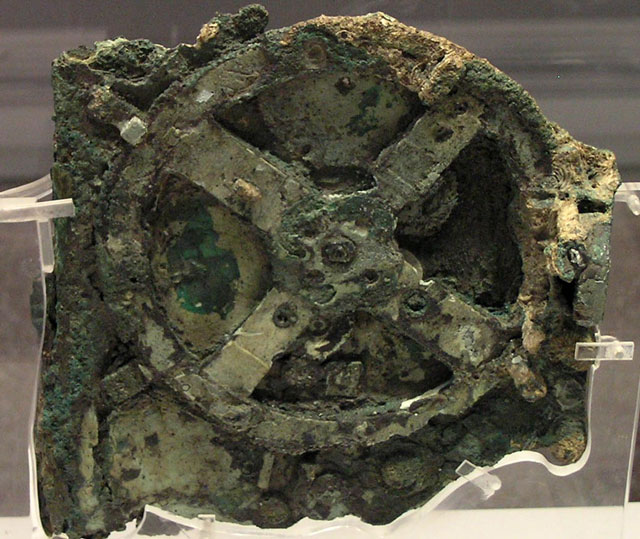
    Antikythera mechanism … possibly the world’s first analogue computer

    True innovation is hard to find, as few things come out of nothing. Take the now ubiquitous selfie, for example. The format may have changed, but the concept of making self-portraits is hundreds if not thousands of years old. The same is true of many inventions that we typically think of as modern, some of which actually have precedents dating back over a thousand years.
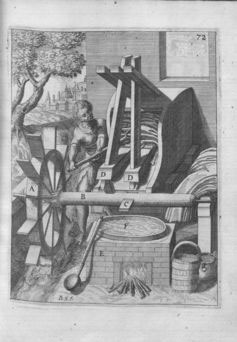
    Did the Romans have machines like this?
    Did the Romans have machines like this?

    A Roman washing machine

    “Fulling” was a major occupation in the Roman world that involved cleaning cloth by trampling it in tubs containing an alkaline solution, such as water and urine or the mineral known as fuller’s earth. But in ancient Antioch, in what is now Turkey, evidence suggests the process may have been mechanised, meaning the Romans may have effectively created the world’s first washing machine as far back as the 1st century AD.

    Traditionally thought of as a medieval invention, the mechanical fulling mill would likely have consisted of a waterwheel that lifted a trip-hammer, which would then drop to press the cloth. A fullers’ canal mentioned in an inscription in Antioch would have supplied an estimated 300 000m3 of water at almost a metre per second, far in excess of what was needed for regular foot-powered fulleries. The power this could generate means it could have supported fulling on an industrial scale with maybe 42 pairs of mechanical hammers.

    An ancient Greek computer

    In 1900, divers off the coast of the Greek island of Antikythera discovered something that changed our view of ancient science. The Antikythera mechanism is a bronze system of 30 gears that models the cycles of the sun and moon. It is effectively the first-known analogue computer, dating back to the 1st century BC. Set in a wooden box, the internal gears would have turned dials on the outside that showed the position of the sun and moon, as well as the rising and setting of specific stars and possibly the positions of Mars and Venus, too. Another dial could be moved to take into account leap years.

    Although we now know that the Babylonians discovered how to use geometry to track the course of Jupiter in around 1800 BC, the Antikythera mechanism is the earliest known device that automatically calculates astronomical phenomena. We know of no other similar devices for several hundred more years until the 8th century AD, when mathematician Muhammed al-Fazari is said to have built the first Islamic astrolabe. And nothing as mechanically sophisticated would appear again until the European astronomical clocks of the 14th century.
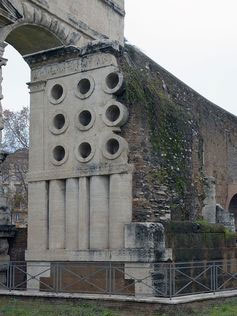
    Tomb of Eurysaces the Baker
    Tomb of Eurysaces the Baker

    The Great Roman Bake-Off

    Bread was big business in the Roman world. It was given out by the state as part of a dole known as the annona. This meant that it was possible for people to make substantial amounts of money as bakers. One such person was Marcus Vergilius Eurysaces, a freedman (ex-slave) from Rome, who was so proud of his successful baking business that he commemorated it on his tomb. Today it is one of the most striking monuments from ancient Rome.

    The top of the monument is decorated with a series of scenes that show a range of baking activities including the mixing and kneading of dough, the forming of loaves and the baked loaves being stacked in baskets. The most curious part, however, is the cylinders that make up the bulk of the monument. These features have baffled scholars for quite some time. One convincing theory argues that it is likely that these cylinders are related to baking and may well represent an early dough-mixing machine. The idea is that a rotating metal arm would have been attached to each cylinder in order to mix the dough.

    The first state space project

    Ninth-century Baghdad in what is now Iraq saw the rise of a growing scientific community, particularly in astronomy, centred on a library known as the House of Wisdom. The problem for these new scholars was that their books were written many centuries earlier and came from a wide range of different cultures — including Persian, Indian and Greek — that did not always agree. The Caliph al Ma’mun decided the only solution was to build an astronomical observatory so the city’s scholars could determine the truth.

    Observatories weren’t new but a state-sponsored scientific institution was. It’s hard to be sure exactly which instruments were used in the al-Shammasiyya observatory, but they probably included a sundial, astrolabes and a quadrant set on the wall to measure the precise position of objects in the sky. The quadrant may have been the first of its kind to be used in astronomical observations. The scientists used these instruments to reassess Ptolemy’s Mathematical Treatise from the 2nd century AD, and to make numerous astronomical observations, including the latitudes and longitudes of 24 fixed stars.The Conversation

    • Zena Kamash is lecturer in roman art and archaeology, Royal Holloway
    • This article was originally published on The Conversation

    Follow TechCentral on Google News Add TechCentral as your preferred source on Google


    WhatsApp YouTube
    Share. Facebook Twitter LinkedIn WhatsApp Telegram Email Copy Link
    Previous ArticleLeaked video shows off Samsung Galaxy S7
    Next Article Durban gets multi-site Internet exchange

    Related Posts

    The missing number in Vodacom's annual report - Nkosana Makate please call me

    The missing number in Vodacom’s annual report

    12 June 2026
    How Sixty60 turned lockdown luck into a lasting lead

    How Sixty60 turned lockdown luck into a lasting lead

    12 June 2026
    SABC+ buckles as 477 000 fans pile in for Bafana opener

    SABC+ buckles as 477 000 fans pile in for Bafana opener

    12 June 2026
    Company News
    When jammers kill the signal, AI goes blind too - Rory Atkinson Orange Logistics Sigfox South Africa

    When jammers kill the signal, AI goes blind too

    12 June 2026
    Workday Horizon shows SA firms how to make AI deliver - Kiv Moodley

    Workday Horizon shows SA firms how to make AI deliver

    12 June 2026
    Hisense, Makro team up for winter laundry promotion

    Hisense, Makro team up for winter laundry promotion

    12 June 2026
    Opinion
    The clock is ticking on South African banks' biggest advantage - Pambos Soteriades

    The clock is ticking on South African banks’ biggest advantage

    9 June 2026

    Clashing judgments leave South Africa’s crypto law unsettled

    2 June 2026
    The clock is ticking on South African banks' biggest advantage - Pambos Soteriades

    The trap inside South Africa’s banking MVNO boom

    1 June 2026

    Subscribe to Updates

    Get the best South African technology news and analysis delivered to your e-mail inbox every morning.

    Latest Posts
    The missing number in Vodacom's annual report - Nkosana Makate please call me

    The missing number in Vodacom’s annual report

    12 June 2026
    How Sixty60 turned lockdown luck into a lasting lead

    How Sixty60 turned lockdown luck into a lasting lead

    12 June 2026
    SABC+ buckles as 477 000 fans pile in for Bafana opener

    SABC+ buckles as 477 000 fans pile in for Bafana opener

    12 June 2026
    The dizzying scale of Elon Musk's fortune

    The dizzying scale of Elon Musk’s fortune

    12 June 2026
    © 2009 - 2026 NewsCentral Media
    • Cookie policy (ZA)
    • TechCentral – privacy and Popia

    Type above and press Enter to search. Press Esc to cancel.

    Manage consent

    TechCentral uses cookies to enhance its offerings. Consenting to these technologies allows us to serve you better. Not consenting or withdrawing consent may adversely affect certain features and functions of the website.

    Functional Always active
    The technical storage or access is strictly necessary for the legitimate purpose of enabling the use of a specific service explicitly requested by the subscriber or user, or for the sole purpose of carrying out the transmission of a communication over an electronic communications network.
    Preferences
    The technical storage or access is necessary for the legitimate purpose of storing preferences that are not requested by the subscriber or user.
    Statistics
    The technical storage or access that is used exclusively for statistical purposes. The technical storage or access that is used exclusively for anonymous statistical purposes. Without a subpoena, voluntary compliance on the part of your Internet Service Provider, or additional records from a third party, information stored or retrieved for this purpose alone cannot usually be used to identify you.
    Marketing
    The technical storage or access is required to create user profiles to send advertising, or to track the user on a website or across several websites for similar marketing purposes.
    • Manage options
    • Manage services
    • Manage {vendor_count} vendors
    • Read more about these purposes
    View preferences
    • {title}
    • {title}
    • {title}