Close Menu
TechCentralTechCentral

    Subscribe to the newsletter

    Get the best South African technology news and analysis delivered to your e-mail inbox every morning.

    Facebook X (Twitter) YouTube LinkedIn
    WhatsApp Facebook X (Twitter) LinkedIn YouTube
    TechCentralTechCentral
    • News
      A degree is no longer enough

      A degree is no longer enough

      3 July 2026
      South Africa's IoT opportunity is smaller than it looks - and already taken

      South Africa’s IoT opportunity is smaller than it looks – and already taken

      3 July 2026
      SA business grows even as optimism sinks to five-year low

      SA business grows even as optimism sinks to five-year low

      3 July 2026
      New rules on how operators can cut off your dormant Sim

      New rules on how operators can cut off your dormant Sim

      2 July 2026
      Meet Penny, Pick n Pay's new AI shopping companion

      Meet Penny, Pick n Pay’s new AI shopping companion

      2 July 2026
    • World

      SK Hynix ends Samsung’s 26-year reign at the top

      22 June 2026
      Google on the hook for what its AI tells users, court rules

      Google on the hook for what its AI tells users, court rules

      15 June 2026
      How Russians juggle VPNs to outwit the Kremlin

      How Russians juggle VPNs to outwit the Kremlin

      15 June 2026
      Amazon CEO flagged Anthropic AI risks to Washington - Andy Jassy

      Amazon CEO flagged Anthropic AI risks to Washington

      14 June 2026
      Trouble at Xbox

      Trouble at Xbox

      11 June 2026
    • In-depth
      AI boom sparks rally, frenzy and fear

      AI boom sparks rally, frenzy and fear

      11 June 2026
      Every plug-in hybrid on sale in South Africa, ranked by price - Lamborghini Temerario

      Every plug-in hybrid on sale in South Africa, ranked by price

      7 June 2026
      What Wi-Fi 8 will mean for wireless networks

      What Wi-Fi 8 will mean for wireless networks

      1 June 2026
      Alfa's electric rebel - Alfa Romeo Junior Elettrica Veloce

      Alfa’s electric rebel

      29 April 2026
      Africa switches on as Europe dims the lights

      Africa switches on as Europe dims the lights

      9 April 2026
    • TCS
      TCS+ | How Tracker is turning vehicle data into business strategy - Silvia Schollenberger

      TCS+ | How Tracker is turning vehicle data into business strategy

      1 July 2026
      TCS+ | IBM Bob: an AI-powered 'development partner' for the enterprise - David Spurway

      TCS+ | IBM Bob: an AI-powered development partner for the enterprise

      30 June 2026
      Watts & Wheels S1E6: 'A flawless Alfa and a bakkie that divides'

      Watts & Wheels S1E6: ‘A flawless Alfa and a bakkie that divides’

      17 June 2026
      Watts & Wheels S1E6: 'A flawless Alfa and a bakkie that divides'

      Watts & Wheels S1E5: ‘A Bentley of the bush and a car that swims’

      8 June 2026
      TCS | Charge's R1.8-billion bet on an off-grid EV future - Charge chairman Joubert Roux

      TCS | Charge’s R1.8-billion bet on an off-grid EV future

      18 May 2026
    • Opinion
      The author, Jannie van Zyl

      South Africa’s broadband future is being decided in orbit, not in Pretoria

      30 June 2026
      The author, Pambos Soteriades

      The pivot South Africa’s MVNOs cannot afford to miss

      23 June 2026
      Brazil's online gambling crackdown is a lesson for South Africa

      Brazil’s online gambling crackdown is a lesson for South Africa

      22 June 2026
      Finish the job Mandela started - Farzam Ehsani

      Finish the job Mandela started

      18 June 2026
      The author, Fanie van Rooyen

      The US just showed it can switch off our AI

      17 June 2026
    • Company Hubs
      • 1Stream
      • Africa Data Centres
      • AfriGIS
      • Altron Digital Business
      • Altron Document Solutions
      • Altron Group
      • Arctic Wolf
      • Ascent Technology
      • AvertITD
      • BBD
      • Braintree
      • CallMiner
      • CambriLearn
      • CM Telecom
      • Contactable
      • CYBER1 Solutions
      • Digicloud Africa
      • Digimune
      • Domains.co.za
      • ESET
      • Euphoria Telecom
      • HOSTAFRICA
      • Incredible Business
      • iONLINE
      • IQbusiness
      • Iris Network Systems
      • Kaspersky
      • LSD Open
      • Mitel
      • NEC XON
      • Netstar
      • Network Platforms
      • Next DLP
      • Ovations
      • Paracon
      • Paratus
      • Q-KON
      • SevenC
      • SkyWire
      • Solid8 Technologies
      • Telit Cinterion
      • Telviva
      • Tenable
      • Vertiv
      • Videri Digital
      • Vodacom Business
      • Wipro
      • Workday
      • XLink
    • Sections
      • AI and machine learning
      • Banking
      • Broadcasting and Media
      • Cloud services
      • Contact centres and CX
      • Cryptocurrencies
      • Education and skills
      • Electronics and hardware
      • Energy and sustainability
      • Enterprise software
      • Financial services
      • HealthTech
      • Information security
      • Internet and connectivity
      • Internet of Things
      • Investment
      • IT services
      • Lifestyle
      • Motoring
      • Policy and regulation
      • Public sector
      • Retail and e-commerce
      • Satellite communications
      • Science
      • SMEs and start-ups
      • Social media
      • Talent and leadership
      • Telecoms
    • Events
    • Advertise
    TechCentralTechCentral
    Home » In-depth » If a robot is conscious, is it okay to turn it off?

    If a robot is conscious, is it okay to turn it off?

    By The Conversation1 November 2020
    Twitter LinkedIn Facebook WhatsApp Email Telegram Copy Link
    News Alerts
    WhatsApp
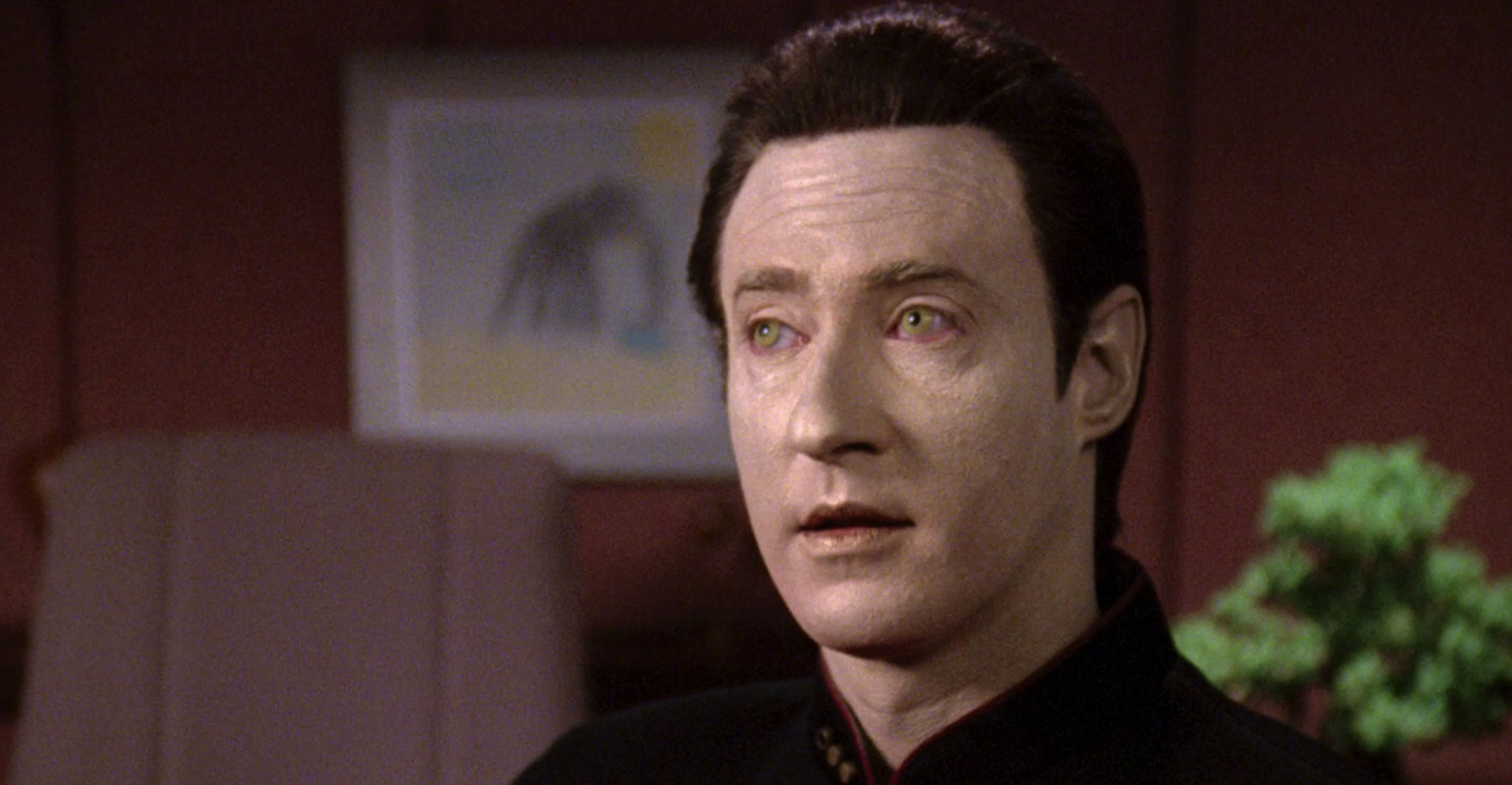
    Lieutenant-commander Data. Image: CBS

    In the Star Trek: The Next Generation episode The Measure of a Man, Data, an android crew member of the Enterprise, is to be dismantled for research purposes unless Captain Picard can argue that Data deserves the same rights as a human being. Naturally, the question arises: What is the basis upon which something has rights? What gives an entity moral standing?

    The philosopher Peter Singer argues that creatures that can feel pain or suffer have a claim to moral standing. He argues that nonhuman animals have moral standing, since they can feel pain and suffer. Limiting it to people would be a form of speciesism, something akin to racism and sexism.

    Without endorsing Singer’s line of reasoning, we might wonder if it can be extended further to an android robot like Data. It would require that Data can either feel pain or suffer. And how you answer that depends on how you understand consciousness and intelligence.

    As real artificial intelligence technology advances toward Hollywood’s imagined versions, the question of moral standing grows more important

    As real artificial intelligence technology advances toward Hollywood’s imagined versions, the question of moral standing grows more important. If AIs have moral standing, philosophers like me reason, it could follow that they have a right to life. That means you cannot simply dismantle them, and might also mean that people shouldn’t interfere with their pursuing their goals.

    IBM’s Deep Blue chess machine was successfully trained to beat grandmaster Gary Kasparov. But it could not do anything else. This computer had what’s called domain-specific intelligence.

    On the other hand, there’s the kind of intelligence that allows for the ability to do a variety of things well. It is called domain-general intelligence. It’s what lets people cook, ski and raise children – tasks that are related, but also very different.

    Artificial general intelligence

    Artificial general intelligence, AGI, is the term for machines that have domain-general intelligence. Arguably no machine has yet demonstrated that kind of intelligence. This summer, a start-up called OpenAI released a new version of its Generative Pre-Training language model. GPT-3 is a natural-language-processing system, trained to read and write so that it can be easily understood by people.

    It drew immediate notice, not just because of its impressive ability to mimic stylistic flourishes and put together plausible content, but also because of how far it had come from a previous version. Despite this impressive performance, GPT-3 doesn’t actually know anything beyond how to string words together in various ways. AGI remains quite far off.

    Named after pioneering AI researcher Alan Turing, the Turing test helps determine when an AI is intelligent. Can a person conversing with a hidden AI tell whether it’s an AI or a human being? If he can’t, then for all practical purposes, the AI is intelligent. But this test says nothing about whether the AI might be conscious.
    There are two parts to consciousness. First, there’s the what-it’s-like-for-me aspect of an experience, the sensory part of consciousness. Philosophers call this phenomenal consciousness. It’s about how you experience a phenomenon, like smelling a rose or feeling pain.

    In contrast, there’s also access consciousness. That’s the ability to report, reason, behave and act in a coordinated and responsive manner to stimuli based on goals. For example, when I pass the soccer ball to my friend making a play on the goal, I am responding to visual stimuli, acting from prior training, and pursuing a goal determined by the rules of the game. I make the pass automatically, without conscious deliberation, in the flow of the game.

    Blindsight nicely illustrates the difference between the two types of consciousness. Someone with this neurological condition might report, for example, that they cannot see anything in the left side of their visual field. But if asked to pick up a pen from an array of objects in the left side of their visual field, they can reliably do so. They cannot see the pen, yet they can pick it up when prompted – an example of access consciousness without phenomenal consciousness.

    Data is an android. How do these distinctions play out with respect to him?

    The Data dilemma

    Data demonstrates that he is self-aware in that he can monitor whether or not, for example, he is optimally charged or there is internal damage to his robotic arm.

    Data is also intelligent in the general sense. He does a lot of distinct things at a high level of mastery. He can fly the Enterprise, take orders from Captain Picard and reason with him about the best path to take.

    He can also play poker with his shipmates, cook, discuss topical issues with close friends, fight with enemies on alien planets and engage in various forms of physical labour. Data has access consciousness. He would clearly pass the Turing test.

    However, Data most likely lacks phenomenal consciousness — he does not, for example, delight in the scent of roses or experience pain. He embodies a supersized version of blindsight. He’s self-aware and has access consciousness – can grab the pen – but across all his senses he lacks phenomenal consciousness.

    What if suffering were also defined as the idea of being thwarted from pursuing a just cause without causing harm to others?

    Now, if Data doesn’t feel pain, at least one of the reasons Singer offers for giving a creature moral standing is not fulfilled. But Data might fulfil the other condition of being able to suffer, even without feeling pain. Suffering might not require phenomenal consciousness the way pain essentially does.

    For example, what if suffering were also defined as the idea of being thwarted from pursuing a just cause without causing harm to others? Suppose Data’s goal is to save his crewmate, but he can’t reach her because of damage to one of his limbs. Data’s reduction in functioning that keeps him from saving his crewmate is a kind of non-phenomenal suffering. He would have preferred to save the crewmate, and would be better off if he did.
    In the episode, the question ends up resting not on whether Data is self-aware – that is not in doubt. Nor is it in question whether he is intelligent – he easily demonstrates that he is in the general sense. What is unclear is whether he is phenomenally conscious. Data is not dismantled because, in the end, his human judges cannot agree on the significance of consciousness for moral standing.

    Data is kind – he acts to support the well-being of his crewmates and those he encounters on alien planets. He obeys orders from people and appears unlikely to harm them, and he seems to protect his own existence. For these reasons he appears peaceful and easier to accept into the realm of things that have moral standing.

    But what about Skynet in the Terminator movies? Or the worries recently expressed by Elon Musk about AI being more dangerous than nukes, and by Stephen Hawking on AI ending humankind?

    Big implications

    Human beings don’t lose their claim to moral standing just because they act against the interests of another person. In the same way, you can’t automatically say that just because an AI acts against the interests of humanity or another AI it doesn’t have moral standing. You might be justified in fighting back against an AI like Skynet, but that does not take away its moral standing. If moral standing is given in virtue of the capacity to non-phenomenally suffer, then Skynet and Data both get it even if only Data wants to help human beings.

    There are no artificial general intelligence machines yet. But now is the time to consider what it would take to grant them moral standing. How humanity chooses to answer the question of moral standing for nonbiological creatures will have big implications for how we deal with future AIs – whether kind and helpful like Data, or set on destruction, like Skynet.The Conversation

    • Written by Anand Vaidya, associate professor of philosophy, San José State University
    • This article is republished from The Conversation under a Creative Commons licence

    Follow TechCentral on Google News Add TechCentral as your preferred source on Google


    Anand Vaidya Elon Musk Peter Singer top
    WhatsApp YouTube
    Share. Facebook Twitter LinkedIn WhatsApp Telegram Email Copy Link
    Previous ArticleTencent’s Honour of Kings tops 100 million daily players
    Next Article RFI sheds light on SABC’s Internet streaming plans

    Related Posts

    The AI utopia South Africa can't afford

    The AI utopia South Africa can’t afford

    1 July 2026
    Tony Leon rejects 'state capture' label in Starlink lobbying row

    Tony Leon rejects ‘state capture’ label in Starlink lobbying row

    30 June 2026
    Icasa's blunt message to Starlink and other satellite operators

    Icasa’s blunt message to Starlink and other satellite operators

    29 June 2026
    Company News
    Mitel Workflow Studio wins global remote-work innovation award

    Mitel Workflow Studio wins global remote-work innovation award

    3 July 2026
    The data sovereignty rules African and EU firms can't ignore - BBD Software

    The data sovereignty rules African and EU firms can’t ignore

    2 July 2026
    Forget job losses - most firms haven't switched AI on yet - iqbusiness

    Forget job losses – most firms haven’t switched AI on yet

    2 July 2026
    Opinion
    The author, Jannie van Zyl

    South Africa’s broadband future is being decided in orbit, not in Pretoria

    30 June 2026
    The author, Pambos Soteriades

    The pivot South Africa’s MVNOs cannot afford to miss

    23 June 2026
    Brazil's online gambling crackdown is a lesson for South Africa

    Brazil’s online gambling crackdown is a lesson for South Africa

    22 June 2026

    Subscribe to Updates

    Get the best South African technology news and analysis delivered to your e-mail inbox every morning.

    Latest Posts
    Mitel Workflow Studio wins global remote-work innovation award

    Mitel Workflow Studio wins global remote-work innovation award

    3 July 2026
    A degree is no longer enough

    A degree is no longer enough

    3 July 2026
    South Africa's IoT opportunity is smaller than it looks - and already taken

    South Africa’s IoT opportunity is smaller than it looks – and already taken

    3 July 2026
    SA business grows even as optimism sinks to five-year low

    SA business grows even as optimism sinks to five-year low

    3 July 2026
    © 2009 - 2026 NewsCentral Media
    Built and maintained by Chronon
    • Cookie policy (ZA)
    • TechCentral – privacy and Popia

    Type above and press Enter to search. Press Esc to cancel.

    Manage consent

    TechCentral uses cookies to enhance its offerings. Consenting to these technologies allows us to serve you better. Not consenting or withdrawing consent may adversely affect certain features and functions of the website.

    Functional Always active
    The technical storage or access is strictly necessary for the legitimate purpose of enabling the use of a specific service explicitly requested by the subscriber or user, or for the sole purpose of carrying out the transmission of a communication over an electronic communications network.
    Preferences
    The technical storage or access is necessary for the legitimate purpose of storing preferences that are not requested by the subscriber or user.
    Statistics
    The technical storage or access that is used exclusively for statistical purposes. The technical storage or access that is used exclusively for anonymous statistical purposes. Without a subpoena, voluntary compliance on the part of your Internet Service Provider, or additional records from a third party, information stored or retrieved for this purpose alone cannot usually be used to identify you.
    Marketing
    The technical storage or access is required to create user profiles to send advertising, or to track the user on a website or across several websites for similar marketing purposes.
    • Manage options
    • Manage services
    • Manage {vendor_count} vendors
    • Read more about these purposes
    View preferences
    • {title}
    • {title}
    • {title}