 When Kevin Wood’s local utility started offering customers money in exchange for using less electricity, the father of one had a battle on his hands. Wood, who lives in Hampshire in southern England, was keen on realising savings while alleviating peak energy demand. But some things — like teenagers — are even harder to manage than maxed-out electricity grids.
“We tried saying, ‘Look, let’s not use your Xbox for an hour,’” Wood says. “[It worked] once. But we’ve agreed not to do that again.”
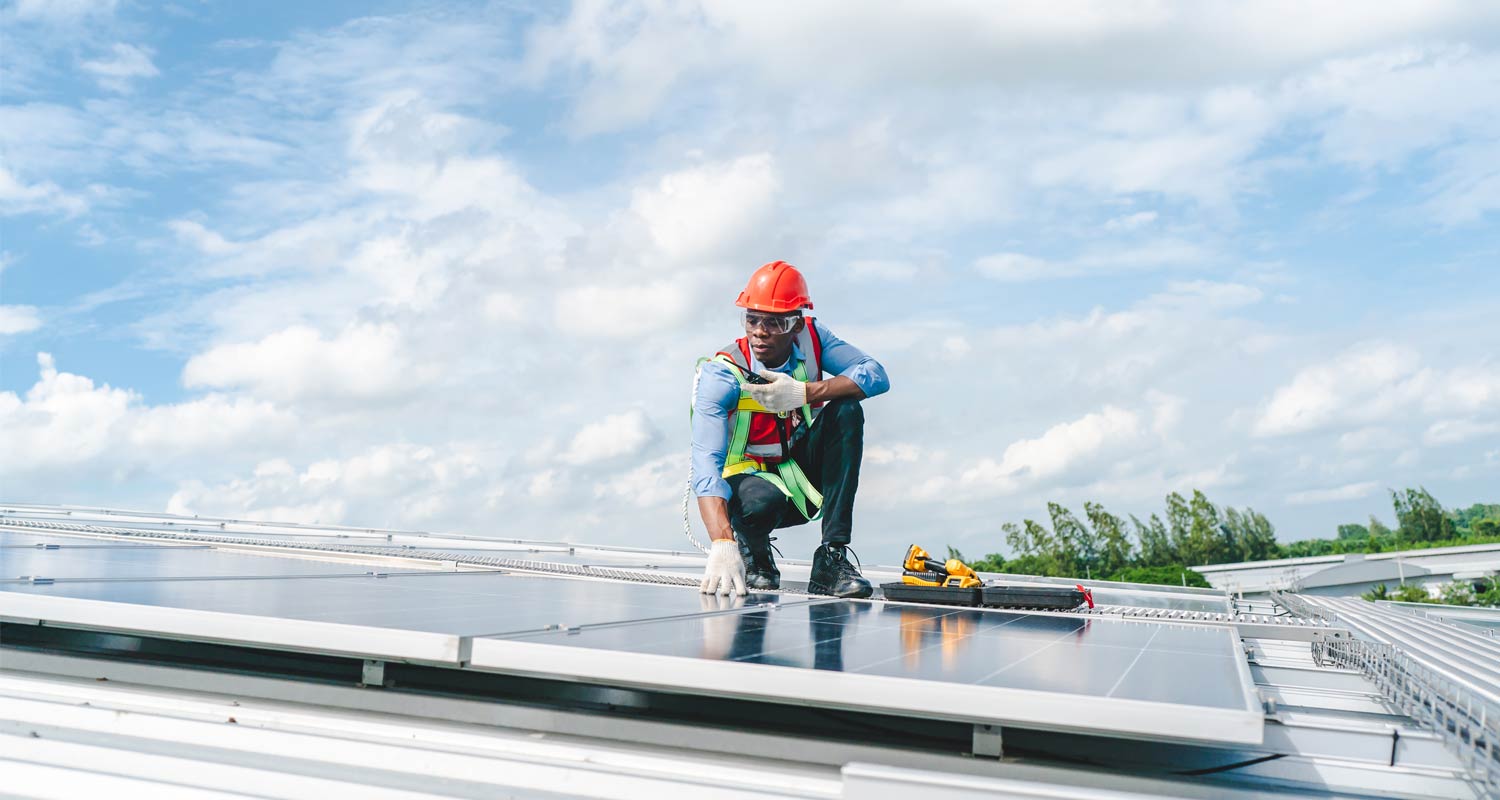
Diplomacy is just one part of Wood’s home-energy setup. He has solar panels, a battery and an electric car. A heat pump is next, once the gas boiler taps out. But installing all of that tech was just stage one — now Wood can’t stop paying attention to it. He tracks the cheapest time to use electricity and schedules his family’s washing, cooking and charging to match. “I am quite proud of the fact that I’m going to be net negative on my electricity,” Wood says. “I’m actually giving back.”
Wood is part of a new group of super-proactive, super-engaged electricity customers. Solar panels, home batteries and other energy-efficient devices are cheaper and more accessible than ever. Higher power bills are making everyone more aware of their electricity use, and utilities are passing on price signals in the form of cheaper rates when demand is low and pricier rates when demand is high. Together those factors are creating a new class of consumer: call them the home energy nerds. It’s a niche for now, but baked into the nerd experience are lessons for everyone, and for utilities.
The relationship between utility and customer is usually a one-way street: the utility offers a price, the consumer pays it and uses the energy supplied. But as power grids move away from fossil fuels, matching demand and supply is becoming more challenging. Utilities are pushing customers to optimise their energy use according to the grid’s needs and around periods of peak demand, while customers are starting to supplement the grid with devices that generate and store electricity at home.
Energy nerds
“The decisions and actions that people take as consumers have more impact on the energy system,” says Marie Claire Brisbois, a senior lecturer in energy policy at the University of Sussex.
So how do you make the leap from energy customer to energy nerd? Many people describe a small nudge — like shifting washing times to take advantage of cheaper power prices, or adding insulation to improve energy efficiency — as the first step. For John Smillie, 37, it was when his family’s old gas furnace broke down in 2018. Replacing it with a newer model spurred Smillie to also upgrade the windows and insulation in his Indiana home.
“That’s when I started thinking, ‘What are all the next steps here?’” he says. The family added a heat pump water heater and eventually a heat pump. By his calculation, their household carbon dioxide emissions dropped by almost 50% between 2022 and 2023, while their total energy usage is around a third of what it was.
Read: I went solar at home … this is what I learnt
Once the tech is installed, energy nerds say there’s no going back. Watching the free electricity flow into your house — and making optimal use of it — is nothing short of addictive. “If anybody says to you they get solar and then they just leave it I’d be amazed,” says Diane Patmore, a 50-year-old IT worker and mother of two from Northamptonshire in the UK. “I think certainly in the first couple of months, you’re obsessed.”
Technical know-how isn’t required; neither is much maths. For Chris Morgan, 35, a church operations manager in Durham in the north of England, three is the magic number — 3kW. That’s how much his home battery can discharge at any one time, so Morgan’s family of four tries to keep their energy consumption under that cap. They use the grid to charge the battery and their EV between 12.30am and 4.30am, when electricity is cheap. During the day, they try to use the stored energy instead of expensive peak-time power from their utility. Meanwhile, energy from the rooftop solar panels goes straight into the grid at a higher price than they paid for power overnight. Effectively, the family buys low and sells high.
 The main clash comes at dinnertime, which calls for both the electric kettle (3kW) and the electric oven (2kW). “Sometimes I’ll say, ‘Why don’t we just [let the kettle finish] before we put the oven on so we don’t have to import from the grid,” Morgan says.
Morgan’s nudge into home-energy obsession was getting a Nissan electric car in June 2021. “I hadn’t really ever considered how much energy I used before having an EV,” he says. “It wasn’t a thing that ever crossed my mind.”
Electric cars are the gateway for many energy nerds. For Robert Wehr, 62, who lives in a rural part of northern Germany, getting a Volkswagen e-Golf in 2020 led to solar panels, then a smart meter to track electricity use. He and his wife now think hard about when to charge their EV to take advantage of the free power the panels generate, and monitor other appliances almost as closely.
“You can always see the exact electricity consumption that you have at the moment,” Wehr says. “This leads to thoughts where you say, ‘Man, how should we go about using the dishwasher?’ You can suddenly see how much the kettle uses. It totally blows me away when you turn it on.”
In addition to saving consumers money — and piquing their curiosity — this small-scale version of what utilities call “load flexing” could be key to managing a more intermittent energy grid, says Mike Fell, a senior research fellow at the UCL Energy Institute in London. Optimising demand could also reduce the need to spend taxpayer dollars building out new power sources.
“Increasingly there has been the ability to offer new services and provide fine levels of control, which is attractive to a lot of people either to improve comfort or because it’s a kind of interesting thing to play with,” Fell says. “It can be quite empowering to people who’ve got the capability to engage with that.”
Online communities
Online communities of energy nerds have sprung up, offering a place to swap tips. In the UK, heat pump owners flock to a website called Heat Pump Monitor to compare their COP, or coefficient of performance. It’s essentially a measure of how many units of heat a heat pump is producing per unit of power going in — the higher the number, the more efficient the device. A 7kW Vaillant Arotherm+ heat pump in Mytchett, Surrey, is currently the leader in efficiency. With a COP of 4.6 averaged over the past year, it’s at the very top end of what manufacturers say users can expect.
Indeed, a big part of being an energy nerd is influencing others. Tom Bray, 35, started tracking his home energy usage after having a heat pump installed in 2021. It produces a COP of 3.4, which he’s happy with. It means he’s paying roughly the same as someone with a gas boiler, and his 19th-century home isn’t the easiest to heat. Three years ago, Bray started sharing his efficiency readings and details about his setup on a YouTube channel, where his most popular video (“How did our heat pump cope in a cold snap?”) has more than 100 000 views. He’s also become something of a local guru. Bray estimates he’s shown 20 neighbours his heat pump, and at least three have subsequently bought one themselves.
The final boss of home energy nerdery is automation. A computerised system can time power use down to the second based on pricing, time of day and user habits. It might be programmed to send cheap grid power to a plugged-in EV overnight, for example, or to fill a battery from solar panels once the homeowner drives to work, then release it to the kitchen at dinner time. A number of companies, including Tesla and Google, are starting to make a play for this space, promising to simplify home-energy management for consumers who have the gear but no interest in monitoring it. For now, though, home-energy automation is largely DIY, too.
It’s what Bram Claeys plans to focus on once he’s finished making his house more energy efficient, a process that includes putting in better insulation, adding more solar panels and installing ceiling fans to keep the house cooler in the summer. Claeys, 50, who lives with his wife and seven-year-old son south of Brussels, already has a heat pump, electric car and solar panels, but his old setup required someone to notice when it was sunny outside and then dash to plug in the car if they wanted to take advantage of the free electrons.
“Then some stupid clouds come sailing in and solar production goes down, but you keep on charging your car and draw a peak from the grid when you didn’t need to do that,” he says.
Claeys and his wife use four apps to manage everything — one for the car, one for the solar panels, one for the heat pump and one for the electricity meter. But he’s planning to buy a simple computer called a Raspberry Pi to streamline things. The new system will do the work for them: charging the car when the solar panels produce the most power or when energy from the grid is at its cheapest. “We are energy nerds,” Claeys says. “We both care a lot, but also for us, we have other things to do than just watch our apps.”
Sarah Chambers, a 52-year-old mother of three from south Wales, realised that her family could save a “substantial amount of money” by investing in a car charger, solar panels and a battery. Her next project is to set up a Home Assistant computer (also based on a Raspberry Pi) to automate the household energy flow. Chambers also opted into a pricing plan with her utility, Octopus Energy, that automatically sends power to her EV when prices are low. “Rather than some patronising company that’s telling you they feel sorry for you and things will get better, they actually empower you to think, ‘I can change this,’” she says.
Tinkerers
A limited number of people are going to monitor multiple apps and proactively change their behaviour, says Rebecca Dibb-Simkin, chief product officer at Octopus, which has embraced dynamic energy pricing. One of the options it offers to UK householders includes pricing that changes every half hour with the wholesale price of energy; other plans offer cheap energy at off-peak times, or payments for selling energy back to the grid at the peak.
Customers who opt into this kind of variable pricing tend to be wealthier, with the time and patience to tinker with their homes. But their tinkering holds valuable lessons, Dibb-Simkin says: it proves that homes can be a source of energy, and can use energy in a way that builds more flexibility into the grid.
“I’m not in the business of trying to save money for Tesla drivers,” she says. “I’m in the business of bringing down energy costs for everyone, but I can only do that by working with people who have the EVs and the hardware in the first place.”
Read: Eric Schmidt, Reed Hastings backing Africa solar start-up
Some energy nerds’ obsession is born of necessity. When dentist Sade Akiode moved back to Lagos, Nigeria after many years practicing in the US, she wanted to make sure she had a reliable home energy supply. Akiode’s initial setup included a petrol generator, dry-cell batteries and an inverter, which takes power from a generator or solar panels and converts it for home use. But the generator kept breaking down, so in 2020 she replaced it with solar panels and more durable lithium-ion batteries. To wean herself off what little grid energy she uses, Akiode is now switching out her air conditioners for models that can run on the inverter.
Akiode’s next step is to add a second inverter and more solar panels so that she can run her ACs and water pump completely off-grid. In a country like Nigeria, where the power supply is unreliable, more people should be turning to solar energy, she says. “Once you have your infrastructure in place to capture it, the sun energy is free.”
 Blackouts are also common in South Africa, where demand outstrips supply so often that Eskom, the publicly owned utility, implements load shedding for up to 12 hours a day. Paul Spencer, 75, lives in a village in the Western Cape, in a house with solar panels and a battery to carry him through the routine outages.
Spencer and his wife have an acute understanding of their appliances’ electricity use. The dryer, for example, is a no-no. “It actually trips the inverter, and then everything goes off,” he says. Spencer’s secret weapon is a smartphone app that allows him to monitor the house’s power use and quickly fill the battery, even remotely, if a last-minute outage is announced.
In South Africa, wealthier consumers like Spencer can afford home-energy tech, making them better equipped to cope with blackouts. (His setup cost R100 000 but would have cost more if his son hadn’t handled the installation.)
Much as the global energy system is unequal — 775 million people live without electricity, while others consume many times the global average — the shift to electric, decentralised power presents new equity challenges, says Matthew Hannon, a professor of sustainable energy business and policy at the University of Strathclyde in Scotland. Deciding when to use power hinges on flexibility that may not be available to those who are sick, or caring for young children or the elderly. And while solar panels, heat pumps and batteries allow their owners to unlock savings, they also cost money upfront.
“The big question is how do we level the playing field and make sure that people have equitable access to the benefits of this,” Hannon says. “As bill payers and as taxpayers, we’re all paying into this transformation. But some people are benefiting more from the smart revolution than others.” — Olivia Rudgard, with Yinka Ibukun, Carolynn Look and Paul Burkhardt, (c) 2024 Bloomberg LP
Get breaking news alerts from TechCentral on WhatsApp