Key takeaways
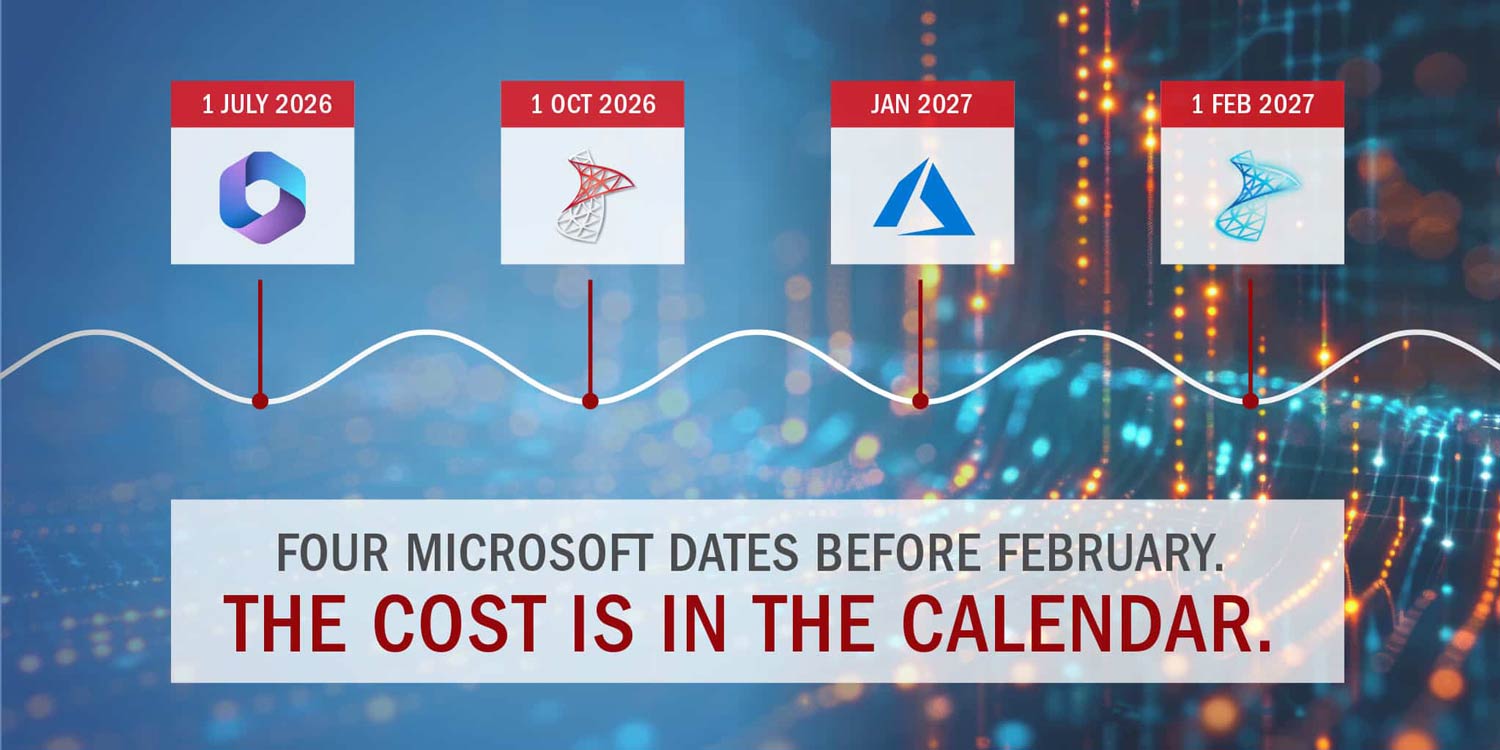
- Nothing will say price increase – Between July and February, four dated changes decide what the Microsoft estate will cost, through list pricing, billing cadence, currency policy and commitment rules. None of them arrives labelled as a cost.
- The pattern has a name – Commercial drift: an estate that grows more expensive with no new licences, no new users and no announcement on the invoice. The cost lives in how you buy, not what you buy.
- Every date forces a decision – Renewal timing, billing terms, currency budgeting and commitment structure each have a before and an after now. Defaulting is also a decision – the expensive one.
- The calendar is public – Microsoft publishes every one of these changes in advance, dated. The gap is not information. It is that in most organisations, nobody owns the reading of it.
The renewal was signed months ago. Nothing new has been bought since – no new users, no new licences, no project that added workloads. Yet the Microsoft line in next year’s budget is tracking higher, and nobody in the finance review can point to the announcement that did it. There is no announcement to point to.
We call this commercial drift: an estate repriced not only through its price list but through the machinery around it – the cadence it is billed on, the currency policy applied to it, the commitment instruments it sits in and where in the calendar its renewal happens to fall. Drift is not a vendor trick. Every change below was announced by Microsoft in advance, dated and published. It is a reading problem, and between now and February the reading is worth real money.
It is also, since this year, a governance matter. In August I argued that King V has made the board accountable for what the organisation buys as well as what it holds, and for the benefit that spend returns. What follows is that accountability applied to the Microsoft estate – date by date.
The calendar
1 July – the list moved, but it reaches you at renewal. Microsoft’s commercial price list rose in US dollar terms on 1 July: Office 365 E3 by 13%, Microsoft 365 E3 by 8%, E5 by 5% and the frontline and Business plans by as much as 43%, with new capability – Copilot Chat among it – packaged in alongside.
What makes this a calendar entry rather than history is how it lands. Existing customers keep their current pricing until renewal, so the increase arrives on each agreement’s own anniversary – quietly, months after the announcement everyone has forgotten.
An estate with several agreements renewing on different dates is carrying several price lists at once. The decision this forces is knowing which anniversary carries what – before the anniversary, not on it.
1 October – monthly billing acquires a price. From 1 October, annual-term software subscriptions bought through Microsoft’s Cloud Solution Provider channel – SQL Server, Windows Server, client access licences among them – carry a 5% cost-of-capital uplift when they are billed monthly. The uplift takes effect at renewal. Annual billing is untouched; so are month-to-month terms.
The decision is as plain as the rule. Where cash flow allows it, move annual commitments to annual billing. Where a renewal is approaching, decide deliberately on its billing terms before it arrives – a choice that exists only until the renewal date.
November – the rand gets one date a year. In November, Microsoft issues the first notice under its new Commercial Cloud currency policy: a single local-currency adjustment each January, replacing the twice-yearly review, with the notice arriving two months ahead. Microsoft frames the change as predictability, and it is – one dated, budgetable event instead of a rolling uncertainty.
What the rand number will be, the November notice decides. The decision on this side of it is to treat the notice as a budget input with a deadline – read the day it lands, priced into the financial-year plan, not filed as correspondence.
1 February – the exchange window closes. On 1 February, Azure reservation exchanges end for services covered by savings plans. Reservations bought before that date keep one final exchange. Reservations themselves are going nowhere – Microsoft still positions them for stable, predictable workloads; what ends is the right to swap them. And for database workloads the flexible alternative already exists – one-year savings plans, at up to 35% off pay-as-you-go rates.
So the decision here is a review of every reservation on the books while the exchange right still exists, and a deliberate choice of commitment instrument for the year ahead rather than an inherited one.
The fifth entry
There is a fifth entry on the calendar, and it has no date because it is always open: utilisation.
Before any renewal, the estate’s actual use deserves the same reading as the price files. Which Microsoft 365 and Copilot seats have been active in the past quarter. Which are assigned and silent. Which subscriptions exist because a project needed them in 2023. I have yet to review an estate where the assigned count matched the active count – and an unused seat renewed onto the new list price is drift in its purest form, a cost with no announcement and no user.
This is not an argument against the tools. It is an argument for renewing what the organisation actually uses, and for sending the measured number into the negotiation instead of the licence count.
How Ascent delivers
Reading this calendar is what a Cloud Solution Provider relationship is for – or should be for. Too many CSP conversations stay at the level of licences and price; the better question is whether the partner behind the agreement reads the machinery on your behalf.
Ascent Technology is a Microsoft Direct CSP Partner, and Ascent’s Microsoft CSP carries licensing, Azure consumption, consolidated billing and partner-led support under one accountable relationship. In practice that means the calendar above is read for each client before its dates arrive: renewal anniversaries mapped against the July list, billing terms restructured ahead of each renewal, the November notice translated into a rand budget line, reservations reviewed before the February window closes and utilisation measured before anything is renewed.
Microsoft has built the instruments – annual billing, savings plans, a predictable currency date. Ascent’s job is to make sure they are used in the client’s favour.
The Microsoft CSP model is independent of Ascent’s consulting and managed services – neither requires the other – but the combination is where the value is strongest, because the partner reading the invoice also understands the architecture underneath it. That is the discipline we call Cheaper and Better, and it is not a slogan. It is cost discipline without quality compromise, applied to a commercial relationship.
Contact us
Contact Ascent Technology to put your Microsoft renewal calendar on one page before your next renewal – which anniversaries carry the July list, which subscriptions face the billing uplift, what the November notice should mean for your rand budget, and which reservations to review before the exchange window closes.
One working session, on your own agreements.
Also see
> Microsoft Cloud Solution Provider (CSP)
> Support Ended for SQL Server 2016. So Did the Microsoft Subsidy.
> The Board Now Owns the Database
- The author, Johan Lamberts, is MD at Ascent Technology
- Read more articles by Ascent Technology on TechCentral
- This promoted content was paid for by the party concerned