
Close Menu
TechCentralTechCentral

    Subscribe to the newsletter

    Get the best South African technology news and analysis delivered to your e-mail inbox every morning.

    Facebook X (Twitter) YouTube LinkedIn
    WhatsApp Facebook X (Twitter) LinkedIn YouTube
    TechCentralTechCentral
    • News
      Nedbank hires MTN's former tech chief as group CIO - Nikos Angelopoulos

      Nedbank hires MTN’s former tech chief as group CIO

      31 July 2026
      Eskom's diesel bill falls 86% as breakdowns hit eight-year low

      Eskom’s diesel bill falls 86% as breakdowns hit eight-year low

      31 July 2026
      Ramaphosa signs off on taking the grid away from Eskom

      Ramaphosa signs off on taking the grid away from Eskom

      31 July 2026
      Microsoft just had the biggest day in stock market history

      Microsoft just had the biggest day in stock market history

      31 July 2026
      MTN Nigeria's growth engine stalled in second quarter - Karl Toriola

      MTN Nigeria’s growth engine stalled in second quarter

      31 July 2026
    • World
      Meta AI will now tell parents if their teen is in crisis

      Meta AI will now tell parents if their teen is in crisis

      17 July 2026
      IBM shares crash 25% as AI upends software spending - Arvind Krishna

      IBM shares crash 25% as AI upends software spending

      15 July 2026
      Jony Ive's first OpenAI device: an AI smart speaker - Jony Ive and Sam Altman

      Jony Ive’s first OpenAI device: an AI smart speaker

      15 July 2026
      Stripe, Advent in talks to buy PayPal for $53-billion

      Stripe, Advent in talks to buy PayPal for $53-billion

      15 July 2026
      Memory crisis sends smartphone market into steep decline

      Memory crisis sends smartphone market into steep decline

      13 July 2026
    • In-depth
      The plan to stop AI from breaking the world - Google DeepMind CEO Demis Hassabis. Image: John Sears

      The plan to stop AI from breaking the world

      16 July 2026
      The internet has a Strait of Hormuz problem

      The internet has a Strait of Hormuz problem

      15 July 2026
      AI boom sparks rally, frenzy and fear

      AI boom sparks rally, frenzy and fear

      11 June 2026
      Every plug-in hybrid on sale in South Africa, ranked by price - Lamborghini Temerario

      Every plug-in hybrid on sale in South Africa, ranked by price

      7 June 2026
      What Wi-Fi 8 will mean for wireless networks

      What Wi-Fi 8 will mean for wireless networks

      1 June 2026
    • TCS
      TCS+ | Why South African workers must become supervisors of digital labour - Accelera Digital Group Cliff de Wit

      TCS+ | Why South African workers must become supervisors of digital labour

      31 July 2026
      TCS | Rapid deployment rules can't work without municipalities: ACT - Nomvuyiso Batyi

      TCS | Icasa’s rules skip the real bottleneck: ACT

      30 July 2026
      TCS+ | iStore Business on why Apple makes sense for SMEs - Sudesh Pillay and Tamia Nontsikelelo

      TCS+ | iStore Business on why Apple makes sense for SMEs

      30 July 2026
      TCS+ | A smarter approach to cloud for South African businesses - Joel Chacko and Jonathan Oaker

      TCS+ | A smarter approach to cloud for South African businesses

      28 July 2026
      TCS | How Optasia lends billions to people banks can't see - Salvador Anglada

      TCS | How Optasia lends billions to people banks can’t see

      23 July 2026
    • Opinion
      The author, Jannie van Zyl

      Selling vapour is corporate suicide in slow motion

      16 July 2026
      Brazil's online gambling crackdown is a lesson for South Africa

      How Amazon outmanoeuvred Starlink in South Africa

      15 July 2026
      The Popia problem with agentic AI - Herman Haasbroek

      The Popia problem with agentic AI

      14 July 2026
      The author, Fanie van Rooyen

      South Africa can still catch the AI wave – here’s how

      7 July 2026
      The author, Fanie van Rooyen

      The AI utopia South Africa can’t afford

      1 July 2026
    • Company Hubs
      • 1Stream
      • Africa Data Centres
      • AfriGIS
      • Altron Digital Business
      • Altron Document Solutions
      • Altron Group
      • Arctic Wolf
      • Ascent Technology
      • AvertITD
      • BBD
      • Braintree
      • CallMiner
      • CambriLearn
      • CM Telecom
      • Contactable
      • CYBER1 Solutions
      • Digicloud Africa
      • Digimune
      • Domains.co.za
      • ESET
      • Euphoria Telecom
      • HOSTAFRICA
      • Incredible Business
      • iONLINE
      • IQbusiness
      • Iris Network Systems
      • Kaspersky
      • LSD Open
      • Mitel
      • NEC XON
      • Netstar
      • Network Platforms
      • Next DLP
      • Ovations
      • Paracon
      • Paratus
      • Q-KON
      • SevenC
      • SkyWire
      • Solid8 Technologies
      • Telit Cinterion
      • Telviva
      • Tenable
      • Vertiv
      • Videri Digital
      • Vodacom Business
      • Vox
      • Wipro
      • Workday
      • XLink
    • Sections
      • AI and machine learning
      • Banking
      • Broadcasting and Media
      • Cloud services
      • Contact centres and CX
      • Cryptocurrencies
      • Education and skills
      • Electronics and hardware
      • Energy and sustainability
      • Enterprise software
      • Financial services
      • HealthTech
      • Information security
      • Internet and connectivity
      • Internet of Things
      • Investment
      • IT services
      • Lifestyle
      • Policy and regulation
      • Public sector
      • Retail and e-commerce
      • Satellite communications
      • Science
      • SMEs and start-ups
      • Social media
      • Talent and leadership
      • Telecoms
      • Watts & Wheels
    • Events
    • Advertise
    TechCentralTechCentral
    Home » Sections » Enterprise software » Modernising legacy systems – without the downtime

    Modernising legacy systems – without the downtime

    Promoted | Unlock speed, scalability and innovation through smart, low-risk legacy system modernisation.
    By BBD9 April 2026
    Twitter LinkedIn Facebook WhatsApp Email Telegram Copy Link
    News Alerts
    WhatsApp

    Modernising legacy systems - without the downtime - BBD Software

    Across industries, critical operations still run on longstanding platforms. Core banking engines, policy administration systems, trade platforms and public sector registries continue to process transactions reliably, underpin compliance and hold decades of institutional knowledge. They work. And that is precisely the challenge.

    A legacy system can continue performing its core function while quietly constraining innovation, scalability, integration and customer experience. Organisations recognise the need to modernise to remain competitive, yet the operational risk of disruption makes transformation feel dangerous. Revenue, regulatory compliance and customer trust depend on continuity. Downtime is rarely an option.

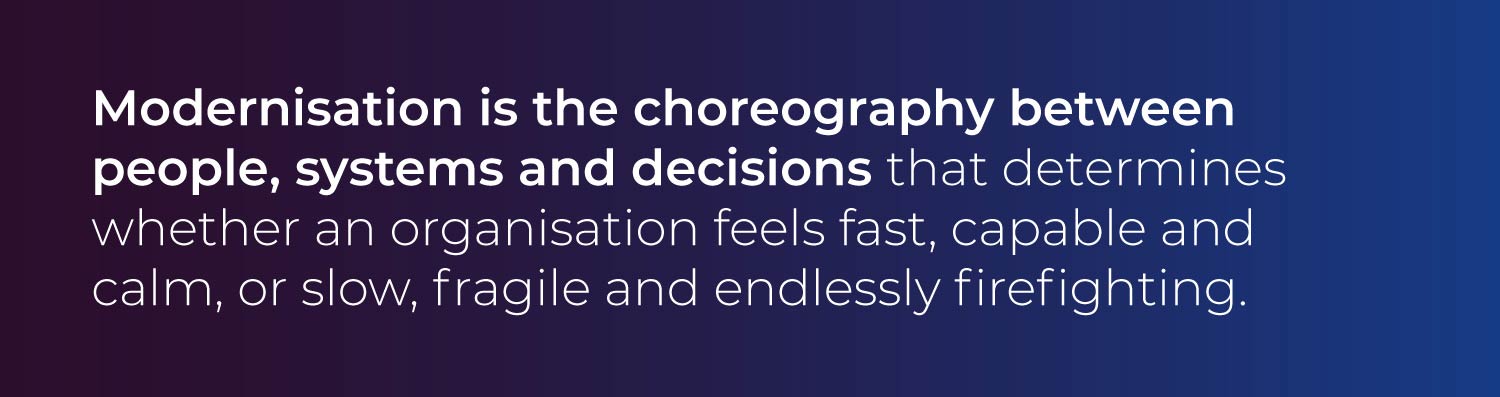
    Legacy system modernisation is not simply about replacing old systems or upgrading infrastructure. As BBD modernisation expert Hendrik Hamman puts it: “Modernisation isn’t just about data moving; it’s about work moving. It’s the choreography between people, systems and decisions that determines whether an organisation feels fast, capable and calm, or slow, fragile and endlessly firefighting.”

    That distinction matters. Successful modernisation requires more than technical upgrades — it requires coordinated, predictable movement of work across teams, systems and decision points.

    Why businesses struggle to modernise

    Many organisations hesitate to modernise legacy systems for understandable reasons. Legacy environments are often complex, with undocumented code and deeply embedded business logic. Integrations span multiple internal platforms and third-party systems. Even small changes can create unintended downstream consequences.

    Hamman says he has more than once seen production legacy code commented with warnings such as “do not touch this code or you will break it” — a telling sign of how fragile and poorly understood certain components have become. The operational risk of downtime is real, particularly in high-volume or regulated environments, while skills supporting older technologies are becoming increasingly scarce.

    Perhaps most deceptively, the system still works. When a legacy platform continues to process transactions, replacing it can appear unnecessarily risky or expensive. Yet beneath the surface, friction accumulates, innovation slows, integration becomes cumbersome and operational workarounds multiply.

    Hamman describes a scenario that highlights the gap clearly: “A team proudly explained that they had integrated two major systems. APIs connected, data flowing, everything technically ‘working’. Yet when we spoke to the people handling the process, the work still felt slow, unpredictable and difficult to manage. The systems were connected, but the work was not.”

    In that example, a customer request still moved through multiple teams, passed through inboxes, waited for approvals, depended on someone noticing it was stuck and relied on a spreadsheet to track progress. From a data perspective, everything appeared modern. From a workflow perspective, nothing had changed.

    Effective legacy system modernisation is grounded in disciplined engineering and structured delivery

    This is where many legacy modernisation efforts fall short. Integration is achieved and architecture is updated, but the lived experience of work remains fragmented. Customers do not experience API integrations; they experience waiting, silence and uncertainty. Employees do not experience data mapping; they experience chasing, escalation and limited visibility.

    Modernising legacy systems without addressing orchestration simply shifts technical components without reducing operational friction.

    An approach that avoids business disruption

    Effective legacy system modernisation is grounded in disciplined engineering and structured delivery. The goal is to reduce risk while steadily improving resilience and agility.

    Assess and prioritise. The process begins with clarity. A comprehensive assessment reviews codebases, architectural patterns, system dependencies, infrastructure posture and operational pain points. It also evaluates risk exposure, compliance considerations and scalability constraints.

    Prioritisation should be driven by business value and technical risk. Not every component requires immediate replacement — in many cases, targeted intervention delivers measurable improvement without unnecessary disruption. Equally important is analysing how work flows through the organisation. Where do handoffs occur? Where do cases stall? Where do exceptions require manual intervention? Understanding both system architecture and workflow behaviour ensures that modernisation addresses real constraints rather than surface symptoms.

    As Hamman puts it: “We spend so much time optimising the happy path that we forget where the real problems actually happen. The 90% success rate looks great on a dashboard until you realise the 10% exceptions are consuming 50% of time, effort and attention.” Modernisation that ignores exception handling risks rebuilding the same operational fragility on newer infrastructure.
    BBD Software

    Adopt a phased coexistence model. A phased approach provides a practical answer to how to modernise legacy systems without downtime. Rather than replacing old systems in a single high-risk event, new components are introduced incrementally while existing systems continue to operate.

    Incremental refactoring or strangulation patterns allow functionality to shift progressively to modern services. API-led integration enables legacy cores to remain stable while new modules are built around them. This coexistence model protects transaction processing and regulatory compliance while steadily improving flexibility and maintainability.

    Move workloads to modern architectures. Modern architectures provide the foundation for long-term scalability. Cloud enablement improves resilience and elastic capacity. Containerisation creates portability between environments. Microservices decouple functionality, enabling faster change cycles. Event-driven patterns enhance responsiveness and integration.

    These shifts can be introduced selectively. A legacy system can remain the system of record while workloads are gradually migrated to modern infrastructure. Data engineering capabilities strengthen analytics and integration without destabilising the operational core. This measured progression reduces risk and ensures the business remains fully operational throughout the transformation.

    Core strategies for low-risk modernisation

    There is no universal framework that applies equally to every organisation. Industry context, regulatory obligations, system criticality and long-term strategy all influence the optimal path. However, several proven strategies commonly form part of a structured modernisation programme.

    In the right circumstances, replatforming can deliver rapid improvements in performance and reliability. Moving a legacy system to modern infrastructure with minimal code changes can improve stability while buying time for deeper transformation — but only when it is the right move for that particular system.

    Refactoring or re-architecting is appropriate for systems with long-term strategic value. Improving internal structure without altering core functionality reduces technical debt and enhances maintainability, positioning the system for future scalability.

    BBD

    Selective component replacement allows organisations to build new capabilities in modern environments while gradually retiring outdated elements. This approach avoids the risk associated with the wholesale replacement of monolithic systems.

    Augmenting legacy platforms with modern capabilities such as APIs, automation or cloud services can unlock immediate value with minimal disruption. This is often an effective starting point for organisations seeking measurable gains without structural overhaul.

    An experienced partner helps determine the right combination of these strategies, ensuring that technical change aligns with business priorities.

    How to choose the right modernisation partner

    Modernising legacy systems demands more than technical competence. It requires structured governance, enterprise architecture expertise and rigorous risk management.

    Organisations should look for a partner with demonstrated experience in enterprise system design, cloud transformation, modern development frameworks, CI/CD and DevOps automation, as well as data migration and integration. A repeatable modernisation framework grounded in real-world delivery is essential for maintaining business continuity throughout the programme.

    A disciplined software development lifecycle underpins successful modernisation. Clear requirements definition, controlled change management, automated testing, structured release processes and continuous monitoring are all essential to reducing risk and maintaining operational stability during transformation.

    Modernising legacy systems is no longer optional for organisations seeking long-term competitiveness

    Equally important is collaboration. Internal teams hold deep domain knowledge. Successful modernisation aligns engineering rigour with operational insight, ensuring that technology improvements translate into tangible improvements in how work moves across the organisation.

    As Hamman’s reflections suggest, true modernisation is measured not by integration diagrams but by how consistently and predictably work moves through the organisation — particularly in highly regulated industries, like the ones BBD delivers into, where downtime is not an option.

    Modernise without disruption

    Modernising legacy systems is no longer optional for organisations seeking long-term competitiveness. Agility, resilience and digital capability depend on it. At the same time, operational stability remains non-negotiable.

    With a phased approach, modern architectures and a disciplined delivery model, organisations can modernise legacy systems without interrupting core business. When modernisation addresses not only infrastructure but also the orchestration of work, it reduces friction, strengthens trust and creates a foundation for sustainable growth.

    Transformation does not require disruption. It requires clarity, engineering discipline and a roadmap grounded in business value.

    About BBD
    A leading international provider of bespoke software solutions, BBD’s four decades of technical and domain expertise spans the education, financial services, insurance, gaming, telecommunications and public sectors. BBD employs over 1 200 highly skilled, motivated and experienced IT professionals, curating flexible teams from our hubs across South Africa, India, the Netherlands, Portugal and the UK. BBD is a 51% black-owned and level-1 B-BBEE partner, with a 135% B-BBEE recognition. For more, visit BBD or connect on Facebook, Instagram, LinkedIn, TikTok or YouTube.

    • Read more articles by BBD on TechCentral
    • This promoted content was paid for by the party concerned

    Follow TechCentral on Google News Add TechCentral as your preferred source on Google


    BBD BBD Software Hendrik Hamman
    WhatsApp YouTube
    Share. Facebook Twitter LinkedIn WhatsApp Telegram Email Copy Link
    Previous ArticleM-KOPA’s 2025 impact: women at the heart of digital inclusion
    Next Article What South African parents look for in an online school

    Related Posts

    Why Europe is turning to South Africa for cross-border innovation - BBD Software

    Why Europe is turning to South Africa for cross-border innovation

    24 July 2026
    Beyond banking: why sustainability data is becoming financial infrastructure

    Why ESG data is becoming core financial infrastructure

    6 July 2026
    The data sovereignty rules African and EU firms can't ignore - BBD Software

    The data sovereignty rules African and EU firms can’t ignore

    2 July 2026
    Add A Comment

    Comments are closed.

    Company News
    Domains.co.za launches self-hosted n8n VPS hosting

    Domains.co.za launches self-hosted n8n VPS hosting

    31 July 2026
    Smarter.tech '26 shows why smarter technology begins with context - Obsidian Systems

    Context is the missing piece in enterprise AI: Obsidian

    31 July 2026
    Huawei launches 12 intelligent transport solutions in South Africa - Sam Tang

    Huawei launches 12 intelligent transport solutions in South Africa

    30 July 2026
    Opinion
    The author, Jannie van Zyl

    Selling vapour is corporate suicide in slow motion

    16 July 2026
    Brazil's online gambling crackdown is a lesson for South Africa

    How Amazon outmanoeuvred Starlink in South Africa

    15 July 2026
    The Popia problem with agentic AI - Herman Haasbroek

    The Popia problem with agentic AI

    14 July 2026

    Subscribe to Updates

    Get the best South African technology news and analysis delivered to your e-mail inbox every morning.

    Latest Posts
    Nedbank hires MTN's former tech chief as group CIO - Nikos Angelopoulos

    Nedbank hires MTN’s former tech chief as group CIO

    31 July 2026
    Eskom's diesel bill falls 86% as breakdowns hit eight-year low

    Eskom’s diesel bill falls 86% as breakdowns hit eight-year low

    31 July 2026
    Ramaphosa signs off on taking the grid away from Eskom

    Ramaphosa signs off on taking the grid away from Eskom

    31 July 2026
    TCS+ | Why South African workers must become supervisors of digital labour - Accelera Digital Group Cliff de Wit

    TCS+ | Why South African workers must become supervisors of digital labour

    31 July 2026
    © 2009 - 2026 NewsCentral Media
    Built and maintained by Chronon
    • Cookie policy (ZA)
    • TechCentral – privacy and Popia

    Type above and press Enter to search. Press Esc to cancel.

    Manage consent

    TechCentral uses cookies to enhance its offerings. Consenting to these technologies allows us to serve you better. Not consenting or withdrawing consent may adversely affect certain features and functions of the website.

    Functional Always active
    The technical storage or access is strictly necessary for the legitimate purpose of enabling the use of a specific service explicitly requested by the subscriber or user, or for the sole purpose of carrying out the transmission of a communication over an electronic communications network.
    Preferences
    The technical storage or access is necessary for the legitimate purpose of storing preferences that are not requested by the subscriber or user.
    Statistics
    The technical storage or access that is used exclusively for statistical purposes. The technical storage or access that is used exclusively for anonymous statistical purposes. Without a subpoena, voluntary compliance on the part of your Internet Service Provider, or additional records from a third party, information stored or retrieved for this purpose alone cannot usually be used to identify you.
    Marketing
    The technical storage or access is required to create user profiles to send advertising, or to track the user on a website or across several websites for similar marketing purposes.
    • Manage options
    • Manage services
    • Manage {vendor_count} vendors
    • Read more about these purposes
    View preferences
    • {title}
    • {title}
    • {title}