 The Seacom 2.0 cable, Seacom’s planned 25 000km submarine broadband system announced earlier this week, will go live in late 2029 or early 2030, according to the company’s CEO, Alpheus Mangale.
Speaking exclusively to TechCentral in an episode of the TechCentral Show to be published this week, Mangale said the massive, 2 000Tbit/s design-capacity cable aims take to advantage of an anticipated surge in internet traffic as terrestrial connectivity on the African continent improves and AI drives a surge in demand for new communications infrastructure.
“About 90% of the planning phase is done, and by the end of this week we will be putting out RFPs (requests for proposals) to the industry for people who will build the cable and do marine surveys for us,” Mangale said.
Seacom 2.0 will follow a similar route to its predecessor cable, which went live in 2009 and had an initial design capacity of 1.28Tbit/s – later upgraded thanks to advances in optical networking technology.
Mangale said the much higher capacity of the newer cable is due to technological advancements like optical space division multiplexing, or OSDM, which maximises the capacity of a single fibre line as well the number of fibre cores that can be bundled together. Seacom 2.0 is expected to have a staggering 48 fibre pairs that could be deployed using a single cable or two 24-pair cables running in parallel.
Cable routing
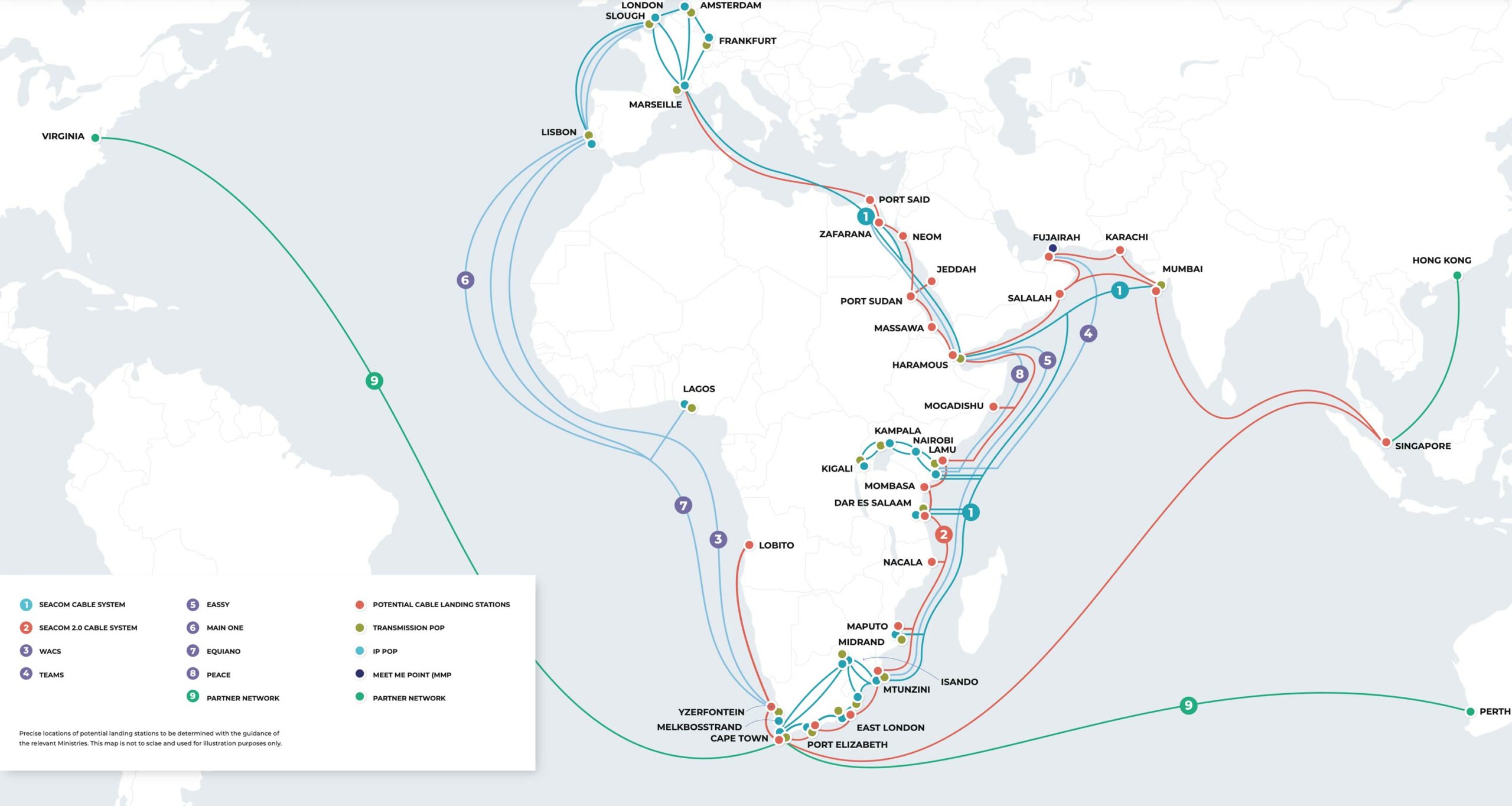
Unlike the older cable, Seacom 2.0 will have a link directly from South Africa to Singapore. Another new leg is a westward loop around the South African coastline to Lobito in Angola. The choice of Lobito as a landing point is strategic, aligning with a massive Lobito Corridor project planned for that region.
Route diversification will be supported by an increase in the number of landing stations, a move that also aims to reduce risk and enhance resilience. In South Africa, five potential landing stations have been earmarked: in Mtunzini, East London, Port Elizabeth, Cape Town and Yzerfontein. Three of these will likely be deployed, according to Mangale. New landing stations are also planned for East Africa.
Read: Seacom 2.0: huge new subsea fibre system planned for Africa
Seacom 2.0 is part of a new generation of high-capacity cables planned for Africa. Google’s Equiano cable, which runs along Africa’s west coast, added 144Tbit/s (design capacity) after its 2023 launch. But even larger cables are on the way, including Google’s Umoja, which will run from South Africa to Australia, also expected to add capacity in the thousands of terabits per second.
The Meta Platforms-backed 2Africa cable, which will circumnavigate the African continent once completed, had its first portion between South Africa and Kenya go live in June 2024.
Read: Google to anchor Africa subsea cables with four new ‘connectivity hubs’
Another high-capacity cable, also backed by Meta Platforms, Project Waterworth, will span a staggering 55 000km once completed and should help bolster global redundancy. Project Waterworth will have landing stations in South Africa. — © 2025 NewsCentral Media
- Look out for the TechCentral Show interview with Seacom’s Alpheus Mangale in the coming days
Get breaking news from TechCentral on WhatsApp. Sign up here.