
Close Menu
TechCentralTechCentral

    Subscribe to the newsletter

    Get the best South African technology news and analysis delivered to your e-mail inbox every morning.

    Facebook X (Twitter) YouTube LinkedIn
    WhatsApp Facebook X (Twitter) LinkedIn YouTube
    TechCentralTechCentral
    • News
      Fewer stores, more Bash: TFG's online pivot gathers pace

      Fewer stores, more Bash: TFG’s online pivot gathers pace

      6 November 2026
      Tesla pulls the plug on the Cybertruck

      Tesla pulls the plug on the Cybertruck

      6 November 2026
      AA boss gives South Africa's car industry five years - Bobby Ramagwede

      AA boss gives South Africa’s car industry five years

      6 November 2026
      AI's black box may not be so black after all

      AI’s black box may not be so black after all

      6 November 2026
      Big wind farms drive a surge in private power registrations

      Big wind farms drive a surge in private power registrations

      6 November 2026
    • World
      John Ternus faces first big test as Apple CEO - John Ternus

      John Ternus faces first big test as Apple CEO

      2 November 2026
      Alleged Israeli spy company heavily targeted Starlink users

      How online ads were used to hunt Starlink users

      28 October 2026
      Anthropic's IPO stands alone

      Anthropic’s IPO stands alone

      23 October 2026
      PHP flaws trigger global scramble as hackers pounce

      PHP flaws trigger global scramble as hackers pounce

      22 October 2026
      OpenAI turns the tables on Apple in trade secrets fight

      OpenAI turns the tables on Apple in trade secrets fight

      15 October 2026
    • In-depth
      Ducking hell: inside Apple's hidden list of words the iPhone won't suggest

      Ducking hell: inside Apple’s hidden list of words the iPhone won’t suggest

      6 November 2026
      Why investors are souring on Netflix

      Why investors are souring on Netflix

      22 October 2026

      10 days that changed the course of AI

      21 September 2026
      Meta to the AI industry: slow down without us - Mark Zuckerberg

      Meta to the AI industry: slow down without us

      16 September 2026
      Google DeepMind CEO Demis Hassabis. Image: John Sears

      The plan to stop AI from breaking the world

      16 July 2026
    • TCS
      TCS+ | Old Mutual's Celiwe Ross on leading people through AI - Old Mutual

      TCS+ | Old Mutual’s Celiwe Ross on leading people through AI

      6 November 2026
      TCS+ | How the Apple ecosystem drives productivity for SMEs - Sudesh Pillay iStore and Kevin McLennan

      TCS+ | How the Apple ecosystem drives productivity for SMEs

      6 November 2026
      TCS+ | Vox on AI, data rules and omnichannel communication for SMEs

      TCS+ | Vox on AI, data rules and omnichannel communication for SMEs

      26 October 2026
      TCS | The Cape Town firm quietly connecting Eskom, Pep and 6 000 ATMs - Réan van Niekerk, Metacom

      TCS | The Cape Town firm quietly connecting Eskom, Pep and 6 000 ATMs

      23 October 2026
      TCS+ | Boards are underestimating the cost of a cyberattack, says Arctic Wolf - Jason Oehley and Andre Den Hond

      TCS+ | Boards are underestimating the cost of a cyberattack, says Arctic Wolf

      22 October 2026
    • Opinion
      Icasa's Sim rules need a privacy backstop - Lloyd Matthew and Heinz Vollmer

      Icasa’s Sim rules need a privacy backstop

      5 November 2026
      AI's boardroom honeymoon is over - Gary Stocks

      AI’s boardroom honeymoon is over

      22 October 2026
      Before South Africa licenses Starlink, it should look at Ukraine - Duncan McLeod

      Before South Africa licenses Starlink, it should look at Ukraine

      21 October 2026
      Nonkqubela Thathakahle Jordan-Dyani

      Why cybersecurity is now a national security issue for South Africa

      15 October 2026
      When a machine can choose, who does it become? Fanie van Rooyen

      When a machine can choose, who does it become?

      9 October 2026
    • Company News
      • 1Stream
      • Africa Data Centres
      • AfriGIS
      • Altron Digital Business
      • Altron Document Solutions
      • Altron Group
      • Arctic Wolf
      • Ascent Technology
      • AvertITD
      • BBD
      • Braintree
      • CallMiner
      • CambriLearn
      • CM.com
      • Contactable
      • CYBER1 Solutions
      • Digicloud Africa
      • Digimune
      • Domains.co.za
      • ESET
      • Euphoria Telecom
      • HOSTAFRICA
      • Incredible Business
      • iONLINE
      • IQbusiness
      • Iris Network Systems
      • Kaspersky
      • LSD Open
      • Mitel
      • NEC XON
      • Netstar
      • Network Platforms
      • Next DLP
      • Ovations
      • Paracon
      • Paratus
      • Publishared
      • Q-KON
      • SevenC
      • SkyWire
      • Solid8 Technologies
      • Telit Cinterion
      • Telviva
      • Tenable
      • Vertiv
      • Videri Digital
      • Vodacom Business
      • Vox
      • Wipro
      • Workday
      • XLink
    • Sections
      • AI and machine learning
      • Banking
      • Broadcasting and media
      • Cloud services
      • Contact centres and CX
      • Cryptocurrencies
      • Education and skills
      • Electronics and hardware
      • Energy and sustainability
      • Enterprise software
      • Fintech and payments
      • HealthTech
      • Information security
      • Internet and connectivity
      • Internet of things
      • Investment
      • IT services
      • Lifestyle
      • Policy and regulation
      • Public sector
      • Retail and e-commerce
      • Satellite communications
      • Science
      • SMEs and start-ups
      • Social media
      • Talent and leadership
      • Telecoms
      • Watts & Wheels
    • Events
    • Advertise
    TechCentralTechCentral
    Home » Sections » Electronics and hardware » A petaflop on a desk – rethinking AI infrastructure for South Africa

    A petaflop on a desk – rethinking AI infrastructure for South Africa

    Promoted | Altron Arrow is bringing ASUS AI systems to South African organisations building local compute.
    By Altron Arrow9 September 2026
    Twitter LinkedIn Facebook WhatsApp Email Telegram Copy Link
    Get breaking news on WhatsApp

    The ASUS ExpertCenter Pro ET900N from Altron Arrow
    The ASUS ExpertCenter Pro ET900N from Altron Arrow

    South African organisations have stopped asking what AI might do for them. The questions now are operational: how to deploy it, where it should run, how much compute it needs, and what that means for their data, their budgets and their technology strategy.

    For years, AI adoption was framed as a software conversation — which platform to adopt, which model to train, which use cases to prioritise. The bottleneck has moved. GPUs, memory, storage, networking, power, cooling, security and data management now determine whether AI gets from proof of concept into production. Access to the right compute is becoming as important as access to the right model.

    The infrastructure challenge in South Africa

    Local organisations face a particular set of constraints. High-performance compute is expensive and access to advanced GPU infrastructure is limited. Bandwidth and latency affect cloud-based AI performance. Electricity supply and data-centre capacity complicate large-scale planning: Africa has less than half a gigawatt of active data centre capacity for more than a billion people. Data sovereignty adds another layer for anyone handling regulated information, and specialised AI infrastructure skills are in short supply.

    South Africa cannot simply replicate the hyperscale models built elsewhere. The assumption that every organisation needs a large data-centre footprint or a major cloud commitment is no longer viable — and it is no longer necessary.

    A huge data centre is not always needed

    As AI adoption matures, workloads are becoming more distributed. Developers need compute for model training and testing. Business units need local inference for analytics, automation and computer vision. Operational environments, from factories to retail stores, increasingly rely on edge AI to process data in real time.

    That creates a role for compact, distributed infrastructure. Rather than centralising compute in a single data centre or cloud environment, organisations can deploy smaller AI-capable systems at different points in the business, providing meaningful compute without the cost and lead times of a traditional AI data-centre build.

    The rise of accessible AI compute

    A new generation of compact systems is emerging to meet this need, designed to put AI compute closer to users, developers and operational environments so that organisations can start small, experiment locally and scale with real demand.

    • The ASUS Ascent GX10 is one example. Built on Nvidia’s GB10 Grace Blackwell Superchip — the same silicon as Nvidia’s DGX Spark — it delivers a petaflop of FP4 AI performance and 128GB of unified memory in a chassis measuring 150x150x51mm, enough to fine-tune models of up to 200 billion parameters on a desk. Two units can be linked over ConnectX-7 networking to double that. It draws up to 180W, which matters in a market where power is a planning constraint rather than a line item.
    • The ASUS ExpertCenter Pro ET900N G3 brings workstation-class performance to business and professional settings, supporting AI workloads that need to sit closer to the user in engineering, analytics, design, research or operational roles. For many organisations it is a practical middle ground: powerful enough for demanding AI tasks, accessible enough to deploy across teams and departments.

    The practical effect of systems like these is local development and testing, faster experimentation cycles, inference close to the point of use, tighter control over sensitive workloads, less reliance on cloud connectivity, and a realistic starting point for an organisation building its own AI capability.
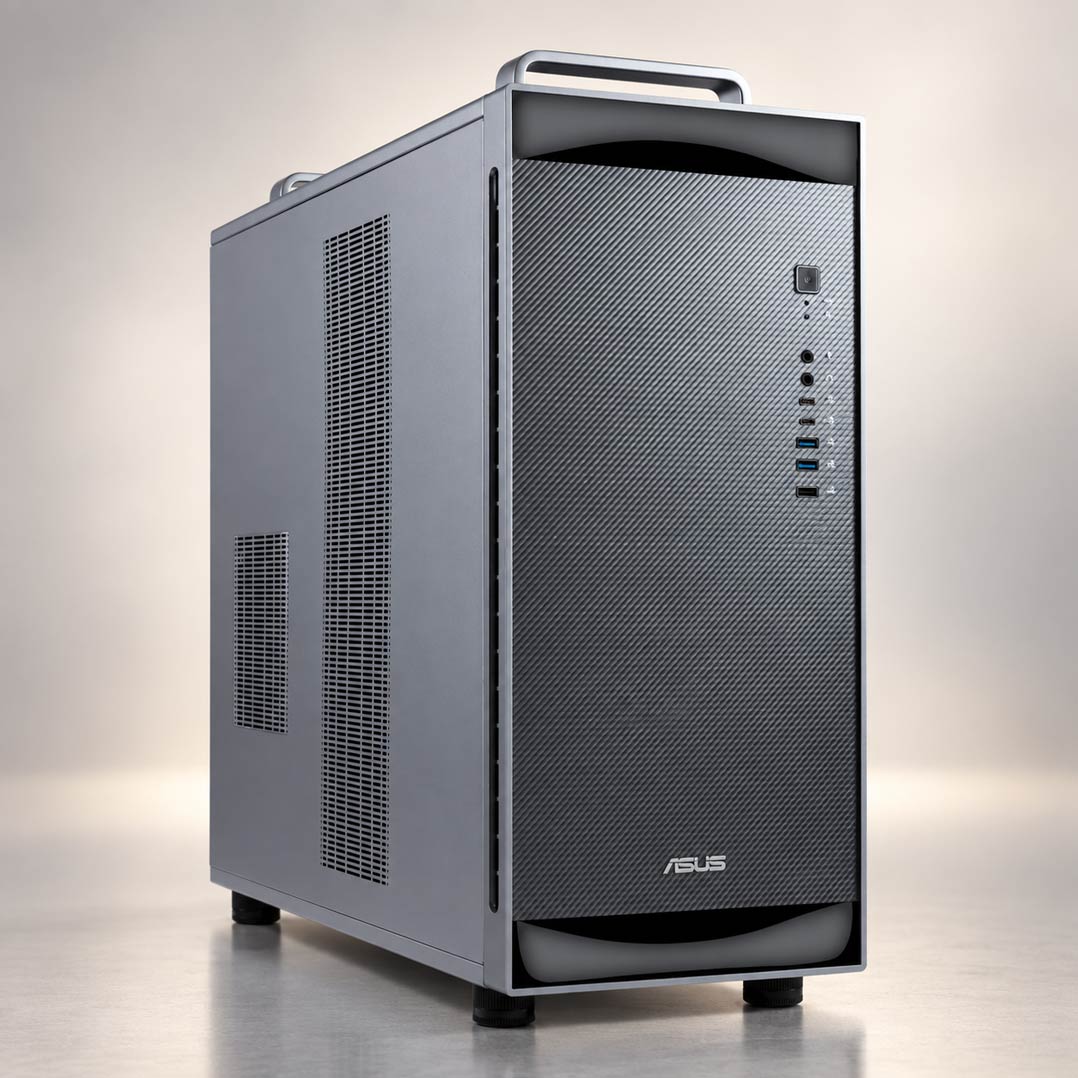
    The ASUS ExpertCenter Pro ET900N from Altron Arrow

    It is no longer cloud versus on-premises

    For years, infrastructure decisions were framed as a binary: cloud or on-premises. AI breaks that framing, because different workloads have different requirements, and those requirements decide where a workload should run.

    Some AI workloads benefit from the elasticity and scale of cloud. Others need low latency, local processing, data sovereignty, predictable costs or offline capability, which points towards on-premises or edge infrastructure.

    So, the future is hybrid. Organisations will blend cloud, on-premises and edge compute according to the nature of each workload, and compact systems such as the GX10 and the ET900N become part of that model, letting them place compute exactly where it is needed. The question is which location suits which workload.

    From proof of concept to production

    Many proofs of concept succeed technically and fail operationally, because infrastructure planning was treated as an afterthought. Closing that gap means assessing current and future workloads, the split between training and inference, GPU and memory requirements, where data sits and which sovereignty rules apply, security, power and cooling, networking and latency, total cost of ownership, and how the environment scales.

    That assessment belongs inside an organisation’s AI strategy rather than beside it. Infrastructure determines what is possible, how quickly AI can be deployed and how economically it can be sustained.

    The role of the technology ecosystem

    Making AI accessible takes more than selling hardware. It requires an ecosystem: compute, infrastructure, software, cybersecurity, distribution, technical expertise and channel partners.

    Altron Arrow, which distributes ASUS AI systems in South Africa, works within that ecosystem to help organisations and partners get hold of what modern AI deployments require. The aim is compute that is realistic, scalable and economically viable for local organisations, rather than a scaled-down copy of a hyperscale build.

    The next stage of AI adoption

    Accessibility will shape the next phase of AI adoption. The organisations that benefit most are likely to be those that understand their own workloads and build an infrastructure strategy around them, rather than those with the largest budgets. For South African businesses, affordability is no longer the barrier it was; what matters now is how quickly AI moves from experiment to operational advantage.

    • The author, Akhona Nkalitshane, is business development manager at Altron Arrow
    • Read more articles by Altron Arrow on TechCentral
    • This promoted content was paid for by the party concerned

    Add TechCentral as a preferred source on GoogleFollow TechCentral on Google NewsGet breaking news on WhatsApp


    Akhona Nkalitshane Altron Altron Arrow Asus ASUS Ascent GX10 ASUS ExpertCenter Pro ET900N edge AI South Africa hybrid AI infrastructure Nvidia Nvidia GB10 Grace Blackwell
    WhatsApp YouTube
    Share. Facebook Twitter LinkedIn WhatsApp Telegram Email Copy Link
    Previous ArticleDis-Chem gets serious about e-commerce – again
    Next Article Can an online school produce a scientist? CambriLearn has an independent answer

    Related Posts

    Altron lifts dividend 15% as IT services returns to growth - Werner Kapp

    Altron lifts dividend 15% as IT services returns to growth

    2 November 2026
    Intel's comeback hits a wall

    Intel’s comeback hits a wall

    30 October 2026
    AI is squeezing Google's search growth - and its cash

    AI is squeezing Google’s search growth – and its cash

    29 October 2026
    Add A Comment

    Comments are closed.

    Company News
    XLink brings dual-network resilience to eSim

    XLink brings dual-network resilience to eSim

    6 November 2026
    CambriLearn parents can now ask AI whether their child went to class

    CambriLearn parents can now ask AI whether their child went to class

    6 November 2026
    'There was hunger for alternatives': PSET launches at Purcon 2026 - Ebenezer Smith

    ‘There was hunger for alternatives’: PSET launches at Purcon 2026

    6 November 2026
    Opinion
    Icasa's Sim rules need a privacy backstop - Lloyd Matthew and Heinz Vollmer

    Icasa’s Sim rules need a privacy backstop

    5 November 2026
    AI's boardroom honeymoon is over - Gary Stocks

    AI’s boardroom honeymoon is over

    22 October 2026
    Before South Africa licenses Starlink, it should look at Ukraine - Duncan McLeod

    Before South Africa licenses Starlink, it should look at Ukraine

    21 October 2026

    Subscribe to Updates

    Get the best South African technology news and analysis delivered to your e-mail inbox every morning.

    Latest Posts
    Fewer stores, more Bash: TFG's online pivot gathers pace

    Fewer stores, more Bash: TFG’s online pivot gathers pace

    6 November 2026
    Tesla pulls the plug on the Cybertruck

    Tesla pulls the plug on the Cybertruck

    6 November 2026
    AA boss gives South Africa's car industry five years - Bobby Ramagwede

    AA boss gives South Africa’s car industry five years

    6 November 2026
    AI's black box may not be so black after all

    AI’s black box may not be so black after all

    6 November 2026
    © 2009 - 2026 NewsCentral Media
    Built and maintained by Chronon
    • Cookie policy (ZA)
    • TechCentral – privacy and Popia

    Type above and press Enter to search. Press Esc to cancel.

    Manage consent

    TechCentral uses cookies to enhance its offerings. Consenting to these technologies allows us to serve you better. Not consenting or withdrawing consent may adversely affect certain features and functions of the website.

    Functional Always active
    The technical storage or access is strictly necessary for the legitimate purpose of enabling the use of a specific service explicitly requested by the subscriber or user, or for the sole purpose of carrying out the transmission of a communication over an electronic communications network.
    Preferences
    The technical storage or access is necessary for the legitimate purpose of storing preferences that are not requested by the subscriber or user.
    Statistics
    The technical storage or access that is used exclusively for statistical purposes. The technical storage or access that is used exclusively for anonymous statistical purposes. Without a subpoena, voluntary compliance on the part of your Internet Service Provider, or additional records from a third party, information stored or retrieved for this purpose alone cannot usually be used to identify you.
    Marketing
    The technical storage or access is required to create user profiles to send advertising, or to track the user on a website or across several websites for similar marketing purposes.
    • Manage options
    • Manage services
    • Manage {vendor_count} vendors
    • Read more about these purposes
    View preferences
    • {title}
    • {title}
    • {title}
    🇿🇦 Sign up to the TechCentral newsletter