Close Menu
TechCentralTechCentral

    Subscribe to the newsletter

    Get the best South African technology news and analysis delivered to your e-mail inbox every morning.

    Facebook X (Twitter) YouTube LinkedIn
    WhatsApp Facebook X (Twitter) LinkedIn YouTube
    TechCentralTechCentral
    • News
      Schreiber suspends home affairs officials over fake AI references - Leon Schreiber

      Schreiber suspends home affairs officials over fake AI references

      30 April 2026
      South Africa headed to the polls in November

      South Africa headed to the polls in November

      30 April 2026
      Google humbles Big Tech's cloud heavyweights

      Google humbles Big Tech’s cloud heavyweights

      30 April 2026
      Logistics start-up Shiprazor pulls in R44-million seed round

      Logistics start-up Shiprazor pulls in R44-million seed round

      30 April 2026
      Why big IT projects in South Africa keep drifting off course

      Why big IT projects in South Africa keep drifting off course

      30 April 2026
    • World
      'It was my idea': Musk claims paternity of OpenAI - Elon Musk

      ‘It was my idea’: Musk claims paternity of OpenAI

      29 April 2026
      Pivotal week for US tech stocks

      Pivotal week for US tech stocks

      28 April 2026
      Worries over OpenAI's growth as Anthropic gains ground - Sam Altman. Shelby Tauber/Reuters

      Worries over OpenAI’s growth as Anthropic gains ground

      28 April 2026
      Taylor Swift trademarks her voice to fight AI fakes

      Taylor Swift trademarks her voice to fight AI fakes

      28 April 2026
      DeepSeek's long-awaited V4 model enters preview

      DeepSeek’s long-awaited V4 model enters preview

      24 April 2026
    • In-depth
      Alfa's electric rebel - Alfa Romeo Junior Elettrica Veloce

      Alfa’s electric rebel

      29 April 2026
      Africa switches on as Europe dims the lights

      Africa switches on as Europe dims the lights

      9 April 2026
      The biggest untapped EV market on Earth is hiding in plain sight

      The biggest untapped EV market on Earth is hiding in plain sight

      1 April 2026
      The R18-billion tech giant hiding in plain sight - Jens Montanana

      The R16-billion tech giant hiding in plain sight

      26 March 2026
      The last generation of coders

      The last generation of coders

      18 February 2026
    • TCS

      TCS+ | ‘The ISP for ISPs’: Vox’s shift to wholesale aggregator

      20 April 2026
      TCS | Werner Lindemann on how AI is rewriting the infosec rulebook

      TCS | Werner Lindemann on how AI is rewriting the infosec rulebook

      15 April 2026
      TCS | Donovan Marsh on AI and the future of filmmaking

      TCS | Donovan Marsh on AI and the future of filmmaking

      7 April 2026
      TCS+ | Vodacom Business moves to crack the SME tech gap - Andrew Fulton, Sannesh Beharie

      TCS+ | Vodacom Business moves to crack the SME tech gap

      7 April 2026
      TCS | MTN's Divysh Joshi on the strategy behind Pi - Divyesh Joshi

      TCS | MTN’s Divyesh Joshi on the strategy behind Pi

      1 April 2026
    • Opinion
      Free calls, dead voice and Shameel Joosub's Spanish ghost - Duncan McLeod

      Free calls, dead voice and Shameel Joosub’s Spanish ghost

      22 April 2026
      The conflict of interest at the heart of PayShap's slow adoption - Cheslyn Jacobs

      The conflict of interest at the heart of PayShap’s slow adoption

      26 March 2026
      South Africa's energy future hinges on getting wheeling right - Aishah Gire

      South Africa’s energy future hinges on getting wheeling right

      10 March 2026
      Free calls, dead voice and Shameel Joosub's Spanish ghost - Duncan McLeod

      Apple just dropped a bomb on the Windows world

      5 March 2026
      R230-million in the bag for Endeavor's third Harvest Fund - Alison Collier

      VC’s centre of gravity is shifting – and South Africa is in the frame

      3 March 2026
    • Company Hubs
      • 1Stream
      • Africa Data Centres
      • AfriGIS
      • Altron Digital Business
      • Altron Document Solutions
      • Altron Group
      • Arctic Wolf
      • Ascent Technology
      • AvertITD
      • BBD
      • Braintree
      • CallMiner
      • CambriLearn
      • Contactable
      • CYBER1 Solutions
      • Digicloud Africa
      • Digimune
      • Domains.co.za
      • ESET
      • Euphoria Telecom
      • HOSTAFRICA
      • Incredible Business
      • iONLINE
      • IQbusiness
      • Iris Network Systems
      • Kaspersky
      • LSD Open
      • Mitel
      • NEC XON
      • Netstar
      • Network Platforms
      • Next DLP
      • Ovations
      • Paracon
      • Paratus
      • Q-KON
      • SevenC
      • SkyWire
      • Solid8 Technologies
      • Telit Cinterion
      • Telviva
      • Tenable
      • Vertiv
      • Videri Digital
      • Vodacom Business
      • Wipro
      • Workday
      • XLink
    • Sections
      • AI and machine learning
      • Banking
      • Broadcasting and Media
      • Cloud services
      • Contact centres and CX
      • Cryptocurrencies
      • Education and skills
      • Electronics and hardware
      • Energy and sustainability
      • Enterprise software
      • Financial services
      • HealthTech
      • Information security
      • Internet and connectivity
      • Internet of Things
      • Investment
      • IT services
      • Lifestyle
      • Motoring
      • Policy and regulation
      • Public sector
      • Retail and e-commerce
      • Satellite communications
      • Science
      • SMEs and start-ups
      • Social media
      • Talent and leadership
      • Telecoms
    • Events
    • Advertise
    TechCentralTechCentral
    Home » Top » Quantum computing faces an uncertain future

    Quantum computing faces an uncertain future

    By Editor1 March 2012
    Twitter LinkedIn Facebook WhatsApp Email Telegram Copy Link
    News Alerts
    WhatsApp

    Quantum effects are vital to modern electronics. They can also be a damnable nuisance. Make a transistor too small, for example, and electrons within it can simply vanish from one place and reappear in another because their location is quantumly indeterminate. Currents thus leak away, and signals are degraded.

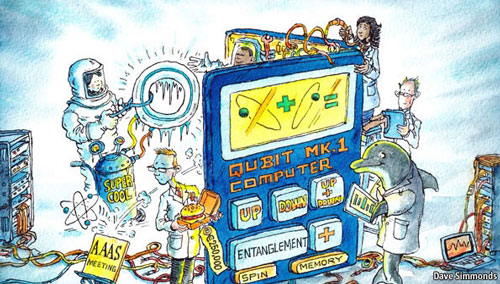
    Other people, though, see opportunity instead. Some of the weird things that go on at the quantum scale afford the possibility of doing computing in a new and faster way, and of sending messages that — in theory at least — cannot be intercepted. Several groups of such enthusiasts hope to build quantum computers capable of solving some of the problems which stump today’s machines, such as finding prime factors of numbers with hundreds of digits or trawling through large databases. They gave a progress report to the annual meeting of the American Association for the Advancement of Science (AAAS) in Vancouver.

    At the core of their efforts lie the quantum-mechanical phenomena of superposition and entanglement. An ordinary digital computer manipulates information in the form of bits, which take the value of either 0 or 1. These are represented within the computer as different voltages of electric current, itself the result of the electron’s charge. This charge is a fixed feature of all electrons; each has the same amount of it as any other. But electrons possess other, less rigid properties like spin, which can be either “up”, “down” or a fuzzy, imprecisely defined combination of the two. Such combinations, known as superpositions, can be used to construct a quantum analogue of the traditional bit — the qubit.

    Entanglement, meanwhile, is the roping together of particles in order to add more qubits. Each extra qubit in a quantum machine doubles the number of simultaneous operations it can perform. It is this which gives quantum computing its power. Two entangled qubits permit four operations; three permit eight; and so on. A 300-qubit computer could perform more concurrent operations than there are atoms in the visible universe.

    Unfortunately, such a machine is not in the offing. Entanglement and superposition are delicate things. Even the slightest disturbance causes qubits to “decohere”, shedding their magical properties. To build a working quantum computer, qubits will have to become more resilient, and progress so far has been slow.

    The first quantum computations were done in the lab in 1995. Since then various teams have managed to entangle as many as 14 qubits. The record holders, a group in Innsbruck, use a device called an ion trap in which each qubit exists as a superposition of a rubidium atom at different energies. Raymond Laflamme and his colleagues at the University of Waterloo, in Canada, have managed to entangle 12 qubits by performing a similar trick, entangling certain atoms within a single molecule of an amino acid called histidine, the properties of which make it particularly suited to such experiments.

    The problem with these approaches is that they will not be easy to scale up. Ion traps reside inside big vacuum chambers, which cannot easily be shrunk. And a molecule of histidine contains only so many suitable atoms. So the search is on for more practical qubits.

    One promising approach is to etch qubits in semiconductors. Charles Marcus, previously of Harvard University and now at the University of Copenhagen, has been using electrons’ spins to do this. Single-electron qubits decohere quickly, so his team decided instead to create a qubit out of two electrons, which they trapped in “quantum dots”, tiny semiconducting crystals (of gallium arsenide, in this case). When two such dots are close together, it is possible to get an electron trapped in one to pop over and join its neighbour in the other. The superposition of the two electrons’ spins produces the qubit.

    Marcus’s team have so far managed to stitch four such qubits together. An array of clever tricks has extended their life to about 10 microseconds — enough to perform the simple algebraic operations that are the lifeblood of computing. They hope to extend their life further by using silicon or carbon, the atomic nuclei of which interfere less with the entangled electrons than do those of gallium arsenide.

    John Martinis and his colleagues at the University of California, Santa Barbara (UCSB), meanwhile, have been trying to forge qubits from superconducting circuits. In a superconductor, electrons do not travel solo. Instead, for complicated quantum-mechanical reasons, they pair up (for the same reasons, the pairs feel no electrical resistance). When they do so, the pairs start behaving like a single particle, superposing proclivities and all. This superparticle can, for instance, in effect be moving in two directions at once. As electrons move, they create a magnetic field. Make a closed loop of superconducting wire, then, and you get a magnetic field which can be facing up and down at the same time. You have yourself a superconducting qubit — or five, the number Martinis has so far managed to entangle.

    He has another clever trick up his sleeve. Using a device called a resonator he has been able to transfer information from the circuit to a single photon and trap it in a cavity for a few microseconds. He has, in other words, created a quantum memory. A few microseconds may not sound much, but it is just about enough to perform some basic operations.

    The problem with all these approaches is that the quantum states they rely on are fragile, which allows errors to creep in. One way to ensure that they do not scupper the calculation is to encode the same information in several qubits instead of just one. Marcus, Martinis and Laflamme have therefore had to build redundant qubits into their systems. For every “logical” qubit needed to do a calculation, there is a handful of physical ones, all of which need to be entangled.

    Michael Freedman is trying to address this problem by taking a different tack. Together with his colleagues at Microsoft’s Station Q research centre, also at UCSB, he is trying to build what he calls a topological quantum computer. This uses a superconductor on top of a layer of an exotic material called indium antimony. When a voltage is applied to this sandwich, the whole lot becomes a quantum system capable of existing in superposed states.

    Where Freedman’s qubits differ from Martinis’s is in the way they react to interference. Nudge any electron in a superconducting circuit and the whole lot decoheres. Freedman’s design, however, is invulnerable to such local disruptions thanks to the peculiar way in which energy is distributed throughout indium antimony. The Microsoft team has yet to create a functioning qubit, but hopes to do so soon, and is searching for other materials in which to repeat the same trick.

    All of this work is pretty fundamental. Researchers are a long way from creating quantum mainframes, which is how most of them see the future of their fiddly devices, let alone quantum desktops. Martinis thinks that a viable quantum processor is still 10 years away. Yet even this is progress of a sort. When he entered the field two decades ago, he thought that building a quantum processor was “insanely difficult”. Now he says it is merely “very, very hard”.  — (c) 2012 The Economist

    • Subscribe to our free daily newsletter
    • Follow us on Twitter or on Google+ or on Facebook
    • Visit our sister website, SportsCentral (still in beta)

    Follow TechCentral on Google News Add TechCentral as your preferred source on Google


    WhatsApp YouTube
    Share. Facebook Twitter LinkedIn WhatsApp Telegram Email Copy Link
    Previous ArticleTelkom won’t cut rates – yet
    Next Article New Dawn deal promises channels for Africa

    Related Posts

    Schreiber suspends home affairs officials over fake AI references - Leon Schreiber

    Schreiber suspends home affairs officials over fake AI references

    30 April 2026
    South Africa headed to the polls in November

    South Africa headed to the polls in November

    30 April 2026
    Google humbles Big Tech's cloud heavyweights

    Google humbles Big Tech’s cloud heavyweights

    30 April 2026
    Company News
    The breach is in the database - Ascent Technology Johan Lamberts

    The breach is in the database

    30 April 2026
    Hospitality sector embraces Google Workspace and Gemini to cut admin - Digicloud Africa, Rand Data Systems

    Hospitality sector embraces Google Workspace and Gemini to cut admin

    30 April 2026
    Paratus Mozambique powers 2026 Santa Maria fishing showdown

    Paratus Mozambique powers 2026 Santa Maria fishing showdown

    30 April 2026
    Opinion
    Free calls, dead voice and Shameel Joosub's Spanish ghost - Duncan McLeod

    Free calls, dead voice and Shameel Joosub’s Spanish ghost

    22 April 2026
    The conflict of interest at the heart of PayShap's slow adoption - Cheslyn Jacobs

    The conflict of interest at the heart of PayShap’s slow adoption

    26 March 2026
    South Africa's energy future hinges on getting wheeling right - Aishah Gire

    South Africa’s energy future hinges on getting wheeling right

    10 March 2026

    Subscribe to Updates

    Get the best South African technology news and analysis delivered to your e-mail inbox every morning.

    Latest Posts
    Schreiber suspends home affairs officials over fake AI references - Leon Schreiber

    Schreiber suspends home affairs officials over fake AI references

    30 April 2026
    South Africa headed to the polls in November

    South Africa headed to the polls in November

    30 April 2026
    Google humbles Big Tech's cloud heavyweights

    Google humbles Big Tech’s cloud heavyweights

    30 April 2026
    Logistics start-up Shiprazor pulls in R44-million seed round

    Logistics start-up Shiprazor pulls in R44-million seed round

    30 April 2026
    © 2009 - 2026 NewsCentral Media
    • Cookie policy (ZA)
    • TechCentral – privacy and Popia

    Type above and press Enter to search. Press Esc to cancel.

    Manage consent

    TechCentral uses cookies to enhance its offerings. Consenting to these technologies allows us to serve you better. Not consenting or withdrawing consent may adversely affect certain features and functions of the website.

    Functional Always active
    The technical storage or access is strictly necessary for the legitimate purpose of enabling the use of a specific service explicitly requested by the subscriber or user, or for the sole purpose of carrying out the transmission of a communication over an electronic communications network.
    Preferences
    The technical storage or access is necessary for the legitimate purpose of storing preferences that are not requested by the subscriber or user.
    Statistics
    The technical storage or access that is used exclusively for statistical purposes. The technical storage or access that is used exclusively for anonymous statistical purposes. Without a subpoena, voluntary compliance on the part of your Internet Service Provider, or additional records from a third party, information stored or retrieved for this purpose alone cannot usually be used to identify you.
    Marketing
    The technical storage or access is required to create user profiles to send advertising, or to track the user on a website or across several websites for similar marketing purposes.
    • Manage options
    • Manage services
    • Manage {vendor_count} vendors
    • Read more about these purposes
    View preferences
    • {title}
    • {title}
    • {title}