Close Menu
TechCentralTechCentral

    Subscribe to the newsletter

    Get the best South African technology news and analysis delivered to your e-mail inbox every morning.

    Facebook X (Twitter) YouTube LinkedIn
    WhatsApp Facebook X (Twitter) LinkedIn YouTube
    TechCentralTechCentral
    • News
      Broadband Infraco in limbo

      Broadband Infraco in limbo

      11 February 2026
      Home affairs' R10 ID fee is forcing companies to rethink identity verification

      Standard Bank joins smart ID push with fee-free launch

      11 February 2026
      Zscaler assets seized from South African data centres

      Zscaler assets seized from South African data centres

      11 February 2026
      SA app wants to end guesswork in online grocery shopping - We Need Milk CEO Arjan van den Berg

      SA app wants to end guesswork in online grocery shopping

      11 February 2026
      Absa appoints M-Pesa boss to lead personal and private banking - Sitoyo Lopokoiyit

      Absa appoints M-Pesa boss to lead personal and private banking

      11 February 2026
    • World
      EU regulators take aim at WhatsApp

      EU regulators take aim at WhatsApp

      9 February 2026
      Musk hits brakes on Mars mission

      Musk hits brakes on Mars mission

      9 February 2026
      Crypto firm accidentally sends R700-billion in bitcoin to its users

      Crypto firm accidentally sends R700-billion in bitcoin to its users

      8 February 2026
      AI won't replace software, says Nvidia CEO amid market rout - Jensen Huang

      AI won’t replace software, says Nvidia CEO amid market rout

      4 February 2026
      Apple acquires audio AI start-up Q.ai

      Apple acquires audio AI start-up Q.ai

      30 January 2026
    • In-depth
      How liberalisation is rewiring South Africa's power sector

      How liberalisation is rewiring South Africa’s power sector

      21 January 2026
      The top-performing South African tech shares of 2025

      The top-performing South African tech shares of 2025

      12 January 2026
      Digital authoritarianism grows as African states normalise internet blackouts

      Digital authoritarianism grows as African states normalise internet blackouts

      19 December 2025
      TechCentral's South African Newsmakers of 2025

      TechCentral’s South African Newsmakers of 2025

      18 December 2025
      Black Friday goes digital in South Africa as online spending surges to record high

      Black Friday goes digital in South Africa as online spending surges to record high

      4 December 2025
    • TCS
      Watts & Wheels S1E4: 'We drive an electric Uber'

      Watts & Wheels S1E4: ‘We drive an electric Uber’

      10 February 2026
      TCS+ | How Cloud On Demand is helping SA businesses succeed in the cloud - Xhenia Rhode, Dion Kalicharan

      TCS+ | Cloud On Demand and Consnet: inside a real-world AWS partner success story

      30 January 2026
      Watts & Wheels S1E4: 'We drive an electric Uber'

      Watts & Wheels S1E3: ‘BYD’s Corolla Cross challenger’

      30 January 2026
      Watts & Wheels S1E4: 'We drive an electric Uber'

      Watts & Wheels S1E2: ‘China attacks, BMW digs in, Toyota’s sublime supercar’

      23 January 2026

      TCS+ | Why cybersecurity is becoming a competitive advantage for SA businesses

      20 January 2026
    • Opinion
      South Africa's skills advantage is being overlooked at home - Richard Firth

      South Africa’s skills advantage is being overlooked at home

      29 January 2026
      Why Elon Musk's Starlink is a 'hard no' for me - Songezo Zibi

      Why Elon Musk’s Starlink is a ‘hard no’ for me

      26 January 2026
      South Africa's new fibre broadband battle - Duncan McLeod

      South Africa’s new fibre broadband battle

      20 January 2026
      AI moves from pilots to production in South African companies - Nazia Pillay SAP

      AI moves from pilots to production in South African companies

      20 January 2026
      South Africa's new fibre broadband battle - Duncan McLeod

      ANC’s attack on Solly Malatsi shows how BEE dogma trumps economic reality

      14 December 2025
    • Company Hubs
      • Africa Data Centres
      • AfriGIS
      • Altron Digital Business
      • Altron Document Solutions
      • Altron Group
      • Arctic Wolf
      • AvertITD
      • Braintree
      • CallMiner
      • CambriLearn
      • CYBER1 Solutions
      • Digicloud Africa
      • Digimune
      • Domains.co.za
      • ESET
      • Euphoria Telecom
      • Incredible Business
      • iONLINE
      • IQbusiness
      • Iris Network Systems
      • LSD Open
      • NEC XON
      • Netstar
      • Network Platforms
      • Next DLP
      • Ovations
      • Paracon
      • Paratus
      • Q-KON
      • SevenC
      • SkyWire
      • Solid8 Technologies
      • Telit Cinterion
      • Tenable
      • Vertiv
      • Videri Digital
      • Vodacom Business
      • Wipro
      • Workday
      • XLink
    • Sections
      • AI and machine learning
      • Banking
      • Broadcasting and Media
      • Cloud services
      • Contact centres and CX
      • Cryptocurrencies
      • Education and skills
      • Electronics and hardware
      • Energy and sustainability
      • Enterprise software
      • Financial services
      • Information security
      • Internet and connectivity
      • Internet of Things
      • Investment
      • IT services
      • Lifestyle
      • Motoring
      • Public sector
      • Retail and e-commerce
      • Satellite communications
      • Science
      • SMEs and start-ups
      • Social media
      • Talent and leadership
      • Telecoms
    • Events
    • Advertise
    TechCentralTechCentral
    Home » News » SA astronomers observe gravitational waves

    SA astronomers observe gravitational waves

    By Agency Staff17 October 2017
    Twitter LinkedIn Facebook WhatsApp Email Telegram Copy Link
    News Alerts
    WhatsApp

    South African scientists have announced that two local telescopes have for the first time detected gravitational waves that are a result of a merging of two neutron stars.

    The two telescopes are the South African Astronomical Observatory (SAAO) in Cape Town and the Southern African Large Telescope (Salt) in the small Karoo town of Sutherland.

    According to previous research, the neutron stars — which are the smallest and densest known stars — collided 130m light years ago, an event that resulted in gravitational waves being emitted and detectable for 100 seconds.

    In an interview shortly after the announcement at the SAAO headquarters in Observatory, Cape Town, on Monday afternoon, Daniel Cunnama, a postdoctoral research fellow at the South African Astronomical Observatory, said the detection, which happened on 17 August, was hugely significant for astrophysics.

    We have managed to follow up this event with South African telescopes in Sutherland. Multiple telescopes contributed to the understanding of this astronomical event

    “We have for the first time detected gravitational waves and electromagnetic radiation, or light, from the same event [the merging of the two neutron stars]… and we have managed to follow up this event with South African telescopes in Sutherland. Multiple telescopes contributed to the understanding of this astronomical event,” he said.

    Leading up to the detection, a total of about 4 000 scientists and astronomical researchers from observatories, universities and other institutions from around the world and many in South Africa collaborated in the research.

    Seven papers have come out from the South African Astronomical Observatory around this event already. Over 70 observatories were included in this observing campaign.

    “The original detection was made in the US, along with the European Space Observatory as well as many others that were involved.

    “It is a great day for South African astronomy. We have shown ourselves to be able to contribute valuably to an international endeavour.

    ‘World-class telescopes’

    “We have world-class telescopes here, which we have managed to set up over the last 20 years and we can really do wonders for future science such as this,” said Cunnama.

    About 130m years ago, in a distant galaxy, two incredibly dense objects, known as neutron stars, merged together in a cataclysmic explosion.

    According to astronomers, this event was so violent that it destroyed the very fabric of space/time.
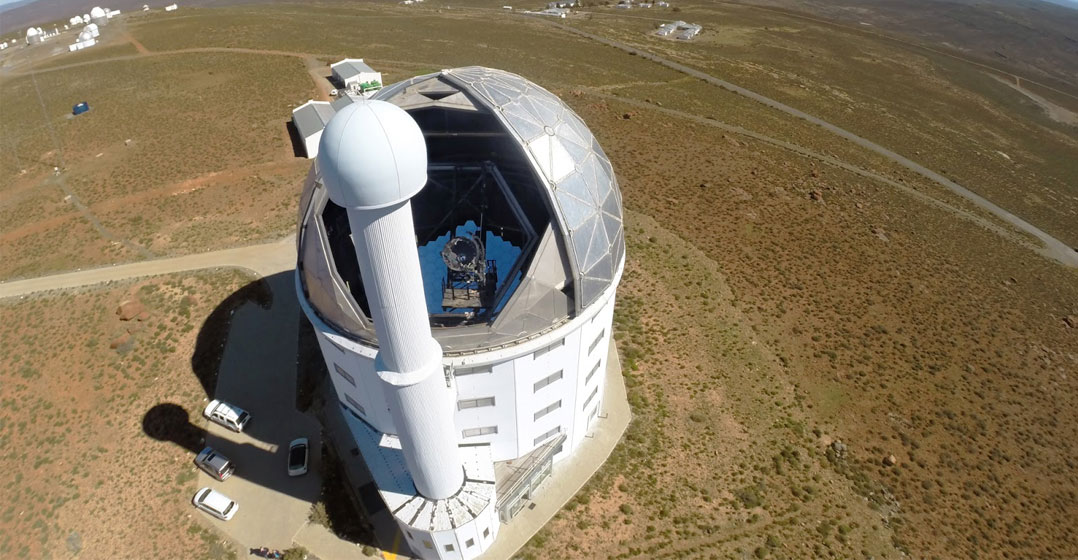
    The Salt telescope from above. Image: saltastro.blogspot.co.za

    The effects of that explosion travelled at the speed of light and reached earth on 16 August and were detected by the US-based Laser Interferometer Gravitational-Wave Observatory (LIGO) and the European-based Virgo detector.

    Subsequent observations by Salt and other telescopes in Sutherland have played a similar role in understanding that event. For the first time, local astronomers have been able to identify and study the source of the gravitational wave event.

    The collision also resulted in an explosion of light, initially in the form of gamma rays, which were detected by space-based telescopes. The gamma rays were then followed by X-rays, ultraviolet, optical, infrared and radio waves.

    After a flurry of messages and e-mails that afternoon in Sutherland, I finally got the coordinates. There was a new object, which had caused the whole of space/time to ripple

    This allowed astronomers to localise the event within hours and launch follow-up observations by Salt and numerous other telescopes in South Africa and around the world.

    Making an announcement earlier on, Cunnama said: “These extremely small and dense objects are the remains of giant stars that have exploded as supernovae and more mass than the sun is compressed into a sphere that is about the size of a city. These neutron stars are commonly found in pairs and Einstein’s theory of general relativity predicts that these incredibly large objects should produce detectable gravitational waves when they merge.”

    The first detection of gravitational waves, made on 14 September 2015 and announced on 11 February 2016, was a milestone in physics and astronomy. It confirmed a major prediction of the general theory of relativity, and marked the beginning of the new field of gravitational-wave astronomy.

    Since the first detection, there have been three more confirmed.

    On 3 October, the three leaders of the research — physicists Rainer Weiss of the Massachusetts Institute of Technology, and Barry Barish and Kip Thorne of the California Institute of Technology — were awarded the 2017 Nobel Prize in Physics for their work on gravitational waves.

    Busy day

    Petri Vaisanen, head of Salt astronomy operations, who was the observer stationed at the Salt telescope, said 18 August — the day after the LIGO detection — was a busy day at the Karoo site.

    “After a flurry of messages and e-mails that afternoon in Sutherland, I finally got the coordinates. There was a new object, which had caused the whole of space/time to ripple, sitting at the outskirts of the galaxy NGC 4993.

    “I knew that everyone with a working telescope in the southern hemisphere was scrambling to get data on it. We decided to drop all other plans for that evening, and went for a spectral observation with Salt, since you need a large telescope for such observations breaking up the light into all its colours.

    “It was a difficult observation since we had to do it in twilight, before it got properly dark. I’m very proud of the whole team. Salt was only the third observatory to provide a spectrum of the target, and the first spectrum that clearly started showing anomalous behaviour proving that this was no run-of-the-mill transient event.”  — SAnews
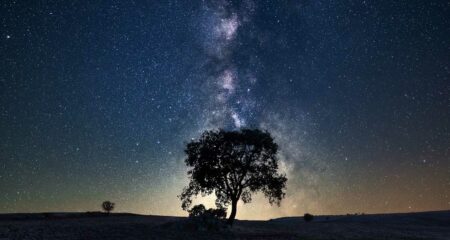


    Salt top
    WhatsApp YouTube Follow on Google News Add as preferred source on Google
    Share. Facebook Twitter LinkedIn WhatsApp Telegram Email Copy Link
    Previous ArticleZuma targets nuclear revival in shock cabinet shake-up
    Next Article Interview: Simon Brown on investing in tech stocks

    Related Posts

    South African telescope solves mystery of 'doomed' giant star

    South African telescope solves mystery of ‘doomed’ giant star

    22 January 2026
    Salt telescope

    South Africa’s flagship telescope turns 20

    2 December 2025

    18GW in unplanned breakdowns cripple Eskom

    2 November 2021
    Company News

    Why Acer is the strategic choice for South Africa’s educational future

    11 February 2026
    Fyndae is building Africa's human verification layer for community security and collaboration

    Fyndae wants to turn lost-item recovery into Africa’s trust infrastructure

    11 February 2026
    How NEC XON tackled identity risk for a major telco - Michael de Neuilly Rice

    How NEC XON tackled identity risk for a major telco

    11 February 2026
    Opinion
    South Africa's skills advantage is being overlooked at home - Richard Firth

    South Africa’s skills advantage is being overlooked at home

    29 January 2026
    Why Elon Musk's Starlink is a 'hard no' for me - Songezo Zibi

    Why Elon Musk’s Starlink is a ‘hard no’ for me

    26 January 2026
    South Africa's new fibre broadband battle - Duncan McLeod

    South Africa’s new fibre broadband battle

    20 January 2026

    Subscribe to Updates

    Get the best South African technology news and analysis delivered to your e-mail inbox every morning.

    Latest Posts
    Broadband Infraco in limbo

    Broadband Infraco in limbo

    11 February 2026

    Why Acer is the strategic choice for South Africa’s educational future

    11 February 2026
    Home affairs' R10 ID fee is forcing companies to rethink identity verification

    Standard Bank joins smart ID push with fee-free launch

    11 February 2026
    Zscaler assets seized from South African data centres

    Zscaler assets seized from South African data centres

    11 February 2026
    © 2009 - 2026 NewsCentral Media
    • Cookie policy (ZA)
    • TechCentral – privacy and Popia

    Type above and press Enter to search. Press Esc to cancel.

    Manage consent

    TechCentral uses cookies to enhance its offerings. Consenting to these technologies allows us to serve you better. Not consenting or withdrawing consent may adversely affect certain features and functions of the website.

    Functional Always active
    The technical storage or access is strictly necessary for the legitimate purpose of enabling the use of a specific service explicitly requested by the subscriber or user, or for the sole purpose of carrying out the transmission of a communication over an electronic communications network.
    Preferences
    The technical storage or access is necessary for the legitimate purpose of storing preferences that are not requested by the subscriber or user.
    Statistics
    The technical storage or access that is used exclusively for statistical purposes. The technical storage or access that is used exclusively for anonymous statistical purposes. Without a subpoena, voluntary compliance on the part of your Internet Service Provider, or additional records from a third party, information stored or retrieved for this purpose alone cannot usually be used to identify you.
    Marketing
    The technical storage or access is required to create user profiles to send advertising, or to track the user on a website or across several websites for similar marketing purposes.
    • Manage options
    • Manage services
    • Manage {vendor_count} vendors
    • Read more about these purposes
    View preferences
    • {title}
    • {title}
    • {title}