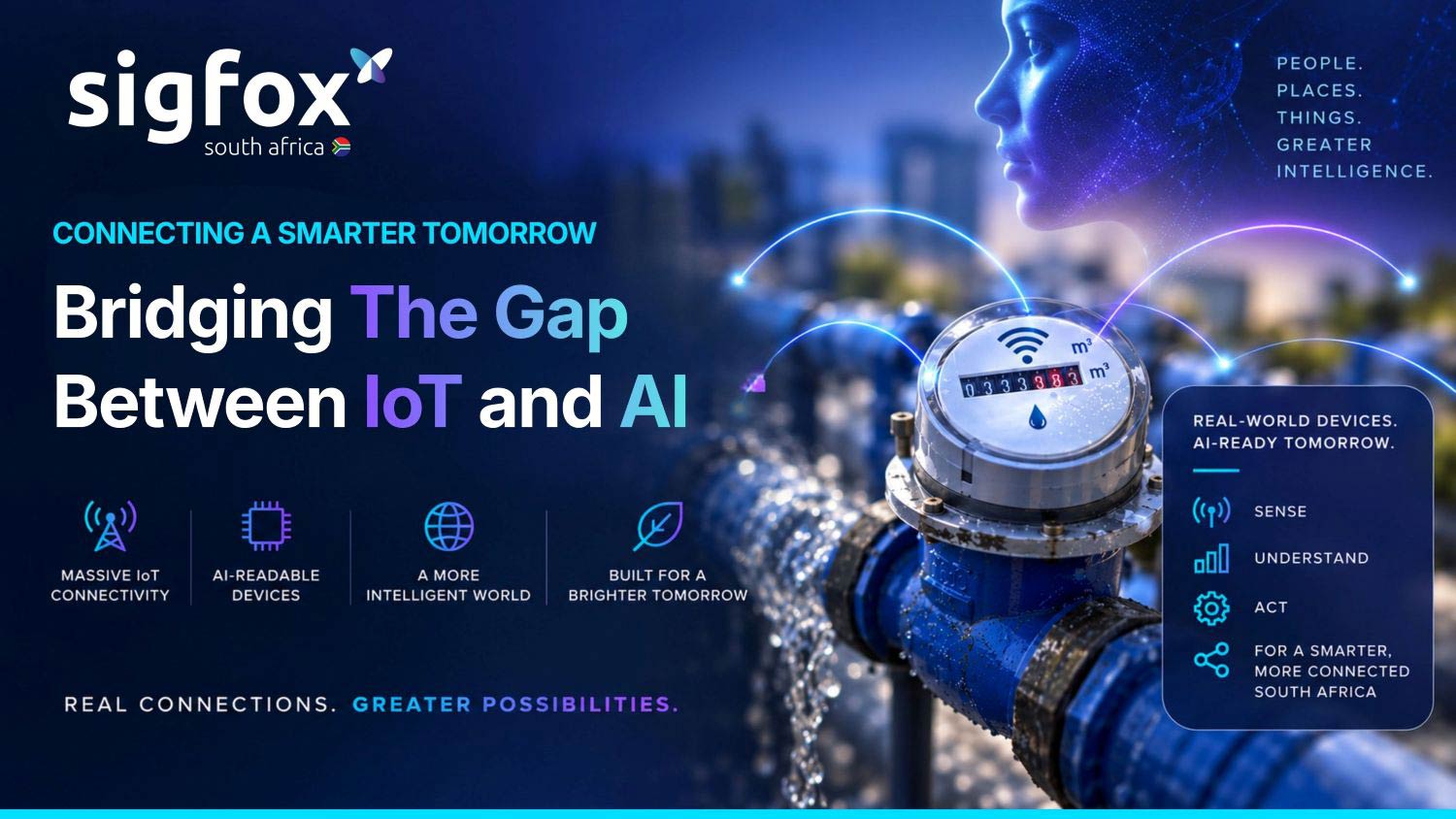
Anthropic introduced the Model Hardware Standard (MHS) on 27 August 2026, a shared specification designed to let AI agents safely operate and interact with physical equipment. Developed initially in collaboration with HHMI Janelia Research Campus, it is being made available through a limited, application-only research preview to scientific research laboratories and advanced manufacturers.
“AI has changed the way we interact with the data coming out of environments, both from a historical reporting function as well as predicting potential future events,” says Gregory Rood, CEO of Sigfox South Africa. “This has been made possible by the ability to consume data and generate multiple different outcomes or reports at a rate not humanly possible a few years ago.
Engage today with Sigfox South Africa
“Therefore the idea of creating a standardised platform that could potentially allow for plug-and-play devices to be integrated into an AI-enabled universe on the go has so many exciting opportunities for business in Africa that we, as the only true open-access IoT network, felt it extremely important to engage in this initiative and provide a blueprint at the outset of what we provide as an LPWAN network operator.”
For the internet of things, the implications could be significant.
Today, connecting a physical device is only one part of creating an intelligent IoT solution. Devices, sensors and machines frequently use different payload structures, interfaces, commands and data models. Applications therefore need to be specifically configured to understand what each device is, what information it generates and how that information should be interpreted.
MHS is designed to help standardise this interaction. Through an MHS-compatible driver, a device can describe itself in a structured format: what it can measure, what actions can be performed, what parameters can be adjusted and what operating or safety limitations need to be observed. AI agents can then discover the device and use that information without requiring an entirely bespoke software integration for every piece of hardware.
Giving AI a clearer view of the physical world
This presents a natural opportunity for the IoT ecosystem surrounding Sigfox 0G technology.
Sigfox is designed to connect large numbers of low-power devices and sensors and transport small amounts of device data efficiently from the physical environment into digital platforms. The global Sigfox 0G ecosystem currently connects more than 14 million devices across more than 70 countries.
By combining this connectivity layer with an emerging hardware standard such as MHS, the industry has an opportunity to make that device information considerably easier for AI systems to consume and act upon.
Rather than an AI application simply receiving an unfamiliar payload of bytes from a sensor, an MHS-enabled implementation could provide the context needed to understand what the device is, what it measures, what the incoming values represent and what capabilities are available.
AI agents such as Claude could then use that structured information as part of a wider AI workflow, analysing device data, identifying anomalies, interpreting conditions or coordinating actions across connected systems.

MHS itself is model-agnostic. Anthropic states that the standard is intended to work with different AI agents and can be accessed through mechanisms including the Model Context Protocol, command-line interfaces and APIs.
From connected devices to AI-readable devices
For electronic engineers and IoT device manufacturers, this could represent an important shift in how future hardware is designed.
Engineering teams have historically focused on questions such as connectivity, radio performance, battery life, sensing capability and device certification. The emergence of standards such as MHS introduces another consideration: how easily can an AI agent understand and interact with the device?
As the standard develops, manufacturers may increasingly choose to make their hardware MHS-compatible from the design stage, enabling devices to describe their functionality to AI systems through a consistent interface.
For Sigfox device manufacturers, this could create a powerful combination: low-power, long-range Sigfox connectivity together with an AI-readable hardware interface. The result is a potential progression from simply connecting the physical world to making the physical world understandable to AI.
Sigfox South Africa joins the conversation
Sigfox South Africa has applied to take part in the MHS research preview, with a particular interest in exploring how the standard could be applied within the massive IoT ecosystem.
The focus is not on replacing existing Sigfox device standards, certification processes or payload structures. Instead, MHS could provide an additional abstraction layer through which AI agents can understand the devices, data and capabilities already connected through the Sigfox ecosystem.
This distinction is important. A Sigfox device would not automatically become AI-enabled simply because it uses the Sigfox network. Instead, an MHS-compatible interface or driver could provide the machine-readable context that allows an AI agent such as Claude to understand that device and interact with its information in a consistent way.
That opens interesting possibilities across sectors including utilities, asset tracking, logistics, agriculture, environmental monitoring, security and industrial operations.
A water meter, for example, could potentially expose not only a reading but also the fact that it is a water meter, the unit of measurement, its operating parameters and relevant device information. An AI agent could use that contextual information alongside historical data and business rules to help identify abnormal consumption, potential leaks or other conditions requiring attention. Connected temperature sensors, tracking devices and industrial monitoring equipment could similarly become easier to incorporate into AI-driven operational workflows.
Building for an AI-first IoT future
Anthropic says MHS is currently an early research preview, with partners helping test the specification, establish safety evaluations and develop best practices before the standard is eventually made open source. That means the technology is still developing. But the direction is significant.
As AI moves beyond analysing information stored in databases and begins interacting more directly with physical systems, the ability for machines to describe themselves to AI in a consistent and safe manner could become increasingly important.
For Sigfox South Africa, engaging at this early stage is about ensuring that the requirements and realities of low-power, large-scale IoT deployments form part of that discussion.
The next evolution of IoT may not simply be about connecting more things. It may be about making those things understandable to AI. By bringing together efficient Sigfox 0G connectivity, intelligent devices and emerging AI hardware standards such as MHS, the physical and digital worlds have the potential to become considerably more closely connected.
- Read more articles by Sigfox South Africa on TechCentral
- This promoted content was paid for by the party concerned