Close Menu
TechCentralTechCentral

    Subscribe to the newsletter

    Get the best South African technology news and analysis delivered to your e-mail inbox every morning.

    Facebook X (Twitter) YouTube LinkedIn
    WhatsApp Facebook X (Twitter) LinkedIn YouTube
    TechCentralTechCentral
    • News
      Blu Label says MTN is coming for its Capitec business - Brett Levy

      Blu Label says MTN is coming for its Capitec business

      26 August 2026
      Blu Label is trading token margin for lost electricity - Mark Levy

      Blu Label’s 400MW electricity plan finally has projects attached

      26 August 2026
      Blu Label's R46-billion electricity squeeze

      Blu Label’s R46-billion electricity squeeze

      26 August 2026
      Apple's new Mac mini chases the home AI agent boom

      Apple’s new Mac mini chases the home AI agent boom

      26 August 2026
      300 million Sims a year for 60 million South Africans - Ferdi Moolman

      300 million Sims a year for 65 million South Africans

      25 August 2026
    • World
      AI-generated music banned from Australian charts

      AI-generated music banned from Australian charts

      26 August 2026
      Russia building its own Starlink - and faster than expected - Vadym Skibitskyi

      Russia building its own Starlink – and faster than expected

      11 August 2026
      Meta AI will now tell parents if their teen is in crisis

      Meta AI will now tell parents if their teen is in crisis

      17 July 2026
      IBM shares crash 25% as AI upends software spending - Arvind Krishna

      IBM shares crash 25% as AI upends software spending

      15 July 2026
      Jony Ive's first OpenAI device: an AI smart speaker - Jony Ive and Sam Altman

      Jony Ive’s first OpenAI device: an AI smart speaker

      15 July 2026
    • In-depth
      Google DeepMind CEO Demis Hassabis. Image: John Sears

      The plan to stop AI from breaking the world

      16 July 2026
      The internet has a Strait of Hormuz problem

      The internet has a Strait of Hormuz problem

      15 July 2026
      AI boom sparks rally, frenzy and fear

      AI boom sparks rally, frenzy and fear

      11 June 2026
      Every plug-in hybrid on sale in South Africa, ranked by price - Lamborghini Temerario

      Every plug-in hybrid on sale in South Africa, ranked by price

      7 June 2026
      What Wi-Fi 8 will mean for wireless networks

      What Wi-Fi 8 will mean for wireless networks

      1 June 2026
    • TCS
      Watts & Wheels S1E8: 'Tesla lands in Africa, just not here'

      Watts & Wheels S1E8: ‘Tesla lands in Africa, just not here’

      24 August 2026
      Meet the CIO | Discovery's Derek Wilcocks on AI, guardrails and growth

      Meet the CIO | Derek Wilcocks on how AI personalised Vitality

      13 August 2026
      TCS | Money just became native to the internet - Steven Boykey Sidley

      TCS | Money just became native to the internet – Steven Boykey Sidley

      12 August 2026
      TCS+ | Specops' Darren James on continuous trust in an AI world

      TCS+ | Specops’ Darren James on continuous trust in an AI world

      7 August 2026
      TCS+ | How AI is turning hardware into a subscription service - Shane van der Merwe Merchant West

      TCS+ | How AI is turning hardware into a subscription service

      6 August 2026
    • Opinion
      The author, Jannie van Zyl

      Selling vapour is corporate suicide in slow motion

      16 July 2026
      Brazil's online gambling crackdown is a lesson for South Africa

      How Amazon outmanoeuvred Starlink in South Africa

      15 July 2026
      The Popia problem with agentic AI - Herman Haasbroek

      The Popia problem with agentic AI

      14 July 2026
      The author, Fanie van Rooyen

      South Africa can still catch the AI wave – here’s how

      7 July 2026
      The author, Fanie van Rooyen

      The AI utopia South Africa can’t afford

      1 July 2026
    • Company Hubs
      • 1Stream
      • Africa Data Centres
      • AfriGIS
      • Altron Digital Business
      • Altron Document Solutions
      • Altron Group
      • Arctic Wolf
      • Ascent Technology
      • AvertITD
      • BBD
      • Braintree
      • CallMiner
      • CambriLearn
      • CM Telecom
      • Contactable
      • CYBER1 Solutions
      • Digicloud Africa
      • Digimune
      • Domains.co.za
      • ESET
      • Euphoria Telecom
      • HOSTAFRICA
      • Incredible Business
      • iONLINE
      • IQbusiness
      • Iris Network Systems
      • Kaspersky
      • LSD Open
      • Mitel
      • NEC XON
      • Netstar
      • Network Platforms
      • Next DLP
      • Ovations
      • Paracon
      • Paratus
      • Q-KON
      • SevenC
      • SkyWire
      • Solid8 Technologies
      • Telit Cinterion
      • Telviva
      • Tenable
      • Vertiv
      • Videri Digital
      • Vodacom Business
      • Vox
      • Wipro
      • Workday
      • XLink
    • Sections
      • AI and machine learning
      • Banking
      • Broadcasting and Media
      • Cloud services
      • Contact centres and CX
      • Cryptocurrencies
      • Education and skills
      • Electronics and hardware
      • Energy and sustainability
      • Enterprise software
      • Financial services
      • HealthTech
      • Information security
      • Internet and connectivity
      • Internet of Things
      • Investment
      • IT services
      • Lifestyle
      • Policy and regulation
      • Public sector
      • Retail and e-commerce
      • Satellite communications
      • Science
      • SMEs and start-ups
      • Social media
      • Talent and leadership
      • Telecoms
      • Watts & Wheels
    • Events
    • Advertise
    TechCentralTechCentral
    Home » Top » Sony finally pulls plug on Betamax

    Sony finally pulls plug on Betamax

    By The Conversation15 November 2015
    Twitter LinkedIn Facebook WhatsApp Email Telegram Copy Link
    News Alerts
    WhatsApp

    betamax-640

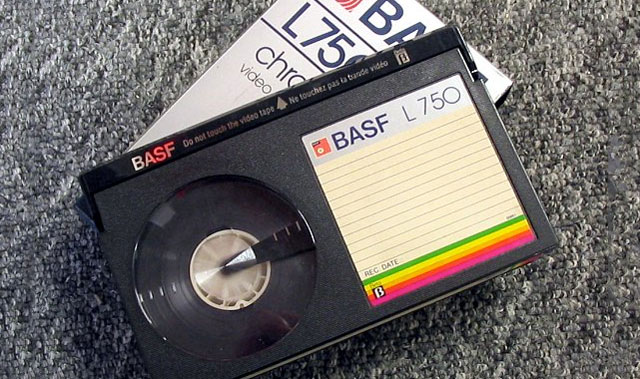
    Sony announced this week that it will stop selling Betamax cassettes from March 2016. It was a format that appeared not to succeed as Sony had desired.

    Betamax was introduced by Sony on 16 April 1975 with the SL-6300 video cassette recorder (VCR) deck and the LV-1801, a television/VCR combination unit that incorporated the SL-6300 and an 18-inch Trinitron colour television.

    The name Betamax came from combining “beta”, a Japanese word which described the recording process, with “max”, which came from the tape path when viewed from above closely resembling the Greek letter of beta.

    Developing the technology was only the first battle. Sony had to also convince the consumers that this new technology should be introduced into their homes.

    For Sony, the uptake of television was on its side. At the time of introducing the new Betamax VCR desk, more than 90% of Japanese households had a colour television. With the release of Betamax television, time-shift viewing, a term commonly used in association with television viewing today, commenced and allowed the public to “watch, whatever, whenever” on their television.

    The concept of time-shifting and recording content created tension between Sony and content creators. Universal Studios and Walt Disney were two of the film industry corporations that attempted to bring an end to video recording technology, in a US court case battle.

    The district court found:

    Even if it were deemed that home-use recording of copyrighted material constituted infringement, the Betamax could still legally be used to record non-copyrighted material or material whose owners consented to the copying. An injunction would deprive the public of the ability to use the Betamax for this non-infringing off-the-air recording.

    Despite appeals, the supreme court agreed and the Betamax ruling still has implications today for the manufacturers of technology designed for legitimate use, but which can also be used to infringe copyright.

    The debate of the VCR’s impact on various media industries continued into the 1980s. But Betamax didn’t just have to battle public uptake and the legalities, it also battled a competing format.

    VHS killed the Betamax
    A year after the release of Betamax, the rival Japanese tech manufacturer JVC released its own VCR format called Video Home System, better known as VHS.

    Sony argued that JVC’s VHS incorporated the Betamax format. This was due to Sony freely disclosing information about Betamax to JVC, in a hope to unify their product specifications. Another Japanese tech manufacturer Matsushita was also approached.

    Despite their similarities, the two formats differed in size and were incompatible. This created a battle between the two formats around the home VCR market.

    The success of VHS over the rival Betamax was evident in the US. In its first year of sales, VHS took 40% of Sony’s business. By 1987, 90% of the US$5,2bn VCR market sales were VHS. Furthermore, by 1988, 170m VCR’s had been sold worldwide, of which only 20m (12%) were Betamax.

    Sony admitted defeat and by 1988 commenced selling the VHS format in conjunction with its Betamax format.

    There are many arguments put forward as to why VHS won the battle. Was it due to the fact that VHS could record two hours, double that of Betamax? Was it the marketing of VHS, or simply due to “the whole product” doing want consumers wanting for the right price?

    The media format wars had not finished by any means. Now the format battle was associated with disc media. Recently there has been the battle of high-definition DVDs: Sony’s Blu-ray versus Toshiba’s HD-DVD. This time Sony won.
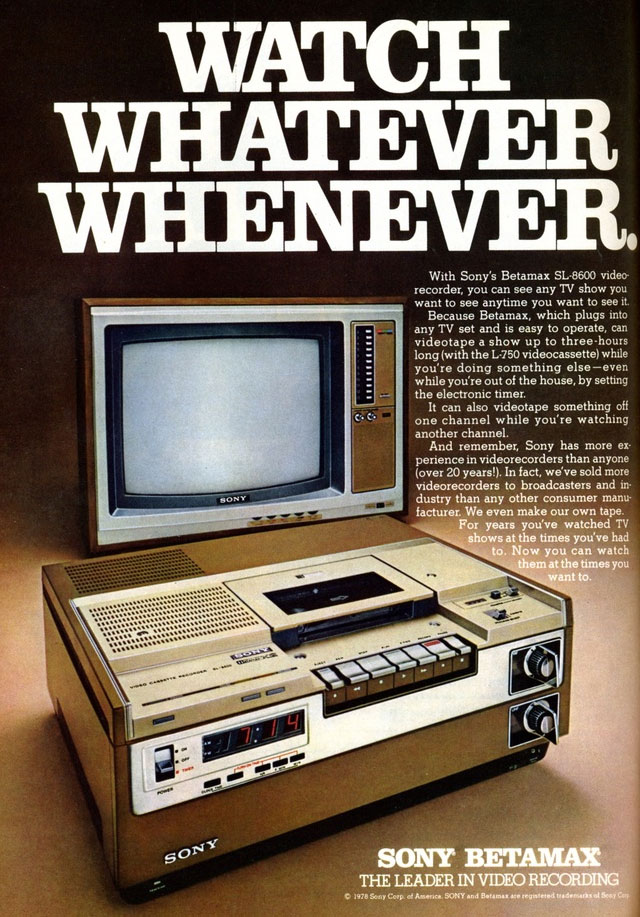
    An early advertisement for Sony Betamax
    An early advertisement for Sony Betamax

    Sony has also recently announced the arrival of its Ultra HD Blu-ray opening the battle grounds of the ultra-high-definition (4K) disc market.

    But in a digital world, consumers are watching their video content via the Internet, across multiple screens with no physical media, tape, disc or otherwise.

    So do all of these formats matter anymore? Will disc media die? Will varying formats become less of an issue in a digital world?

    Digital video compression was first associated with H.120 in 1984 and since then there have been several improvements in image quality. This is without looking at the variation in file extensions.

    Format wars will not go away anytime soon. Unlike the battle of physical media, where a consumer would purchase one device which was associated with one format, digital allows one device that can access multiple formats.

    While some may argue this to be a positive, this choice in digital formats may create more frustration for consumers. To watch content, they may be required to change the software, upgrade the software or download specific software associated with that video format.

    From a professional perspective, no longer can producers of video content think about a singular platform, but must make sure that the content is available across a number of platforms, in a number of formats, which all have individual specifications.

    These various changes in media formats have all occurred in the 40 years since Sony’s Betamax was released. Where will the format wars be in 40 years’ time?The Conversation

    • Marc C-Scott is lecturer in screen media at Victoria University
    • This article was originally published on The Conversation

    Follow TechCentral on Google News Add TechCentral as your preferred source on Google


    Betamax JVC Mark C-Scott Sony Sony Betamax VHS
    WhatsApp YouTube
    Share. Facebook Twitter LinkedIn WhatsApp Telegram Email Copy Link
    Previous ArticleHow TensorFlow move could transform AI
    Next Article Bigger rivals should fear Telkom, Cell C deal

    Related Posts

    GTA VI and the weight of hype

    GTA VI and the weight of hype

    7 July 2026
    South Africa's right-to-repair vacuum

    South Africa’s right-to-repair vacuum

    27 May 2026
    Nvidia's RTX 5090 GPU in already as rare as hen's teeth

    Global GPU shortage set to deepen gaming industry woes

    27 February 2026
    Company News
    Red Hat validates LSD Open for virtual machine migrations

    Red Hat validates LSD Open for virtual machine migrations

    26 August 2026
    Agentic AI is turning WhatsApp into a sales channel - CM.com

    Agentic AI is turning WhatsApp into a sales channel

    26 August 2026
    What African and EU firms must know about data residency - BBD Software

    What African and EU firms must know about data residency

    26 August 2026
    Opinion
    The author, Jannie van Zyl

    Selling vapour is corporate suicide in slow motion

    16 July 2026
    Brazil's online gambling crackdown is a lesson for South Africa

    How Amazon outmanoeuvred Starlink in South Africa

    15 July 2026
    The Popia problem with agentic AI - Herman Haasbroek

    The Popia problem with agentic AI

    14 July 2026

    Subscribe to Updates

    Get the best South African technology news and analysis delivered to your e-mail inbox every morning.

    Latest Posts
    Blu Label says MTN is coming for its Capitec business - Brett Levy

    Blu Label says MTN is coming for its Capitec business

    26 August 2026
    Blu Label is trading token margin for lost electricity - Mark Levy

    Blu Label’s 400MW electricity plan finally has projects attached

    26 August 2026
    Red Hat validates LSD Open for virtual machine migrations

    Red Hat validates LSD Open for virtual machine migrations

    26 August 2026
    Agentic AI is turning WhatsApp into a sales channel - CM.com

    Agentic AI is turning WhatsApp into a sales channel

    26 August 2026
    © 2009 - 2026 NewsCentral Media
    Built and maintained by Chronon
    • Cookie policy (ZA)
    • TechCentral – privacy and Popia

    Type above and press Enter to search. Press Esc to cancel.

    Manage consent

    TechCentral uses cookies to enhance its offerings. Consenting to these technologies allows us to serve you better. Not consenting or withdrawing consent may adversely affect certain features and functions of the website.

    Functional Always active
    The technical storage or access is strictly necessary for the legitimate purpose of enabling the use of a specific service explicitly requested by the subscriber or user, or for the sole purpose of carrying out the transmission of a communication over an electronic communications network.
    Preferences
    The technical storage or access is necessary for the legitimate purpose of storing preferences that are not requested by the subscriber or user.
    Statistics
    The technical storage or access that is used exclusively for statistical purposes. The technical storage or access that is used exclusively for anonymous statistical purposes. Without a subpoena, voluntary compliance on the part of your Internet Service Provider, or additional records from a third party, information stored or retrieved for this purpose alone cannot usually be used to identify you.
    Marketing
    The technical storage or access is required to create user profiles to send advertising, or to track the user on a website or across several websites for similar marketing purposes.
    • Manage options
    • Manage services
    • Manage {vendor_count} vendors
    • Read more about these purposes
    View preferences
    • {title}
    • {title}
    • {title}