
Close Menu
TechCentralTechCentral

    Subscribe to the newsletter

    Get the best South African technology news and analysis delivered to your e-mail inbox every morning.

    Facebook X (Twitter) YouTube LinkedIn
    WhatsApp Facebook X (Twitter) LinkedIn YouTube
    TechCentralTechCentral
    • News
      Top SA computer scientist on IBM's chip breakthrough

      Top SA computer scientist on IBM’s chip breakthrough

      26 June 2026
      Telcos agree plan to tighten Sim registration under Rica

      Telcos agree plan to tighten Sim registration under Rica

      26 June 2026
      Gigabit fibre arrives in Joburg township for R5/day - Alan Knott-Craig

      Gigabit fibre arrives in Joburg township for R5/day

      26 June 2026
      Standard Bank deal cuts the dollar out of China trade

      Standard Bank deal cuts the dollar out of China trade

      26 June 2026
      Starlink lines up a frontal assault on mobile operators

      Starlink lines up a frontal assault on mobile operators

      26 June 2026
    • World

      SK Hynix ends Samsung’s 26-year reign at the top

      22 June 2026
      Google on the hook for what its AI tells users, court rules

      Google on the hook for what its AI tells users, court rules

      15 June 2026
      How Russians juggle VPNs to outwit the Kremlin

      How Russians juggle VPNs to outwit the Kremlin

      15 June 2026
      Amazon CEO flagged Anthropic AI risks to Washington - Andy Jassy

      Amazon CEO flagged Anthropic AI risks to Washington

      14 June 2026
      Trouble at Xbox

      Trouble at Xbox

      11 June 2026
    • In-depth
      AI boom sparks rally, frenzy and fear

      AI boom sparks rally, frenzy and fear

      11 June 2026
      Every plug-in hybrid on sale in South Africa, ranked by price - Lamborghini Temerario

      Every plug-in hybrid on sale in South Africa, ranked by price

      7 June 2026
      What Wi-Fi 8 will mean for wireless networks

      What Wi-Fi 8 will mean for wireless networks

      1 June 2026
      Alfa's electric rebel - Alfa Romeo Junior Elettrica Veloce

      Alfa’s electric rebel

      29 April 2026
      Africa switches on as Europe dims the lights

      Africa switches on as Europe dims the lights

      9 April 2026
    • TCS
      Watts & Wheels S1E6: 'A flawless Alfa and a bakkie that divides'

      Watts & Wheels S1E6: ‘A flawless Alfa and a bakkie that divides’

      17 June 2026
      Watts & Wheels S1E6: 'A flawless Alfa and a bakkie that divides'

      Watts & Wheels S1E5: ‘A Bentley of the bush and a car that swims’

      8 June 2026
      TCS | Charge's R1.8-billion bet on an off-grid EV future - Charge chairman Joubert Roux

      TCS | Charge’s R1.8-billion bet on an off-grid EV future

      18 May 2026
      TCS+ | The Up&Up Group on the hidden cost of AI - Jason Harrison

      TCS+ | The Up&Up Group on the hidden cost of AI

      13 May 2026
      Michael Rossouw

      TCS+ | The retirement decision most South Africans get wrong

      6 May 2026
    • Opinion
      The pivot South Africa's MVNOs cannot afford to miss

      The pivot South Africa’s MVNOs cannot afford to miss

      23 June 2026
      Brazil's online gambling crackdown is a lesson for South Africa

      Brazil’s online gambling crackdown is a lesson for South Africa

      22 June 2026
      Finish the job Mandela started - Farzam Ehsani

      Finish the job Mandela started

      18 June 2026
      The author, Fanie van Rooyen

      The US just showed it can switch off our AI

      17 June 2026
      The pivot South Africa's MVNOs cannot afford to miss

      The clock is ticking on South African banks’ biggest advantage

      9 June 2026
    • Company Hubs
      • 1Stream
      • Africa Data Centres
      • AfriGIS
      • Altron Digital Business
      • Altron Document Solutions
      • Altron Group
      • Arctic Wolf
      • Ascent Technology
      • AvertITD
      • BBD
      • Braintree
      • CallMiner
      • CambriLearn
      • CM Telecom
      • Contactable
      • CYBER1 Solutions
      • Digicloud Africa
      • Digimune
      • Domains.co.za
      • ESET
      • Euphoria Telecom
      • HOSTAFRICA
      • Incredible Business
      • iONLINE
      • IQbusiness
      • Iris Network Systems
      • Kaspersky
      • LSD Open
      • Mitel
      • NEC XON
      • Netstar
      • Network Platforms
      • Next DLP
      • Ovations
      • Paracon
      • Paratus
      • Q-KON
      • SevenC
      • SkyWire
      • Solid8 Technologies
      • Telit Cinterion
      • Telviva
      • Tenable
      • Vertiv
      • Videri Digital
      • Vodacom Business
      • Wipro
      • Workday
      • XLink
    • Sections
      • AI and machine learning
      • Banking
      • Broadcasting and Media
      • Cloud services
      • Contact centres and CX
      • Cryptocurrencies
      • Education and skills
      • Electronics and hardware
      • Energy and sustainability
      • Enterprise software
      • Financial services
      • HealthTech
      • Information security
      • Internet and connectivity
      • Internet of Things
      • Investment
      • IT services
      • Lifestyle
      • Motoring
      • Policy and regulation
      • Public sector
      • Retail and e-commerce
      • Satellite communications
      • Science
      • SMEs and start-ups
      • Social media
      • Talent and leadership
      • Telecoms
    • Events
    • Advertise
    TechCentralTechCentral
    Home » In-depth » Technology could tear apart the nation state

    Technology could tear apart the nation state

    By The Conversation12 February 2015
    Twitter LinkedIn Facebook WhatsApp Email Telegram Copy Link
    News Alerts
    WhatsApp

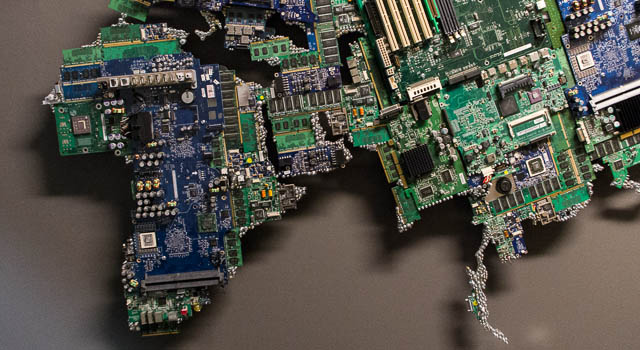
    Africa wrap map 640

    Throughout history, whenever new technologies have emerged that change our means of production and ability to communicate they have tended to transform society. The rapid technological development of the past century — in biotechnology, IT, nanotechnology and artificial intelligence — holds the promise to do the same for our post-industrial world.

    Our political institutions, the rule of law, human rights, the banking system, our education system — and even capitalism itself — are products of the industrial age. We have learnt to navigate the industrial economy as individuals, and as societies we can exert some control to define its shape and limits.

    But what comes next, in a post-industrial world? Even in the past decade, digital products and services, the Internet and mobile technology have changed our lives. This is the result of accumulated advances over the past 50 years; there is much more to come. For example, recent studies indicate that digitisation is likely to replace about half of known jobs within 20 years.

    In the industrial economy, more was better — but now this is not always the case. The developed world is sick from overeating, while greater productivity leads to cheaper goods and greater consumption, which squanders Earth’s resources ever faster and fosters a wasteful, consumption-based economy. Instead, a future economy would strive to provide a world of plenty, with virtually no waste.

    It is the convergence of cutting-edge biotech, infotech, nanotech, and cognitive sciences (Binc) that will be at the heart of the living and intelligent technologies of tomorrow.

    As technology becomes more lifelike more components can be recycled, in the same way that materials are within biological systems. Thanks to automation, only a small percentage of the population will be needed to produce and distribute what everybody needs. For example, today only about 2% of the Danish population is engaged in agriculture and fishery, down from almost everybody some 150 years ago — and these 2% can feed several countries the size of Denmark. With the development of personal fabricators — super-advanced 3D printers — it’s likely citizens will be able to design, manufacture and recycle pretty much everything they need at home.

    The Binc technologies are likely to lead to big changes in society, just as computerisation has been the driving force for the past 50 years. This could be as drastic as the differences between the Stone Age and the Bronze Age, or from agricultural society to the scientific age of industry. Inevitably, such a shift leads to changes in economic and political systems, national sovereignty, balances of power, the environment, the human condition, even religion. But this time the changes will not take place over hundreds of years, but within a generation or so.

    What is bringing about this change now? We believe four interacting patterns indicate what is underway.

    1. A digital economy
    The digital economy is fundamentally different. Digital products and services account for an increasing part of the economy, yet only the first unit requires capital and labour — subsequent digital copies are practically free of cost. Such digitisation and automation removes more jobs than it creates, driving demand for highly skilled individuals and competition for scarcer middle and low-grade jobs. With virtually none of the transportation costs you would get with physical products, on the Internet such products are immediately global, and the best product takes all — look at the dominance of Facebook, Google and Microsoft over their rivals.

    2. An eroding middle class and democracy
    As recently documented by Thomas Piketty, the erosion of the middle class in all developed economies. The gap between the middle class and the super-rich widens, concentrating wealth and political power among the elites. In today’s financial economy, there is greater return on investment in speculation than in production; being rich is a surer path to wealth than working.

    With about half of middle class jobs disappearing, nation states will lose much of their tax revenue. Unless we radically rethink taxation, this will fundamentally change the economic foundation upon which democratic states are governed.

    As economic and political elites converge, political power is concentrated in progressively fewer hands. This power grab is supported by the information infrastructure, through which citizens’ personal data can be monitored and accessed, eroding privacy, civil and democratic rights.

    3. One world
    Global challenges are beyond the powers of individual nations. For example, the CO2 generated in one country affects the entire planet; there is only one environment — and the transition to a sustainable energy system must be a global one.

    As information, people and capital travel with increasing freedom around the world, the planet is gradually redefined from some 200 national economies to one global economy, for which there is no common law. Businesses can re-home themselves in low- or no-tax states — this leads to a race to the bottom with competing nations cutting corporate tax rates even as income tax revenues dwindle. Single states will no longer be able to take care of their citizens alone.

    As nations become more interconnected, this will also lead to difficulties in how to align their often radically different economic, cultural and governmental structures — for example, between traditional Arabic, industrial Russian and modern, digitised Scandinavian.

    4. The need for new narratives
    The 19th and 20th centuries saw the struggle between capital and workers play out across the left-right political spectrum, but today this distinction is weak. In the West, there is some broad agreement based around a vision of the open society, a liberal democracy, market economy and public welfare. But in other regions of the world, any such broad agreement is around different, even contradictory concepts.

    Technological change is so rapid that it has outstripped political and legal frameworks, changing the way the economy or even society works before the law can catch up. The converging Binc technologies will accelerate this process into something we have difficulty imagining. And as yet there are no global institutions that can handle this transformation.

    The grand narratives which used to keep societies together — religion, nation and class — are losing their power to guide and explain the world, and are sometimes used for the support of totalitarian regimes. In fact, the only grand narrative that has survived is “the free market”: it can provide consumer goods efficiently, but it is incapable of solving any of our current problems. If anything, it fuels them.

    The new Binc age
    To create sustainable economies, preserve human dignity and avoid social conflict, these issues must be at the forefront of national and international politics. In a world in which knowledge is viewed as an indisputable asset, we must put it to work to understand this global transformation and develop sustainable paths for the future. Continuing to cling to the belief that only free markets and nation states will resolve our current dilemmas is naïve. We need to recognise reality as it is — not as it once was.

    With the right political, legal and economic structures and institutions in place, the convergence of Binc technologies can promise meaningful work, leisure time, prosperity and freedom for all. Conversely, apathy and avarice could see this transition bring our world into a new dark age, a dystopia controlled by a tiny elite.The Conversation

    • Lene Rachel Andersen is futurist at Next Scandinavia, associate at Initiative for Science, Society and Policy (ISSP) and research associate at the University of Southern Denmark. Steen Rasmussen is external research professor at the Santa Fe Institute in the US and professor and head of the Centre for Fundamental Living Technology, head of science board at the ISSSP at the University of Southern Denmark
    • This article was originally published on The Conversation

    Follow TechCentral on Google News Add TechCentral as your preferred source on Google


    Lene Rachel Andersen Steen Rasmussen
    WhatsApp YouTube
    Share. Facebook Twitter LinkedIn WhatsApp Telegram Email Copy Link
    Previous ArticleMTN, Telkom still locked in talks
    Next Article Science, maths education a ‘challenge’
    Company News
    Kaspersky's blueprint for industrial cyber resilience

    Kaspersky’s blueprint for industrial cyber resilience

    25 June 2026
    The spaza is not informal - it is foundational - Lesaka Technologies Lincoln Mali

    The spaza is not informal – it is foundational

    24 June 2026
    A smarter way to buy or renew your Red Hat subscriptions - LSD Open

    A smarter way to buy or renew your Red Hat subscriptions

    22 June 2026
    Opinion
    The pivot South Africa's MVNOs cannot afford to miss

    The pivot South Africa’s MVNOs cannot afford to miss

    23 June 2026
    Brazil's online gambling crackdown is a lesson for South Africa

    Brazil’s online gambling crackdown is a lesson for South Africa

    22 June 2026
    Finish the job Mandela started - Farzam Ehsani

    Finish the job Mandela started

    18 June 2026

    Subscribe to Updates

    Get the best South African technology news and analysis delivered to your e-mail inbox every morning.

    Latest Posts
    Top SA computer scientist on IBM's chip breakthrough

    Top SA computer scientist on IBM’s chip breakthrough

    26 June 2026
    Telcos agree plan to tighten Sim registration under Rica

    Telcos agree plan to tighten Sim registration under Rica

    26 June 2026
    Gigabit fibre arrives in Joburg township for R5/day - Alan Knott-Craig

    Gigabit fibre arrives in Joburg township for R5/day

    26 June 2026
    Standard Bank deal cuts the dollar out of China trade

    Standard Bank deal cuts the dollar out of China trade

    26 June 2026
    © 2009 - 2026 NewsCentral Media
    Built and maintained by Chronon
    • Cookie policy (ZA)
    • TechCentral – privacy and Popia

    Type above and press Enter to search. Press Esc to cancel.

    Manage consent

    TechCentral uses cookies to enhance its offerings. Consenting to these technologies allows us to serve you better. Not consenting or withdrawing consent may adversely affect certain features and functions of the website.

    Functional Always active
    The technical storage or access is strictly necessary for the legitimate purpose of enabling the use of a specific service explicitly requested by the subscriber or user, or for the sole purpose of carrying out the transmission of a communication over an electronic communications network.
    Preferences
    The technical storage or access is necessary for the legitimate purpose of storing preferences that are not requested by the subscriber or user.
    Statistics
    The technical storage or access that is used exclusively for statistical purposes. The technical storage or access that is used exclusively for anonymous statistical purposes. Without a subpoena, voluntary compliance on the part of your Internet Service Provider, or additional records from a third party, information stored or retrieved for this purpose alone cannot usually be used to identify you.
    Marketing
    The technical storage or access is required to create user profiles to send advertising, or to track the user on a website or across several websites for similar marketing purposes.
    • Manage options
    • Manage services
    • Manage {vendor_count} vendors
    • Read more about these purposes
    View preferences
    • {title}
    • {title}
    • {title}

