
Close Menu
TechCentralTechCentral

    Subscribe to the newsletter

    Get the best South African technology news and analysis delivered to your e-mail inbox every morning.

    Facebook X (Twitter) YouTube LinkedIn
    WhatsApp Facebook X (Twitter) LinkedIn YouTube
    TechCentralTechCentral
    • News
      Europe is building an alternative to Microsoft Office

      Europe is building an alternative to Microsoft Office

      11 March 2026
      Canal+ brands Showmax an 'expensive failure'

      Canal+ brands Showmax an ‘expensive failure’

      11 March 2026
      FNB launches eWallet on WhatsApp as it overhauls service

      FNB launches eWallet on WhatsApp as it overhauls service

      11 March 2026
      DStv owner pivots to AI for content production

      DStv owner pivots to AI for content production

      11 March 2026
      Canal+ targets JSE listing as it doubles down on Africa - Maxime Saada

      Canal+ targets JSE listing as it doubles down on Africa

      11 March 2026
    • World
      OpenAI secures $840-billion valuation in latest funding round

      OpenAI secures $840-billion valuation in latest funding round

      1 March 2026

      Stripe mulling bid for PayPal: report

      25 February 2026
      Xbox chief Phil Spencer retires from Microsoft

      Xbox chief Phil Spencer retires from Microsoft

      22 February 2026
      Prominent Southern African journalist targeted with Predator spyware

      Prominent Southern African journalist targeted with Predator spyware

      18 February 2026
      More drama in Warner Bros tug of war

      More drama in Warner Bros tug of war

      17 February 2026
    • In-depth
      The last generation of coders

      The last generation of coders

      18 February 2026
      Sentech is in dire straits

      Sentech is in dire straits

      10 February 2026
      How liberalisation is rewiring South Africa's power sector

      How liberalisation is rewiring South Africa’s power sector

      21 January 2026
      The top-performing South African tech shares of 2025

      The top-performing South African tech shares of 2025

      12 January 2026
      Digital authoritarianism grows as African states normalise internet blackouts

      Digital authoritarianism grows as African states normalise internet blackouts

      19 December 2025
    • TCS
      TCS+ | Bolt ups the ante on platform safety - Simo Kalajdzic

      TCS+ | Bolt ups the ante on platform safety

      4 March 2026
      Watts & Wheels S1E4: 'We drive an electric Uber'

      Watts & Wheels S1E4: ‘We drive an electric Uber’

      10 February 2026
      TCS+ | How Cloud On Demand is helping SA businesses succeed in the cloud - Xhenia Rhode, Dion Kalicharan

      TCS+ | Cloud On Demand and Consnet: inside a real-world AWS partner success story

      30 January 2026
      Watts & Wheels S1E4: 'We drive an electric Uber'

      Watts & Wheels S1E3: ‘BYD’s Corolla Cross challenger’

      30 January 2026
      Watts & Wheels S1E4: 'We drive an electric Uber'

      Watts & Wheels S1E2: ‘China attacks, BMW digs in, Toyota’s sublime supercar’

      23 January 2026
    • Opinion
      The AI fraud crisis your bank is not ready for - Andries Maritz

      The AI fraud crisis your bank is not ready for

      18 February 2026
      A million reasons monopolies don't work - Duncan McLeod

      A million reasons monopolies don’t work

      10 February 2026
      The author, Business Leadership South Africa CEO Busi Mavuso

      Eskom unbundling U-turn threatens to undo hard-won electricity gains

      9 February 2026
      South Africa's skills advantage is being overlooked at home - Richard Firth

      South Africa’s skills advantage is being overlooked at home

      29 January 2026
      Why Elon Musk's Starlink is a 'hard no' for me - Songezo Zibi

      Why Elon Musk’s Starlink is a ‘hard no’ for me

      26 January 2026
    • Company Hubs
      • 1Stream
      • Africa Data Centres
      • AfriGIS
      • Altron Digital Business
      • Altron Document Solutions
      • Altron Group
      • Arctic Wolf
      • AvertITD
      • Braintree
      • CallMiner
      • CambriLearn
      • CYBER1 Solutions
      • Digicloud Africa
      • Digimune
      • Domains.co.za
      • ESET
      • Euphoria Telecom
      • Incredible Business
      • iONLINE
      • IQbusiness
      • Iris Network Systems
      • LSD Open
      • Mitel
      • NEC XON
      • Netstar
      • Network Platforms
      • Next DLP
      • Ovations
      • Paracon
      • Paratus
      • Q-KON
      • SevenC
      • SkyWire
      • Solid8 Technologies
      • Telit Cinterion
      • Tenable
      • Vertiv
      • Videri Digital
      • Vodacom Business
      • Wipro
      • Workday
      • XLink
    • Sections
      • AI and machine learning
      • Banking
      • Broadcasting and Media
      • Cloud services
      • Contact centres and CX
      • Cryptocurrencies
      • Education and skills
      • Electronics and hardware
      • Energy and sustainability
      • Enterprise software
      • Financial services
      • HealthTech
      • Information security
      • Internet and connectivity
      • Internet of Things
      • Investment
      • IT services
      • Lifestyle
      • Motoring
      • Policy and regulation
      • Public sector
      • Retail and e-commerce
      • Satellite communications
      • Science
      • SMEs and start-ups
      • Social media
      • Talent and leadership
      • Telecoms
    • Events
    • Advertise
    TechCentralTechCentral
    Home » Science » The quest for the world’s hottest chilli

    The quest for the world’s hottest chilli

    By The Conversation11 July 2016
    Twitter LinkedIn Facebook WhatsApp Email Telegram Copy Link
    News Alerts
    WhatsApp
    carolina-reaper-640
    The Carolina Reaper measures 2,2m on the Scoville scale

    If you’ve ever tasted a really hot chilli, you’ll know just how potent the effects can be. The burning heat sensation on the lips, on the tongue — and if you are not careful, on other more sensitive areas, such as the eyes — can be severe and last for a painfully long time.

    The chemical that causes this effect is capsaicin, one of a host of very similar compounds, collectively known as capsaicinoids, all of which contribute to the taste and effects.

    Chilli fruits vary enormously in their pungency — in other words, how much capsaicinoid is present — and it is useful to have a reliable guide to what you’re putting in your mouth.

    The first person to try to assess this scientifically was an American pharmacist working at the start of the 20th century, Wilbur Scoville. If the name rings a bell, it is because chillies are now commonly rated on the “Scoville” scale.

    In 1912, Scoville didn’t have access to modern analytical equipment, so he did the next best thing — he used the human taste bud. His method was, in essence, very simple. He dried the chillies, ground them to a powder and macerated a grain of the powder overnight in alcohol. The resulting alcoholic solution was then diluted sequentially with sugared water: 1ml of solution diluted in 100ml of water, then 2ml in 100ml, and so on. Starting with the most dilute, the solutions were then tasted, until “a distinct but weak pungency is perceptible on the tongue”.

    This level of dilution would become the Scoville rating for that chilli. The higher the level of capsaicinoids present in the chilli, the more the alcohol solution would need to be diluted, and thus the higher the Scoville rating.

    There are obvious limitations to this method, not least that everyone’s taste buds are different, and any two people tasting the same solution may perceive them very differently. To some extent this can be overcome by using a panel of testers, and take the point at which the majority agree that a solution has detectable pungency.

    Now some of this may some a bit familiar. Doesn’t all this talk of multiple dilutions sound a bit like homeopathy? Well, Scoville’s method, while imperfect, is at least an attempt at a scientific method. Homeopathy, on the other hand, is simply nonsense.
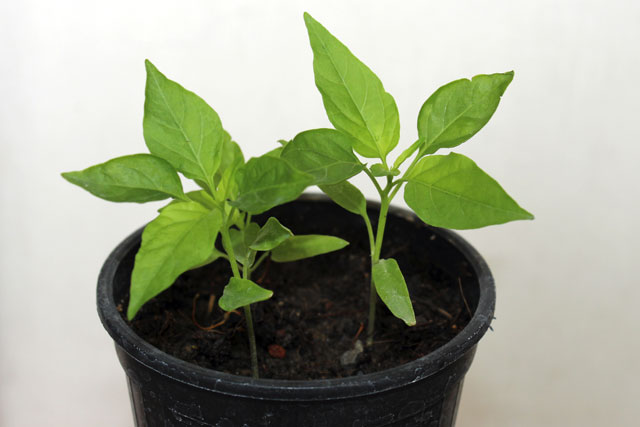
    A 30-day-old Carolina Reaper plant
    A 30-day-old Carolina Reaper plant

    In any event, chillies are now examined using high-performance liquid chromatography to accurately determine the level of capsaicin and dihydrocapsaicin (the two most prevalent capsaicinoids). These levels can be reported in a variety of ways, such as the American Spice Trade Association’s pungency rating, but are usually converted to Scoville’s scale by assuming that pure capsaicin would have a Scoville rating of 16m.

    In the last 20 years, there have been increasingly heated attempts to produce the hottest chilli on the planet, a title currently held by the Carolina Reaper, which has an eye-watering rating of 2,2m Scovilles. It was created by Ed Currie in a greenhouse in South Carolina, and is described as having a “fruity, sweet taste with a hint of cinnamon and chocolate undertones”.

    The increase in the level of heat in the chilli has been achieved by selective breeding, but other factors affect how hot a chilli fruit will be, too.

    A recent study showed that when chilli plants are subjected to drought conditions, they tend to accumulate more capsaicin than plants grown under normal conditions. But this only holds for chillies that are either mild or moderately hot. Some chilli growers also believe that predation by animals will cause chillies to produce hotter fruits, to deter further attacks.

    If you can’t stand the heat…

    In order to test some of these hypotheses, I took part in a recent trial at the University of Bath in which we grew three types of chillies in three different conditions: well looked after, pest damaged and nutrient deprived. Measurement of the levels of capsaicinoids in the resulting fruit gave some tantalising results — notably that the pest-damaged plants did show a small increase in the levels, while the nutrient-starved plants produced less.

    We also observed something unexpected. Considering the levels of heat at early, middle and late stages of the experiment, we showed that two different species of chilli behaved very differently. The jalapeno (a capsicum annum), produced its hottest fruit, under any conditions, in young plants, with the levels dropping as the plant matured. Conversely, the Madre Vieja (a capsicum baccatum) showed a slow but steady increase in heat as the plant aged.

    Clearly, the art of getting a chilli to be as hot as possible is not simple, and there is more research to be done. It’s thirsty work, but someone’s got to do it.The Conversation

    • Timothy Woodman is senior NMR spectroscopist, University of Bath
    • This article was originally published on The Conversation

    Follow TechCentral on Google News Add TechCentral as your preferred source on Google


    WhatsApp YouTube
    Share. Facebook Twitter LinkedIn WhatsApp Telegram Email Copy Link
    Previous ArticleEvery Hlaudi has a silver lining
    Next Article Faith Muthambi to answer to ANC

    Related Posts

    Europe is building an alternative to Microsoft Office

    Europe is building an alternative to Microsoft Office

    11 March 2026
    Mitel launches Edge platform for mission-critical on-premises communications

    Mitel launches Edge platform for mission-critical on-premises communications

    11 March 2026
    Canal+ brands Showmax an 'expensive failure'

    Canal+ brands Showmax an ‘expensive failure’

    11 March 2026
    Company News
    Mitel launches Edge platform for mission-critical on-premises communications

    Mitel launches Edge platform for mission-critical on-premises communications

    11 March 2026
    Why the smartest companies have stopped chasing cheap outsourcing deals - BBD

    Why the smartest companies have stopped chasing cheap outsourcing deals

    11 March 2026
    How MSB Micro Systems helps resellers deliver always-on enterprise APN

    How MSB Micro Systems helps resellers deliver always-on enterprise APN

    11 March 2026
    Opinion
    The AI fraud crisis your bank is not ready for - Andries Maritz

    The AI fraud crisis your bank is not ready for

    18 February 2026
    A million reasons monopolies don't work - Duncan McLeod

    A million reasons monopolies don’t work

    10 February 2026
    The author, Business Leadership South Africa CEO Busi Mavuso

    Eskom unbundling U-turn threatens to undo hard-won electricity gains

    9 February 2026

    Subscribe to Updates

    Get the best South African technology news and analysis delivered to your e-mail inbox every morning.

    Latest Posts
    Europe is building an alternative to Microsoft Office

    Europe is building an alternative to Microsoft Office

    11 March 2026
    Mitel launches Edge platform for mission-critical on-premises communications

    Mitel launches Edge platform for mission-critical on-premises communications

    11 March 2026
    Canal+ brands Showmax an 'expensive failure'

    Canal+ brands Showmax an ‘expensive failure’

    11 March 2026
    FNB launches eWallet on WhatsApp as it overhauls service

    FNB launches eWallet on WhatsApp as it overhauls service

    11 March 2026
    © 2009 - 2026 NewsCentral Media
    • Cookie policy (ZA)
    • TechCentral – privacy and Popia

    Type above and press Enter to search. Press Esc to cancel.

    Manage consent

    TechCentral uses cookies to enhance its offerings. Consenting to these technologies allows us to serve you better. Not consenting or withdrawing consent may adversely affect certain features and functions of the website.

    Functional Always active
    The technical storage or access is strictly necessary for the legitimate purpose of enabling the use of a specific service explicitly requested by the subscriber or user, or for the sole purpose of carrying out the transmission of a communication over an electronic communications network.
    Preferences
    The technical storage or access is necessary for the legitimate purpose of storing preferences that are not requested by the subscriber or user.
    Statistics
    The technical storage or access that is used exclusively for statistical purposes. The technical storage or access that is used exclusively for anonymous statistical purposes. Without a subpoena, voluntary compliance on the part of your Internet Service Provider, or additional records from a third party, information stored or retrieved for this purpose alone cannot usually be used to identify you.
    Marketing
    The technical storage or access is required to create user profiles to send advertising, or to track the user on a website or across several websites for similar marketing purposes.
    • Manage options
    • Manage services
    • Manage {vendor_count} vendors
    • Read more about these purposes
    View preferences
    • {title}
    • {title}
    • {title}