
Close Menu
TechCentralTechCentral

    Subscribe to the newsletter

    Get the best South African technology news and analysis delivered to your e-mail inbox every morning.

    Facebook X (Twitter) YouTube LinkedIn
    WhatsApp Facebook X (Twitter) LinkedIn YouTube
    TechCentralTechCentral
    • News
      Consumers get new weapon against direct marketing spam

      Consumers get new weapon against phone call spam

      16 April 2026
      Standard Bank data breach fallout deepens

      Standard Bank data breach fallout deepens

      16 April 2026
      Gemini gets personal for South African users

      Gemini gets personal for South African users

      16 April 2026
      South Africa's AI moment is now - and we risk blowing it - Stafford Masie

      South Africa’s AI moment is now – and we risk blowing it

      16 April 2026
      Stafford Masie: South Africa risks regulating away its AI future

      Stafford Masie: South Africa risks regulating away its AI future

      16 April 2026
    • World
      Adobe bets on AI agents to fend off cheaper rivals

      Adobe bets on AI agents to fend off cheaper rivals

      16 April 2026
      Google poised to lose ad crown to Meta

      Google poised to lose ad crown to Meta

      14 April 2026
      Grand Theft Data - hackers hit Rockstar Games - Grand Theft Auto

      Grand Theft Data – hackers hit Rockstar Games

      14 April 2026
      UK PM Keir Starmer declares war on doomscrolling

      UK PM Keir Starmer declares war on doomscrolling

      13 April 2026
      Big Tech is going nuclear

      Big Tech is going nuclear

      10 April 2026
    • In-depth
      Africa switches on as Europe dims the lights

      Africa switches on as Europe dims the lights

      9 April 2026
      The biggest untapped EV market on Earth is hiding in plain sight

      The biggest untapped EV market on Earth is hiding in plain sight

      1 April 2026
      The R18-billion tech giant hiding in plain sight - Jens Montanana

      The R16-billion tech giant hiding in plain sight

      26 March 2026
      The last generation of coders

      The last generation of coders

      18 February 2026
      Sentech is in dire straits

      Sentech is in dire straits

      10 February 2026
    • TCS
      TCS | Werner Lindemann on how AI is rewriting the infosec rulebook

      TCS | Werner Lindemann on how AI is rewriting the infosec rulebook

      15 April 2026
      TCS | Donovan Marsh on AI and the future of filmmaking

      TCS | Donovan Marsh on AI and the future of filmmaking

      7 April 2026
      TCS+ | Vodacom Business moves to crack the SME tech gap - Andrew Fulton, Sannesh Beharie

      TCS+ | Vodacom Business moves to crack the SME tech gap

      7 April 2026
      TCS | MTN's Divysh Joshi on the strategy behind Pi - Divyesh Joshi

      TCS | MTN’s Divyesh Joshi on the strategy behind Pi

      1 April 2026
      Anoosh Rooplal

      TCS | Anoosh Rooplal on the Post Office’s last stand

      27 March 2026
    • Opinion
      The conflict of interest at the heart of PayShap's slow adoption - Cheslyn Jacobs

      The conflict of interest at the heart of PayShap’s slow adoption

      26 March 2026
      South Africa's energy future hinges on getting wheeling right - Aishah Gire

      South Africa’s energy future hinges on getting wheeling right

      10 March 2026
      Hold the doom: the case for a South African comeback - Duncan McLeod

      Apple just dropped a bomb on the Windows world

      5 March 2026
      R230-million in the bag for Endeavor's third Harvest Fund - Alison Collier

      VC’s centre of gravity is shifting – and South Africa is in the frame

      3 March 2026
      Hold the doom: the case for a South African comeback - Duncan McLeod

      Hold the doom: the case for a South African comeback

      26 February 2026
    • Company Hubs
      • 1Stream
      • Africa Data Centres
      • AfriGIS
      • Altron Digital Business
      • Altron Document Solutions
      • Altron Group
      • Arctic Wolf
      • Ascent Technology
      • AvertITD
      • BBD
      • Braintree
      • CallMiner
      • CambriLearn
      • CYBER1 Solutions
      • Digicloud Africa
      • Digimune
      • Domains.co.za
      • ESET
      • Euphoria Telecom
      • HOSTAFRICA
      • Incredible Business
      • iONLINE
      • IQbusiness
      • Iris Network Systems
      • Kaspersky
      • LSD Open
      • Mitel
      • NEC XON
      • Netstar
      • Network Platforms
      • Next DLP
      • Ovations
      • Paracon
      • Paratus
      • Q-KON
      • SevenC
      • SkyWire
      • Solid8 Technologies
      • Telit Cinterion
      • Telviva
      • Tenable
      • Vertiv
      • Videri Digital
      • Vodacom Business
      • Wipro
      • Workday
      • XLink
    • Sections
      • AI and machine learning
      • Banking
      • Broadcasting and Media
      • Cloud services
      • Contact centres and CX
      • Cryptocurrencies
      • Education and skills
      • Electronics and hardware
      • Energy and sustainability
      • Enterprise software
      • Financial services
      • HealthTech
      • Information security
      • Internet and connectivity
      • Internet of Things
      • Investment
      • IT services
      • Lifestyle
      • Motoring
      • Policy and regulation
      • Public sector
      • Retail and e-commerce
      • Satellite communications
      • Science
      • SMEs and start-ups
      • Social media
      • Talent and leadership
      • Telecoms
    • Events
    • Advertise
    TechCentralTechCentral
    Home » Sections » Internet and connectivity » Why LTE is fibre’s best friend

    Why LTE is fibre’s best friend

    Promoted | Home fibre users need to have a failover option for those times when their fibre line goes down.
    By Vox19 February 2024
    Twitter LinkedIn Facebook WhatsApp Email Telegram Copy Link
    News Alerts
    WhatsApp

    Internet connectivity underpins everything in our digital age and plays a vital role in our economy — from businesses keeping their systems live and responsive, to mines working in remote areas and households that need to support work-from-home and remote schooling.

    The internet, a global network of interconnected computers, devices and databases, makes it possible for us to access information and communicate from anywhere in the world. Wi-Fi, on the other hand, allows us to connect our devices to the Internet. A Wi-Fi connection can come from fibre, LTE, wireless or a satellite connection.

    Consider for a moment what happens when there is no connectivity.

    To stay connected, fibre users need to have a failover option for those times when the fibre line goes down

    At the level of the individual, you cannot send or receive e-mails or WhatsApp messages. Access to entertainment – whether online streaming or gaming – also goes down when connectivity is interrupted. If you are busy shopping, you can’t pay with your debit or credit card – and are you guaranteed, in our digital age, to have the right amount of cash on you? Probably not.

    If you’re working from home, you’ll need to resign yourself to working offline for a while, or else, if connectivity is imperative in the moment, you’ll have to head off to a venue where you can be online.

    Do any of the above scenarios sound – annoyingly – familiar?
    Thinking in terms of the bigger picture, we know that reliable internet connectivity is critically important to business communities and the economy in general. South Africa requires connectivity to keep moving forward, because a connected population has access to education portals and skills courses, and the country’s citizens can shop, work and communicate online – all important factors in keeping the engine of the economy turning.

    The gold standard of connectivity

    Fixed-line fibre is an internet connection built on a network of fibre optic cables that sends data at unbelievably high speeds, using light pulses sent through thin strands of flexible glass. This speed is why we refer to fixed-line fibre as being the “gold in the ground”, because it represents the pinnacle of fast internet options.

    Fibre’s value is immeasurable because it brings us the gift of super-fast connectivity – usually laid in the earth, or else positioned above ground – depending on the terrain – or under the ocean, if we consider inter-continental links. Fibre’s speed and ever-decreasing latency has seen the advancement of many cutting-edge technologies that will drive smart cities, robots, autonomous cars, cross-continental surgeries and much more into a globally connected future.

    As fibre networks continue to expand, many more South Africans and businesses are able to access the power of this technology. However, while very reliable, there are some things that can go wrong on the fibre network. For example, municipal employees working on a water pipe could trench through the in-ground fibre line connecting your area, or vandals and criminals damage the infrastructure.

    To stay connected, fibre users need to have a failover option for those times when the fibre line goes down, and one of these options is LTE.

    When you can’t afford to be disconnected

    There are situations when people simply can’t afford not to have a connection, and yet the reality is that, no matter which connectivity solution you use in South Africa, we are battling a host of issues at any given moment. Imagine someone working from home and needing to run critical tasks or host important virtual meetings, or a student trying to submit an online assignment or exam when the connectivity drops.

    A sudden drop in fibre connectivity is really bad news.

    There are many risks, and this is where LTE as a failover solution becomes crucial, as the user is making use of fibre as the basic service, with LTE on standby and ready to go the instant something goes wrong.

    Vox has offered a business LTE failover solution for some time, with the latest – and very popular – addition being an LTE failover solution, available on MTN, to our fibre-to-the-home (FTTH) clients. Households which have wireless internet connections also have access to the failover solution.

    Clarifying LTE

    Taking a step backwards, let’s have a look at what LTE actually means.

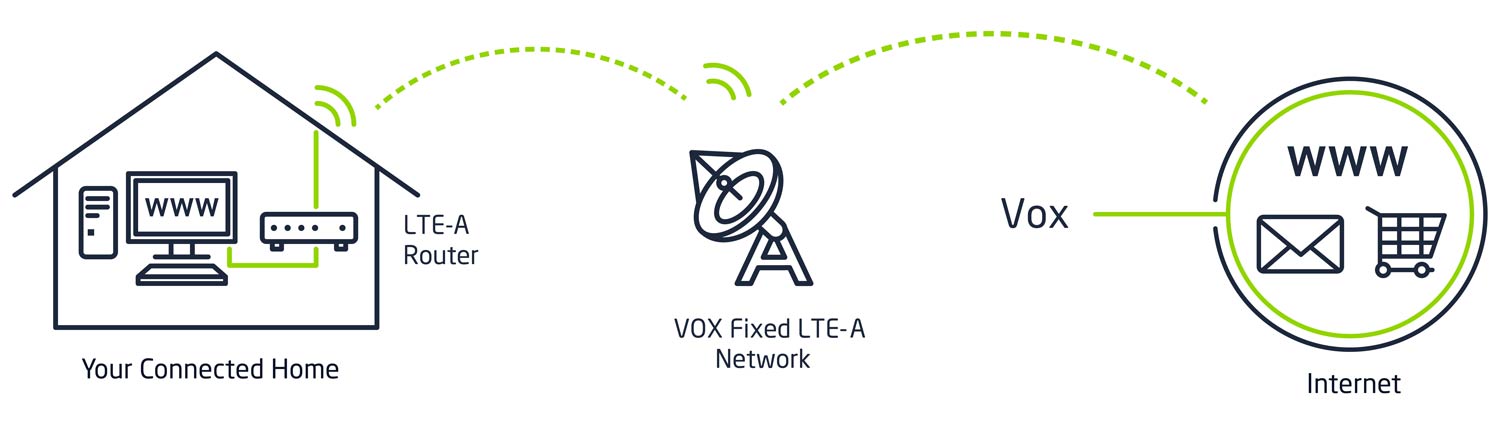
    LTE stands for “Long Term Evolution” and is sometimes referred to as 4G LTE. It’s a wireless internet solution which uses radio waves to transmit data between a router and a cell tower, enabling mobile devices to connect to these networks.

    Simply put, apart from some backhaul, fibre does not play a role in LTE networks, hence the term “wireless”, because the technology is enabled by the cell towers that transmit the radio waves.

    There is no need to stop what you are doing, jump up, pull out cables, switch routers or hit on and off buttons

    A relatively new technology, fixed LTE provides high-speed internet access in areas where other types of internet solutions are not available.

    LTE has base stations around most of the country and is a compelling option for those who are in areas where fibre has not yet been rolled out. Also, people who are waiting for fibre rollout may well find that using mobile data is not sustainable, because it becomes very expensive. This makes fixed LTE a solid consideration, especially when keeping it as a failover when the fibre is installed.

    There are a number of factors that determine the speed and experience while using LTE. These include how far you are from the base station, the weather conditions and how many people are using the same base station. 

    How can LTE work for you?

    Vox offers an LTE failover subscription fee of R35/month. The user rents or buys the router. FTTH customers do a self-install and then sit back and enjoy the internet, because if their fibre line goes down, they will automatically switch to LTE until the fibre is up and running again.

    A key point to note is that this solution is not only for fibre links but is also compatible with microwave links. During this automatic failover process, they will get notified about the switchover so that they know what is happening when it happens. In other words — true failover. There is no need to stop what you are doing, jump up, pull out cables, switch routers or hit on and off buttons.

    As mentioned already, many customers use LTE while waiting for fibre rollout in their area. It is sufficient for the type of internet speeds most people need, but would be insufficient for some competitive gamers, or inappropriate for an SME or enterprise where internet voice is critical to the business. However, even in these instances, it is still smart to have an LTE failover option for basic connectivity for core functions.

    • The author, Chris Boshoff, is senior product manager, LTE and APN, at Vox
    • Read more articles by Vox on TechCentral
    • This promoted content was paid for by the party concerned

    Follow TechCentral on Google News Add TechCentral as your preferred source on Google


    Chris Boshoff Vox Vox LTE
    WhatsApp YouTube
    Share. Facebook Twitter LinkedIn WhatsApp Telegram Email Copy Link
    Previous ArticleLSD Open announces Broadcom partnership, with a focus on VMware
    Next Article Bias-free futures: strategies for ethical AI implementation

    Related Posts

    Vox bets on hybrid connectivity

    Vox bets on hybrid connectivity

    14 April 2026
    SA's cybersecurity triple bind: more threats, less talent, tighter regulation - Vox

    SA’s cybersecurity triple bind: more threats, less talent, tighter regulation

    17 March 2026
    TCS+ | Vox Kiwi: a wireless solution promising a fibre-like experience - Theo van Zyl

    TCS+ | Vox Kiwi: a wireless solution promising a fibre-like experience

    13 March 2026
    Add A Comment

    Comments are closed.

    Company News
    Fibre: the backbone of South Africa's digital health ecosystem - Mweb

    Fibre: the backbone of South Africa’s digital health ecosystem

    16 April 2026
    New man to accelerate wholesale connectivity in the DRC - Gaetan Soltesz, FAST Congo

    New man to accelerate wholesale connectivity in the DRC

    15 April 2026
    Avast Business and Avert IT Distribution rewrite the SMB cybersecurity playbook

    Avast Business and Avert IT Distribution rewrite the SMB cybersecurity playbook

    15 April 2026
    Opinion
    The conflict of interest at the heart of PayShap's slow adoption - Cheslyn Jacobs

    The conflict of interest at the heart of PayShap’s slow adoption

    26 March 2026
    South Africa's energy future hinges on getting wheeling right - Aishah Gire

    South Africa’s energy future hinges on getting wheeling right

    10 March 2026
    Hold the doom: the case for a South African comeback - Duncan McLeod

    Apple just dropped a bomb on the Windows world

    5 March 2026

    Subscribe to Updates

    Get the best South African technology news and analysis delivered to your e-mail inbox every morning.

    Latest Posts
    Consumers get new weapon against direct marketing spam

    Consumers get new weapon against phone call spam

    16 April 2026
    Standard Bank data breach fallout deepens

    Standard Bank data breach fallout deepens

    16 April 2026
    Gemini gets personal for South African users

    Gemini gets personal for South African users

    16 April 2026
    South Africa's AI moment is now - and we risk blowing it - Stafford Masie

    South Africa’s AI moment is now – and we risk blowing it

    16 April 2026
    © 2009 - 2026 NewsCentral Media
    • Cookie policy (ZA)
    • TechCentral – privacy and Popia

    Type above and press Enter to search. Press Esc to cancel.

    Manage consent

    TechCentral uses cookies to enhance its offerings. Consenting to these technologies allows us to serve you better. Not consenting or withdrawing consent may adversely affect certain features and functions of the website.

    Functional Always active
    The technical storage or access is strictly necessary for the legitimate purpose of enabling the use of a specific service explicitly requested by the subscriber or user, or for the sole purpose of carrying out the transmission of a communication over an electronic communications network.
    Preferences
    The technical storage or access is necessary for the legitimate purpose of storing preferences that are not requested by the subscriber or user.
    Statistics
    The technical storage or access that is used exclusively for statistical purposes. The technical storage or access that is used exclusively for anonymous statistical purposes. Without a subpoena, voluntary compliance on the part of your Internet Service Provider, or additional records from a third party, information stored or retrieved for this purpose alone cannot usually be used to identify you.
    Marketing
    The technical storage or access is required to create user profiles to send advertising, or to track the user on a website or across several websites for similar marketing purposes.
    • Manage options
    • Manage services
    • Manage {vendor_count} vendors
    • Read more about these purposes
    View preferences
    • {title}
    • {title}
    • {title}