

Close Menu
TechCentralTechCentral

    Subscribe to the newsletter

    Get the best South African technology news and analysis delivered to your e-mail inbox every morning.

    Facebook X (Twitter) YouTube LinkedIn
    WhatsApp Facebook X (Twitter) LinkedIn YouTube
    TechCentralTechCentral
    • News
      South Africa's stablecoin silence is becoming a policy failure

      South Africa’s stablecoin silence is becoming a policy failure

      6 February 2026
      Every electric car you can buy in South Africa in early 2026, ranked by price

      Every electric car you can buy in South Africa in early 2026, ranked by price

      6 February 2026
      From stocks to crypto, markets reel as AI doubts grow

      From stocks to crypto, markets reel as AI doubts grow

      6 February 2026
      South Africa deepens China ties as US trade tensions escalate

      South Africa deepens China ties as US trade tensions escalate

      6 February 2026
      Big changes at Lesaka as Bank Zero deal nears completion - Lincoln Mali

      Big changes at Lesaka as Bank Zero deal nears completion

      6 February 2026
    • World
      AI won't replace software, says Nvidia CEO amid market rout - Jensen Huang

      AI won’t replace software, says Nvidia CEO amid market rout

      4 February 2026
      Apple acquires audio AI start-up Q.ai

      Apple acquires audio AI start-up Q.ai

      30 January 2026
      SpaceX IPO may be largest in history

      SpaceX IPO may be largest in history

      28 January 2026
      Nvidia throws AI at the weather

      Nvidia throws AI at weather forecasting

      27 January 2026
      Debate erupts over value of in-flight Wi-Fi

      Debate erupts over value of in-flight Wi-Fi

      26 January 2026
    • In-depth
      How liberalisation is rewiring South Africa's power sector

      How liberalisation is rewiring South Africa’s power sector

      21 January 2026
      The top-performing South African tech shares of 2025

      The top-performing South African tech shares of 2025

      12 January 2026
      Digital authoritarianism grows as African states normalise internet blackouts

      Digital authoritarianism grows as African states normalise internet blackouts

      19 December 2025
      TechCentral's South African Newsmakers of 2025

      TechCentral’s South African Newsmakers of 2025

      18 December 2025
      Black Friday goes digital in South Africa as online spending surges to record high

      Black Friday goes digital in South Africa as online spending surges to record high

      4 December 2025
    • TCS
      TCS+ | How Cloud On Demand is helping SA businesses succeed in the cloud - Xhenia Rhode, Dion Kalicharan

      TCS+ | Cloud On Demand and Consnet: inside a real-world AWS partner success story

      30 January 2026
      Watts & Wheels S1E3: 'BYD's Corolla Cross challenger'

      Watts & Wheels S1E3: ‘BYD’s Corolla Cross challenger’

      30 January 2026
      Watts & Wheels S1E3: 'BYD's Corolla Cross challenger'

      Watts & Wheels S1E2: ‘China attacks, BMW digs in, Toyota’s sublime supercar’

      23 January 2026

      TCS+ | Why cybersecurity is becoming a competitive advantage for SA businesses

      20 January 2026
      Watts & Wheels S1E3: 'BYD's Corolla Cross challenger'

      Watts & Wheels: S1E1 – ‘William, Prince of Wheels’

      8 January 2026
    • Opinion
      South Africa's skills advantage is being overlooked at home - Richard Firth

      South Africa’s skills advantage is being overlooked at home

      29 January 2026
      Why Elon Musk's Starlink is a 'hard no' for me - Songezo Zibi

      Why Elon Musk’s Starlink is a ‘hard no’ for me

      26 January 2026
      South Africa's new fibre broadband battle - Duncan McLeod

      South Africa’s new fibre broadband battle

      20 January 2026
      AI moves from pilots to production in South African companies - Nazia Pillay SAP

      AI moves from pilots to production in South African companies

      20 January 2026
      South Africa's new fibre broadband battle - Duncan McLeod

      ANC’s attack on Solly Malatsi shows how BEE dogma trumps economic reality

      14 December 2025
    • Company Hubs
      • Africa Data Centres
      • AfriGIS
      • Altron Digital Business
      • Altron Document Solutions
      • Altron Group
      • Arctic Wolf
      • AvertITD
      • Braintree
      • CallMiner
      • CambriLearn
      • CYBER1 Solutions
      • Digicloud Africa
      • Digimune
      • Domains.co.za
      • ESET
      • Euphoria Telecom
      • Incredible Business
      • iONLINE
      • IQbusiness
      • Iris Network Systems
      • LSD Open
      • NEC XON
      • Netstar
      • Network Platforms
      • Next DLP
      • Ovations
      • Paracon
      • Paratus
      • Q-KON
      • SevenC
      • SkyWire
      • Solid8 Technologies
      • Telit Cinterion
      • Tenable
      • Vertiv
      • Videri Digital
      • Vodacom Business
      • Wipro
      • Workday
      • XLink
    • Sections
      • AI and machine learning
      • Banking
      • Broadcasting and Media
      • Cloud services
      • Contact centres and CX
      • Cryptocurrencies
      • Education and skills
      • Electronics and hardware
      • Energy and sustainability
      • Enterprise software
      • Financial services
      • Information security
      • Internet and connectivity
      • Internet of Things
      • Investment
      • IT services
      • Lifestyle
      • Motoring
      • Public sector
      • Retail and e-commerce
      • Satellite communications
      • Science
      • SMEs and start-ups
      • Social media
      • Talent and leadership
      • Telecoms
    • Events
    • Advertise
    TechCentralTechCentral
    Home » Opinion » Roger Hislop » Where is Africa at the world’s technology table?

    Where is Africa at the world’s technology table?

    By Roger Hislop31 March 2016
    Twitter LinkedIn Facebook WhatsApp Email Telegram Copy Link
    News Alerts
    WhatsApp

    roger-hislop-180Global standards bodies are the crucible in which our networking future is forged. It is the well from which our connectivity springs. It may look like a crowd of middle-aged bearded and bespectacled men warming the seats of hotel conference rooms, but it’s so much more. It’s where decisions are made, arguments had, and documents prepared that will decide how millions of products that we use every day will work. And Africa is not there.

    Last week, the IEEE 802 group had its plenary conference in Macau, a special autonomous region of China, just over the Zhujiang River Estuary from Hong Kong. In the gaudy halls of the leviathan Venetian Hotel and Casino, research and development engineers from America, Europe and Asia came together to hammer out their differences to make technical standards stronger, better, more.

    The IEEE, or the Institute of Electrical and Electronic Engineers, was an American organisation, but became global. It has a number of societies, including the Computer Society. And it’s in the computer society where IEEE 802 sits, making standards for local- and wide-area networking.

    These include 802.11 (wireless networks, you know it as Wi-Fi), 802.3 (wired LAN such as Ethernet), 802.15 (“personal area” networks, which includes Bluetooth, but also the new visible-light network “Li-Fi”), 802.22 for TV white space networks, and others.

    Representatives on the different working groups are researchers from equipment manufacturers, consultants, network operators, as well as universities and government agencies. There are more MScs and PhDs than you can shake a stick at. They all volunteer their time and effort — for the commercial success of their organisations, and for the greater good.

    They are meticulous — documenting every step in the process, considering every angle. Millions, even billions of dollars hang off things being done right. There’s something like 10 billion Wi-Fi devices out there. Three hundred million Gigabit Ethernet ports shipped — just last year.

    Important work

    There was no one from Africa at the plenary. Okay, sure, there was a smattering of African descent (like two or three out of almost a thousand people). But actually flown in from our continent? Nada (apart from me). How many Africans have chaired IEEE 802 working groups? Zilch.

    Don’t feel too bad, though … the same applies to South America. There is also a hopeless paucity of involvement from that other southern land.

    Why? No good reason. There are technologists and researchers on both continents doing world-class work. There are many people from Africa that have either the technical skills, or the organisational skills, or both.

    Cost is a factor, but a minor one. IEEE membership is US$160/year. Attending conferences is expensive, but every day thousands of people from South Africa get on planes to far off places for business.

    What’s stopping us is awareness, and confidence — knowing that you can get involved, and be directly engaged with some of the world’s most cutting-edge technology development, that we’d be very welcome to join in. All of the IEEE leaders I talked to recognised the need to bring Africa into the conversation. They want it to happen.

    And by cutting edge, we’re looking at new Ethernet standards for bonded 25Gbit/s interfaces to handle 400Gbit/s speeds. We’re looking at wireless technology that uses the office lights to carry hundreds of megabits per second and mobile technology that will take IEEE technologies to the edge of 5G mobile (the IEEE is way ahead of the mobile industry on 5G).
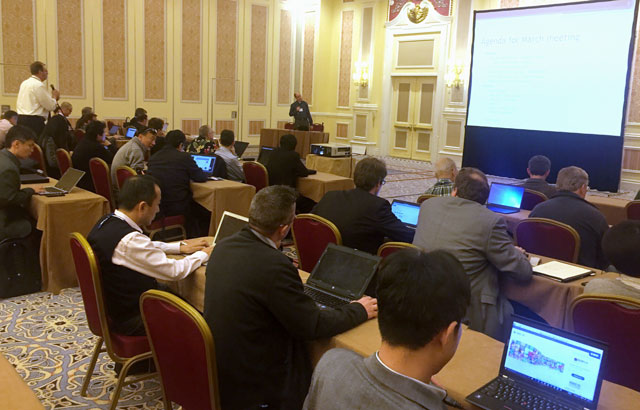
    A small portion of the thousand or more delegates at the recent IEEE
    A small portion of the thousand or more delegates at the recent IEEE 802 conference in Macau

    I recently got involved in the 802.22 working group, because cognitive radio is where fame, fortune and glamour begins. Because the IEEE wants to introduce new blood and fresh ideas, I was elected chair of the 802.22.3 task group on SCOS (spectrum characterisation and occupancy sensing). So now we have one African chairing a group.

    White-space spectrum and dynamic spectrum assignment is a very exciting area in wireless technology. If you cast your mind back, you may remember 802.22, or “Wi-Far” — a cognitive radio technology designed to provide long distance (20-30km range) communication in the white spaces between TV broadcast channels. The standard was completed in 2012, but things went quiet for a long time, as the regulatory environment had to change radically. Finally, that change is coming.

    And it will come faster and faster — we need more spectrum for connectivity. So much of it is unused, or inefficiently used. There are gaps in TV bands. There are bands reserved for satellite links, but not used in most areas. The same is true with bands for nautical and military radar.

    What we need to know is what spectrum is being used when, for what, and by whom so that we can share it more efficiently. And that is why the 802.22.3 standard is being developed … spectrum occupancy sensing and real-time spectrum databases are going to be critical to connectivity for ever more people, ever more demanding applications, and ever more devices. There are billions of Internet users, there will be trillions of Internet of things devices.

    Important work

    South Africa is full of development engineers who are smart, well trained and motivated. We can influence the standards to move in a way that is more suitable for our environment.

    We have around 250 wireless Internet service providers in the country shooting Wi-Fi to their customers, point-to-point, over 15km or 20km distances. Why not develop a Wi-Fi substandard that makes the preamble longer by ten microseconds so they can reach 30km?

    If there is an accepted IEEE standard, there will be a chipset manufacturer making the silicon, and that will go into product.

    Getting involved in this fundamental technology development is easier than you think. And it’s more interesting than you think. The global technology and research, and standards-defining community is more welcoming than you think.

    Go to 802world.org and find something interesting. Most working groups have mail reflectors so you can start to follow the conversation.

    Africa has been a technology taker for too long. It’s high time we become a technology maker.

    • Roger is an engineer in the research and innovation group at Internet Solutions. He writes here in his private capacity


    IEEE Roger Hislop
    WhatsApp YouTube Follow on Google News Add as preferred source on Google
    Share. Facebook Twitter LinkedIn WhatsApp Telegram Email Copy Link
    Previous ArticleNow Hawks probing Thuli Madonsela
    Next Article Zuma to split telecoms department – again

    Related Posts

    Flatten the duck: how businesses can go on an energy diet that works

    Flatten the duck: how businesses can go on an energy diet that works

    10 January 2024

    IEEE lifts ban on Huawei researchers

    3 June 2019

    US war with Huawei moves to a dangerous new arena

    31 May 2019
    Company News
    The skills gap is a thinking gap: why South African employers can't find problem solvers

    The skills gap is a thinking gap: why SA employers can’t find problem solvers

    6 February 2026
    Vox Kiwi Wireless: fibre-like broadband for South African homes

    Vox Kiwi Wireless: fibre-like broadband for South African homes

    5 February 2026
    NEC XON achieves an African first with full Fortinet accreditation - Ian Kruger

    NEC XON achieves an African first with full Fortinet accreditation

    5 February 2026
    Opinion
    South Africa's skills advantage is being overlooked at home - Richard Firth

    South Africa’s skills advantage is being overlooked at home

    29 January 2026
    Why Elon Musk's Starlink is a 'hard no' for me - Songezo Zibi

    Why Elon Musk’s Starlink is a ‘hard no’ for me

    26 January 2026
    South Africa's new fibre broadband battle - Duncan McLeod

    South Africa’s new fibre broadband battle

    20 January 2026

    Subscribe to Updates

    Get the best South African technology news and analysis delivered to your e-mail inbox every morning.

    Latest Posts
    South Africa's stablecoin silence is becoming a policy failure

    South Africa’s stablecoin silence is becoming a policy failure

    6 February 2026
    Every electric car you can buy in South Africa in early 2026, ranked by price

    Every electric car you can buy in South Africa in early 2026, ranked by price

    6 February 2026
    From stocks to crypto, markets reel as AI doubts grow

    From stocks to crypto, markets reel as AI doubts grow

    6 February 2026
    South Africa deepens China ties as US trade tensions escalate

    South Africa deepens China ties as US trade tensions escalate

    6 February 2026
    © 2009 - 2026 NewsCentral Media
    • Cookie policy (ZA)
    • TechCentral – privacy and Popia

    Type above and press Enter to search. Press Esc to cancel.

    Manage consent

    TechCentral uses cookies to enhance its offerings. Consenting to these technologies allows us to serve you better. Not consenting or withdrawing consent may adversely affect certain features and functions of the website.

    Functional Always active
    The technical storage or access is strictly necessary for the legitimate purpose of enabling the use of a specific service explicitly requested by the subscriber or user, or for the sole purpose of carrying out the transmission of a communication over an electronic communications network.
    Preferences
    The technical storage or access is necessary for the legitimate purpose of storing preferences that are not requested by the subscriber or user.
    Statistics
    The technical storage or access that is used exclusively for statistical purposes. The technical storage or access that is used exclusively for anonymous statistical purposes. Without a subpoena, voluntary compliance on the part of your Internet Service Provider, or additional records from a third party, information stored or retrieved for this purpose alone cannot usually be used to identify you.
    Marketing
    The technical storage or access is required to create user profiles to send advertising, or to track the user on a website or across several websites for similar marketing purposes.
    • Manage options
    • Manage services
    • Manage {vendor_count} vendors
    • Read more about these purposes
    View preferences
    • {title}
    • {title}
    • {title}