Close Menu
TechCentralTechCentral

    Subscribe to the newsletter

    Get the best South African technology news and analysis delivered to your e-mail inbox every morning.

    Facebook X (Twitter) YouTube LinkedIn
    WhatsApp Facebook X (Twitter) LinkedIn YouTube
    TechCentralTechCentral
    • News
      How Comsol turned 60MHz into a national 5G bet - Iain Stevenson

      How Comsol turned 60MHz into a national 5G bet

      20 August 2026
      Humanoid robots poised for their 'ChatGPT moment'

      Humanoid robots poised for their ‘ChatGPT moment’

      20 August 2026
      SpaceX breaks cover at Icasa satellite spectrum hearings

      SpaceX breaks cover at Icasa satellite spectrum hearings

      20 August 2026
      South Africa to get a new national 5G broadband network - Iain Stevenson

      South Africa to get a new national 5G broadband network

      20 August 2026
      WhatsApp's free lunch ends on 1 October

      WhatsApp’s free lunch ends on 1 October

      19 August 2026
    • World
      Russia building its own Starlink - and faster than expected - Vadym Skibitskyi

      Russia building its own Starlink – and faster than expected

      11 August 2026
      Meta AI will now tell parents if their teen is in crisis

      Meta AI will now tell parents if their teen is in crisis

      17 July 2026
      IBM shares crash 25% as AI upends software spending - Arvind Krishna

      IBM shares crash 25% as AI upends software spending

      15 July 2026
      Jony Ive's first OpenAI device: an AI smart speaker - Jony Ive and Sam Altman

      Jony Ive’s first OpenAI device: an AI smart speaker

      15 July 2026
      Stripe, Advent in talks to buy PayPal for $53-billion

      Stripe, Advent in talks to buy PayPal for $53-billion

      15 July 2026
    • In-depth
      Google DeepMind CEO Demis Hassabis. Image: John Sears

      The plan to stop AI from breaking the world

      16 July 2026
      The internet has a Strait of Hormuz problem

      The internet has a Strait of Hormuz problem

      15 July 2026
      AI boom sparks rally, frenzy and fear

      AI boom sparks rally, frenzy and fear

      11 June 2026
      Every plug-in hybrid on sale in South Africa, ranked by price - Lamborghini Temerario

      Every plug-in hybrid on sale in South Africa, ranked by price

      7 June 2026
      What Wi-Fi 8 will mean for wireless networks

      What Wi-Fi 8 will mean for wireless networks

      1 June 2026
    • TCS
      Meet the CIO | Discovery's Derek Wilcocks on AI, guardrails and growth

      Meet the CIO | Derek Wilcocks on how AI personalised Vitality

      13 August 2026
      TCS | Money just became native to the internet - Steven Boykey Sidley

      TCS | Money just became native to the internet – Steven Boykey Sidley

      12 August 2026
      TCS+ | Specops' Darren James on continuous trust in an AI world

      TCS+ | Specops’ Darren James on continuous trust in an AI world

      7 August 2026
      TCS+ | How AI is turning hardware into a subscription service - Shane van der Merwe Merchant West

      TCS+ | How AI is turning hardware into a subscription service

      6 August 2026
      TCS+ | Why South African workers must become supervisors of digital labour - Accelera Digital Group Cliff de Wit

      TCS+ | Why South African workers must become supervisors of digital labour

      31 July 2026
    • Opinion
      The author, Jannie van Zyl

      Selling vapour is corporate suicide in slow motion

      16 July 2026
      Brazil's online gambling crackdown is a lesson for South Africa

      How Amazon outmanoeuvred Starlink in South Africa

      15 July 2026
      The Popia problem with agentic AI - Herman Haasbroek

      The Popia problem with agentic AI

      14 July 2026
      The author, Fanie van Rooyen

      South Africa can still catch the AI wave – here’s how

      7 July 2026
      The author, Fanie van Rooyen

      The AI utopia South Africa can’t afford

      1 July 2026
    • Company Hubs
      • 1Stream
      • Africa Data Centres
      • AfriGIS
      • Altron Digital Business
      • Altron Document Solutions
      • Altron Group
      • Arctic Wolf
      • Ascent Technology
      • AvertITD
      • BBD
      • Braintree
      • CallMiner
      • CambriLearn
      • CM Telecom
      • Contactable
      • CYBER1 Solutions
      • Digicloud Africa
      • Digimune
      • Domains.co.za
      • ESET
      • Euphoria Telecom
      • HOSTAFRICA
      • Incredible Business
      • iONLINE
      • IQbusiness
      • Iris Network Systems
      • Kaspersky
      • LSD Open
      • Mitel
      • NEC XON
      • Netstar
      • Network Platforms
      • Next DLP
      • Ovations
      • Paracon
      • Paratus
      • Q-KON
      • SevenC
      • SkyWire
      • Solid8 Technologies
      • Telit Cinterion
      • Telviva
      • Tenable
      • Vertiv
      • Videri Digital
      • Vodacom Business
      • Vox
      • Wipro
      • Workday
      • XLink
    • Sections
      • AI and machine learning
      • Banking
      • Broadcasting and Media
      • Cloud services
      • Contact centres and CX
      • Cryptocurrencies
      • Education and skills
      • Electronics and hardware
      • Energy and sustainability
      • Enterprise software
      • Financial services
      • HealthTech
      • Information security
      • Internet and connectivity
      • Internet of Things
      • Investment
      • IT services
      • Lifestyle
      • Policy and regulation
      • Public sector
      • Retail and e-commerce
      • Satellite communications
      • Science
      • SMEs and start-ups
      • Social media
      • Talent and leadership
      • Telecoms
      • Watts & Wheels
    • Events
    • Advertise
    TechCentralTechCentral
    Home » Sections » Electronics and hardware » Who wants a foldable phone anyway?

    Who wants a foldable phone anyway?

    By Leonid Bershidsky9 November 2018
    Twitter LinkedIn Facebook WhatsApp Email Telegram Copy Link
    News Alerts
    WhatsApp

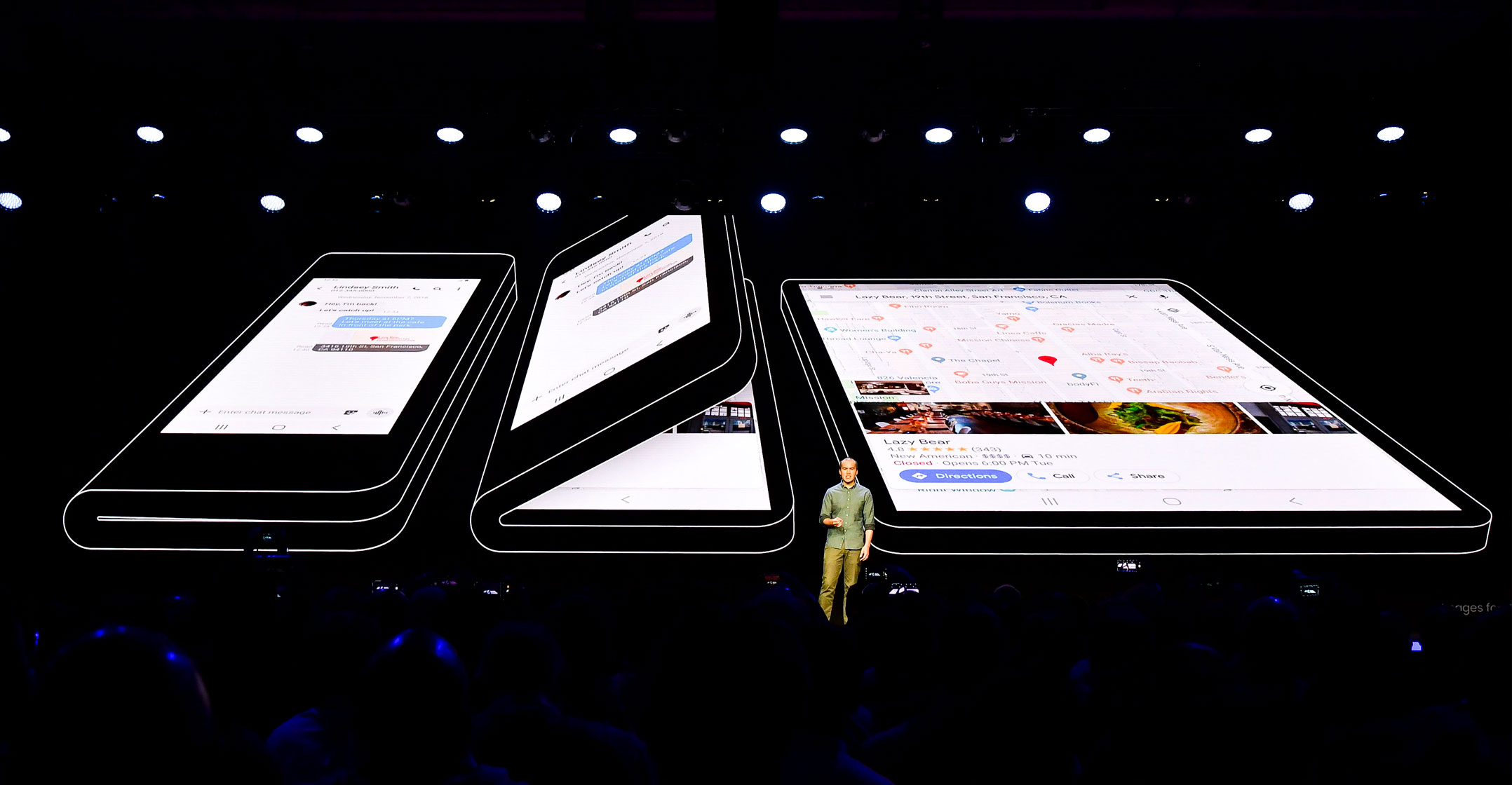
    On Wednesday, after years of rumours and speculation, Samsung finally presented a smartphone with a foldable display that it plans to start selling next year. At the risk of sounding like a wide-eyed teenager, I consider this a potentially disruptive innovation on the scale of the iPhone — if the manufacturers can handle it right.

    The technology has been more or less ripe for a while. The organic light-emitting compounds and the circuitry that deliver electric charges to them can be printed onto film as well as fused into inflexible glass. But the challenges of producing a device with a flexible display have been formidable.

    How does one make the folded gadget thin enough to fit into a jeans pocket and still pack a battery that can power a large screen long enough for heavy use? What kind of hinge would be needed to make sure the phone folds neatly and safely? How many times can a display be folded before it crumbles? How would apps automatically resize when a user goes from a small display to a bigger one and back again? Some of the technical problems haven’t been resolved yet — for example, Samsung apparently hasn’t found a way to embed a fingerprint reader into the foldable screen the way it’s been able to do for its next-generation glass phones.

    Even Samsung is apparently cautious, treating foldable phones simply as a niche market with growth potential

    Besides, it’s been argued, the business logic is questionable. Why would anyone want a foldable phone anyway, and which existing technology would it disrupt? Traditional phone screens have been big enough to make tablets redundant for most people, and the tablet market — even including detachable keyboard devices such as the Microsoft Surface and its clones — has been shrinking (unit shipments declined 5.4% year on year in the three months through to September, according to research firm IDC). And when a start-up called Royole presented a foldable-screen phone to get ahead of Samsung, a reviewer who got to play with it wrote that it felt more like a gimmick than a revolutionary device.

    Even Samsung is apparently cautious, treating foldable phones simply as a niche market with growth potential.

    I’d argue that the doubts are similar to those voiced when Apple presented the original iPhone. Who wanted a touchscreen phone, anyway, and how would it compete with the enormous variety of devices out there? Of course that alone doesn’t invalidate the doubts; plenty of technological innovations didn’t fly. Remember Amazon’s Fire Phone, which promised something akin to Star Wars holograms emerging from its display? It turned out to be a dud.

    Killing tablets

    I argued at the time that Amazon was the wrong company to push an adventurous innovation like this: it didn’t have the kind of pull with developers necessary to make the new 3D functionality important to users. Samsung — and Google, which is helping the Korean giant and other phone makers bring Android to foldable devices — do have it. And there are compelling reasons both for users and for manufacturers to go with the new technology.

    It’s true that smartphones with 6-inch screens are killing tablets; that’s been happening ever since Samsung launched the Galaxy Note in 2011 to cries of “Who would want a huge phone like this?” People, however, go for these big-screen phones as a compromise, simply because a tablet doesn’t fit into a pocket and is unwieldy for basic calling and messaging. Reading, watching videos and playing games on a big-screen phone is not particularly kind to the eyes; typing long messages on the tiny keyboards is a skill some just can’t master, at least without getting what’s now being called “smartphone thumb”. It’s all tolerable, but tiring. And showing something to a friend on a 6-inch screen while also trying to look at it yourself is an exercise fit for a contortionist.

    What’s so wrong with this form factor?

    For manufacturers, the benefit of pushing foldable phones could also be significant. No matter how durable the polymer of the flexible displays, it’ll wear out from a lot of folding, creating a natural (though hopefully reasonable) replacement cycle that could make it easier to plan sales and production. Now, the average upgrade cycle of a smartphone in the US is 32 months; it was 24 to 25 months in 2013 and 2014. Shortening the cycle, if only slightly, would make for a livelier smartphone market and perhaps end the current lull in unit sales (they dropped 2.1% in the three months to June).

    I’m rooting for Samsung and Google not to mess up the opportunity

    Samsung and Google just need to play their cards right. It’s important for the former to get rave reviews with the first new product it launches and to make sure the early adopters don’t start complaining too soon about its quality; it’s necessary for the latter to tweak Android so that it’s not too much work for developers to adjust apps to foldable displays. That’s a big hurdle that should be overcome before Samsung markets anything; launching without at least the most-used apps fully compatible with the changeable form factor could kill the potential revolution in its infancy.

    Everything doesn’t have to be perfect; the first iPhone wasn’t, and it only sold a million or two units per quarter in its first year. It just needs to be good enough for the early users to catch on to the advantages. It’ll only take a few years from there to mass adoption — again, barring major quality and compatibility issues. The technology will finally arrive if Apple, which buys iPhone displays from Samsung and LG (another company that has been working on flexible screens), takes the leap, as it has done repeatedly after watching other manufacturers’ experiments — bigger screen sizes, multiple camera lenses, rounded glass and other incremental innovations.

    None of this is a given. I’m rooting for Samsung and Google not to mess up the opportunity.  — (c) 2018 Bloomberg LP

    Follow TechCentral on Google News Add TechCentral as your preferred source on Google


    Leonid Bershidsky Samsung top
    WhatsApp YouTube
    Share. Facebook Twitter LinkedIn WhatsApp Telegram Email Copy Link
    Previous ArticleMTN breakthrough in Nigeria said to be imminent [updated]
    Next Article VW said to roll out cheaper e-car to challenge Tesla

    Related Posts

    Samsung Fold8 series unveiled as folding phone war looms

    Samsung Fold8 series unveiled as folding phone war looms

    22 July 2026
    Samsung's new Galaxy Z series: foldables, perfected

    Samsung’s new Galaxy Z series: foldables, perfected

    22 July 2026
    Memory crisis sends smartphone market into steep decline

    Memory crisis sends smartphone market into steep decline

    13 July 2026
    Company News
    Smarter operations take centre stage at Electra Mining Africa 2026

    Smarter operations take centre stage at Electra Mining Africa 2026

    20 August 2026
    Fidelity turns to Sigfox to spot fires before they start

    Fidelity turns to Sigfox to spot fires before they start

    19 August 2026
    Paratus Rwanda marks first year with AfPIF opening reception

    Paratus Rwanda marks first year with AfPIF opening reception

    18 August 2026
    Opinion
    The author, Jannie van Zyl

    Selling vapour is corporate suicide in slow motion

    16 July 2026
    Brazil's online gambling crackdown is a lesson for South Africa

    How Amazon outmanoeuvred Starlink in South Africa

    15 July 2026
    The Popia problem with agentic AI - Herman Haasbroek

    The Popia problem with agentic AI

    14 July 2026

    Subscribe to Updates

    Get the best South African technology news and analysis delivered to your e-mail inbox every morning.

    Latest Posts
    How Comsol turned 60MHz into a national 5G bet - Iain Stevenson

    How Comsol turned 60MHz into a national 5G bet

    20 August 2026
    Humanoid robots poised for their 'ChatGPT moment'

    Humanoid robots poised for their ‘ChatGPT moment’

    20 August 2026
    Smarter operations take centre stage at Electra Mining Africa 2026

    Smarter operations take centre stage at Electra Mining Africa 2026

    20 August 2026
    SpaceX breaks cover at Icasa satellite spectrum hearings

    SpaceX breaks cover at Icasa satellite spectrum hearings

    20 August 2026
    © 2009 - 2026 NewsCentral Media
    Built and maintained by Chronon
    • Cookie policy (ZA)
    • TechCentral – privacy and Popia

    Type above and press Enter to search. Press Esc to cancel.

    Manage consent

    TechCentral uses cookies to enhance its offerings. Consenting to these technologies allows us to serve you better. Not consenting or withdrawing consent may adversely affect certain features and functions of the website.

    Functional Always active
    The technical storage or access is strictly necessary for the legitimate purpose of enabling the use of a specific service explicitly requested by the subscriber or user, or for the sole purpose of carrying out the transmission of a communication over an electronic communications network.
    Preferences
    The technical storage or access is necessary for the legitimate purpose of storing preferences that are not requested by the subscriber or user.
    Statistics
    The technical storage or access that is used exclusively for statistical purposes. The technical storage or access that is used exclusively for anonymous statistical purposes. Without a subpoena, voluntary compliance on the part of your Internet Service Provider, or additional records from a third party, information stored or retrieved for this purpose alone cannot usually be used to identify you.
    Marketing
    The technical storage or access is required to create user profiles to send advertising, or to track the user on a website or across several websites for similar marketing purposes.
    • Manage options
    • Manage services
    • Manage {vendor_count} vendors
    • Read more about these purposes
    View preferences
    • {title}
    • {title}
    • {title}