Close Menu
TechCentralTechCentral

    Subscribe to the newsletter

    Get the best South African technology news and analysis delivered to your e-mail inbox every morning.

    Facebook X (Twitter) YouTube LinkedIn
    WhatsApp Facebook X (Twitter) LinkedIn YouTube
    TechCentralTechCentral
    • News
      Gaping holes in South African government cyber defences

      Gaping holes in South African government cyber defences

      2 April 2026
      EV charging start-up Charge bypasses JSE for token-based raise - Joubert Roux

      EV charging start-up Charge bypasses JSE for token-based raise

      2 April 2026
      Ring, reject, repeat: South Africa's spam call crisis

      Ring, reject, repeat: South Africa’s spam call crisis

      2 April 2026
      Four astronauts begin humanity's return to the moon - Artemis II

      Four astronauts begin humanity’s return to the moon

      2 April 2026
      Sars to give every taxpayer a digital identity in sweeping tech overhaul

      Sars to give every taxpayer a digital identity in sweeping tech overhaul

      1 April 2026
    • World
      Amazon in talks to buy satellite operator Globalstar

      Amazon in talks to buy satellite operator Globalstar

      2 April 2026

      Apple plans to open Siri to rival AI services

      27 March 2026
      It's official: ads are coming to ChatGPT

      It’s official: ads are coming to ChatGPT

      23 March 2026
      Mystery Chinese AI model revealed to be Xiaomi's

      Mystery Chinese AI model revealed to be Xiaomi’s

      19 March 2026
      A mystery AI model has developers buzzing

      A mystery AI model has developers buzzing

      18 March 2026
    • In-depth
      The R18-billion tech giant hiding in plain sight - Jens Montanana

      The R16-billion tech giant hiding in plain sight

      26 March 2026
      The last generation of coders

      The last generation of coders

      18 February 2026
      Sentech is in dire straits

      Sentech is in dire straits

      10 February 2026
      How liberalisation is rewiring South Africa's power sector

      How liberalisation is rewiring South Africa’s power sector

      21 January 2026
      The top-performing South African tech shares of 2025

      The top-performing South African tech shares of 2025

      12 January 2026
    • TCS
      TCS | MTN's Divysh Joshi on the strategy behind Pi - Divyesh Joshi

      TCS | MTN’s Divyesh Joshi on the strategy behind Pi

      1 April 2026
      Anoosh Rooplal

      TCS | Anoosh Rooplal on the Post Office’s last stand

      27 March 2026
      Meet the CIO | HealthBridge CTO Anton Fatti on the future of digital health

      Meet the CIO | Healthbridge CTO Anton Fatti on the future of digital health

      23 March 2026
      TCS+ | Arctic Wolf unpacks the evolving threat landscape for SA businesses - Clare Loveridge and Jason Oehley

      TCS+ | Arctic Wolf unpacks the evolving threat landscape for SA businesses

      19 March 2026
      TCS+ | Vox Kiwi: a wireless solution promising a fibre-like experience - Theo van Zyl

      TCS+ | Vox Kiwi: a wireless solution promising a fibre-like experience

      13 March 2026
    • Opinion
      The conflict of interest at the heart of PayShap's slow adoption - Cheslyn Jacobs

      The conflict of interest at the heart of PayShap’s slow adoption

      26 March 2026
      South Africa's energy future hinges on getting wheeling right - Aishah Gire

      South Africa’s energy future hinges on getting wheeling right

      10 March 2026
      Hold the doom: the case for a South African comeback - Duncan McLeod

      Apple just dropped a bomb on the Windows world

      5 March 2026
      VC's centre of gravity is shifting - and South Africa is in the frame - Alison Collier

      VC’s centre of gravity is shifting – and South Africa is in the frame

      3 March 2026
      Hold the doom: the case for a South African comeback - Duncan McLeod

      Hold the doom: the case for a South African comeback

      26 February 2026
    • Company Hubs
      • 1Stream
      • Africa Data Centres
      • AfriGIS
      • Altron Digital Business
      • Altron Document Solutions
      • Altron Group
      • Arctic Wolf
      • Ascent Technology
      • AvertITD
      • BBD
      • Braintree
      • CallMiner
      • CambriLearn
      • CYBER1 Solutions
      • Digicloud Africa
      • Digimune
      • Domains.co.za
      • ESET
      • Euphoria Telecom
      • HOSTAFRICA
      • Incredible Business
      • iONLINE
      • IQbusiness
      • Iris Network Systems
      • Kaspersky
      • LSD Open
      • Mitel
      • NEC XON
      • Netstar
      • Network Platforms
      • Next DLP
      • Ovations
      • Paracon
      • Paratus
      • Q-KON
      • SevenC
      • SkyWire
      • Solid8 Technologies
      • Telit Cinterion
      • Telviva
      • Tenable
      • Vertiv
      • Videri Digital
      • Vodacom Business
      • Wipro
      • Workday
      • XLink
    • Sections
      • AI and machine learning
      • Banking
      • Broadcasting and Media
      • Cloud services
      • Contact centres and CX
      • Cryptocurrencies
      • Education and skills
      • Electronics and hardware
      • Energy and sustainability
      • Enterprise software
      • Financial services
      • HealthTech
      • Information security
      • Internet and connectivity
      • Internet of Things
      • Investment
      • IT services
      • Lifestyle
      • Motoring
      • Policy and regulation
      • Public sector
      • Retail and e-commerce
      • Satellite communications
      • Science
      • SMEs and start-ups
      • Social media
      • Talent and leadership
      • Telecoms
    • Events
    • Advertise
    TechCentralTechCentral
    Home » Editor's pick » 7 Earth-like planets orbiting nearby star

    7 Earth-like planets orbiting nearby star

    By Agency Staff23 February 2017
    Twitter LinkedIn Facebook WhatsApp Email Telegram Copy Link
    News Alerts
    WhatsApp
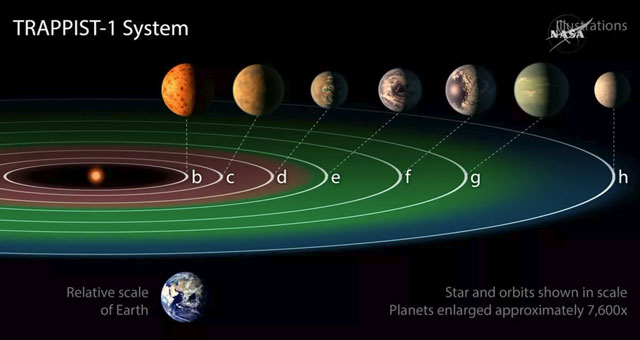
    The planets “e”, “f” and “g”, marked in green, are directly in the “habitable zone”. Image: Nasa

    When astronomers eyeball little stars twinkling through their telescopes, they now know for certain that circling around some of them are worlds not unlike our own.

    On Wednesday, an international research team using both ground and space-based telescopes announced they’d discovered a solar system 40 light years away with seven Earth-size planets revolving around a small star.

    It’s possible that the innermost three planets have “limited regions” with conditions amenable to liquid water, according to the new study published in the journal Nature.

    The next three fall more squarely in what astronomers call the habitable zone, where conditions for life, namely temperature and liquid water, are likelier.

    The seventh planet circling the system’s dim star is probably too cold for liquid water.

    These dim stars, or “ultracool dwarf stars” in the lingo, have a bright side. They’re weak to begin with, so planets passing between them and us will block a greater percentage of light than they can with much larger and brighter stars. That makes them about 80 times easier to detect than if they orbited a Sun-size star.

    The finding expands on the announcement last year of three Earth-size planets orbiting this star, called Trappist-1. The team, led by Michaël Gillon of the Université de Liège in Belgium, has since figured out that one of those three planets is actually three separate planets. Two newly found neighbours bring the Trappist–1 system total to seven, Wednesday evening’s announcement revealed.

    The first planets outside our solar system, known as exoplanets, were discovered in the mid-1990s. From the earliest findings — Jupiter-sized planets orbiting stars more closely than Mercury circles the Sun — astronomers had to tear up assumptions about what solar systems look like.

    Since then, some 3 500 expolanets have been discovered. If 200bn stars are in the Milky Way galaxy, and each of them has at least one planet, that’s billions of possibilities for Earth-like planets.

    The rise of exoplanets, the demotion of Pluto to “dwarf planet” a decade ago, and the possibility of a Planet 9 far beyond Neptune all illustrate that, as every year goes by and every new discovery is made, preconceptions about the universe around us are made to be disproved.

    When our solar system was the only one we knew of, it was easy to fantasise — on television, film and in our daydreams — that other stars had a menagerie of worlds like ours. What today’s unveiling reveals is that assumption, still no doubt wrong, is not as wrong as we thought.

    In the age of big data, it’s common for researchers to dismiss a data set because the sample size is too small. The sample size of exoplanets is still too small. Several thousand planets are documented, compared with the many hundreds of billions of possibilities. The good news is that the Trappist-1 discovery has a huge influence on the odds of finding Earth-size planets elsewhere. If there are seven orbiting a nearby sun, it’s safer to assume that many more are out there that scientists haven’t seen yet.

    The exoplanet catalogue, as remarkable as it is, reflects the limitations of tools that astronomers have used at this point. In the next few years, new telescopes will bring advanced power to their investigations. The Transiting Exoplanet Survey Satellite (Tess) will be launched this year and will search for planets around 200 000 or so bright stars. The James Webb Space Telescope, which will be launched next year, is a powerful soup-to-nuts observatory that will enable astronomers to study everything from the early moments of the universe to the formation of planets.

    With these observatories, astronomers will be able to better home in on the atmospheres of exosolar planets, if they have any.

    These instruments, scientists hope, will help answer the most elementary question of them all: if there are other Earths, are there other living creatures? Are we alone in the universe? “We’ve made a crucial step toward finding if there is life out there,” said Amaury Triaud of the Institute of Astronomy in Cambridge, England.

    Excitement over even the most tentative “yes” should be tempered by the fact that scientists aren’t sure how life began on Earth. The hunt for extraterrestrial life is still very young.

    Before this discovery, astronomers had one solar system with four rocky planets to study — Mercury, Venus, Earth and Mars. “Now we have seven more that we can study in detail,” Gillon said. “This is not in a few decades. We are doing this now.”

    The seventh planet circling the system’s star is probably too cold for liquid water, but probably doesn’t mean definitely. “Three are in the standard habitable zone,” said Julien de Wit, a co-author. “Yet all seven could be ‘habitable’.”  — (c) 2017 Bloomberg LP

    Follow TechCentral on Google News Add TechCentral as your preferred source on Google


    Michaël Gillon Nasa Trappist-1 Université de Liège
    WhatsApp YouTube
    Share. Facebook Twitter LinkedIn WhatsApp Telegram Email Copy Link
    Previous ArticleHuge spike in IT spending at Barclays Africa
    Next Article Brian Molefe now an ANC MP

    Related Posts

    Four astronauts begin humanity's return to the moon - Artemis II

    Four astronauts begin humanity’s return to the moon

    2 April 2026
    Musk hits brakes on Mars mission

    Musk hits brakes on Mars mission

    9 February 2026
    Breaking free from legacy thinking in banks: AI, automation and the agentic operating model - Steve Burke iqbusiness

    Breaking free from legacy thinking in banks: AI, automation and the agentic operating model

    15 January 2026
    Company News
    Synthesis helps financial enterprises transform with new Gemini Enterprise - Digicloud Africa

    Synthesis helps financial enterprises transform with new Gemini Enterprise

    2 April 2026
    The next churn wave is already in your contact centre conversations - CallMiner

    The next churn wave is already in your contact centre conversations

    2 April 2026
    Mining's problem isn't output, it's execution - Workday

    Mining’s problem isn’t output, it’s execution – Workday

    1 April 2026
    Opinion
    The conflict of interest at the heart of PayShap's slow adoption - Cheslyn Jacobs

    The conflict of interest at the heart of PayShap’s slow adoption

    26 March 2026
    South Africa's energy future hinges on getting wheeling right - Aishah Gire

    South Africa’s energy future hinges on getting wheeling right

    10 March 2026
    Hold the doom: the case for a South African comeback - Duncan McLeod

    Apple just dropped a bomb on the Windows world

    5 March 2026

    Subscribe to Updates

    Get the best South African technology news and analysis delivered to your e-mail inbox every morning.

    Latest Posts
    Gaping holes in South African government cyber defences

    Gaping holes in South African government cyber defences

    2 April 2026
    EV charging start-up Charge bypasses JSE for token-based raise - Joubert Roux

    EV charging start-up Charge bypasses JSE for token-based raise

    2 April 2026
    Ring, reject, repeat: South Africa's spam call crisis

    Ring, reject, repeat: South Africa’s spam call crisis

    2 April 2026
    Amazon in talks to buy satellite operator Globalstar

    Amazon in talks to buy satellite operator Globalstar

    2 April 2026
    © 2009 - 2026 NewsCentral Media
    • Cookie policy (ZA)
    • TechCentral – privacy and Popia

    Type above and press Enter to search. Press Esc to cancel.

    Manage consent

    TechCentral uses cookies to enhance its offerings. Consenting to these technologies allows us to serve you better. Not consenting or withdrawing consent may adversely affect certain features and functions of the website.

    Functional Always active
    The technical storage or access is strictly necessary for the legitimate purpose of enabling the use of a specific service explicitly requested by the subscriber or user, or for the sole purpose of carrying out the transmission of a communication over an electronic communications network.
    Preferences
    The technical storage or access is necessary for the legitimate purpose of storing preferences that are not requested by the subscriber or user.
    Statistics
    The technical storage or access that is used exclusively for statistical purposes. The technical storage or access that is used exclusively for anonymous statistical purposes. Without a subpoena, voluntary compliance on the part of your Internet Service Provider, or additional records from a third party, information stored or retrieved for this purpose alone cannot usually be used to identify you.
    Marketing
    The technical storage or access is required to create user profiles to send advertising, or to track the user on a website or across several websites for similar marketing purposes.
    • Manage options
    • Manage services
    • Manage {vendor_count} vendors
    • Read more about these purposes
    View preferences
    • {title}
    • {title}
    • {title}