
Close Menu
TechCentralTechCentral

    Subscribe to the newsletter

    Get the best South African technology news and analysis delivered to your e-mail inbox every morning.

    Facebook X (Twitter) YouTube LinkedIn
    WhatsApp Facebook X (Twitter) LinkedIn YouTube
    TechCentralTechCentral
    • News
      South Africa planning big overhaul of public sector IT - State IT Agency Sita

      South Africa planning big overhaul of public sector IT

      23 April 2026
      Usaasa's 30-year run nears its end - Communications minister Solly Malatsi. Image c/o DCDT

      Usaasa’s 30-year run nears its end

      23 April 2026
      Charge to switch on first N3 off-grid EV stations in May - Joubert Roux

      Charge to switch on first N3 off-grid EV stations in May

      23 April 2026
      Middle-class South Africa is ditching streaming for AI

      Middle-class South Africa is ditching streaming for AI

      23 April 2026
      Mythos forces South African banks onto high alert - Graham Lee

      Mythos forces South African banks onto high alert

      23 April 2026
    • World
      More organic compounds detected on Mars - Nasa Curiosity rover

      More organic compounds detected on Mars

      21 April 2026
      Adobe bets on AI agents to fend off cheaper rivals

      Adobe bets on AI agents to fend off cheaper rivals

      16 April 2026
      Google poised to lose ad crown to Meta

      Google poised to lose ad crown to Meta

      14 April 2026
      Grand Theft Data - hackers hit Rockstar Games - Grand Theft Auto

      Grand Theft Data – hackers hit Rockstar Games

      14 April 2026
      UK PM Keir Starmer declares war on doomscrolling

      UK PM Keir Starmer declares war on doomscrolling

      13 April 2026
    • In-depth
      Africa switches on as Europe dims the lights

      Africa switches on as Europe dims the lights

      9 April 2026
      The biggest untapped EV market on Earth is hiding in plain sight

      The biggest untapped EV market on Earth is hiding in plain sight

      1 April 2026
      The R18-billion tech giant hiding in plain sight - Jens Montanana

      The R16-billion tech giant hiding in plain sight

      26 March 2026
      The last generation of coders

      The last generation of coders

      18 February 2026
      Sentech is in dire straits

      Sentech is in dire straits

      10 February 2026
    • TCS

      TCS+ | ‘The ISP for ISPs’: Vox’s shift to wholesale aggregator

      20 April 2026
      TCS | Werner Lindemann on how AI is rewriting the infosec rulebook

      TCS | Werner Lindemann on how AI is rewriting the infosec rulebook

      15 April 2026
      TCS | Donovan Marsh on AI and the future of filmmaking

      TCS | Donovan Marsh on AI and the future of filmmaking

      7 April 2026
      TCS+ | Vodacom Business moves to crack the SME tech gap - Andrew Fulton, Sannesh Beharie

      TCS+ | Vodacom Business moves to crack the SME tech gap

      7 April 2026
      TCS | MTN's Divysh Joshi on the strategy behind Pi - Divyesh Joshi

      TCS | MTN’s Divyesh Joshi on the strategy behind Pi

      1 April 2026
    • Opinion
      The conflict of interest at the heart of PayShap's slow adoption - Cheslyn Jacobs

      The conflict of interest at the heart of PayShap’s slow adoption

      26 March 2026
      South Africa's energy future hinges on getting wheeling right - Aishah Gire

      South Africa’s energy future hinges on getting wheeling right

      10 March 2026
      Hold the doom: the case for a South African comeback - Duncan McLeod

      Apple just dropped a bomb on the Windows world

      5 March 2026
      R230-million in the bag for Endeavor's third Harvest Fund - Alison Collier

      VC’s centre of gravity is shifting – and South Africa is in the frame

      3 March 2026
      Hold the doom: the case for a South African comeback - Duncan McLeod

      Hold the doom: the case for a South African comeback

      26 February 2026
    • Company Hubs
      • 1Stream
      • Africa Data Centres
      • AfriGIS
      • Altron Digital Business
      • Altron Document Solutions
      • Altron Group
      • Arctic Wolf
      • Ascent Technology
      • AvertITD
      • BBD
      • Braintree
      • CallMiner
      • CambriLearn
      • CYBER1 Solutions
      • Digicloud Africa
      • Digimune
      • Domains.co.za
      • ESET
      • Euphoria Telecom
      • HOSTAFRICA
      • Incredible Business
      • iONLINE
      • IQbusiness
      • Iris Network Systems
      • Kaspersky
      • LSD Open
      • Mitel
      • NEC XON
      • Netstar
      • Network Platforms
      • Next DLP
      • Ovations
      • Paracon
      • Paratus
      • Q-KON
      • SevenC
      • SkyWire
      • Solid8 Technologies
      • Telit Cinterion
      • Telviva
      • Tenable
      • Vertiv
      • Videri Digital
      • Vodacom Business
      • Wipro
      • Workday
      • XLink
    • Sections
      • AI and machine learning
      • Banking
      • Broadcasting and Media
      • Cloud services
      • Contact centres and CX
      • Cryptocurrencies
      • Education and skills
      • Electronics and hardware
      • Energy and sustainability
      • Enterprise software
      • Financial services
      • HealthTech
      • Information security
      • Internet and connectivity
      • Internet of Things
      • Investment
      • IT services
      • Lifestyle
      • Motoring
      • Policy and regulation
      • Public sector
      • Retail and e-commerce
      • Satellite communications
      • Science
      • SMEs and start-ups
      • Social media
      • Talent and leadership
      • Telecoms
    • Events
    • Advertise
    TechCentralTechCentral
    Home » Sections » AI and machine learning » Why you need a consistent AI implementation strategy

    Why you need a consistent AI implementation strategy

    Promoted | Businesses must avoid a common misstep when it comes to artificial intelligence: focusing on strategy, not AI implementation.
    By Mark Nasila7 September 2023
    Twitter LinkedIn Facebook WhatsApp Email Telegram Copy Link
    News Alerts
    WhatsApp
    Assessing AI readiness is paramount to execution, writes Mark Nasila
    The author, FNB’s Mark Nasila

    Artificial intelligence is revolutionising various industries around the world.

    In China, AI is being used to educate students in over 1 700 schools across 200 cities. In Australia, an AI has developed a flu vaccine that surpasses the effectiveness of all existing vaccines. In the US, a machine-learning robot is independently preparing burgers.

    Resourceful developers are already using OpenAI’s groundbreaking language-generating algorithm, GPT-3, to automatically produce popular blog posts, design websites and create interactive role-playing experiences. These are just a few examples of the incredible real-world applications of AI.

    The primary hurdle in the adoption of AI in business lies in the complexity of organisations

    But the effectiveness of an emerging technology depends on its utilisation. As businesses aim to take advantage of innovative solutions driven by AI, they must enhance their approach to implementing technology, and they need to avoid one of the most common missteps: focusing on strategy and not implementation.

    According to a Forbes report on AI business adoption in 2020, the percentage of companies investing over $50 million in Big Data and AI initiatives has increased to 64.8% in 2020 from 39.7% in 2018. Nearly all companies (98.8%) are investing in these areas. However, only 51.9% of companies are accelerating their investment rate, a significant drop from 91.6% in 2019. Additionally, only 14.6% of companies have successfully deployed AI capabilities at a widespread production level.

    The primary hurdle in the adoption of AI in business lies in the complexity of organisations, which poses challenges when it comes to integrating and implementing AI solutions. High-performing companies, as highlighted in a McKinsey survey, credit a significant portion of their profits to the effective integration and utilisation of AI. This is why successful implementation of AI requires careful planning and a consistent strategy.

    Focus is key

    McKinsey consultants Tim Fontaine, Brian McCarthy and Tamim Saleh recommend an approach where businesses focus on using AI to enhance a specific crucial business process or function, rather than attempting to implement AI across the entire company.

    It is important for businesses to rethink their business models to fully leverage the benefits of AI, as simply plugging AI into existing processes may not yield the desired results or valuable insights.
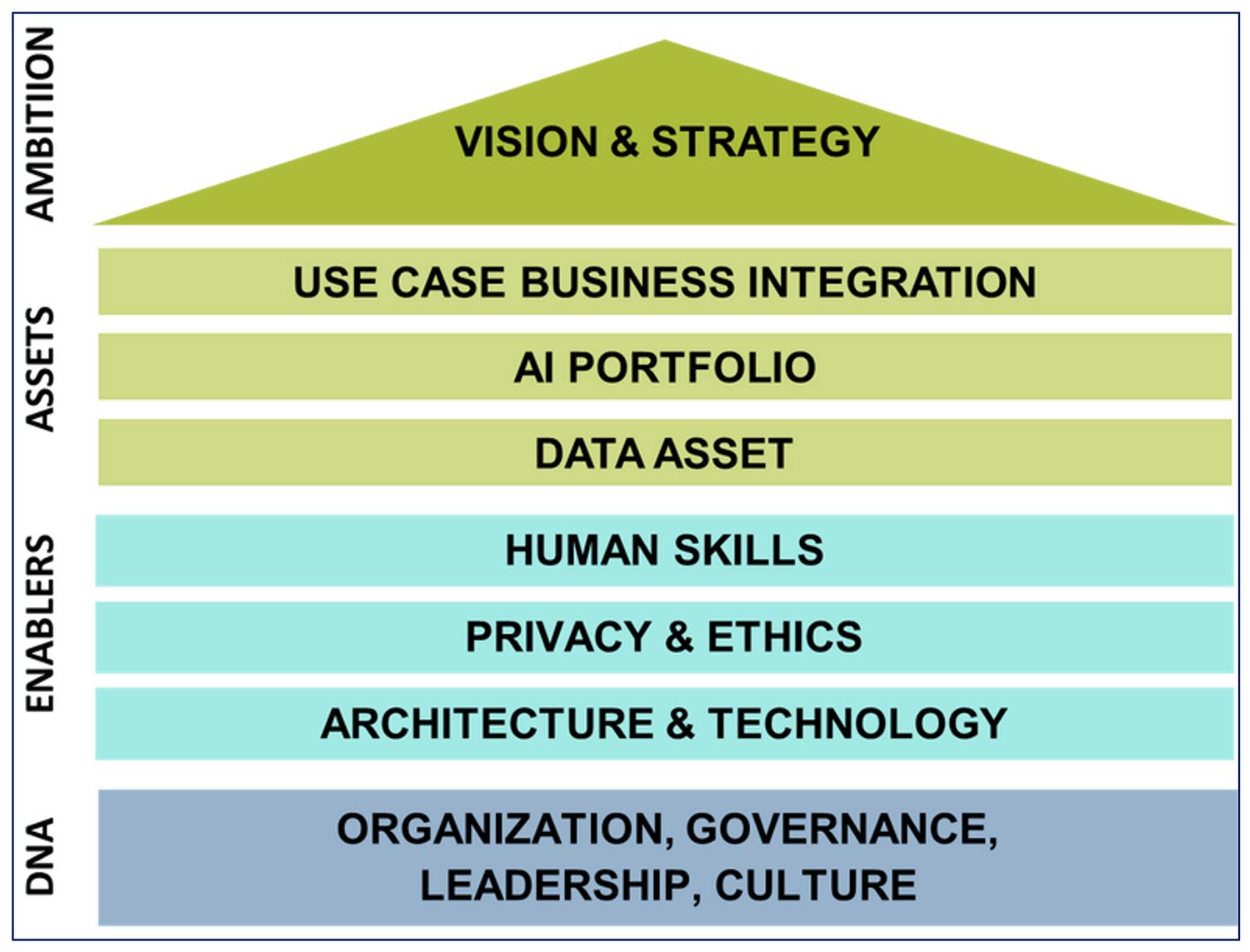
    Source: An AI implementation framework by Ulla Kruhse-Lehtonen and Dirk Hofmann (2020)

    If you define the wrong use cases for AI, your organisation’s ambitions for it will be set too low, and outcomes are likely to disappoint, making further implementations harder. It’s important to start by setting an appropriate vision and strategy, and by assessing your existing internal assets, tools, capabilities, enablers and other factors that can assist with successful AI roll-outs.

    Assets are a combination of data, your AI portfolio, and your particular business’s use case integration. Enablers are your human skills, privacy and ethics, your architecture and technology. Lastly, your DNA is your organisation, governance, leadership and culture.

    Formulate your data strategy

    At the outset, it’s essential to align your business and digital strategy with a data and AI vision, focusing on key opportunity areas for optimisation and innovation. It’s equally important to identify business processes where data and AI can be applied, including product development, sales, HR, and more – that is, to understand the current state of your organisation by assessing readiness of your current data and AI capabilities.

    It pays to make sure both your assets and enablers as per Kruhse-Lehtonen and Hofmann’s framework above are set up for success, as this helps to define the target state for your processes after implementing data and AI.

    Articulating the role of AI

    To achieve success in implementing AI, it is crucial to develop a well-defined business strategy that aligns with specific objectives and measurable key performance indicators. A notable example is Amazon, where Jeff Bezos assigned managers in 2010 to explore how AI and machine learning could enhance their competitiveness. This strategic move played a significant role in Amazon becoming a global leader in AI implementation.

    Although your journey towards AI success may differ, it is advisable to pause and evaluate your business requirements in order to chart a path towards AI transformation that’s based on solid and applicable use cases.

    The selection of an appropriate AI strategy for a specific activity depends on two factors: data complexity and work complexity.

    Based on the analysis of complexity, the following AI strategies are suggested for different scenarios: The efficiency strategy is suitable for activities with low data and work complexity. The effectiveness strategy is appropriate for activities with high data complexity but low work complexity. The expert strategy is recommended for activities with low data complexity but high work complexity. Finally, the innovation strategy is the preferred approach for activities with both high data and work complexity. By understanding the complexity of an activity, one can determine the most suitable AI strategy to adopt.

    Google DeepMind founder wants US to enforce AI standardsHiring the right people is key

    In a Forbes report on AI business adoption in 2020, 37% of respondents identified limited AI expertise or knowledge as a barrier to successful implementation. Other challenges included increasing data complexities and siloed data (31%) and a lack of tools for developing AI models (26%).

    One important factor for successful AI implementation is ensuring that employees are prepared to work with smart systems. Without proper training and support, the scalability of AI solutions within businesses can be hindered. It is also essential for companies to recognise the need to update traditional policies and provide enhanced business support to accommodate AI integration.

    Creating a diverse and multi-disciplinary AI team is crucial, incorporating roles such as AI and machine learning engineers, data scientists and web developers to leverage various technologies required for AI projects. Outsourcing a portion of AI development to software development outsourcing firms may also be an option if local expertise is not readily available.

    Reimagine business models

    It is common for businesses to adopt a product-centric approach in AI product development, where the focus is on building the product first and then finding customers for it.

    A customer-centric AI strategy emphasises the development of AI solutions that improve interactions and service delivery to customers. The goal is to eliminate friction, personalise engagements and enhance overall efficiency, leading to increased revenue and profitability.

    By aligning the AI strategy with customer-centric key performance indicators, businesses can measure the results and identify ways to better serve their customers across various aspects of their operations. Adopting a customer-centric approach in AI strategy allows businesses to prioritise customer needs and preferences, ultimately driving success in the market.

    Select suitable technologies

    It is advisable for companies to identify AI technologies that can accelerate the creation of new business capabilities and subsequently allocate further investments to other prioritised areas within the company.

    The term “technical debt” is commonly used to describe the impact of choosing an easy solution in software development, which leads to additional rework and costs compared to a better approach that may take longer. According to a McKinsey survey, CIOs reported that a significant portion of the technology budget dedicated to new products is diverted to resolving issues related to tech debt. They estimated that tech debt accounts for a substantial percentage (20-40%) of the value of their entire technology stack.

    If an AI program fails to be accepted by users, it becomes a once-off solution instead of a learning system

    In addition to technical debt, there are also other forms of debt, such as people debt, caused by supporting outdated assets and resulting in employee attrition; and process debt, which refers to work that doesn’t add value to the organisation or its goals.

    Scalability and upgrading considerations

    AI and data science rely on continuous learning and feedback for development. If an AI program fails to be accepted by users, it becomes a once-off solution instead of a learning system. To promote adoption, businesses can use immediate feedback from MVPs or prototypes, provide employee training, and conduct review sessions for ongoing improvement. Any successful AI solution for a specific business problem, no matter how small, can showcase the advantages of AI and build support for larger scalable projects.

    AI should be treated as an ongoing effort by businesses rather than a one-time endeavour. This means continually investing resources to improve and refine the AI program, making it difficult for competitors to replicate and strengthening the organisation’s competitive advantage over time.

    Scaling up in-house AI capabilities and fostering a culture of continuous learning and improvement are also crucial for successful AI implementation.

    • The author, Prof Mark Nasila, is chief data and analytics officer in FNB’s chief risk office
    • Read more articles by Mark Nasila on TechCentral
    • This promoted content was paid for by the party concerned

    Follow TechCentral on Google News Add TechCentral as your preferred source on Google


    FNB Mark Nasila
    WhatsApp YouTube
    Share. Facebook Twitter LinkedIn WhatsApp Telegram Email Copy Link
    Previous ArticleUnlock growth potential with intelligent cash investment from Sasfin
    Next Article Realistic view of innovation prevents rash investment

    Related Posts

    FNB CEO Harry Kellan steps down after just two years

    FNB CEO Harry Kellan steps down after just two years

    30 March 2026
    Optasia wants to do for banks what it did for telcos - Salvador Anglada

    Optasia wants to do for banks what it did for telcos

    24 March 2026
    FNB launches eWallet on WhatsApp as it overhauls service

    FNB launches eWallet on WhatsApp as it overhauls service

    11 March 2026
    Add A Comment

    Comments are closed.

    Company News
    Security by design is the channel's strongest pitch - Othelo Vieira

    Security by design is the channel’s strongest pitch

    23 April 2026
    Your brand is invisible to the AI that's choosing your competitor - Michelle Losco

    Your brand is invisible to the AI that’s choosing your competitor

    23 April 2026
    How AnyDesk is redefining remote access for African enterprises

    How AnyDesk is redefining remote access for African enterprises

    22 April 2026
    Opinion
    The conflict of interest at the heart of PayShap's slow adoption - Cheslyn Jacobs

    The conflict of interest at the heart of PayShap’s slow adoption

    26 March 2026
    South Africa's energy future hinges on getting wheeling right - Aishah Gire

    South Africa’s energy future hinges on getting wheeling right

    10 March 2026
    Hold the doom: the case for a South African comeback - Duncan McLeod

    Apple just dropped a bomb on the Windows world

    5 March 2026

    Subscribe to Updates

    Get the best South African technology news and analysis delivered to your e-mail inbox every morning.

    Latest Posts
    South Africa planning big overhaul of public sector IT - State IT Agency Sita

    South Africa planning big overhaul of public sector IT

    23 April 2026
    Usaasa's 30-year run nears its end - Communications minister Solly Malatsi. Image c/o DCDT

    Usaasa’s 30-year run nears its end

    23 April 2026
    Charge to switch on first N3 off-grid EV stations in May - Joubert Roux

    Charge to switch on first N3 off-grid EV stations in May

    23 April 2026
    Middle-class South Africa is ditching streaming for AI

    Middle-class South Africa is ditching streaming for AI

    23 April 2026
    © 2009 - 2026 NewsCentral Media
    • Cookie policy (ZA)
    • TechCentral – privacy and Popia

    Type above and press Enter to search. Press Esc to cancel.

    Manage consent

    TechCentral uses cookies to enhance its offerings. Consenting to these technologies allows us to serve you better. Not consenting or withdrawing consent may adversely affect certain features and functions of the website.

    Functional Always active
    The technical storage or access is strictly necessary for the legitimate purpose of enabling the use of a specific service explicitly requested by the subscriber or user, or for the sole purpose of carrying out the transmission of a communication over an electronic communications network.
    Preferences
    The technical storage or access is necessary for the legitimate purpose of storing preferences that are not requested by the subscriber or user.
    Statistics
    The technical storage or access that is used exclusively for statistical purposes. The technical storage or access that is used exclusively for anonymous statistical purposes. Without a subpoena, voluntary compliance on the part of your Internet Service Provider, or additional records from a third party, information stored or retrieved for this purpose alone cannot usually be used to identify you.
    Marketing
    The technical storage or access is required to create user profiles to send advertising, or to track the user on a website or across several websites for similar marketing purposes.
    • Manage options
    • Manage services
    • Manage {vendor_count} vendors
    • Read more about these purposes
    View preferences
    • {title}
    • {title}
    • {title}