Close Menu
TechCentralTechCentral

    Subscribe to the newsletter

    Get the best South African technology news and analysis delivered to your e-mail inbox every morning.

    Facebook X (Twitter) YouTube LinkedIn
    WhatsApp Facebook X (Twitter) LinkedIn YouTube
    TechCentralTechCentral
    • News
      Vula Medical named as South Africa's 2025 app of the year

      Vula Medical named as South Africa’s 2025 app of the year

      5 December 2025
      Netflix, Warner Bros talks raise fresh headaches for MultiChoice

      Netflix, Warner Bros talks raise fresh headaches for MultiChoice

      5 December 2025
      Big Microsoft 365 price increases coming next year

      Big Microsoft price increases coming next year

      5 December 2025
      Vodacom to take control of Safaricom in R36-billion deal - Shameel Joosub

      Vodacom to take control of Safaricom in R36-billion deal

      4 December 2025
      Black Friday goes digital in South Africa as online spending surges to record high

      Black Friday goes digital in South Africa as online spending surges to record high

      4 December 2025
    • World
      Amazon and Google launch multi-cloud service for faster connectivity

      Amazon and Google launch multi-cloud service for faster connectivity

      1 December 2025
      Google makes final court plea to stop US breakup

      Google makes final court plea to stop US breakup

      21 November 2025
      Bezos unveils monster rocket: New Glenn 9x4 set to dwarf Saturn V

      Bezos unveils monster rocket: New Glenn 9×4 set to dwarf Saturn V

      21 November 2025
      Tech shares turbocharged by Nvidia's stellar earnings

      Tech shares turbocharged by stellar Nvidia earnings

      20 November 2025
      Config file blamed for Cloudflare meltdown that disrupted the web

      Config file blamed for Cloudflare meltdown that disrupted the web

      19 November 2025
    • In-depth
      Jensen Huang Nvidia

      So, will China really win the AI race?

      14 November 2025
      Valve's Linux console takes aim at Microsoft's gaming empire

      Valve’s Linux console takes aim at Microsoft’s gaming empire

      13 November 2025
      iOCO's extraordinary comeback plan - Rhys Summerton

      iOCO’s extraordinary comeback plan

      28 October 2025
      Why smart glasses keep failing - no, it's not the tech - Mark Zuckerberg

      Why smart glasses keep failing – it’s not the tech

      19 October 2025
      BYD to blanket South Africa with megawatt-scale EV charging network - Stella Li

      BYD to blanket South Africa with megawatt-scale EV charging network

      16 October 2025
    • TCS
      TCS+ | How Cloud on Demand helps partners thrive in the AWS ecosystem - Odwa Ndyaluvane and Xenia Rhode

      TCS+ | How Cloud On Demand helps partners thrive in the AWS ecosystem

      4 December 2025
      TCS | MTN Group CEO Ralph Mupita on competition, AI and the future of mobile

      TCS | Ralph Mupita on competition, AI and the future of mobile

      28 November 2025
      TCS | Dominic Cull on fixing South Africa's ICT policy bottlenecks

      TCS | Dominic Cull on fixing South Africa’s ICT policy bottlenecks

      21 November 2025
      TCS | BMW CEO Peter van Binsbergen on the future of South Africa's automotive industry

      TCS | BMW CEO Peter van Binsbergen on the future of South Africa’s automotive industry

      6 November 2025
      TCS | Why Altron is building an AI factory - Bongani Andy Mabaso

      TCS | Why Altron is building an AI factory in Johannesburg

      28 October 2025
    • Opinion
      Your data, your hardware: the DIY AI revolution is coming - Duncan McLeod

      Your data, your hardware: the DIY AI revolution is coming

      20 November 2025
      Zero Carbon Charge founder Joubert Roux

      The energy revolution South Africa can’t afford to miss

      20 November 2025
      It's time for a new approach to government IT spend in South Africa - Richard Firth

      It’s time for a new approach to government IT spend in South Africa

      19 November 2025
      How South Africa's broken Rica system fuels murder and mayhem - Farhad Khan

      How South Africa’s broken Rica system fuels murder and mayhem

      10 November 2025
      South Africa's AI data centre boom risks overloading a fragile grid - Paul Colmer

      South Africa’s AI data centre boom risks overloading a fragile grid

      30 October 2025
    • Company Hubs
      • Africa Data Centres
      • AfriGIS
      • Altron Digital Business
      • Altron Document Solutions
      • Altron Group
      • Arctic Wolf
      • AvertITD
      • Braintree
      • CallMiner
      • CambriLearn
      • CYBER1 Solutions
      • Digicloud Africa
      • Digimune
      • Domains.co.za
      • ESET
      • Euphoria Telecom
      • Incredible Business
      • iONLINE
      • IQbusiness
      • Iris Network Systems
      • LSD Open
      • NEC XON
      • Netstar
      • Network Platforms
      • Next DLP
      • Ovations
      • Paracon
      • Paratus
      • Q-KON
      • SevenC
      • SkyWire
      • Solid8 Technologies
      • Telit Cinterion
      • Tenable
      • Vertiv
      • Videri Digital
      • Vodacom Business
      • Wipro
      • Workday
      • XLink
    • Sections
      • AI and machine learning
      • Banking
      • Broadcasting and Media
      • Cloud services
      • Contact centres and CX
      • Cryptocurrencies
      • Education and skills
      • Electronics and hardware
      • Energy and sustainability
      • Enterprise software
      • Financial services
      • Information security
      • Internet and connectivity
      • Internet of Things
      • Investment
      • IT services
      • Lifestyle
      • Motoring
      • Public sector
      • Retail and e-commerce
      • Satellite communications
      • Science
      • SMEs and start-ups
      • Social media
      • Talent and leadership
      • Telecoms
    • Events
    • Advertise
    TechCentralTechCentral
    Home » Sections » Science » Could your iPhone take you to the moon?

    Could your iPhone take you to the moon?

    By The Conversation2 July 2019
    Twitter LinkedIn Facebook WhatsApp Email Telegram Copy Link
    News Alerts
    WhatsApp
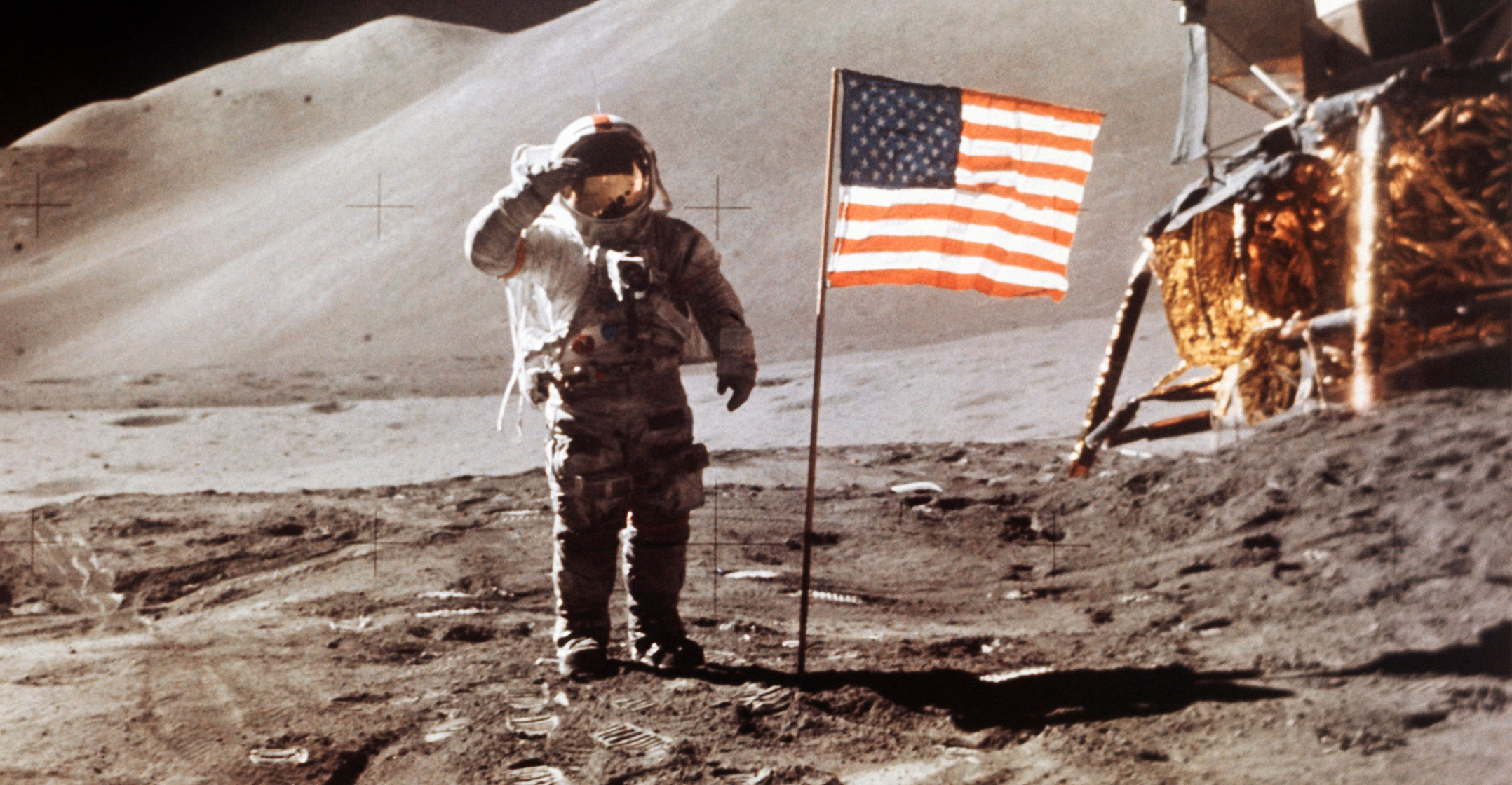
    Apollo 15 Lunar Module pilot James B Irwin salutes while standing on the surface of the moon on 30 July 1971 (Nasa/AP)

    Many people who are old enough to have experienced the first moon landing will vividly remember what it was like watching Neil Armstrong utter his famous quote: “That’s one small step for a man, one giant leap for mankind.”. Half a century later, the event is still one of the top achievements of mankind. Despite the rapid technological advances since then, astronauts haven’t actually been back to the moon since 1972.

    This seems surprising. After all, when we reflect on this historic event, it is often said that we now have more computing power in our pocket than the computer aboard Apollo 11 did. But is that true? And, if so, how much more powerful are our phones?

    On board Apollo 11 was a computer called the Apollo Guidance Computer (AGC). It had 2 048 words of memory which could be used to store “temporary results” — data that is lost when there is no power. This type of memory is referred to as RAM. Each word comprised 16 binary digits (bits), with a bit being a zero or a one. This means that the Apollo computer had 32 768 bits of RAM memory.

    The Apollo 11 computer would not be able to store this article in its 32 768 bits of RAM

    In addition, it had 72KB of ROM, which is equivalent to 589 824 bits. This memory is programmed and cannot be changed once it is finalised.

    A single alphabetical character — say an “a” or a “b” — typically requires eight bits to be stored. That means the Apollo 11 computer would not be able to store this article in its 32 768 bits of RAM. Compare that to your mobile phone or an MP3 player and you can appreciate that they are able to store much more, often containing thousands of e-mails, songs and photographs.

    To put that into more concrete terms, the latest phones typically have 4GB of RAM. That is 34 359 738 368 bits. This is more than one million (1 048 576 to be exact) times more memory than the Apollo computer had in RAM. The iPhone also has up to 512GB of ROM memory. That is 4 398 046 511 104 bits, which is more seven million times more than that of the guidance computer.

    Processing power

    But memory isn’t the only thing that matters. The Apollo 11 computer had a processor — an electronic circuit that performs operations on external data sources — which ran at 0.043MHz. The latest iPhone’s processor is estimated to run at about 2 490MHz. Apple do not advertise the processing speed, but others have calculated it. This means that the iPhone in your pocket has over 100 000 times the processing power of the computer that landed man on the moon 50 years ago.

    The situation is even more stark when you consider that there will be other processing built into the iPhone which looks after particular tasks, such as the display.

    It’s one thing comparing against a state-of-the-art phone, but how did the Apollo 11 computer compare against a classic calculator? Texas Instruments was one of the most famous manufacturers of calculators. In 1998, it released the TI-73, and in 2004, the TI-84.

    The following tables shows the specification of these two calculators.
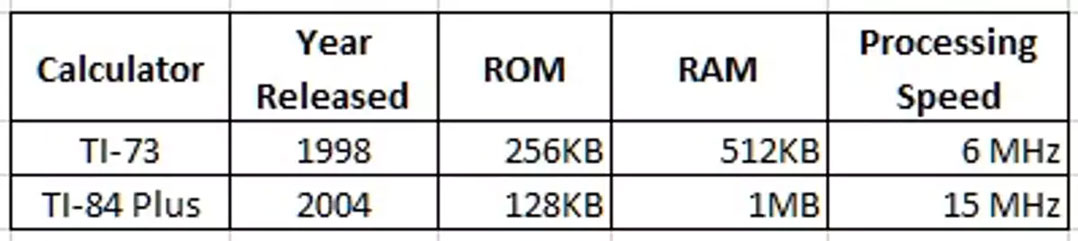
    Image: Supplied by author

    If we compare the two calculators against the Apollo guidance computer, we can note that the TI-73 has slightly less ROM, but eight times more RAM. By the time the TI-84 was released, amount of RAM had increased to 32 times more than the Apollo computer and the ROM was now more than 14 500 times more.
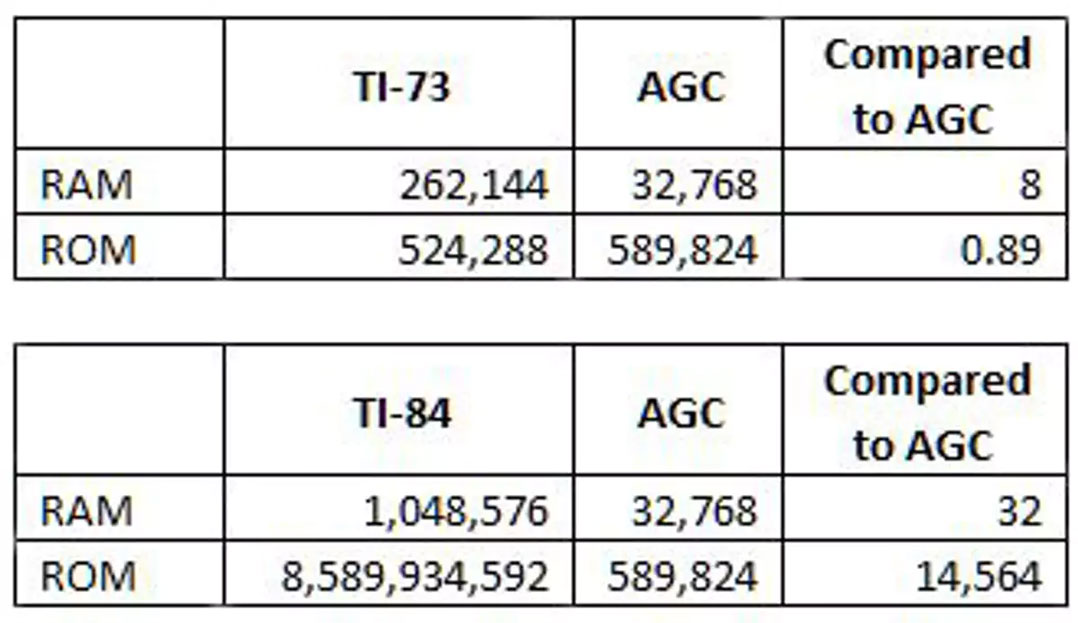
    Image: Supplied by author

    Regarding processing speed, the TI-73 was 140 times faster than the Apollo computer and the TI-84 was almost 350 times faster.

    It’s mind-blowing to think about that a simple calculator, designed to help students decades ago pass their exams, was more powerful than the computer that landed man on the moon.

    The Apollo computer was state-of-the-art in its time, but what would have been different if the moon landing had the state-of-the-art computers that are available today?

    I suspect that the software development time would have been a lot faster, due to the software development tools that are available today. It would have been a lot quicker to write, debug and test the complex code required to deliver a man to the moon.
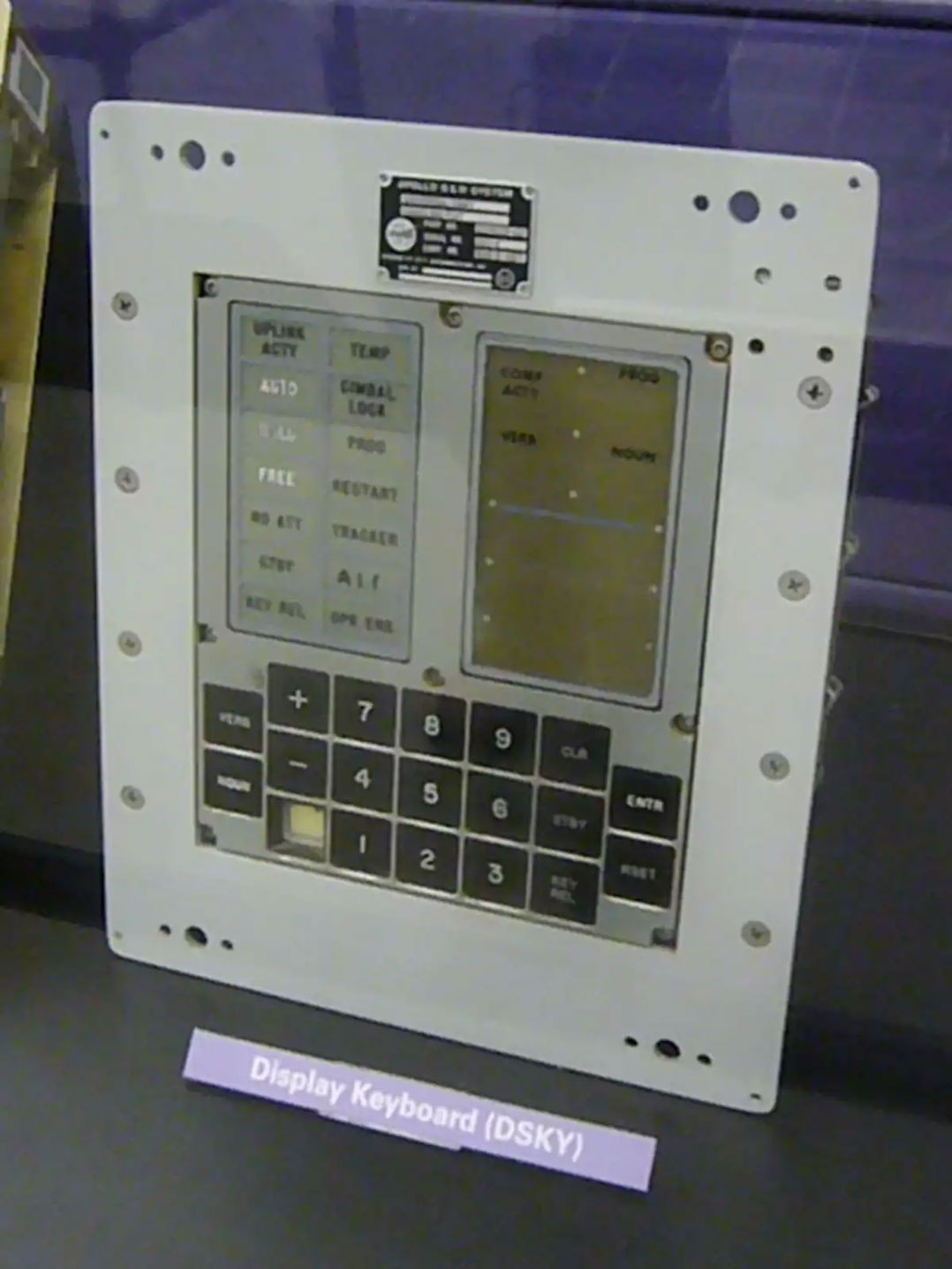
    Apollo Guidance Computer

    The user interface (called Display Keyboard (DSKY)) had a calculator-type interface where commands had to be input using numerical codes. Today’s interface would be a lot easier to use — which could matter in a stressful situation. It would almost certainly not have a keyboard, but would use swipe commands on a touch screen. If that were not possible, due to having to wear gloves, the interface might be through gestures, eye movement or some other intuitive interface.

    Surprisingly, one thing that wouldn’t be better today is the communication speed with Earth. The actual time it takes to communicate is the same today as it was in 1969 — that is, the speed of light, which means that it takes 1.26 seconds for a message to get from the moon to Earth. But with the larger files we now send — and from greater and greater distances — to get an image from a spacecraft to Earth today will take relatively longer than it did in 1969. That said, it would look much prettier thanks to advances in camera technology.

    One thing that wouldn’t be better today is communication speed with Earth

    Perhaps the biggest change we would see is the computer being a lot more artificially intelligent. I am sure that the flying and landing of the space craft would not be put solely into the hands of the computer, but it would have much more information and intelligence and would be able to make many more decisions than the Apollo 11 computer was able to do in 1969. This could be a huge relief for the astronauts. Armstrong did say that, on a worrying scale from one to 10, walking on the moon was about a one — whereas making the final descent to land was about a 13.

    So, let us end by acknowledging what it took to land people on the moon in 1969 with the limited computing power that was available at the time. It really was a remarkable achievement.The Conversation

    • Written by Graham Kendall, professor of computer science and Provost/CEO/PVC, University of Nottingham
    • This article is republished from The Conversation under a Creative Commons licence


    Neil Armstrong top
    Subscribe to TechCentral Subscribe to TechCentral
    Share. Facebook Twitter LinkedIn WhatsApp Telegram Email Copy Link
    Previous ArticleVisa, PayPal may bear a ‘heavy burden’ with Facebook crypto plan
    Next Article Interview: PPS chief technology officer Avsharn Bachoo

    Related Posts

    18GW in unplanned breakdowns cripple Eskom

    2 November 2021

    Nersa kicks the Karpowership can down the road

    13 September 2021

    If you think South African load shedding is bad, try Zimbabwe’s

    13 September 2021
    Company News
    Beat the summer heat with Samsung's WindFree air conditioners

    Beat the summer heat with Samsung’s WindFree air conditioners

    5 December 2025
    AI is not a technology problem - iqbusiness

    AI is not a technology problem – iqbusiness

    5 December 2025
    Telcos are sitting on a data gold mine - but few know what do with it - Phillip du Plessis

    Telcos are sitting on a data gold mine – but few know what do with it

    4 December 2025
    Opinion
    Your data, your hardware: the DIY AI revolution is coming - Duncan McLeod

    Your data, your hardware: the DIY AI revolution is coming

    20 November 2025
    Zero Carbon Charge founder Joubert Roux

    The energy revolution South Africa can’t afford to miss

    20 November 2025
    It's time for a new approach to government IT spend in South Africa - Richard Firth

    It’s time for a new approach to government IT spend in South Africa

    19 November 2025

    Subscribe to Updates

    Get the best South African technology news and analysis delivered to your e-mail inbox every morning.

    Latest Posts
    Vula Medical named as South Africa's 2025 app of the year

    Vula Medical named as South Africa’s 2025 app of the year

    5 December 2025
    Beat the summer heat with Samsung's WindFree air conditioners

    Beat the summer heat with Samsung’s WindFree air conditioners

    5 December 2025
    Netflix, Warner Bros talks raise fresh headaches for MultiChoice

    Netflix, Warner Bros talks raise fresh headaches for MultiChoice

    5 December 2025
    Big Microsoft 365 price increases coming next year

    Big Microsoft price increases coming next year

    5 December 2025
    © 2009 - 2025 NewsCentral Media
    • Cookie policy (ZA)
    • TechCentral – privacy and Popia

    Type above and press Enter to search. Press Esc to cancel.

    Manage consent

    TechCentral uses cookies to enhance its offerings. Consenting to these technologies allows us to serve you better. Not consenting or withdrawing consent may adversely affect certain features and functions of the website.

    Functional Always active
    The technical storage or access is strictly necessary for the legitimate purpose of enabling the use of a specific service explicitly requested by the subscriber or user, or for the sole purpose of carrying out the transmission of a communication over an electronic communications network.
    Preferences
    The technical storage or access is necessary for the legitimate purpose of storing preferences that are not requested by the subscriber or user.
    Statistics
    The technical storage or access that is used exclusively for statistical purposes. The technical storage or access that is used exclusively for anonymous statistical purposes. Without a subpoena, voluntary compliance on the part of your Internet Service Provider, or additional records from a third party, information stored or retrieved for this purpose alone cannot usually be used to identify you.
    Marketing
    The technical storage or access is required to create user profiles to send advertising, or to track the user on a website or across several websites for similar marketing purposes.
    • Manage options
    • Manage services
    • Manage {vendor_count} vendors
    • Read more about these purposes
    View preferences
    • {title}
    • {title}
    • {title}