
Close Menu
TechCentralTechCentral

    Subscribe to the newsletter

    Get the best South African technology news and analysis delivered to your e-mail inbox every morning.

    Facebook X (Twitter) YouTube LinkedIn
    WhatsApp Facebook X (Twitter) LinkedIn YouTube
    TechCentralTechCentral
    • News
      The retailer that is about to become your bank

      The retailer that is about to become your bank

      30 July 2026
      Wits announces quantum communications breakthrough - Tatjana Kleine

      Wits announces quantum communications breakthrough

      30 July 2026
      TCS | Rapid deployment rules can't work without municipalities: ACT - Nomvuyiso Batyi

      TCS | Icasa’s rules skip the real bottleneck: ACT

      30 July 2026
      Cisco hands Africa business to partner veteran Ossama Eldeeb

      Cisco hands Africa business to partner veteran Ossama Eldeeb

      30 July 2026
      Meta cash flow collapses as AI bill hits $145-billion - Mark Zuckerberg

      Meta cash flow collapses as AI bill hits $145-billion

      30 July 2026
    • World
      Meta AI will now tell parents if their teen is in crisis

      Meta AI will now tell parents if their teen is in crisis

      17 July 2026
      IBM shares crash 25% as AI upends software spending - Arvind Krishna

      IBM shares crash 25% as AI upends software spending

      15 July 2026
      Jony Ive's first OpenAI device: an AI smart speaker - Jony Ive and Sam Altman

      Jony Ive’s first OpenAI device: an AI smart speaker

      15 July 2026
      Stripe, Advent in talks to buy PayPal for $53-billion

      Stripe, Advent in talks to buy PayPal for $53-billion

      15 July 2026
      Memory crisis sends smartphone market into steep decline

      Memory crisis sends smartphone market into steep decline

      13 July 2026
    • In-depth
      The plan to stop AI from breaking the world - Google DeepMind CEO Demis Hassabis. Image: John Sears

      The plan to stop AI from breaking the world

      16 July 2026
      The internet has a Strait of Hormuz problem

      The internet has a Strait of Hormuz problem

      15 July 2026
      AI boom sparks rally, frenzy and fear

      AI boom sparks rally, frenzy and fear

      11 June 2026
      Every plug-in hybrid on sale in South Africa, ranked by price - Lamborghini Temerario

      Every plug-in hybrid on sale in South Africa, ranked by price

      7 June 2026
      What Wi-Fi 8 will mean for wireless networks

      What Wi-Fi 8 will mean for wireless networks

      1 June 2026
    • TCS
      TCS+ | iStore Business on why Apple makes sense for SMEs - Sudesh Pillay and Tamia Nontsikelelo

      TCS+ | iStore Business on why Apple makes sense for SMEs

      30 July 2026
      TCS+ | A smarter approach to cloud for South African businesses - Joel Chacko and Jonathan Oaker

      TCS+ | A smarter approach to cloud for South African businesses

      28 July 2026
      TCS | How Optasia lends billions to people banks can't see - Salvador Anglada

      TCS | How Optasia lends billions to people banks can’t see

      23 July 2026
      The rands-and-cents case for electric trucks - William Kelly Watts & Wheels with Wills

      The rands-and-cents case for electric trucks

      20 July 2026
      Watts & Wheels S1E7: 'Ferrari's EV breaks the internet'

      Watts & Wheels S1E7: ‘Ferrari’s EV breaks the internet’

      8 July 2026
    • Opinion
      The author, Jannie van Zyl

      Selling vapour is corporate suicide in slow motion

      16 July 2026
      Brazil's online gambling crackdown is a lesson for South Africa

      How Amazon outmanoeuvred Starlink in South Africa

      15 July 2026
      The Popia problem with agentic AI - Herman Haasbroek

      The Popia problem with agentic AI

      14 July 2026
      The author, Fanie van Rooyen

      South Africa can still catch the AI wave – here’s how

      7 July 2026
      The author, Fanie van Rooyen

      The AI utopia South Africa can’t afford

      1 July 2026
    • Company Hubs
      • 1Stream
      • Africa Data Centres
      • AfriGIS
      • Altron Digital Business
      • Altron Document Solutions
      • Altron Group
      • Arctic Wolf
      • Ascent Technology
      • AvertITD
      • BBD
      • Braintree
      • CallMiner
      • CambriLearn
      • CM Telecom
      • Contactable
      • CYBER1 Solutions
      • Digicloud Africa
      • Digimune
      • Domains.co.za
      • ESET
      • Euphoria Telecom
      • HOSTAFRICA
      • Incredible Business
      • iONLINE
      • IQbusiness
      • Iris Network Systems
      • Kaspersky
      • LSD Open
      • Mitel
      • NEC XON
      • Netstar
      • Network Platforms
      • Next DLP
      • Ovations
      • Paracon
      • Paratus
      • Q-KON
      • SevenC
      • SkyWire
      • Solid8 Technologies
      • Telit Cinterion
      • Telviva
      • Tenable
      • Vertiv
      • Videri Digital
      • Vodacom Business
      • Vox
      • Wipro
      • Workday
      • XLink
    • Sections
      • AI and machine learning
      • Banking
      • Broadcasting and Media
      • Cloud services
      • Contact centres and CX
      • Cryptocurrencies
      • Education and skills
      • Electronics and hardware
      • Energy and sustainability
      • Enterprise software
      • Financial services
      • HealthTech
      • Information security
      • Internet and connectivity
      • Internet of Things
      • Investment
      • IT services
      • Lifestyle
      • Policy and regulation
      • Public sector
      • Retail and e-commerce
      • Satellite communications
      • Science
      • SMEs and start-ups
      • Social media
      • Talent and leadership
      • Telecoms
      • Watts & Wheels
    • Events
    • Advertise
    TechCentralTechCentral
    Home Ā» Opinion Ā» Ivo Vegter Ā» Geeks retreating, talking, teaching

    Geeks retreating, talking, teaching

    By Editor19 January 2010
    Twitter LinkedIn Facebook WhatsApp Email Telegram Copy Link
    News Alerts
    WhatsApp

    Ivo Vegter

    [By Ivo Vegter] The second GeekRetreat was held last weekend in the picturesque surroundings of Stanford, in the Western Cape. This gathering of technology entrepreneurs, educators, journalists, and venture capitalists is unique in its format and composition.

    Attendance is limited, so that everyone gets to talk to everyone else, and no cliques form. There is no planned schedule. It is planned on the day by the attendees themselves. Each brings their own passions, problems, solutions or proposals.

    The result is that ideas that otherwise would not occur to organisers, are not designed to attract sponsors, or emerge only after a conference has started, get aired.

    Many topics were discussed, ranging from serious (such as my own discussion on banking law, described in more detail in a column on The Daily Maverick), to ambitious (how to crowd-source start-up funding), to socially relevant (using technology to improve primary and secondary education), to reflexive (tips on coding and general work productivity) to recursive (a talk on giving better talks).

    Some of these will result in concrete projects, though much of the value of the event was merely in sharing ideas, gaining new perspectives, and meeting the people who care about them.

    Telecoms lobbying
    Among the technology topics, one key session was led by Samantha Perry, the editor of Brainstorm, a technology magazine. In light of recent changes in the telecommunications environment, such as the court ruling that permits self-provision, the progress on interconnection regulation, and the completion of the Seacom undersea cable, it asked whether there was still much point in lobbying for legal orĀ  regulatory change.

    The discussion was lively, but concluded that many barriers remain if the country is to lower the cost of communication and extend Internet access to as broad a population as possible.

    There was consensus that any commentary, advocacy or active lobbying would have to address specific barriers, and do so in a consistent, clear manner. In particular, it should not try to propose technical solutions to problems. Many entrepreneurs working independently and testing their ideas in the open market are better at discovering those, provided there are no legal barriers to doing so.
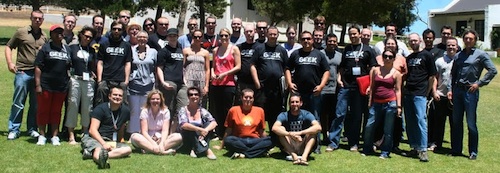
    GeekRetreaters 2010 (photo credit: Paul Furber)
    GeekRetreaters 2010 (photo credit: Paul Furber)

    Of the specific barriers discussed, local-loop unbundling was viewed with surprisingly little enthusiasm. International experience had shown the process to be slow and fraught with complexity. By the time it has an effect, the benefits were thought to be too little too late, especially on a continent where mobile has already outstripped fixed access by an order of magnitude.

    The group also noted that many specific interventions are merely small parts of a larger puzzle. Neither number portability, nor lower interconnect rates, for example, can be expected to spur competition and cost reductions in isolation.

    It did, however, seem useful to those present to prioritise regulatory issues that could most beneficially be raised with the media, the department of communications, the Independent Communications Authority of South Africa, or with broader government entities such as the department of trade & industry or the National Planning Commission.

    Spectrum allocation was discussed as a likely contender for the top spot on any priority list, because much radio frequency spectrum is presently unused, and more will be freed by the introduction of digital terrestrial television. How this is allocated, or whether it is made tradeable, will have a significant impact on the innovative and efficient use to which it can be put.

    Geek School
    Education was a theme that ran through many of the sessions, often spontaneously. The sense that education is the key to unlock the future prosperity and growth of our nation, but that the status quo is untenable, was strong.

    Education was discussed from many angles. Primary and secondary school level featured prominently, especially in light of the deplorable recent performance of public education. The fear was voiced that a new “lost generation” would be created unless private individuals take initiative and do something about it.

    How to use technology to improve education was also a common topic. One innovative proposal involved promoting games not usually considered educational for their pedagogic value. It was noted that many overtly education games bore children to distraction. The analogy was made between old-fashioned board, card or dice games, which are entertaining and do not have a direct educational purpose, but which do teach language, strategy, motor skills, arithmetic or finance.

    In another discussion, the fact that fixed Internet access, at 11% of the population, remains limited to wealthy elites, was highlighted. The majority of SA’s population (75%) relies on mobile phones as their sole means of communication. Moreover, few of those are smart phones, and even the ability to run Java is not universal on the basic units which many of the poor use. As a result, education solutions not only have to be mobile, but have to work with technologies such as USSD, available on even the lowliest of GSM handsets.

    At the school-leaver level, a promising proposal — establishing a Geek School — was made by Heidi Schneigansz, a producer at Quirk eMarketing, but known by her online handle, SnowGoose. This venture would start by introducing grade 10 and 11 learners to Web entrepreneurship as a potential career alternative after leaving school.

    Those who start online technology businesses, instead of attending university, would then find in the Geek School an inexpensive training and support facility. Over a period of several months or more, it would give emerging entrepreneurs access to successful start-ups and business leaders. Using social networks and other technology, students will be able to develop skills, learn about pitfalls, and solicit advice.

    Several attendees proved very enthusiastic in helping with such a project, offering either technology expertise, market knowledge, or start-up experience to put flesh on the bones of what prior to this GeekRetreat was merely a skeleton of an idea.

    The 50 invited geeks, chosen for their record of contributing to the development of the internet in SA, their proven value to the inaugural GeekRetreat in July 2009, or their commitment to making new projects happen, proved to be a dynamic, vibrant group, brimming with ideas and the enthusiasm to make them happen.

    Each person present in Stanford last weekend was raised on the power of social networks and high technology, and nurtured by the experience of collaboration. Each appeared optimistic not only about SA’s potential, but also about their own ability to help achieve it.

    • Ivo Vegter is a freelance journalist
    • Vegter photo credit: Sally Shorkend/The Daily Maverick
    • Subscribe to our free daily newsletter
    • Follow us on Twitter or on Facebook

    Follow TechCentral on Google News Add TechCentral as your preferred source on Google


    GeekRetreat Heidi Scheigansz Icasa Ivo Vegter Quirk eMarketing Samantha Perry
    WhatsApp YouTube
    Share. Facebook Twitter LinkedIn WhatsApp Telegram Email Copy Link
    Previous ArticleApple tablet, new iLife, iPhone 4 on the cards?
    Next Article Parliament’s Vadi vows to get tough in 2010

    Related Posts

    TCS | Rapid deployment rules can't work without municipalities: ACT - Nomvuyiso Batyi

    TCS | Icasa’s rules skip the real bottleneck: ACT

    30 July 2026
    Radical rethink for South Africa's national AI policy

    Radical rethink for South Africa’s national AI policy

    29 July 2026
    Prime spectrum lies idle as the Woan's ghost lingers

    Prime spectrum lies idle as the Woan’s ghost lingers

    27 July 2026
    Company News
    Why identity has become a board-level growth issue - Contactable

    Why identity has become a board-level growth issue

    30 July 2026
    Why Netstar is tracking your favourite sporting event

    Why Netstar is tracking your favourite sporting event

    30 July 2026
    Huawei Connect 2026: taking South African AI beyond pilots

    Huawei Connect 2026: taking South African AI beyond pilots

    29 July 2026
    Opinion
    The author, Jannie van Zyl

    Selling vapour is corporate suicide in slow motion

    16 July 2026
    Brazil's online gambling crackdown is a lesson for South Africa

    How Amazon outmanoeuvred Starlink in South Africa

    15 July 2026
    The Popia problem with agentic AI - Herman Haasbroek

    The Popia problem with agentic AI

    14 July 2026

    Subscribe to Updates

    Get the best South African technology news and analysis delivered to your e-mail inbox every morning.

    Latest Posts
    The retailer that is about to become your bank

    The retailer that is about to become your bank

    30 July 2026
    TCS+ | iStore Business on why Apple makes sense for SMEs - Sudesh Pillay and Tamia Nontsikelelo

    TCS+ | iStore Business on why Apple makes sense for SMEs

    30 July 2026
    Wits announces quantum communications breakthrough - Tatjana Kleine

    Wits announces quantum communications breakthrough

    30 July 2026
    Why identity has become a board-level growth issue - Contactable

    Why identity has become a board-level growth issue

    30 July 2026
    © 2009 - 2026 NewsCentral Media
    Built and maintained by Chronon
    • Cookie policy (ZA)
    • TechCentral – privacy and Popia

    Type above and press Enter to search. Press Esc to cancel.

    Manage consent

    TechCentral uses cookies to enhance its offerings. Consenting to these technologies allows us to serve you better. Not consenting or withdrawing consent may adversely affect certain features and functions of the website.

    Functional Always active
    The technical storage or access is strictly necessary for the legitimate purpose of enabling the use of a specific service explicitly requested by the subscriber or user, or for the sole purpose of carrying out the transmission of a communication over an electronic communications network.
    Preferences
    The technical storage or access is necessary for the legitimate purpose of storing preferences that are not requested by the subscriber or user.
    Statistics
    The technical storage or access that is used exclusively for statistical purposes. The technical storage or access that is used exclusively for anonymous statistical purposes. Without a subpoena, voluntary compliance on the part of your Internet Service Provider, or additional records from a third party, information stored or retrieved for this purpose alone cannot usually be used to identify you.
    Marketing
    The technical storage or access is required to create user profiles to send advertising, or to track the user on a website or across several websites for similar marketing purposes.
    • Manage options
    • Manage services
    • Manage {vendor_count} vendors
    • Read more about these purposes
    View preferences
    • {title}
    • {title}
    • {title}