Close Menu
TechCentralTechCentral

    Subscribe to the newsletter

    Get the best South African technology news and analysis delivered to your e-mail inbox every morning.

    Facebook X (Twitter) YouTube LinkedIn
    WhatsApp Facebook X (Twitter) LinkedIn YouTube
    TechCentralTechCentral
    • News
      Netflix, Warner Bros talks raise fresh headaches for MultiChoice

      Netflix, Warner Bros talks raise fresh headaches for MultiChoice

      5 December 2025
      Big Microsoft 365 price increases coming next year

      Big Microsoft price increases coming next year

      5 December 2025
      Vodacom to take control of Safaricom in R36-billion deal - Shameel Joosub

      Vodacom to take control of Safaricom in R36-billion deal

      4 December 2025
      Black Friday goes digital in South Africa as online spending surges to record high

      Black Friday goes digital in South Africa as online spending surges to record high

      4 December 2025
      BYD takes direct aim at Toyota with launch of sub-R500 000 Sealion 5 PHEV

      BYD takes direct aim at Toyota with launch of sub-R500 000 Sealion 5 PHEV

      4 December 2025
    • World
      Amazon and Google launch multi-cloud service for faster connectivity

      Amazon and Google launch multi-cloud service for faster connectivity

      1 December 2025
      Google makes final court plea to stop US breakup

      Google makes final court plea to stop US breakup

      21 November 2025
      Bezos unveils monster rocket: New Glenn 9x4 set to dwarf Saturn V

      Bezos unveils monster rocket: New Glenn 9×4 set to dwarf Saturn V

      21 November 2025
      Tech shares turbocharged by Nvidia's stellar earnings

      Tech shares turbocharged by stellar Nvidia earnings

      20 November 2025
      Config file blamed for Cloudflare meltdown that disrupted the web

      Config file blamed for Cloudflare meltdown that disrupted the web

      19 November 2025
    • In-depth
      Jensen Huang Nvidia

      So, will China really win the AI race?

      14 November 2025
      Valve's Linux console takes aim at Microsoft's gaming empire

      Valve’s Linux console takes aim at Microsoft’s gaming empire

      13 November 2025
      iOCO's extraordinary comeback plan - Rhys Summerton

      iOCO’s extraordinary comeback plan

      28 October 2025
      Why smart glasses keep failing - no, it's not the tech - Mark Zuckerberg

      Why smart glasses keep failing – it’s not the tech

      19 October 2025
      BYD to blanket South Africa with megawatt-scale EV charging network - Stella Li

      BYD to blanket South Africa with megawatt-scale EV charging network

      16 October 2025
    • TCS
      TCS+ | How Cloud on Demand helps partners thrive in the AWS ecosystem - Odwa Ndyaluvane and Xenia Rhode

      TCS+ | How Cloud On Demand helps partners thrive in the AWS ecosystem

      4 December 2025
      TCS | MTN Group CEO Ralph Mupita on competition, AI and the future of mobile

      TCS | Ralph Mupita on competition, AI and the future of mobile

      28 November 2025
      TCS | Dominic Cull on fixing South Africa's ICT policy bottlenecks

      TCS | Dominic Cull on fixing South Africa’s ICT policy bottlenecks

      21 November 2025
      TCS | BMW CEO Peter van Binsbergen on the future of South Africa's automotive industry

      TCS | BMW CEO Peter van Binsbergen on the future of South Africa’s automotive industry

      6 November 2025
      TCS | Why Altron is building an AI factory - Bongani Andy Mabaso

      TCS | Why Altron is building an AI factory in Johannesburg

      28 October 2025
    • Opinion
      Your data, your hardware: the DIY AI revolution is coming - Duncan McLeod

      Your data, your hardware: the DIY AI revolution is coming

      20 November 2025
      Zero Carbon Charge founder Joubert Roux

      The energy revolution South Africa can’t afford to miss

      20 November 2025
      It's time for a new approach to government IT spend in South Africa - Richard Firth

      It’s time for a new approach to government IT spend in South Africa

      19 November 2025
      How South Africa's broken Rica system fuels murder and mayhem - Farhad Khan

      How South Africa’s broken Rica system fuels murder and mayhem

      10 November 2025
      South Africa's AI data centre boom risks overloading a fragile grid - Paul Colmer

      South Africa’s AI data centre boom risks overloading a fragile grid

      30 October 2025
    • Company Hubs
      • Africa Data Centres
      • AfriGIS
      • Altron Digital Business
      • Altron Document Solutions
      • Altron Group
      • Arctic Wolf
      • AvertITD
      • Braintree
      • CallMiner
      • CambriLearn
      • CYBER1 Solutions
      • Digicloud Africa
      • Digimune
      • Domains.co.za
      • ESET
      • Euphoria Telecom
      • Incredible Business
      • iONLINE
      • IQbusiness
      • Iris Network Systems
      • LSD Open
      • NEC XON
      • Netstar
      • Network Platforms
      • Next DLP
      • Ovations
      • Paracon
      • Paratus
      • Q-KON
      • SevenC
      • SkyWire
      • Solid8 Technologies
      • Telit Cinterion
      • Tenable
      • Vertiv
      • Videri Digital
      • Vodacom Business
      • Wipro
      • Workday
      • XLink
    • Sections
      • AI and machine learning
      • Banking
      • Broadcasting and Media
      • Cloud services
      • Contact centres and CX
      • Cryptocurrencies
      • Education and skills
      • Electronics and hardware
      • Energy and sustainability
      • Enterprise software
      • Financial services
      • Information security
      • Internet and connectivity
      • Internet of Things
      • Investment
      • IT services
      • Lifestyle
      • Motoring
      • Public sector
      • Retail and e-commerce
      • Satellite communications
      • Science
      • SMEs and start-ups
      • Social media
      • Talent and leadership
      • Telecoms
    • Events
    • Advertise
    TechCentralTechCentral
    Home » World » How Russia is evading sanctions to buy high-end chips

    How Russia is evading sanctions to buy high-end chips

    Russia looks to be successfully working around sanctions to secure crucial semiconductors and other technologies for its war in Ukraine.
    By Agency Staff6 March 2023
    Twitter LinkedIn Facebook WhatsApp Email Telegram Copy Link
    News Alerts
    WhatsApp

    Russia looks to be successfully working around European Union and Group of Seven sanctions to secure crucial semiconductors and other technologies for its war in Ukraine, according to a senior European diplomat.

    Russian imports in general have largely returned to their pre-war 2020 levels and analysis of trade data suggests that advanced chips and integrated circuits made in the EU and other allied nations are being shipped to Russia through third countries such as Turkey, the United Arab Emirates and Kazakhstan, the diplomat said, pointing to those private assessments.

    EU and G7 countries have introduced multiple rounds of sanctions since the invasion of Ukraine a year ago in an effort to degrade the Russian war machine and undermine its economy. The data suggest that the real impact in some areas is so far falling short of what officials might have hoped for.

    Just signing up to new sanctions is not enough. Governments now need enforcement mechanisms

    “Just signing up to new sanctions is not enough,” said Daniel Tannebaum, global anti-financial crime practice leader at consulting firm Oliver Wyman. “Governments now need enforcement mechanisms.”

    Shipments from China to Russia have also surged as Beijing plays an increasingly important role in supplying Moscow, the diplomat added, asking not to be named discussing sensitive information. Those countries outside the EU haven’t sanctioned Russia themselves, but most have repeatedly denied they are helping the Kremlin.

    The EU has sanctioned nearly 1 500 individuals, restricted exports on hundreds of goods and technologies, and targeted many of Moscow’s key revenue sources. But some officials worry that the bloc still lacks an effective apparatus to enforce those measures and lags behind the US.

    With a longer history of sanctioning foreign powers, the US has a centralised agency, more efficient procedures for gathering information as well as stringent legislation and the tools to enforce the rules at home and abroad.

    Patchwork effort

    In the EU, enforcement is a patchwork effort that mostly falls to member states.

    While the European Commission, the bloc’s executive arm, monitors implementation and provides guidance, national authorities are responsible for identifying breaches and imposing penalties. And that means the results are inconsistent.

    Ultimately, it’s about political will, said one EU official involved in the process, and national officials can come under pressure when it comes to taking tough action against their own companies.

    “Our sanctions are biting hard and contributing to sustained economic recession in Russia,” commission vice president Valdis Dombrovskis said in Bulgaria last week. “But their effectiveness also depends on how well they are enforced.”

    On the surface of things, sanctions appear to be effective. Russia’s economy has contracted and many of its banks and companies remain cut off from international financial and trading systems. There is also evidence that the restrictions on European and US technologies have weakened key Russian industries and hampered their ability to innovate in the future.

    But information collected by the Geneva-based Trade Data Monitor indicates that some sanctioned goods — particularly advanced semiconductors — are being diverted to Russia via third countries, many of which abruptly changed their trading habits following Russia’s invasion.
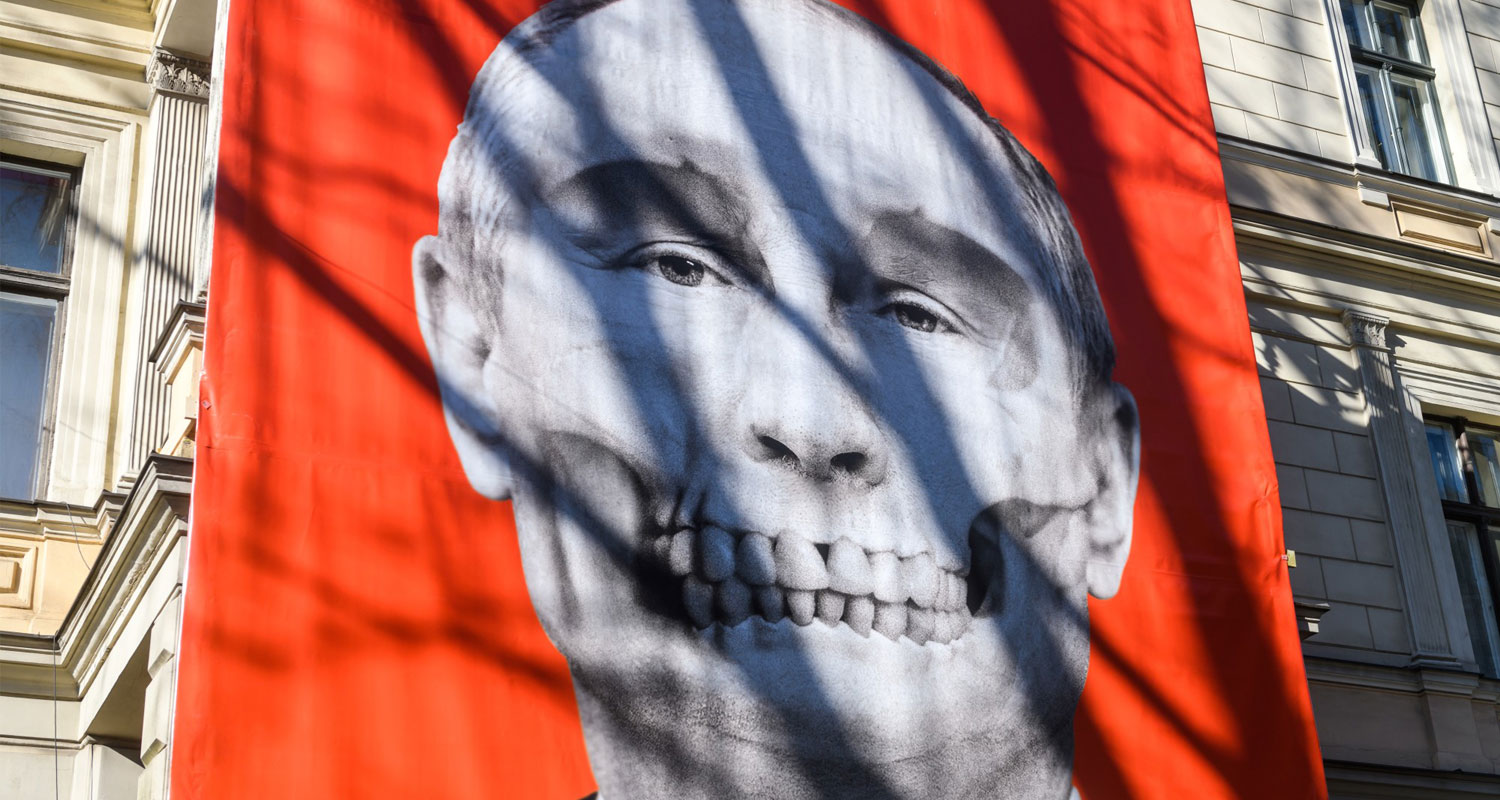
    Huge banner with Russian President Vladimir Putin’s skull hung at Medine History Museum in front of Russian embassy, Riga, Latvia, 9 March 2022. Image: Gints Ivuskans

    In some cases, the exports to Russia of technologies that could be used for military purposes in Ukraine have gone from effectively zero to millions of dollars.

    Kazakhstan provides a key example. In 2022, the Central Asian nation exported US$3.7-million worth of advanced semiconductors to Russia, up from a mere $12 000 worth the year before the war started.

    Russia was buying an average of $163-million worth of advanced chips and integrated circuits from the EU, the US, Japan and the UK each year between 2017 and 2021. In 2022, that slumped to about $60-million.

    The data shows Turkey, Serbia, the UAE and half a dozen other economies in Eastern Europe and Central Asia helped make up the shortfall. Meanwhile, shipments of hi-tech components to those countries from the allied nations surged by a similar amount.

    The same sort of patterns are apparent across hundreds of product categories, but it is especially acute when it comes to advanced chips and integrated circuits that can be used for military purposes, the diplomat said.

    With Russia’s war in Ukraine now into its second year, the EU and its allies are increasingly focused on tightening any loopholes and preventing successive rounds of sanctions they’ve introduced from being circumvented.

    It would of course be more convenient for everybody if there was one EU-level institution in charge

    But tracking shipments isn’t a straightforward process. Buyers sometimes use complex corporate vehicles and distribution models to obscure the final destination of their goods. Incomplete paperwork can add to the opacity, as well as so-called transshipment points, where goods are moved between vehicles or rerouted.

    On Thursday, the Biden administration released a compliance note aimed at cracking down on intermediaries used to evade sanctions and export controls on Russia. The notice names China, Armenia, Turkey and Uzbekistan as locations that may be used to illegally redirect restricted items to Russia.

    The G7 announced last week a new mechanism to bolster enforcement and the EU has also introduced several tools in its recent packages to go after those aiding Russia.

    But EU countries have so far been shy about using some of those tools and going after potential breaches at home, at least publicly. Discussions on toughening up the EU’s enforcement regime have opened a debate over where the share of responsibilities between Brussels and Europe’s capitals should lie when it comes to policing measures, officials and diplomats say.

    “It would of course be more convenient for everybody if there was one EU-level institution in charge,” Toms Platacis, the acting director of the Latvian Financial Intelligence Unit, said in an interview.

    Tortuous

    Latvia has criminalised sanctions violations, while other EU countries have not, so violators can “look for other countries where evading sanctions carries less potential penalty”, he said.

    In implementing successive rounds of sanctions, EU nations have been careful to limit the impact on their own bottom line and the wider global economy. That has at times led to often tortuous discussions between member states over exemptions and reporting requirements.

    With every round of sanctions we take a step forward with new measures and one step back with new exemptions, one senior European minister said. Some member states are less enthusiastic about enforcement and are not doing enough, the minister added.

    “Enforcement of export sanctions is not trivial,” said Beata Javorcik, chief economist at the European Bank for Reconstruction and Development. “Every government wants all other countries to enforce them but prefers to be lenient vis-à-vis its own firms. The experience with export restrictions during the Cold War shows this clearly. Thus, leaving enforcement of sanctions to national governments may not always work perfectly.”  — Alberto Nardelli, with Bryce Baschuk and Aaron Eglitis, (c) 2023 Bloomberg LP

    Get TechCentral’s daily newsletter


    Subscribe to TechCentral Subscribe to TechCentral
    Share. Facebook Twitter LinkedIn WhatsApp Telegram Email Copy Link
    Previous ArticlePersonalisation in retail: the more we change, the more we stay the same
    Next Article ISP body tells fibre network operators: give consumers choice

    Related Posts

    Netflix, Warner Bros talks raise fresh headaches for MultiChoice

    Netflix, Warner Bros talks raise fresh headaches for MultiChoice

    5 December 2025
    Big Microsoft 365 price increases coming next year

    Big Microsoft price increases coming next year

    5 December 2025
    AI is not a technology problem - iqbusiness

    AI is not a technology problem – iqbusiness

    5 December 2025
    Company News
    AI is not a technology problem - iqbusiness

    AI is not a technology problem – iqbusiness

    5 December 2025
    Telcos are sitting on a data gold mine - but few know what do with it - Phillip du Plessis

    Telcos are sitting on a data gold mine – but few know what do with it

    4 December 2025
    Unlock smarter computing with your surface Copilot+ PC

    Unlock smarter computing with your Surface Copilot+ PC

    4 December 2025
    Opinion
    Your data, your hardware: the DIY AI revolution is coming - Duncan McLeod

    Your data, your hardware: the DIY AI revolution is coming

    20 November 2025
    Zero Carbon Charge founder Joubert Roux

    The energy revolution South Africa can’t afford to miss

    20 November 2025
    It's time for a new approach to government IT spend in South Africa - Richard Firth

    It’s time for a new approach to government IT spend in South Africa

    19 November 2025

    Subscribe to Updates

    Get the best South African technology news and analysis delivered to your e-mail inbox every morning.

    Latest Posts
    Netflix, Warner Bros talks raise fresh headaches for MultiChoice

    Netflix, Warner Bros talks raise fresh headaches for MultiChoice

    5 December 2025
    Big Microsoft 365 price increases coming next year

    Big Microsoft price increases coming next year

    5 December 2025
    AI is not a technology problem - iqbusiness

    AI is not a technology problem – iqbusiness

    5 December 2025
    Vodacom to take control of Safaricom in R36-billion deal - Shameel Joosub

    Vodacom to take control of Safaricom in R36-billion deal

    4 December 2025
    © 2009 - 2025 NewsCentral Media
    • Cookie policy (ZA)
    • TechCentral – privacy and Popia

    Type above and press Enter to search. Press Esc to cancel.

    Manage consent

    TechCentral uses cookies to enhance its offerings. Consenting to these technologies allows us to serve you better. Not consenting or withdrawing consent may adversely affect certain features and functions of the website.

    Functional Always active
    The technical storage or access is strictly necessary for the legitimate purpose of enabling the use of a specific service explicitly requested by the subscriber or user, or for the sole purpose of carrying out the transmission of a communication over an electronic communications network.
    Preferences
    The technical storage or access is necessary for the legitimate purpose of storing preferences that are not requested by the subscriber or user.
    Statistics
    The technical storage or access that is used exclusively for statistical purposes. The technical storage or access that is used exclusively for anonymous statistical purposes. Without a subpoena, voluntary compliance on the part of your Internet Service Provider, or additional records from a third party, information stored or retrieved for this purpose alone cannot usually be used to identify you.
    Marketing
    The technical storage or access is required to create user profiles to send advertising, or to track the user on a website or across several websites for similar marketing purposes.
    • Manage options
    • Manage services
    • Manage {vendor_count} vendors
    • Read more about these purposes
    View preferences
    • {title}
    • {title}
    • {title}