
Close Menu
TechCentralTechCentral

    Subscribe to the newsletter

    Get the best South African technology news and analysis delivered to your e-mail inbox every morning.

    Facebook X (Twitter) YouTube LinkedIn
    WhatsApp Facebook X (Twitter) LinkedIn YouTube
    TechCentralTechCentral
    • News
      Vodacom targets satellite-to-phone service in South Africa next year

      Vodacom targets satellite-to-phone service in South Africa next year

      10 November 2026
      Vodacom eyes SA and Kenya for AI data centre hubs after Egypt - Shameel Joosub

      Vodacom eyes SA and Kenya for AI data centre hubs after Egypt

      10 November 2026
      Eskom chairman Mteto Nyati and energy minister Kgosientsho Ramokgopa speak to the media in Irene, Pretoria

      South Africa’s first new nuclear reactors could be online by 2036

      10 November 2026
      Comsol's 5G network pricing comes into view

      Comsol’s 5G network pricing comes into view

      10 November 2026
      Safaricom ruling tripped default clauses in Vodacom's loans

      Safaricom ruling tripped default clauses in Vodacom’s loans

      10 November 2026
    • World
      John Ternus faces first big test as Apple CEO - John Ternus

      John Ternus faces first big test as Apple CEO

      2 November 2026
      Alleged Israeli spy company heavily targeted Starlink users

      How online ads were used to hunt Starlink users

      28 October 2026
      Anthropic's IPO stands alone

      Anthropic’s IPO stands alone

      23 October 2026
      PHP flaws trigger global scramble as hackers pounce

      PHP flaws trigger global scramble as hackers pounce

      22 October 2026
      OpenAI turns the tables on Apple in trade secrets fight

      OpenAI turns the tables on Apple in trade secrets fight

      15 October 2026
    • In-depth
      Ducking hell: inside Apple's hidden list of words the iPhone won't suggest

      Ducking hell: inside Apple’s hidden list of words the iPhone won’t suggest

      6 November 2026
      Why investors are souring on Netflix

      Why investors are souring on Netflix

      22 October 2026

      10 days that changed the course of AI

      21 September 2026
      Meta to the AI industry: slow down without us - Mark Zuckerberg

      Meta to the AI industry: slow down without us

      16 September 2026
      Google DeepMind CEO Demis Hassabis. Image: John Sears

      The plan to stop AI from breaking the world

      16 July 2026
    • TCS
      TCS+ | Old Mutual's Celiwe Ross on leading people through AI - Old Mutual

      TCS+ | Old Mutual’s Celiwe Ross on leading people through AI

      6 November 2026
      TCS+ | How the Apple ecosystem drives productivity for SMEs - Sudesh Pillay iStore and Kevin McLennan

      TCS+ | How the Apple ecosystem drives productivity for SMEs

      6 November 2026
      TCS+ | Vox on AI, data rules and omnichannel communication for SMEs

      TCS+ | Vox on AI, data rules and omnichannel communication for SMEs

      26 October 2026
      TCS | The Cape Town firm quietly connecting Eskom, Pep and 6 000 ATMs - Réan van Niekerk, Metacom

      TCS | The Cape Town firm quietly connecting Eskom, Pep and 6 000 ATMs

      23 October 2026
      TCS+ | Boards are underestimating the cost of a cyberattack, says Arctic Wolf - Jason Oehley and Andre Den Hond

      TCS+ | Boards are underestimating the cost of a cyberattack, says Arctic Wolf

      22 October 2026
    • Opinion
      Icasa's Sim rules need a privacy backstop - Lloyd Matthew and Heinz Vollmer

      Icasa’s Sim rules need a privacy backstop

      5 November 2026
      AI's boardroom honeymoon is over - Gary Stocks

      AI’s boardroom honeymoon is over

      22 October 2026
      Before South Africa licenses Starlink, it should look at Ukraine - Duncan McLeod

      Before South Africa licenses Starlink, it should look at Ukraine

      21 October 2026
      Nonkqubela Thathakahle Jordan-Dyani

      Why cybersecurity is now a national security issue for South Africa

      15 October 2026
      When a machine can choose, who does it become? Fanie van Rooyen

      When a machine can choose, who does it become?

      9 October 2026
    • Company News
      • 1Stream
      • Africa Data Centres
      • AfriGIS
      • Altron Digital Business
      • Altron Document Solutions
      • Altron Group
      • Arctic Wolf
      • Ascent Technology
      • AvertITD
      • BBD
      • Braintree
      • CallMiner
      • CambriLearn
      • CM.com
      • Contactable
      • CYBER1 Solutions
      • Digicloud Africa
      • Digimune
      • Domains.co.za
      • ESET
      • Euphoria Telecom
      • HOSTAFRICA
      • Incredible Business
      • iONLINE
      • IQbusiness
      • Iris Network Systems
      • Kaspersky
      • LSD Open
      • Mitel
      • NEC XON
      • Netstar
      • Network Platforms
      • Next DLP
      • Ovations
      • Paracon
      • Paratus
      • Publishared
      • Q-KON
      • SevenC
      • SkyWire
      • Solid8 Technologies
      • Telit Cinterion
      • Telviva
      • Tenable
      • Vertiv
      • Videri Digital
      • Vodacom Business
      • Vox
      • Wipro
      • Workday
      • XLink
    • Sections
      • AI and machine learning
      • Banking
      • Broadcasting and media
      • Cloud services
      • Contact centres and CX
      • Cryptocurrencies
      • Education and skills
      • Electronics and hardware
      • Energy and sustainability
      • Enterprise software
      • Fintech and payments
      • HealthTech
      • Information security
      • Internet and connectivity
      • Internet of things
      • Investment
      • IT services
      • Lifestyle
      • Policy and regulation
      • Public sector
      • Retail and e-commerce
      • Satellite communications
      • Science
      • SMEs and start-ups
      • Social media
      • Talent and leadership
      • Telecoms
      • Watts & Wheels
    • Events
    • Advertise
    TechCentralTechCentral
    Home » Sections » Energy and sustainability » Ignore the alarmists: bitcoin’s energy consumption is justified

    Ignore the alarmists: bitcoin’s energy consumption is justified

    The solution to environmental damage is to bring a halt to debt-fuelled consumption, not to point a finger of blame at bitcoin.
    By Rob Price18 October 2022
    Twitter LinkedIn Facebook WhatsApp Email Telegram Copy Link
    Get breaking news on WhatsApp

    The author, Rob Price, argues liberation from tyranny is energy well spent

    The ethereum merge to “proof of stake” (PoS) last month revealed several misunderstandings about bitcoin’s energy consumption.

    In this article, I present five reasons why bitcoin mining energy consumption is worthwhile as we endeavour to liberate millions from financial tyranny. First, though, a couple of foundational principles that we can agree upon:

    • Energy is a scarce resource; the environment is precious, and conservation thereof is a good principle; and
    • Each individual values energy differently.

    Some of us find value in exercise, others don’t. Some value sport, politics, social media and Britney Spears concerts. While we may judge those at a Britney concert, generally aren’t judgmental of the energy used that goes into the organisation and hosting of such an event, or try to regulate it. So, why do we judge bitcoin’s energy consumption? More on that in a moment – let’s get into those five reasons:

    1. Bitcoin’s energy consumption estimates are hugely variable and largely inaccurate

    “Proof of work” is bitcoin’s consensus mechanism whereby “miners” utilise specialised computer hardware and electricity to secure the network. They get paid with new bitcoin in return.

    We do not know how much energy is used by miners. We only know how many hashes are being allocated to the network by the hardware called Asics – at the time of writing, about 282 million TH/second.
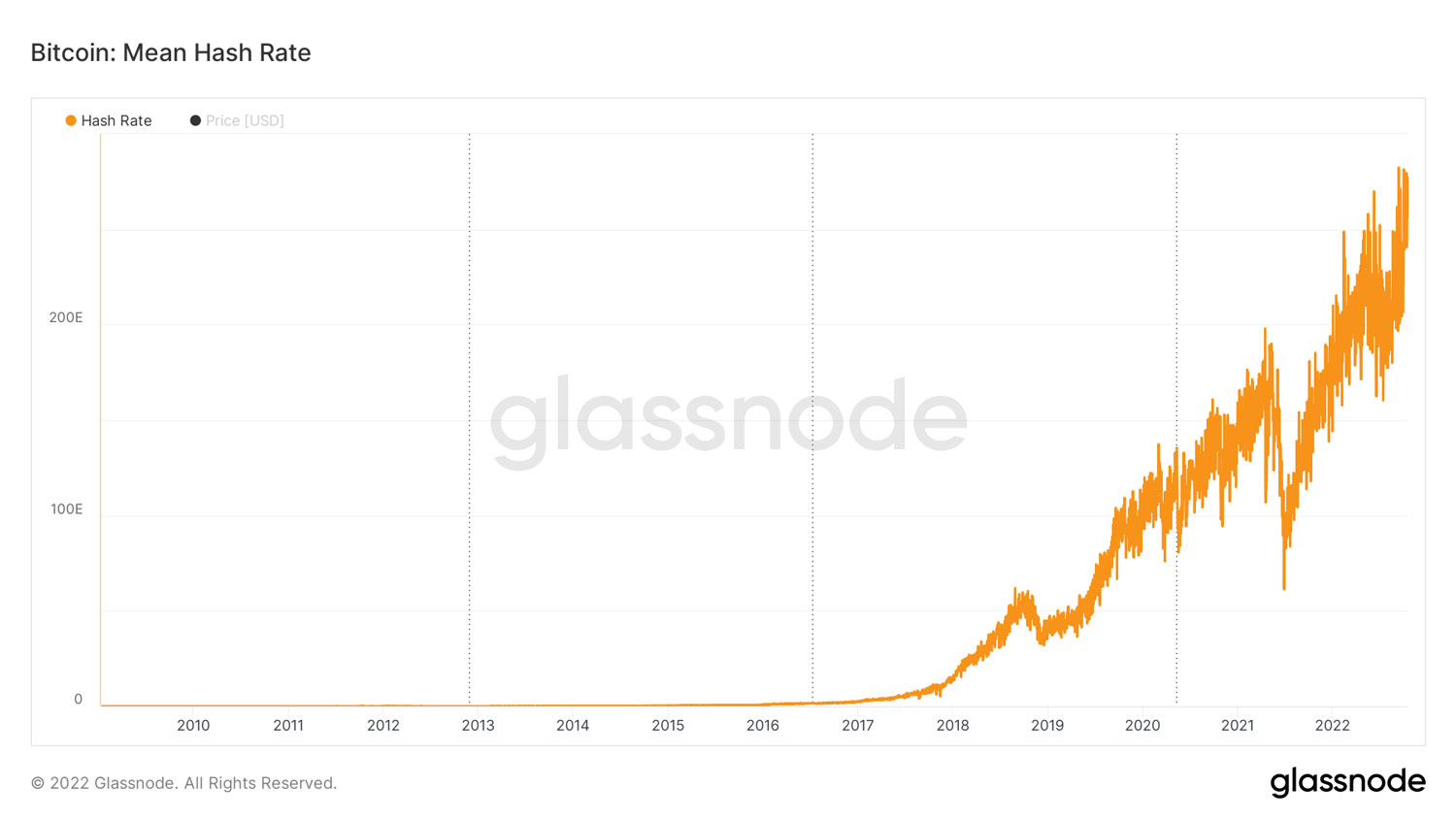
    Source: Glassnode

    The energy estimates are just that, estimates. The rely on estimates of the electricity price paid by bitcoin miners and estimates of the model of equipment used, both of which are impossible to know.

    To get an indication of the estimate variability, Cambridge University estimates that bitcoin energy consumption ranges anywhere between 50.13TW/h and 180TW/h. That’s a big estimate range, even for economists (I should know, I am one), and should raise some initial doubt when drawing clear policy conclusions from this data.
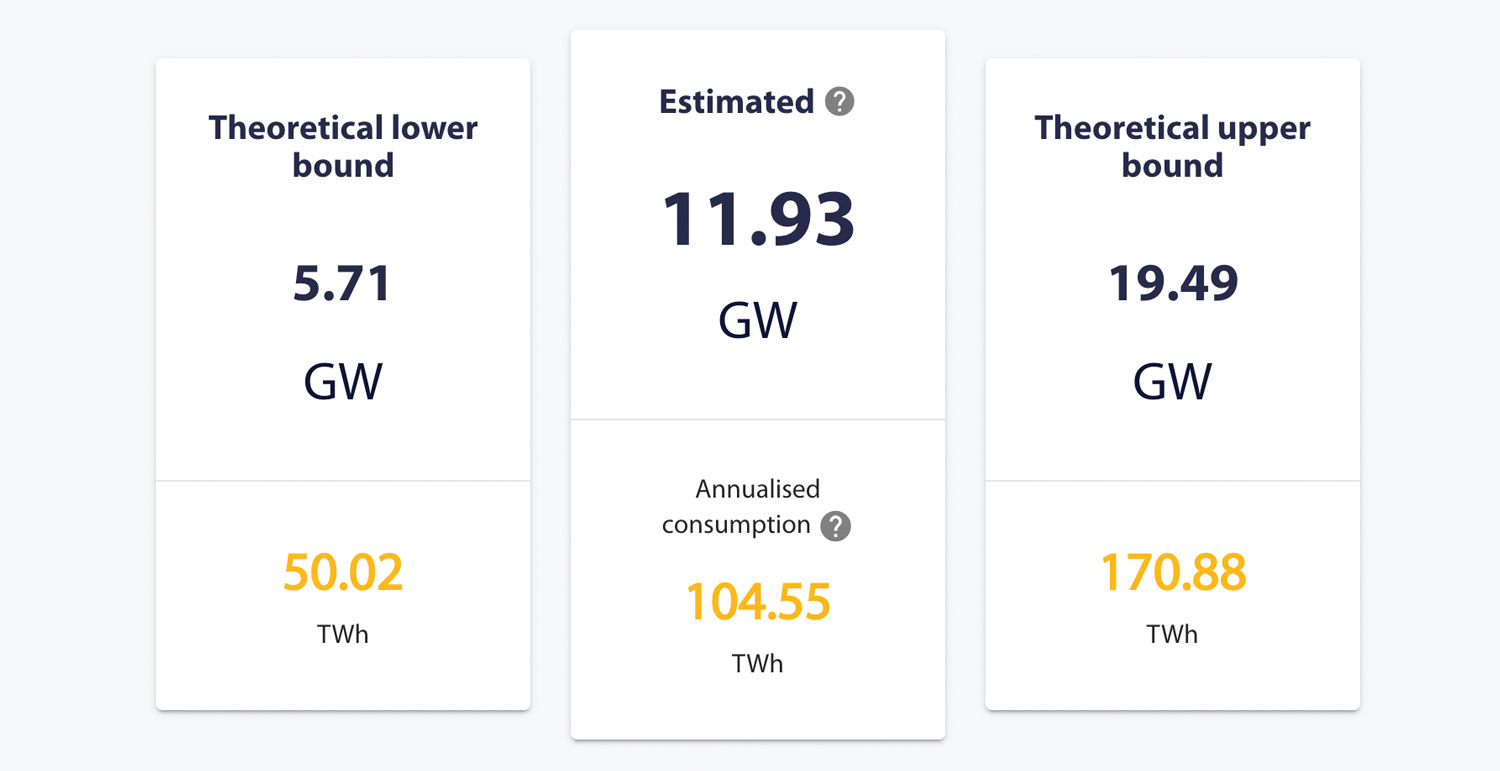
    Bitcoin network power demand, 18 October 2022. Source: ccaf.io/cbeci/index

    The price paid by bitcoin miners for electricity is particularly uncertain, and it reveals something unique about mining and its potential impact on the energy industry.

    Bitcoin miners are only profitable if they can secure cheap electricity. The cheapest electricity is stranded energy, or free energy. While energy is a scarce resource, significant amounts of electricity are wasted every single day because it is difficult to optimise production for consumption – ask Eskom (bad joke, sorry).

    Power generation facilities generally cannot to turn on/off at the flick of a switch and consumer demand for electricity varies substantially across time of day, day of week and season. Electricity also does not transport or store particularly well. So large amounts of energy are ploughed into the earth because energy might be undesired by consumers at a given time or place.

    Unlike other electricity consumers, bitcoin miners can run almost anywhere, so they can be transported directly to power sources. Bitcoin miners hunt down stranded electricity – so, contrary to popular opinion, they rarely compete with consumers and do not consume average electricity prices. For example, there are very few bitcoin miners in South Africa because it is infeasible given the high cost of electricity.

    Cambridge estimates that the total amount of electricity lost to transmission and distribution in the US alone could power the bitcoin network 1.9 times over, while the total amount of energy lost to gas flaring could power the network 6.5 times over.
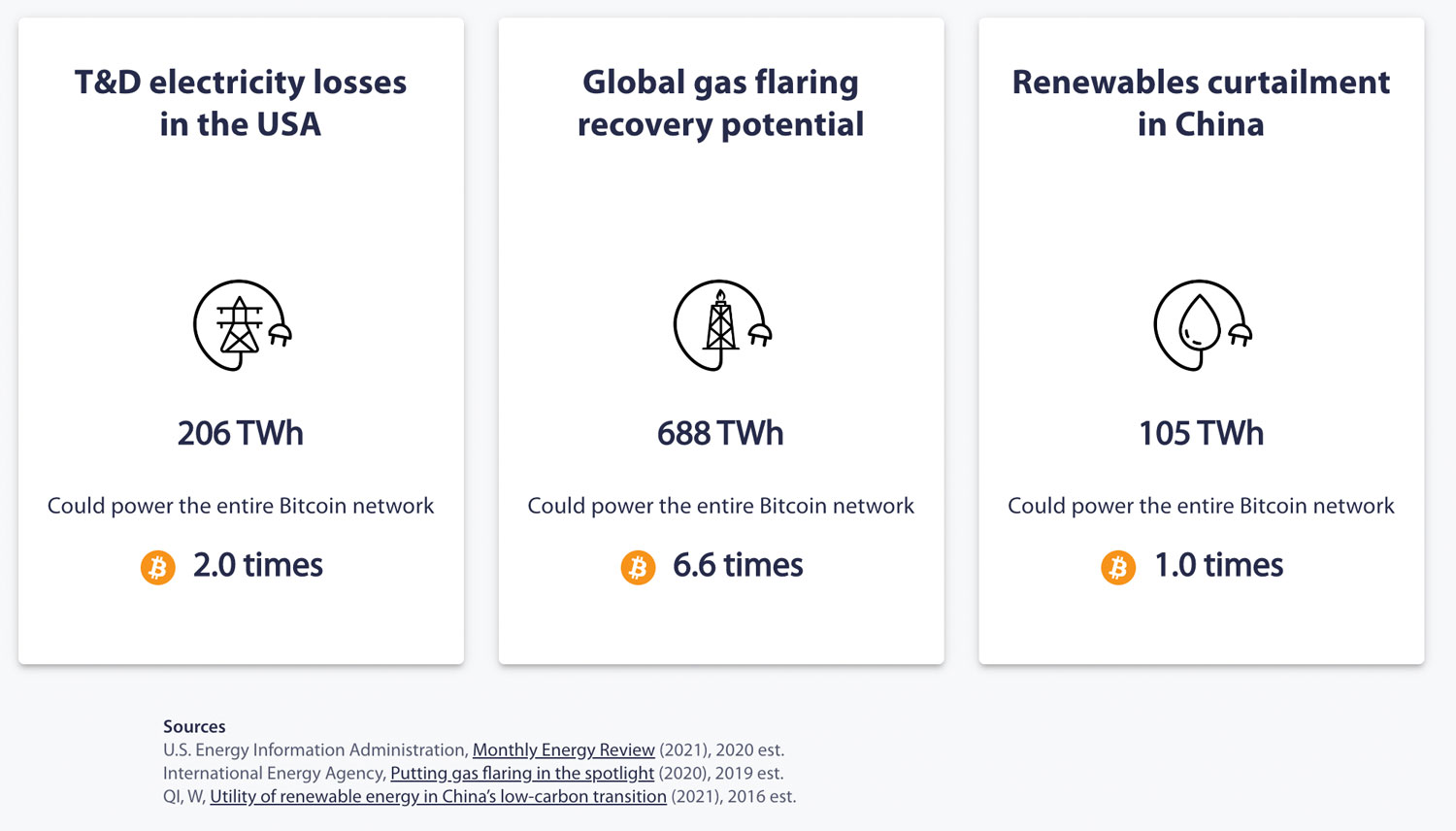
    Source: ccaf.io/cbeci/index/comparisons

    2. Bitcoin mining is potentially revolutionary for renewable energy and grid stability

    Renewable energy sources like solar and wind are notoriously intermittent, have high upfront fixed costs and tend to be located far from consumers. These factors present additional challenges relative to coal power plants, for example. Bitcoin miners can offer renewable energy providers a baseload of demand, which can make their operations more economically viable in a way that no other industry can. There is evidence of dynamic at an industrial scale in Texas.

    Miners can also turn off in a heartbeat, which implies that energy regulators can turn off bitcoin miners if the grid ever experiences instability. This provides robustness to energy grids, as evidenced in Texas in February 2022.

    3. Liberation from financial tyranny is energy well spent

    Returning to my question, “Why do we judge the energy usage of proof-of-work blockchain miners?” Why don’t we judge the amount of energy used by global banks? There are two key insights in answering this question.

    • Blockchain transparency: Hash-rate data is available, which is unlike any other industry in the world. So, while the estimates of bitcoin mining’s energy consumption are inaccurate, they can still be calculated, which creates a focal point for detractors.
    • Detractors: Many people do not like or do not understand bitcoin. If you do not see value in bitcoin, then clearly you won’t think the energy usage is worth it. So, we should not be surprised that detractors focus on energy consumption.

    What about bitcoin’s users – do they think the energy usage is worthwhile?

    • Women in Afghanistan are unable to access bank accounts due to their gender but can use bitcoin as a bank account to conduct work on the Internet.
    • Venezuelan families suffering from hyperinflation have been able to use bitcoin to feed their families.
    • Political dissidents in Nigeria or Belarus have used bitcoin as a crowd-funding platform to fight political oppression.

    These are small examples of politically oppressed people who can liberate themselves from tyranny because of decentralised, secure and censorship-resistant money. No matter the energy usage, there is an argument to be made that bitcoin’s positive impact on human rights vastly supersedes its energy cost.

    4. The “alternative”, proof of stake, has major drawbacks, including censorship

    Despite the massive potential benefits of proof of work, advocates for ethereum proof of stake might argue that there is an alternative to PoW — can’t we just shift to PoS and save the energy? No, these consensus mechanisms are not substitutes.

    • This tech is untested. There exists no longstanding decentralised and successful PoS blockchain.
    • Staking pools appear to give power to large, centralised custodians, mirroring dynamics seen in traditional finance. There is risk of censorship and government control.
    • PoW pushes miners to capture stranded energy sources in far-flung regions of the earth, which is inherently decentralising.
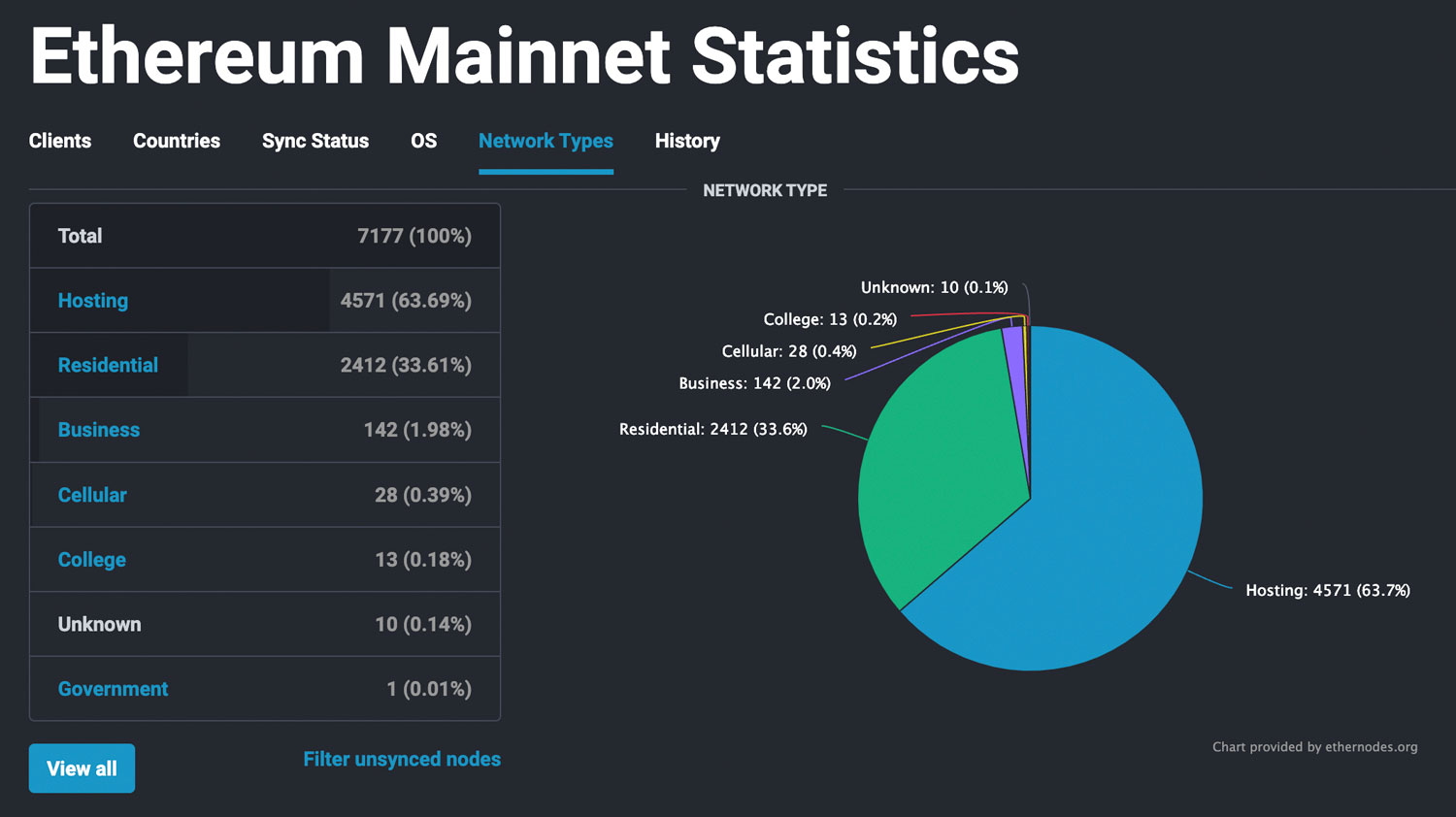
    More than two-thirds of ether validators run through centralised validator pools. Source: ethernodes.org

    Centralisation and censorship risks do not imply the ethereum is useless but this is a major risk that is largely glossed over by optimistic ethereum holders.

    5. Conservation requires natural constraints

    Returning to the challenge of energy conservation: we need to up our efforts to protect our scarce resources. So, why are we consuming resources at such a rapid rate?

    The answer is staring us right in the face… zero interest rates! What are governments telling us when they lower interest rates? Consume more! More houses, cars, clothes and whatever else. Are we surprised that we damage the environment when we encourage everyone in the world to consume more than they can afford?
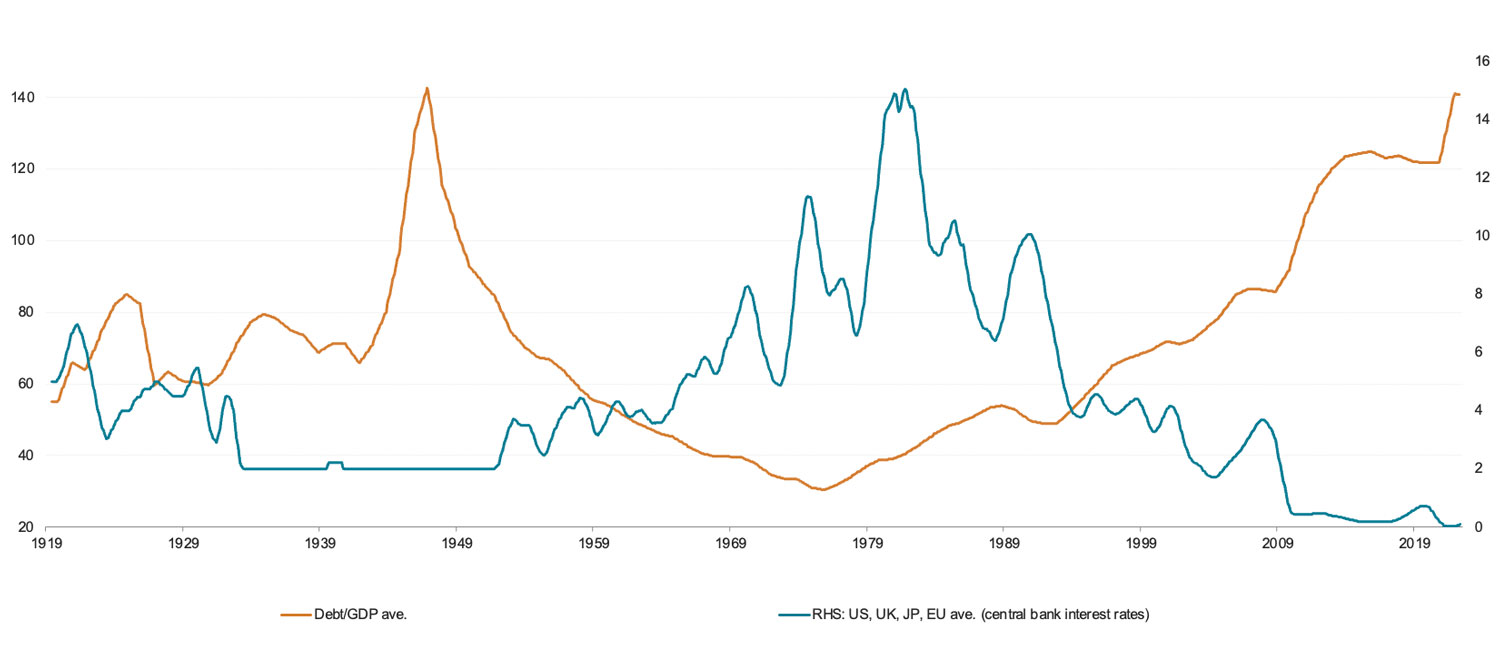
    Developed market interest rates have been close to zero for more than 10 years, promoting debt-fuelled consumption

    The solution to environmental damage is to bring a halt to debt-fuelled consumption. The adoption of sound money assets that are out of the hands of governments and free of censorship is our best hope at achieving this goal.

    • The author, Rob Price, is the founder of Sound Money, a digital asset investment firm. He has a master’s degree in economics from the University of Cape Town and is a CFA charterholder. He was previously head of asset allocation at Alexander Forbes.

    Get the latest and best South African tech news

    Add TechCentral as a preferred source on GoogleFollow TechCentral on Google NewsGet breaking news on WhatsApp


    Bitcoin Ethereum Rob Price
    WhatsApp YouTube
    Share. Facebook Twitter LinkedIn WhatsApp Telegram Email Copy Link
    Previous ArticleBeyond EVs: BMW sees a hydrogen future for the motoring industry
    Next Article Patel’s EV dream threatens R154-billion climate aid deal

    Related Posts

    Remember when bitcoin was killing the planet?

    21 September 2026
    Bitcoin roars back to life after Trump pushes Clarity Act - DOnald Trump

    Bitcoin roars back to life after Trump pushes Clarity Act

    20 August 2026
    Bitcoin at $65 000: stalled, or simply early?

    Bitcoin at $65 000: stalled, or simply early?

    22 July 2026
    Company News
    The hidden risks of fragmented IT and unenforced SLAs - ITC Systems Durban

    The hidden risks of fragmented IT and unenforced SLAs

    10 November 2026
    Why AI-powered customer experience will decide South Africa's festive retail winners - CM.com

    Why AI-powered customer experience will decide South Africa’s festive retail winners

    10 November 2026
    Traditional QA undermines modern customer experience - Martie de Beer, Telviva

    Traditional QA undermines modern customer experience

    10 November 2026
    Opinion
    Icasa's Sim rules need a privacy backstop - Lloyd Matthew and Heinz Vollmer

    Icasa’s Sim rules need a privacy backstop

    5 November 2026
    AI's boardroom honeymoon is over - Gary Stocks

    AI’s boardroom honeymoon is over

    22 October 2026
    Before South Africa licenses Starlink, it should look at Ukraine - Duncan McLeod

    Before South Africa licenses Starlink, it should look at Ukraine

    21 October 2026

    Subscribe to Updates

    Get the best South African technology news and analysis delivered to your e-mail inbox every morning.

    Latest Posts
    The hidden risks of fragmented IT and unenforced SLAs - ITC Systems Durban

    The hidden risks of fragmented IT and unenforced SLAs

    10 November 2026
    Why AI-powered customer experience will decide South Africa's festive retail winners - CM.com

    Why AI-powered customer experience will decide South Africa’s festive retail winners

    10 November 2026
    Vodacom targets satellite-to-phone service in South Africa next year

    Vodacom targets satellite-to-phone service in South Africa next year

    10 November 2026
    Vodacom eyes SA and Kenya for AI data centre hubs after Egypt - Shameel Joosub

    Vodacom eyes SA and Kenya for AI data centre hubs after Egypt

    10 November 2026
    © 2009 - 2026 NewsCentral Media
    Built and maintained by Chronon
    • Cookie policy (ZA)
    • TechCentral – privacy and Popia

    Type above and press Enter to search. Press Esc to cancel.

    Manage consent

    TechCentral uses cookies to enhance its offerings. Consenting to these technologies allows us to serve you better. Not consenting or withdrawing consent may adversely affect certain features and functions of the website.

    Functional Always active
    The technical storage or access is strictly necessary for the legitimate purpose of enabling the use of a specific service explicitly requested by the subscriber or user, or for the sole purpose of carrying out the transmission of a communication over an electronic communications network.
    Preferences
    The technical storage or access is necessary for the legitimate purpose of storing preferences that are not requested by the subscriber or user.
    Statistics
    The technical storage or access that is used exclusively for statistical purposes. The technical storage or access that is used exclusively for anonymous statistical purposes. Without a subpoena, voluntary compliance on the part of your Internet Service Provider, or additional records from a third party, information stored or retrieved for this purpose alone cannot usually be used to identify you.
    Marketing
    The technical storage or access is required to create user profiles to send advertising, or to track the user on a website or across several websites for similar marketing purposes.
    • Manage options
    • Manage services
    • Manage {vendor_count} vendors
    • Read more about these purposes
    View preferences
    • {title}
    • {title}
    • {title}
    🇿🇦 Sign up to the TechCentral newsletter