Close Menu
TechCentralTechCentral

    Subscribe to the newsletter

    Get the best South African technology news and analysis delivered to your e-mail inbox every morning.

    Facebook X (Twitter) YouTube LinkedIn
    WhatsApp Facebook X (Twitter) LinkedIn YouTube
    TechCentralTechCentral
    • News
      Vodacom to take control of Safaricom in R36-billion deal - Shameel Joosub

      Vodacom to take control of Safaricom in R36-billion deal

      4 December 2025
      Black Friday goes digital in South Africa as online spending surges to record high

      Black Friday goes digital in South Africa as online spending surges to record high

      4 December 2025
      BYD takes direct aim at Toyota with launch of sub-R500 000 Sealion 5 PHEV

      BYD takes direct aim at Toyota with launch of sub-R500 000 Sealion 5 PHEV

      4 December 2025
      'Get it now': Takealot in new instant deliveries pilot

      ‘Get it now’: Takealot in new instant deliveries pilot

      4 December 2025
      What South Africans searched for most in 2025

      What South Africans searched for most in 2025, according to Google

      4 December 2025
    • World
      Amazon and Google launch multi-cloud service for faster connectivity

      Amazon and Google launch multi-cloud service for faster connectivity

      1 December 2025
      Google makes final court plea to stop US breakup

      Google makes final court plea to stop US breakup

      21 November 2025
      Bezos unveils monster rocket: New Glenn 9x4 set to dwarf Saturn V

      Bezos unveils monster rocket: New Glenn 9×4 set to dwarf Saturn V

      21 November 2025
      Tech shares turbocharged by Nvidia's stellar earnings

      Tech shares turbocharged by stellar Nvidia earnings

      20 November 2025
      Config file blamed for Cloudflare meltdown that disrupted the web

      Config file blamed for Cloudflare meltdown that disrupted the web

      19 November 2025
    • In-depth
      Jensen Huang Nvidia

      So, will China really win the AI race?

      14 November 2025
      Valve's Linux console takes aim at Microsoft's gaming empire

      Valve’s Linux console takes aim at Microsoft’s gaming empire

      13 November 2025
      iOCO's extraordinary comeback plan - Rhys Summerton

      iOCO’s extraordinary comeback plan

      28 October 2025
      Why smart glasses keep failing - no, it's not the tech - Mark Zuckerberg

      Why smart glasses keep failing – it’s not the tech

      19 October 2025
      BYD to blanket South Africa with megawatt-scale EV charging network - Stella Li

      BYD to blanket South Africa with megawatt-scale EV charging network

      16 October 2025
    • TCS
      TCS+ | How Cloud on Demand helps partners thrive in the AWS ecosystem - Odwa Ndyaluvane and Xenia Rhode

      TCS+ | How Cloud On Demand helps partners thrive in the AWS ecosystem

      4 December 2025
      TCS | MTN Group CEO Ralph Mupita on competition, AI and the future of mobile

      TCS | Ralph Mupita on competition, AI and the future of mobile

      28 November 2025
      TCS | Dominic Cull on fixing South Africa's ICT policy bottlenecks

      TCS | Dominic Cull on fixing South Africa’s ICT policy bottlenecks

      21 November 2025
      TCS | BMW CEO Peter van Binsbergen on the future of South Africa's automotive industry

      TCS | BMW CEO Peter van Binsbergen on the future of South Africa’s automotive industry

      6 November 2025
      TCS | Why Altron is building an AI factory - Bongani Andy Mabaso

      TCS | Why Altron is building an AI factory in Johannesburg

      28 October 2025
    • Opinion
      Your data, your hardware: the DIY AI revolution is coming - Duncan McLeod

      Your data, your hardware: the DIY AI revolution is coming

      20 November 2025
      Zero Carbon Charge founder Joubert Roux

      The energy revolution South Africa can’t afford to miss

      20 November 2025
      It's time for a new approach to government IT spend in South Africa - Richard Firth

      It’s time for a new approach to government IT spend in South Africa

      19 November 2025
      How South Africa's broken Rica system fuels murder and mayhem - Farhad Khan

      How South Africa’s broken Rica system fuels murder and mayhem

      10 November 2025
      South Africa's AI data centre boom risks overloading a fragile grid - Paul Colmer

      South Africa’s AI data centre boom risks overloading a fragile grid

      30 October 2025
    • Company Hubs
      • Africa Data Centres
      • AfriGIS
      • Altron Digital Business
      • Altron Document Solutions
      • Altron Group
      • Arctic Wolf
      • AvertITD
      • Braintree
      • CallMiner
      • CambriLearn
      • CYBER1 Solutions
      • Digicloud Africa
      • Digimune
      • Domains.co.za
      • ESET
      • Euphoria Telecom
      • Incredible Business
      • iONLINE
      • IQbusiness
      • Iris Network Systems
      • LSD Open
      • NEC XON
      • Netstar
      • Network Platforms
      • Next DLP
      • Ovations
      • Paracon
      • Paratus
      • Q-KON
      • SevenC
      • SkyWire
      • Solid8 Technologies
      • Telit Cinterion
      • Tenable
      • Vertiv
      • Videri Digital
      • Vodacom Business
      • Wipro
      • Workday
      • XLink
    • Sections
      • AI and machine learning
      • Banking
      • Broadcasting and Media
      • Cloud services
      • Contact centres and CX
      • Cryptocurrencies
      • Education and skills
      • Electronics and hardware
      • Energy and sustainability
      • Enterprise software
      • Financial services
      • Information security
      • Internet and connectivity
      • Internet of Things
      • Investment
      • IT services
      • Lifestyle
      • Motoring
      • Public sector
      • Retail and e-commerce
      • Satellite communications
      • Science
      • SMEs and start-ups
      • Social media
      • Talent and leadership
      • Telecoms
    • Events
    • Advertise
    TechCentralTechCentral
    Home » Sections » AI and machine learning » India’s call centre jobs are vanishing as AI chatbots take over
    India's call centre jobs are vanishing as AI chatbots take over

    India’s call centre jobs are vanishing as AI chatbots take over

    By Agency Staff16 October 2025

    At a start-up office in Bengaluru, developers are fine-tuning AI chatbots that talk and message like humans.

    The company, LimeChat, has an audacious goal: to make customer service jobs almost obsolete. It says its generative AI agents enable clients to slash by 80% the number of workers needed to handle 10 000 monthly queries.

    “Once you hire a LimeChat agent, you never have to hire again,” Nikhil Gupta, its 28-year-old co-founder, told Reuters.

    Rather than pump the brakes as the technology threatens jobs built on routine tasks, the country is accelerating

    Cheap labour and English proficiency helped make India the world’s back office – sometimes at the expense of workers elsewhere. Now, AI-powered systems are subsuming jobs done by headset-wearing graduates in technical support, customer care and data management, sparking a scramble to adapt, a Reuters examination found.

    That’s driving business for AI start-ups that help companies slash staffing costs and scale operations – even though many consumers still prefer to deal with a person.

    This account of the disruptive changes transforming India’s US$283-billion IT sector is based on interviews with 30 people, including industry executives, recruiters, workers and current and former government officials. Reuters also visited two AI start-ups and tested voice and text chatbots that handle increasingly sophisticated customer interactions in human-like ways.

    Let it rip

    Rather than pump the brakes as the technology threatens jobs built on routine tasks, the country is accelerating, wagering that a let-it-rip approach will create enough new opportunities to absorb those displaced, Reuters found. The outcome of India’s gamble carries weight far beyond its borders – a test case for whether embracing AI-driven disruption can elevate a developing economy or render it a cautionary tale.

    The global conversational AI market is growing 24% a year and should reach $41-billion by 2030, consultancy Grand View Research estimates.

    India, which relies on IT for 7.5% of its GDP, is leaning in. In a February speech, Prime Minister Narendra Modi said “work does not disappear due to technology. Its nature changes and new types of jobs are created”.

    Not everyone shares Modi’s confidence in India’s preparedness. Santosh Mehrotra, a former Indian official and visiting professor at the University of Bath’s Centre for Development Studies, criticised the government for a lack of urgency in assessing AI’s effects on India’s young workforce. “There’s no gameplan,” he said.

    Business process management employs 1.65 million workers in call centres, payroll and data handling in India. Hiring has plummeted due to increased automation and digitalisation, despite rising demand for AI coordinators and process analysts, said Neeti Sharma, CEO of staffing firm TeamLease Digital.
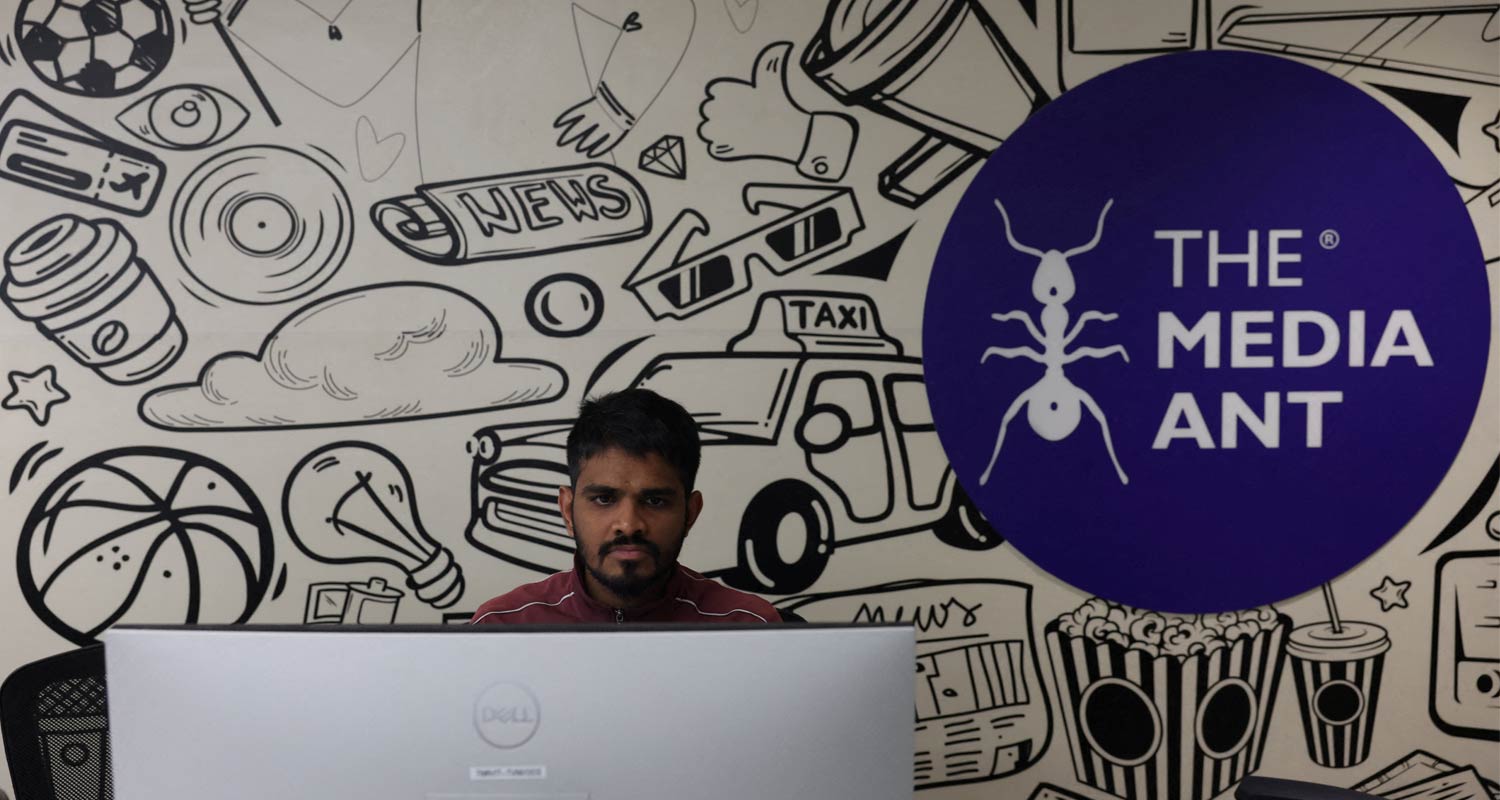
    A developer works inside the office of AI startup The Media Ant, in Bengaluru, India. Priyanshu Singh/Reuters
    A developer works inside the office of AI start-up The Media Ant, in Bengaluru, India. Priyanshu Singh/Reuters

    Net headcount in the segment, which represents one-fifth of IT output, grew by fewer than 17 000 workers in each of the past two years, down from 130 000 in 2022/2023 and 177 000 in 2021/2022, TeamLease Digital figures show.

    Reuters spoke to three current and five former customer-service workers, who described increasing job insecurity and integration of AI, including tools that suggest responses and bots that handle nearly all routine queries autonomously.

    Megha S, 32, was earning $10 000/year at a Bengaluru-based software solutions provider. She said she was laid off last month, just before India’s festive season, as the company moved to implement AI tools to review the quality of sales calls.

    Jefferies predicted that India’s call centres would face a revenue hit of 50% from AI adoption over five years

    “I was told I am the first one who has been replaced by AI,” said Megha, who spoke on the condition that her full name and former employer not be identified. “I’ve not told my parents.”

    Sumita Dawra, a former labour ministry secretary who oversaw an Indian government taskforce on AI’s impact on the workforce before retiring in March, said while the technology offered productivity gains that would lead to new jobs, India could consider stronger social security measures, such as unemployment benefits, to help those displaced during the transition.

    However, a senior Indian official told Reuters the government believed AI would ultimately have little impact on overall employment. India’s IT and labour ministries, and Modi’s office, didn’t respond to requests for comment.

    Besides AI, factors clouding the outlook for India’s IT sector include US tariffs; a proposal by a US lawmaker for a 25% tax on firms using foreign outsourcing services; and President Trump’s $100 000 fee on new H-1B visas, which are widely used by tech firms to sponsor Indian workers.

    AI factory

    Investment bank Jefferies predicted in September that India’s call centres would face a revenue hit of 50% – and around 35% for other back-office functions – from AI adoption over the next five years.

    That would spell near-term job losses in India, which accounts for 52% of the global outsourcing market.

    “The biggest impact is going to be on young students coming out of college,” said Pramod Bhasin, who in the 1990s established India’s first call centre with 18 employees for GE Capital, where workstations were partitioned by saris strung from the ceiling.

    Read: OpenAI adds rand pricing, launches cheaper ChatGPT Go tier

    In the longer run, India could transition from “back office” to the world’s “AI factory” by capitalising on demand for AI engineers and automation deployment, said Bhasin, who went on to found IT services firm Genpact.

    One beneficiary of that demand is LimeChat, which Reuters visited in August. Gupta, the co-founder, said his developers and engineers have helped automate 5 000 jobs across India. The company’s bots handle 70% of customer complaints for its clients, and it plans to achieve 90-95% within a year, he said.

    “If you’re giving us 100 000 rupees per month, you are automating the job of at least 15 agents,” said Gupta. At that price – about $1 130 – the service costs roughly the same as three customer-care staff, he said.
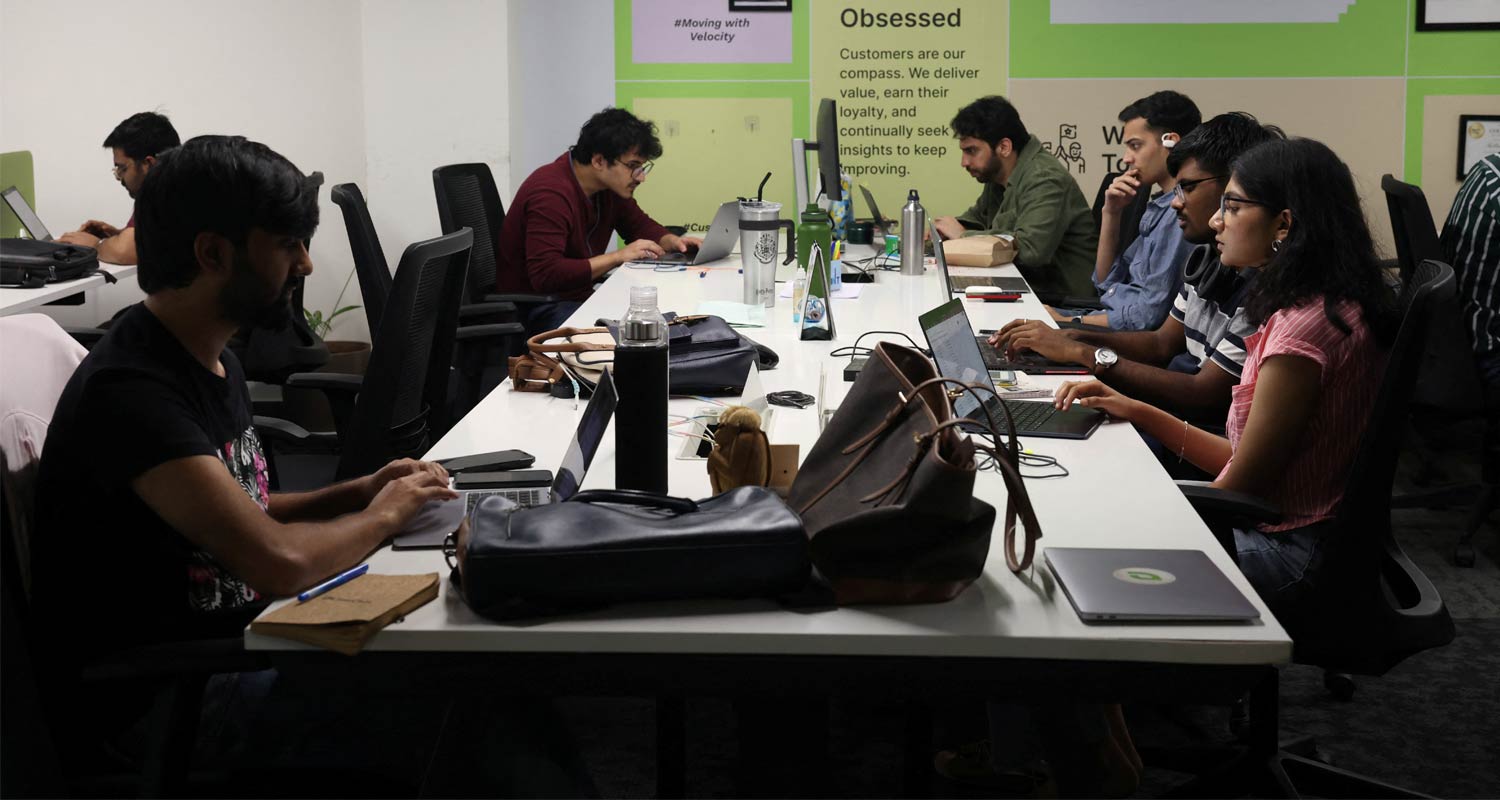
    Developers work inside the office of AI startup LimeChat in Bengaluru, India. Priyanshu Singh/Reuters
    Developers work inside the office of AI start-up LimeChat in Bengaluru, India. Priyanshu Singh/Reuters

    LimeChat’s sales soared to $1.5-million in 2024 from $79 000 two years earlier, regulatory disclosures show. Last year, the firm began integrating Microsoft’s Azure language models and algorithms in a partnership to launch a new e-commerce chatbot.

    Among Gupta’s clients is Indian ayurvedic products firm Kapiva, which has deployed a LimeChat bot for customer interactions over WhatsApp.

    Keying in a prompt – “What kind of diet should I have to reduce weight?” – yielded an AI meal-plan creator. A follow-up query in English and Hindi about how a slimming juice differs from another item was also answered, with the chatbot eventually sharing links to Kapiva products with a smiling emoji. Kapiva didn’t respond to Reuters questions.

    Haptik offers ‘AI agents that deliver human-like customer experiences’ that cost $120 and can cut support costs by 30%

    LimeChat’s rivals include Reliance, the conglomerate chaired by Mukesh Ambani, which acquired Indian start-up Haptik in 2019.

    Haptik says it offers “AI agents that deliver human-like customer experiences” that cost $120 and can cut support costs by 30%. Revenue skyrocketed to almost $18-million last year from less than $1-million in 2020, disclosures show.

    Haptik promoted a webinar in September by posing the question: “What if you had a full-time employee who never sleeps and costs just 10 000 rupees?”

    “We are seeing a huge shift,” Haptik product manager Suji Ravi said in the webinar, which Reuters reporters attended. “Brands are not investing in human agents and they want to deploy AI agents.”

    For LimeChat client Mamaearth, an Indian personal-care brand, the main attraction of AI chatbots is scalability, said Vipul Maheshwari, head of product and analytics at parent firm Honasa Consumer.

    Make or break

    “Providing good customer support is make or break for us,” he said. “But can we infinitely scale my customer support team? Absolutely not.”

    The chatbot used by Mamaearth could go beyond simple assistance like order tracking, and help users with queries such as recommending the right products during pregnancy or, in some cases, handle an agitated customer, Maheshwari said.

    The promise and perils of AI are evident at The Media Ant. The Bengaluru-based advertising agency cut 40% of its workforce to about 100 over the past year and vacated space in another building to save on rent, said founder Samir Chaudhary.

    Read: FlySafair bets on AI to keep fares low and customers sweet

    The firm eliminated 15 salespeople, replacing them with AI bots that identify leads and send emails to prospective customers, Chaudhary said. A six-member call centre was replaced with a voice agent called Neha that speaks in near-flawless, Indian-accented English.

    When a Reuters reporter asked Neha about advertising on YouTube, she sought details about the budget and target markets, noted the requirements and ended the conversation cheerfully: “I will e-mail you the details … have a great day.”

    “Ask her out for a coffee and she will laugh it off,” Chaudhary said.

    Developers attend a meeting inside pods at the office of AI startup LimeChat in Bengaluru, India. Priyanshu Singh/Reuters
    Developers attend a meeting inside pods at the office of AI start-up LimeChat in Bengaluru, India. Priyanshu Singh/Reuters

    Yet the race to embrace AI isn’t always smooth for companies. Take Sweden’s Klarna. Chatbots helped the fintech firm cut thousands of jobs last year, but its CEO told Reuters in September the company is now “trying to course correct” and use the technology to improve products rather than reduce costs.

    Chatbots have limitations. While most generic e-commerce-related queries posed by a Reuters reporter were handled well by LimeChat bots, some stumped them.

    When LimeChat client Knya’s bot was asked for proof of its claim that a million medical professionals trust its products, such as its stethoscopes, it replied: “I am sorry, I don’t have enough information to answer your question.” Knya didn’t respond to a request for comment.

    Recruiters are asking for students with basic AI skills. We are going to streamline our courses even further

    Customer surveys show chatbots are still disliked by many.

    An August 2024 EY survey of a thousand Indian consumers found 62% made purchases influenced by AI recommendations, compared with 30% globally. Yet, “the desire for a human connection remains strong”, EY noted, with 78% preferring online platforms that provide human support.

    LimeChat’s Gupta, though, said well-trained AI agents could resolve queries faster than humans. He said many standard bots pass conversations to a human agent when they encounter angry customers: “You need a very small number of people to just handle negative experiences.”

    From Java to AI

    In the 1990s and 2000s, India’s tech boom fuelled rural to urban migration. Cities like Bengaluru became outsourcing hubs as domestic firms, including Tata Consultancy Services, Infosys and Wipro, grew into global juggernauts.

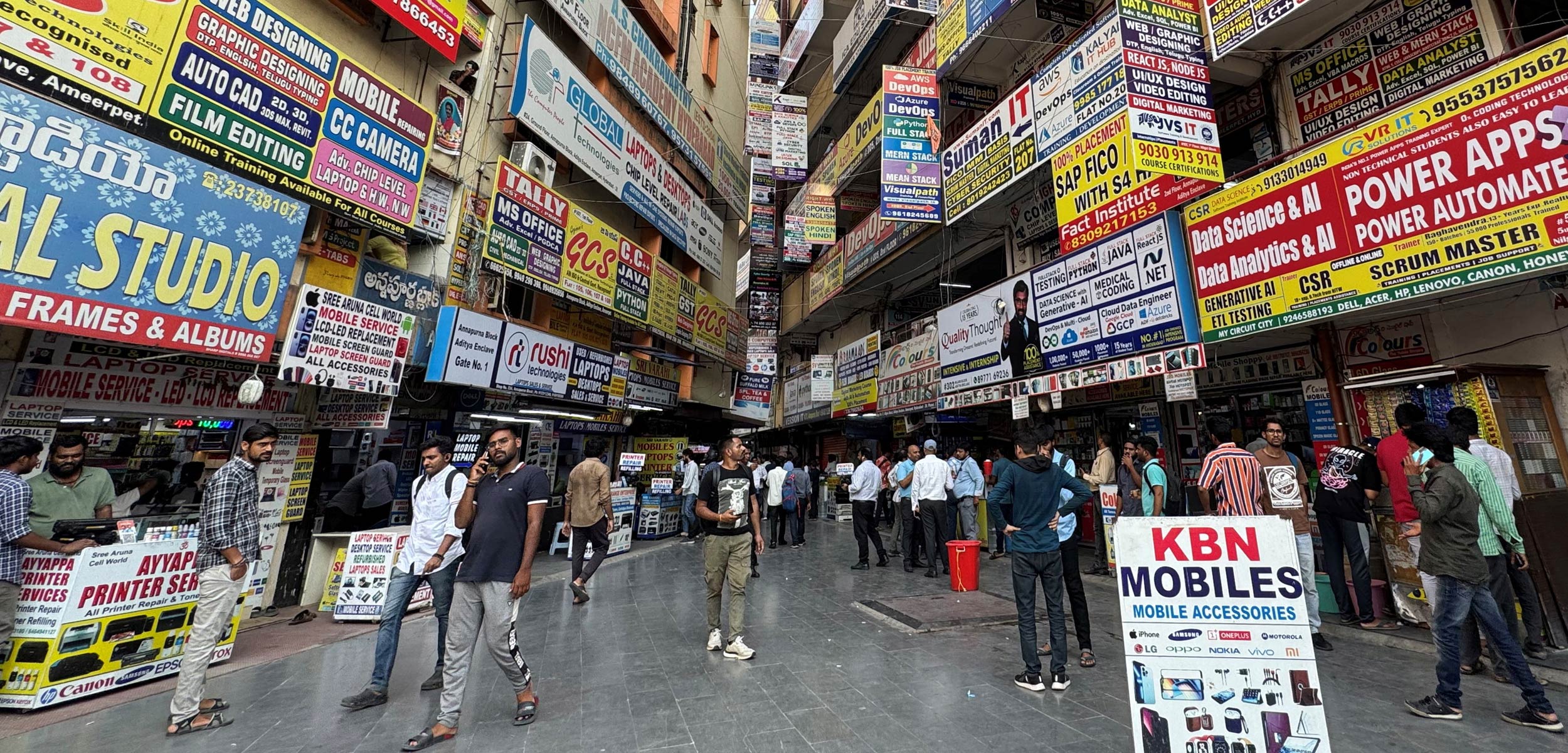
    That expansion trickled through to Ameerpet, a Hyderabad neighbourhood where university graduates fill classrooms to learn IT skills and earn certifications for tech jobs.

    Read: Investors warn of global ‘hype bubble’ in AI

    Ameerpet’s training centres traditionally offered courses in Microsoft Office and programming languages like Java. Visiting in April, Reuters found these centres are increasingly focused on AI training.

    Outside one, Quality Thought, a banner featured a robot overlooking a globe with the letters “AI.”

    The centre was offering a nine-month course in AI data science and prompt engineering for about $1 360, more than double the price of a traditional web-development programme.

    A laptop screen shows an interaction with an AI chatbot during a visit to the office of AI start-up The Media Ant, in Bengaluru, India. Priyanshu Singh/Reuters
    A laptop screen shows an interaction with an AI chatbot during a visit to the office of AI start-up The Media Ant, in Bengaluru, India. Priyanshu Singh/Reuters

    “Recruiters are asking for students with basic AI skills,” staffer Priyanka Kandulapati said. “We are going to streamline our courses even further to suit the demand.”

    In a discussion with start-up founders last month about the pace of change, venture capitalist Vinod Khosla, who co-founded Sun Microsystems, offered a stark view of the future for India.

    “All IT services will be replaced in the next five years,” he said. “It’s going to be pretty chaotic.”  — Munsif Vengattil and Aditya Kalra, (c) 2025 Reuters

    • Main image: People walk around a complex of software skill training centres surrounded by multiple billboards in Hyderabad, India. Rishika Sadam/Reuters

    Get breaking news from TechCentral on WhatsApp. Sign up here.



    Subscribe to TechCentral Subscribe to TechCentral
    Share. Facebook Twitter LinkedIn WhatsApp Telegram Email Copy Link
    Previous ArticleSA gamblers abandon casinos for phones as online betting surges
    Next Article BYD supercharges South Africa’s electric future

    Related Posts

    AI is not a technology problem - iqbusiness

    AI is not a technology problem – iqbusiness

    5 December 2025
    Vodacom to take control of Safaricom in R36-billion deal - Shameel Joosub

    Vodacom to take control of Safaricom in R36-billion deal

    4 December 2025
    Black Friday goes digital in South Africa as online spending surges to record high

    Black Friday goes digital in South Africa as online spending surges to record high

    4 December 2025
    Company News
    AI is not a technology problem - iqbusiness

    AI is not a technology problem – iqbusiness

    5 December 2025
    Telcos are sitting on a data gold mine - but few know what do with it - Phillip du Plessis

    Telcos are sitting on a data gold mine – but few know what do with it

    4 December 2025
    Unlock smarter computing with your surface Copilot+ PC

    Unlock smarter computing with your Surface Copilot+ PC

    4 December 2025
    Opinion
    Your data, your hardware: the DIY AI revolution is coming - Duncan McLeod

    Your data, your hardware: the DIY AI revolution is coming

    20 November 2025
    Zero Carbon Charge founder Joubert Roux

    The energy revolution South Africa can’t afford to miss

    20 November 2025
    It's time for a new approach to government IT spend in South Africa - Richard Firth

    It’s time for a new approach to government IT spend in South Africa

    19 November 2025

    Subscribe to Updates

    Get the best South African technology news and analysis delivered to your e-mail inbox every morning.

    Latest Posts
    AI is not a technology problem - iqbusiness

    AI is not a technology problem – iqbusiness

    5 December 2025
    Vodacom to take control of Safaricom in R36-billion deal - Shameel Joosub

    Vodacom to take control of Safaricom in R36-billion deal

    4 December 2025
    Black Friday goes digital in South Africa as online spending surges to record high

    Black Friday goes digital in South Africa as online spending surges to record high

    4 December 2025
    BYD takes direct aim at Toyota with launch of sub-R500 000 Sealion 5 PHEV

    BYD takes direct aim at Toyota with launch of sub-R500 000 Sealion 5 PHEV

    4 December 2025
    © 2009 - 2025 NewsCentral Media
    • Cookie policy (ZA)
    • TechCentral – privacy and Popia

    Type above and press Enter to search. Press Esc to cancel.

    Manage consent

    TechCentral uses cookies to enhance its offerings. Consenting to these technologies allows us to serve you better. Not consenting or withdrawing consent may adversely affect certain features and functions of the website.

    Functional Always active
    The technical storage or access is strictly necessary for the legitimate purpose of enabling the use of a specific service explicitly requested by the subscriber or user, or for the sole purpose of carrying out the transmission of a communication over an electronic communications network.
    Preferences
    The technical storage or access is necessary for the legitimate purpose of storing preferences that are not requested by the subscriber or user.
    Statistics
    The technical storage or access that is used exclusively for statistical purposes. The technical storage or access that is used exclusively for anonymous statistical purposes. Without a subpoena, voluntary compliance on the part of your Internet Service Provider, or additional records from a third party, information stored or retrieved for this purpose alone cannot usually be used to identify you.
    Marketing
    The technical storage or access is required to create user profiles to send advertising, or to track the user on a website or across several websites for similar marketing purposes.
    • Manage options
    • Manage services
    • Manage {vendor_count} vendors
    • Read more about these purposes
    View preferences
    • {title}
    • {title}
    • {title}