Close Menu
TechCentralTechCentral

    Subscribe to the newsletter

    Get the best South African technology news and analysis delivered to your e-mail inbox every morning.

    Facebook X (Twitter) YouTube LinkedIn
    WhatsApp Facebook X (Twitter) LinkedIn YouTube
    TechCentralTechCentral
    • News
      Nedbank hires MTN's former tech chief as group CIO - Nikos Angelopoulos

      Nedbank hires MTN’s former tech chief as group CIO

      31 July 2026
      Eskom's diesel bill falls 86% as breakdowns hit eight-year low

      Eskom’s diesel bill falls 86% as breakdowns hit eight-year low

      31 July 2026
      Ramaphosa signs off on taking the grid away from Eskom

      Ramaphosa signs off on taking the grid away from Eskom

      31 July 2026
      Microsoft just had the biggest day in stock market history

      Microsoft just had the biggest day in stock market history

      31 July 2026
      MTN Nigeria's growth engine stalled in second quarter - Karl Toriola

      MTN Nigeria’s growth engine stalled in second quarter

      31 July 2026
    • World
      Meta AI will now tell parents if their teen is in crisis

      Meta AI will now tell parents if their teen is in crisis

      17 July 2026
      IBM shares crash 25% as AI upends software spending - Arvind Krishna

      IBM shares crash 25% as AI upends software spending

      15 July 2026
      Jony Ive's first OpenAI device: an AI smart speaker - Jony Ive and Sam Altman

      Jony Ive’s first OpenAI device: an AI smart speaker

      15 July 2026
      Stripe, Advent in talks to buy PayPal for $53-billion

      Stripe, Advent in talks to buy PayPal for $53-billion

      15 July 2026
      Memory crisis sends smartphone market into steep decline

      Memory crisis sends smartphone market into steep decline

      13 July 2026
    • In-depth
      The plan to stop AI from breaking the world - Google DeepMind CEO Demis Hassabis. Image: John Sears

      The plan to stop AI from breaking the world

      16 July 2026
      The internet has a Strait of Hormuz problem

      The internet has a Strait of Hormuz problem

      15 July 2026
      AI boom sparks rally, frenzy and fear

      AI boom sparks rally, frenzy and fear

      11 June 2026
      Every plug-in hybrid on sale in South Africa, ranked by price - Lamborghini Temerario

      Every plug-in hybrid on sale in South Africa, ranked by price

      7 June 2026
      What Wi-Fi 8 will mean for wireless networks

      What Wi-Fi 8 will mean for wireless networks

      1 June 2026
    • TCS
      TCS+ | Why South African workers must become supervisors of digital labour - Accelera Digital Group Cliff de Wit

      TCS+ | Why South African workers must become supervisors of digital labour

      31 July 2026
      TCS | Rapid deployment rules can't work without municipalities: ACT - Nomvuyiso Batyi

      TCS | Icasa’s rules skip the real bottleneck: ACT

      30 July 2026
      TCS+ | iStore Business on why Apple makes sense for SMEs - Sudesh Pillay and Tamia Nontsikelelo

      TCS+ | iStore Business on why Apple makes sense for SMEs

      30 July 2026
      TCS+ | A smarter approach to cloud for South African businesses - Joel Chacko and Jonathan Oaker

      TCS+ | A smarter approach to cloud for South African businesses

      28 July 2026
      TCS | How Optasia lends billions to people banks can't see - Salvador Anglada

      TCS | How Optasia lends billions to people banks can’t see

      23 July 2026
    • Opinion
      The author, Jannie van Zyl

      Selling vapour is corporate suicide in slow motion

      16 July 2026
      Brazil's online gambling crackdown is a lesson for South Africa

      How Amazon outmanoeuvred Starlink in South Africa

      15 July 2026
      The Popia problem with agentic AI - Herman Haasbroek

      The Popia problem with agentic AI

      14 July 2026
      The author, Fanie van Rooyen

      South Africa can still catch the AI wave – here’s how

      7 July 2026
      The author, Fanie van Rooyen

      The AI utopia South Africa can’t afford

      1 July 2026
    • Company Hubs
      • 1Stream
      • Africa Data Centres
      • AfriGIS
      • Altron Digital Business
      • Altron Document Solutions
      • Altron Group
      • Arctic Wolf
      • Ascent Technology
      • AvertITD
      • BBD
      • Braintree
      • CallMiner
      • CambriLearn
      • CM Telecom
      • Contactable
      • CYBER1 Solutions
      • Digicloud Africa
      • Digimune
      • Domains.co.za
      • ESET
      • Euphoria Telecom
      • HOSTAFRICA
      • Incredible Business
      • iONLINE
      • IQbusiness
      • Iris Network Systems
      • Kaspersky
      • LSD Open
      • Mitel
      • NEC XON
      • Netstar
      • Network Platforms
      • Next DLP
      • Ovations
      • Paracon
      • Paratus
      • Q-KON
      • SevenC
      • SkyWire
      • Solid8 Technologies
      • Telit Cinterion
      • Telviva
      • Tenable
      • Vertiv
      • Videri Digital
      • Vodacom Business
      • Vox
      • Wipro
      • Workday
      • XLink
    • Sections
      • AI and machine learning
      • Banking
      • Broadcasting and Media
      • Cloud services
      • Contact centres and CX
      • Cryptocurrencies
      • Education and skills
      • Electronics and hardware
      • Energy and sustainability
      • Enterprise software
      • Financial services
      • HealthTech
      • Information security
      • Internet and connectivity
      • Internet of Things
      • Investment
      • IT services
      • Lifestyle
      • Policy and regulation
      • Public sector
      • Retail and e-commerce
      • Satellite communications
      • Science
      • SMEs and start-ups
      • Social media
      • Talent and leadership
      • Telecoms
      • Watts & Wheels
    • Events
    • Advertise
    TechCentralTechCentral
    Home » News » James Webb telescope’s stunning new images of Jupiter

    James Webb telescope’s stunning new images of Jupiter

    Nasa’s James Webb Space Telescope has captured stunning new images of the largest planet in the solar system. The observations will give scientists even more clues to Jupiter’s inner life.
    By Nasa23 August 2022
    Twitter LinkedIn Facebook WhatsApp Email Telegram Copy Link
    News Alerts
    WhatsApp
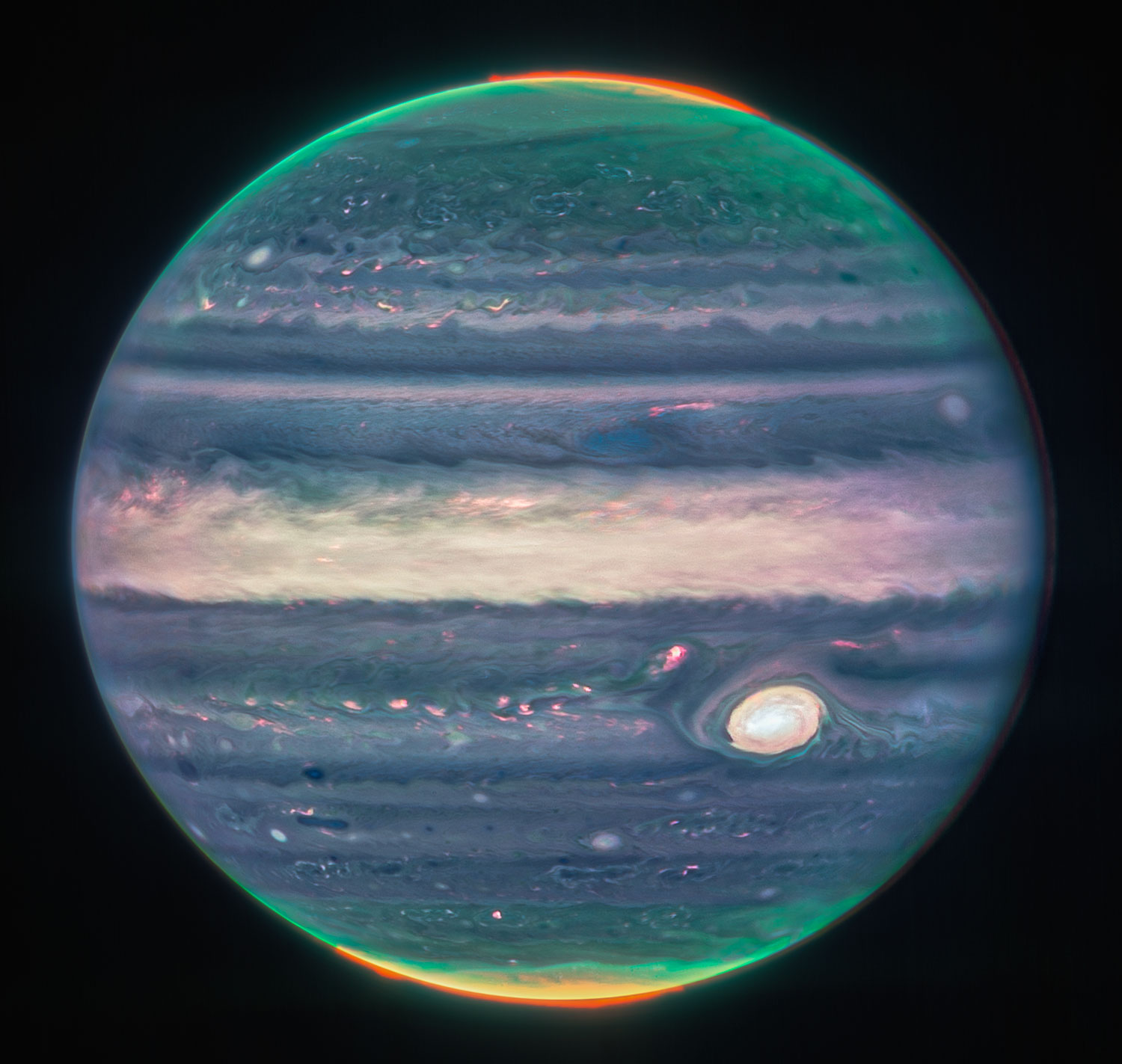
    Webb NIRCam composite image of Jupiter from three filters – F360M (red), F212N (yellow-green), and F150W2 (cyan) – and alignment due to the planet’s rotation. Credit: Nasa, ESA, CSA, Jupiter ERS Team; image processing by Judy Schmidt

    With giant storms, powerful winds, auroras, and extreme temperature and pressure conditions, Jupiter has a lot going on. Now, Nasa’s James Webb Space Telescope has captured new images of the planet. Webb’s Jupiter observations will give scientists even more clues to Jupiter’s inner life.

    “We hadn’t really expected it to be this good, to be honest,” said planetary astronomer Imke de Pater, professor emerita of the University of California, Berkeley. De Pater led the observations of Jupiter with Thierry Fouchet, a professor at the Paris Observatory, as part of an international collaboration for Webb’s Early Release Science programme. Webb itself is an international mission led by Nasa with its partners ESA (European Space Agency) and CSA (Canadian Space Agency). “It’s really remarkable that we can see details on Jupiter together with its rings, tiny satellites and even galaxies in one image,” she said.

    The two images come from the observatory’s Near-Infrared Camera (NIRCam), which has three specialised infrared filters that showcase details of the planet. Since infrared light is invisible to the human eye, the light has been mapped onto the visible spectrum. Generally, the longest wavelengths appear redder and the shortest wavelengths are shown as more blue. Scientists collaborated with citizen scientist Judy Schmidt to translate the Webb data into images.

    The Great Red Spot appears white in these views, as do other clouds, because they are reflecting a lot of sunlight

    In the standalone view of Jupiter, created from a composite of several images from Webb, auroras extend to high altitudes above both the northern and southern poles of Jupiter. The auroras shine in a filter that is mapped to redder colours, which also highlights light reflected from lower clouds and upper hazes. A different filter, mapped to yellows and greens, shows hazes swirling around the northern and southern poles. A third filter, mapped to blues, showcases light that is reflected from a deeper main cloud.

    The Great Red Spot, a famous storm so big it could swallow Earth, appears white in these views, as do other clouds, because they are reflecting a lot of sunlight.

    “The brightness here indicates high altitude – so the Great Red Spot has high-altitude hazes, as does the equatorial region,” said Heidi Hammel, Webb interdisciplinary scientist for solar system observations and vice president for science at Aura. “The numerous bright white ‘spots’ and ‘streaks’ are likely very high-altitude cloud tops of condensed convective storms.” By contrast, dark ribbons north of the equatorial region have little cloud cover.
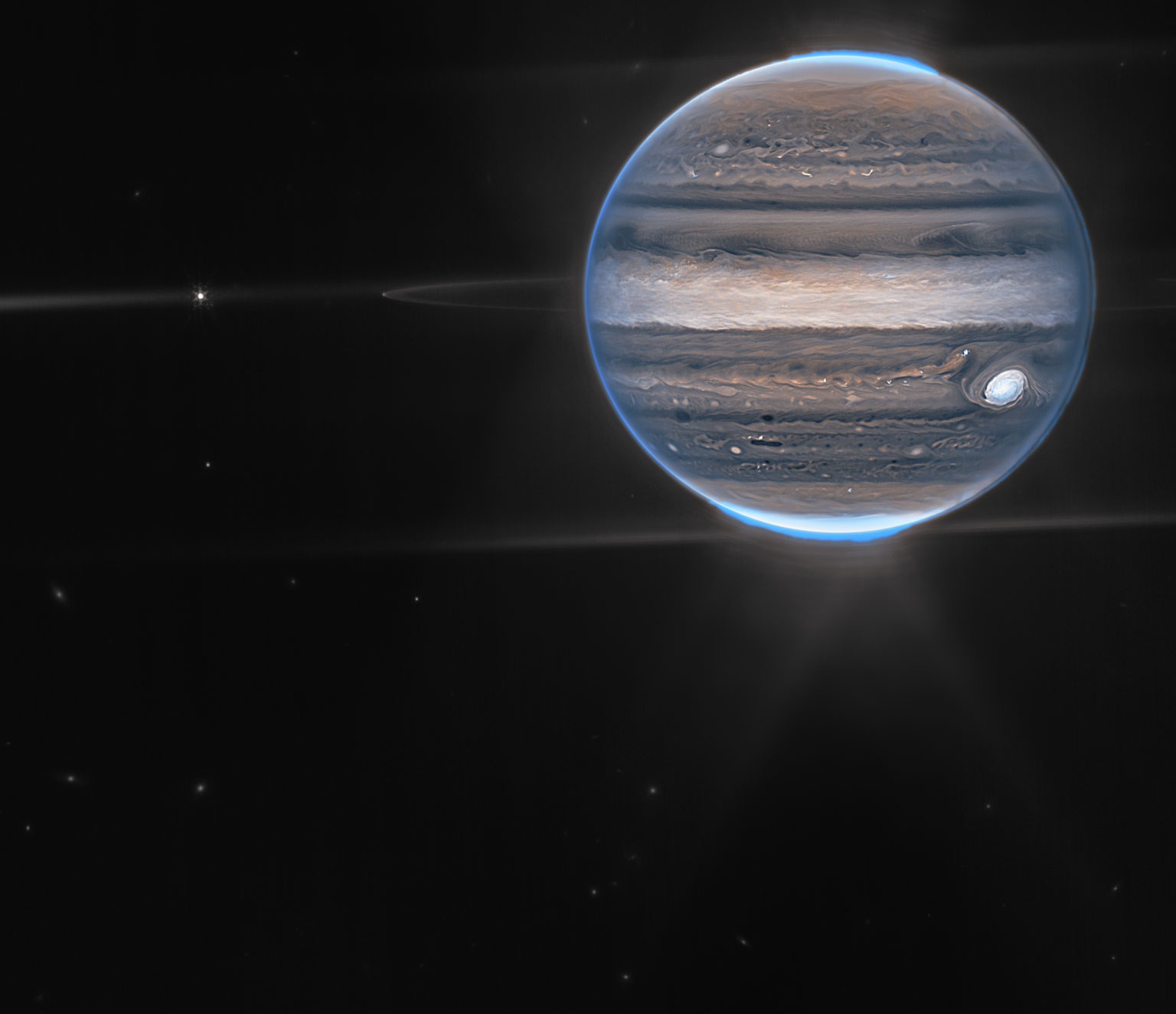
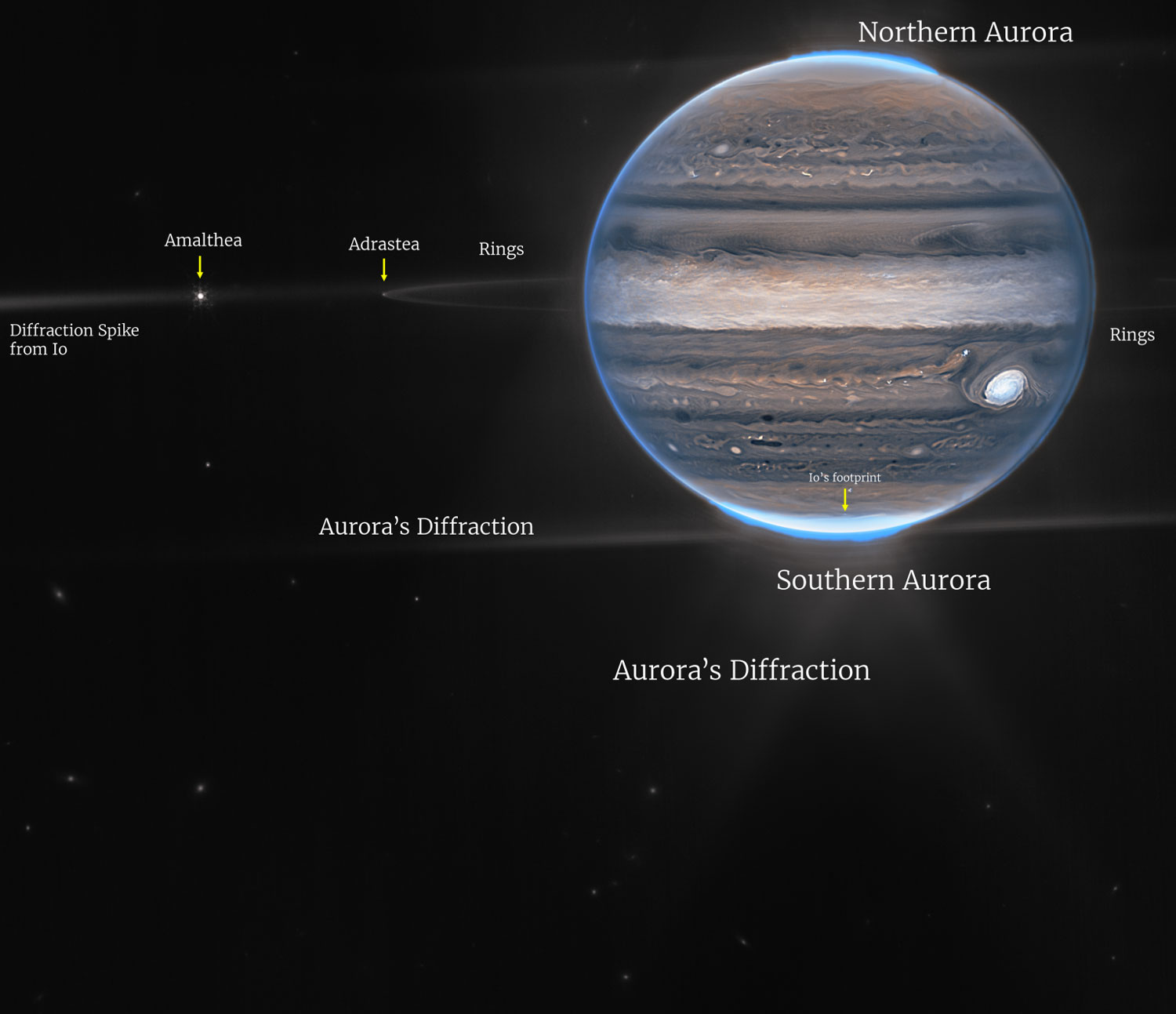
    In the images above, a wide-field view showcases Jupiter in the upper right quadrant. The planet’s swirling horizontal stripes are rendered in blues, browns and cream. Electric blue auroras glow above Jupiter’s north and south poles. A white glow emanates out from the auroras. Along the planet’s equator, rings glow in a faint white. At the far left edge of the rings, a moon appears as a tiny white dot. Slightly further to the left, another moon glows with tiny white diffraction spikes. The rest of the image is the blackness of space, with faintly glowing white galaxies in the distance. Webb NIRCam composite image from two filters – F212N (orange) and F335M (cyan) – of Jupiter system, unlabelled (top) and labelled (bottom). Image: Nasa, ESA, CSA, Jupiter ERS team; image processing by Ricardo Hueso (UPV/EHU) and Judy Schmidt.

    In a wide-field view, Webb sees Jupiter with its faint rings, which are a million times fainter than the planet, and two tiny moons called Amalthea and Adrastea. The fuzzy spots in the lower background are likely galaxies “photobombing” this Jovian view.

    “This one image sums up the science of our Jupiter system programme, which studies the dynamics and chemistry of Jupiter itself, its rings and its satellite system,” Fouchet said. Researchers have already begun analysing Webb data to get new science results about our solar system’s largest planet.

    Data from telescopes like Webb doesn’t arrive on Earth neatly packaged. Instead, it contains information about the brightness of the light on Webb’s detectors. This information arrives at the Space Telescope Science Institute (STScI), Webb’s mission and science operations centre, as raw data. STScI processes the data into calibrated files for scientific analysis and delivers it to the Mikulski Archive for Space Telescopes for dissemination. Scientists then translate that information into images like these during the course of their research. While a team at STScI formally processes Webb images for official release, non-professional astronomers known as citizen scientists often dive into the public data archive to retrieve and process images, too.

    Judy Schmidt of Modesto California, a longtime image processor in the citizen science community, processed these new views of Jupiter. For the image that includes the tiny satellites, she collaborated with Ricardo Hueso, a co-investigator on these observations, who studies planetary atmospheres at the University of the Basque Country in Spain.
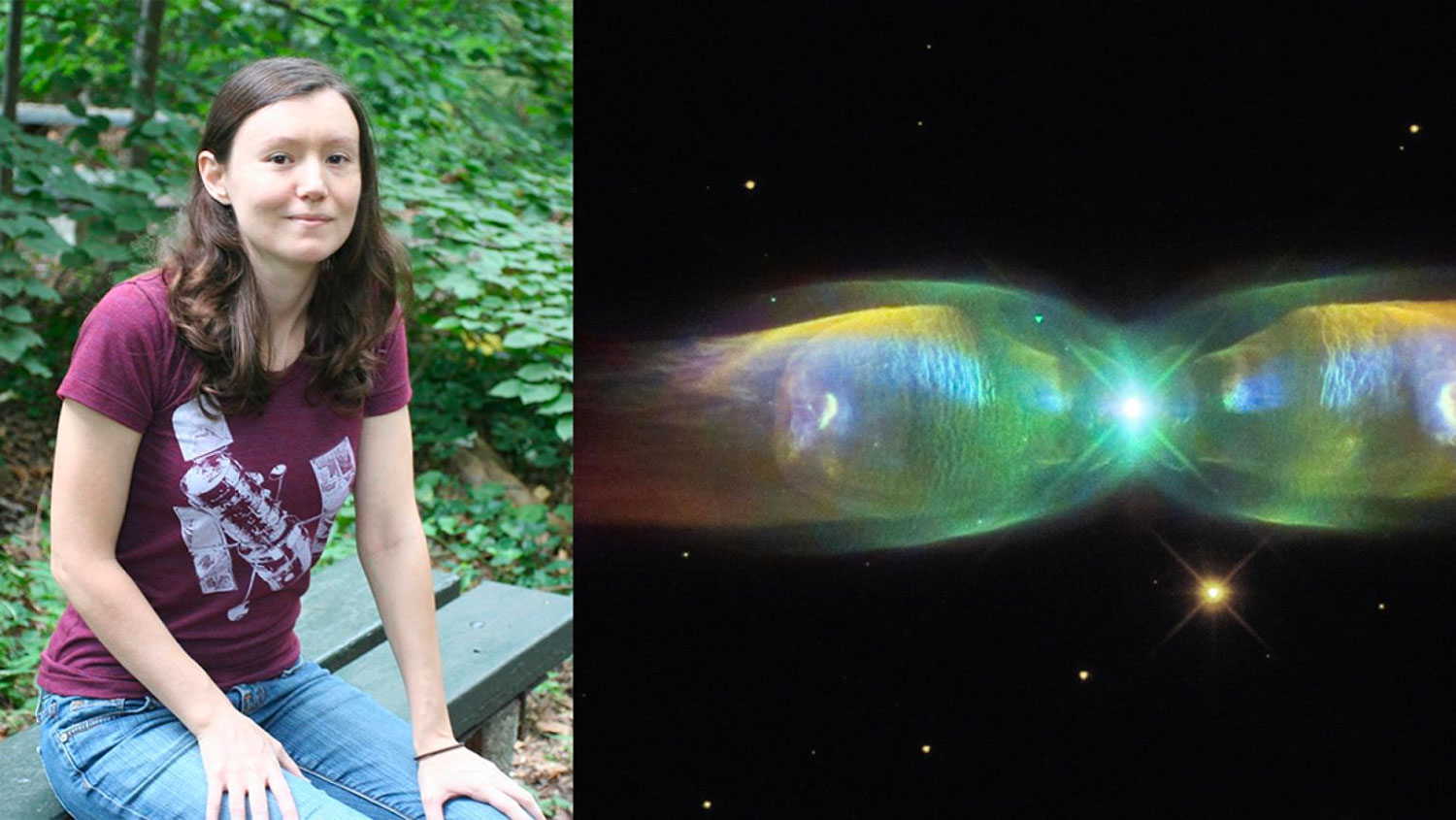
    Citizen scientist Judy Schmidt of Modesto, California, processes astronomical images from NASA spacecraft, such as the Hubble Space Telescope. An example of her work is Minkowski’s Butterfly, right, a planetary nebula in the direction of the constellation Ophiuchus

    Schmidt has no formal educational background in astronomy. But 10 years ago, an ESA contest sparked her insatiable passion for image processing. The “Hubble’s Hidden Treasures” competition invited the public to find new gems in Hubble data. Out of nearly 3 000 submissions, Schmidt took home third place for an image of a newborn star.

    Since the ESA contest, she has been working on Hubble and other telescope data as a hobby. “Something about it just stuck with me, and I can’t stop,” she said. “I could spend hours and hours every day.”

    Her love of astronomy images led her to process images of nebulae, globular clusters, stellar nurseries and other spectacular cosmic objects. Her guiding philosophy is: “I try to get it to look natural, even if it’s not anything close to what your eye can see.” These images have caught the attention of professional scientists, including Hammel, who previously collaborated with Schmidt on refining Hubble images of comet Shoemaker-Levy 9’s Jupiter impact.

    Jupiter is actually harder to work with than more distant cosmic wonders, Schmidt says, because of how fast it rotates. Combining a stack of images into one view can be challenging when Jupiter’s distinctive features have rotated during the time that the images were taken and are no longer aligned. Sometimes she has to digitally make adjustments to stack the images in a way that makes sense.

    Webb will deliver observations about every phase of cosmic history, but if Schmidt had to pick one thing to be excited about, it would be more Webb views of star-forming regions. In particular, she is fascinated by young stars that produce powerful jets in small nebula patches called Herbig-Haro objects. “I’m really looking forward to seeing these weird and wonderful baby stars blowing holes into nebulas,” she said.  – Elizabeth Landau, Nasa

    • Read the original article
    Follow TechCentral on Google News Add TechCentral as your preferred source on Google


    Judy Schmidt Nasa
    WhatsApp YouTube
    Share. Facebook Twitter LinkedIn WhatsApp Telegram Email Copy Link
    Previous ArticleHawks swoop on Office of Chief Justice over IT tender
    Next Article Huawei founder urges focus on cash flow, survival in downturn

    Related Posts

    SpaceX is the Dutch East India Company of the space age

    SpaceX is the Dutch East India Company of the space age

    15 July 2026
    More organic compounds detected on Mars - Nasa Curiosity rover

    More organic compounds detected on Mars

    21 April 2026

    The cameras behind Artemis II’s stunning lunar images

    15 April 2026
    Company News
    Domains.co.za launches self-hosted n8n VPS hosting

    Domains.co.za launches self-hosted n8n VPS hosting

    31 July 2026
    Smarter.tech '26 shows why smarter technology begins with context - Obsidian Systems

    Context is the missing piece in enterprise AI: Obsidian

    31 July 2026
    Huawei launches 12 intelligent transport solutions in South Africa - Sam Tang

    Huawei launches 12 intelligent transport solutions in South Africa

    30 July 2026
    Opinion
    The author, Jannie van Zyl

    Selling vapour is corporate suicide in slow motion

    16 July 2026
    Brazil's online gambling crackdown is a lesson for South Africa

    How Amazon outmanoeuvred Starlink in South Africa

    15 July 2026
    The Popia problem with agentic AI - Herman Haasbroek

    The Popia problem with agentic AI

    14 July 2026

    Subscribe to Updates

    Get the best South African technology news and analysis delivered to your e-mail inbox every morning.

    Latest Posts
    Nedbank hires MTN's former tech chief as group CIO - Nikos Angelopoulos

    Nedbank hires MTN’s former tech chief as group CIO

    31 July 2026
    Eskom's diesel bill falls 86% as breakdowns hit eight-year low

    Eskom’s diesel bill falls 86% as breakdowns hit eight-year low

    31 July 2026
    Ramaphosa signs off on taking the grid away from Eskom

    Ramaphosa signs off on taking the grid away from Eskom

    31 July 2026
    TCS+ | Why South African workers must become supervisors of digital labour - Accelera Digital Group Cliff de Wit

    TCS+ | Why South African workers must become supervisors of digital labour

    31 July 2026
    © 2009 - 2026 NewsCentral Media
    Built and maintained by Chronon
    • Cookie policy (ZA)
    • TechCentral – privacy and Popia

    Type above and press Enter to search. Press Esc to cancel.

    Manage consent

    TechCentral uses cookies to enhance its offerings. Consenting to these technologies allows us to serve you better. Not consenting or withdrawing consent may adversely affect certain features and functions of the website.

    Functional Always active
    The technical storage or access is strictly necessary for the legitimate purpose of enabling the use of a specific service explicitly requested by the subscriber or user, or for the sole purpose of carrying out the transmission of a communication over an electronic communications network.
    Preferences
    The technical storage or access is necessary for the legitimate purpose of storing preferences that are not requested by the subscriber or user.
    Statistics
    The technical storage or access that is used exclusively for statistical purposes. The technical storage or access that is used exclusively for anonymous statistical purposes. Without a subpoena, voluntary compliance on the part of your Internet Service Provider, or additional records from a third party, information stored or retrieved for this purpose alone cannot usually be used to identify you.
    Marketing
    The technical storage or access is required to create user profiles to send advertising, or to track the user on a website or across several websites for similar marketing purposes.
    • Manage options
    • Manage services
    • Manage {vendor_count} vendors
    • Read more about these purposes
    View preferences
    • {title}
    • {title}
    • {title}