
Close Menu
TechCentralTechCentral

    Subscribe to the newsletter

    Get the best South African technology news and analysis delivered to your e-mail inbox every morning.

    Facebook X (Twitter) YouTube LinkedIn
    WhatsApp Facebook X (Twitter) LinkedIn YouTube
    TechCentralTechCentral
    • News
      Why Telkom is pouring capex into IT - Serame Taukobong

      Why Telkom is pouring capital spending into IT

      2 June 2026
      Telkom's data growth story still has years to run: CEO

      Telkom’s data growth story still has years to run: CEO

      2 June 2026
      Reserve Bank draws a line on inflation - Lesetja Kganyago. Siphiwe Sibeko/Reuters

      Reserve Bank draws a line on inflation

      2 June 2026

      Clashing judgments leave South Africa’s crypto law unsettled

      2 June 2026
      Telkom's four-year SIU standoff awaits a final ruling

      Telkom’s four-year SIU standoff awaits a final ruling

      2 June 2026
    • World
      Astronomers discover exoplanets with magnetic fields

      Strange winds reveal magnetic fields on distant ‘hot Jupiters’

      2 June 2026
      Nvidia's first CPUs to debut in Windows laptops this week

      Nvidia CPUs to debut in Windows laptops this week

      31 May 2026
      Watch: Bezos rocket erupts in fireball during ground test

      Watch: Bezos rocket erupts in fireball during ground test

      29 May 2026
      AI boom hands Samsung chip workers life-changing bonuses

      AI boom hands Samsung chip workers life-changing bonuses

      27 May 2026
      Luce lit: Ferrari unveils its first electric car

      Luce lit: Ferrari unveils its first electric car

      26 May 2026
    • In-depth
      Alfa's electric rebel - Alfa Romeo Junior Elettrica Veloce

      Alfa’s electric rebel

      29 April 2026
      Africa switches on as Europe dims the lights

      Africa switches on as Europe dims the lights

      9 April 2026
      The biggest untapped EV market on Earth is hiding in plain sight

      The biggest untapped EV market on Earth is hiding in plain sight

      1 April 2026
      AI, cybersecurity power standout year for Datatec - Jens Montanana

      The R16-billion tech giant hiding in plain sight

      26 March 2026
      The last generation of coders

      The last generation of coders

      18 February 2026
    • TCS
      TCS | Charge's R1.8-billion bet on an off-grid EV future - Charge chairman Joubert Roux

      TCS | Charge’s R1.8-billion bet on an off-grid EV future

      18 May 2026
      TCS+ | The Up&Up Group on the hidden cost of AI - Jason Harrison

      TCS+ | The Up&Up Group on the hidden cost of AI

      13 May 2026
      Michael Rossouw

      TCS+ | The retirement decision most South Africans get wrong

      6 May 2026
      TCS | The Cape Town start-up listening for TB with AI - Braden van Breda

      TCS | The Cape Town start-up listening for TB with AI

      4 May 2026

      TCS+ | ‘The ISP for ISPs’: Vox’s shift to wholesale aggregator

      20 April 2026
    • Opinion
      Treasury's crypto crackdown is a betrayal of Mandela's promise - Duncan McLeod

      Treasury’s crypto crackdown is a betrayal of Mandela’s promise

      22 May 2026
      South Africa is sleepwalking into another AI policy failure - Celeste Labuschagne

      South Africa is sleepwalking into another AI policy failure

      20 May 2026
      AI won't fix your culture - it will expose it - Jackie Kennedy

      AI won’t fix your culture – it will expose it

      19 May 2026
      Treasury's crypto crackdown is a betrayal of Mandela's promise - Duncan McLeod

      Free calls, dead voice and Shameel Joosub’s Spanish ghost

      22 April 2026
      The conflict of interest at the heart of PayShap's slow adoption - Cheslyn Jacobs

      The conflict of interest at the heart of PayShap’s slow adoption

      26 March 2026
    • Company Hubs
      • 1Stream
      • Africa Data Centres
      • AfriGIS
      • Altron Digital Business
      • Altron Document Solutions
      • Altron Group
      • Arctic Wolf
      • Ascent Technology
      • AvertITD
      • BBD
      • Braintree
      • CallMiner
      • CambriLearn
      • CM Telecom
      • Contactable
      • CYBER1 Solutions
      • Digicloud Africa
      • Digimune
      • Domains.co.za
      • ESET
      • Euphoria Telecom
      • HOSTAFRICA
      • Incredible Business
      • iONLINE
      • IQbusiness
      • Iris Network Systems
      • Kaspersky
      • LSD Open
      • Mitel
      • NEC XON
      • Netstar
      • Network Platforms
      • Next DLP
      • Ovations
      • Paracon
      • Paratus
      • Q-KON
      • SevenC
      • SkyWire
      • Solid8 Technologies
      • Telit Cinterion
      • Telviva
      • Tenable
      • Vertiv
      • Videri Digital
      • Vodacom Business
      • Wipro
      • Workday
      • XLink
    • Sections
      • AI and machine learning
      • Banking
      • Broadcasting and Media
      • Cloud services
      • Contact centres and CX
      • Cryptocurrencies
      • Education and skills
      • Electronics and hardware
      • Energy and sustainability
      • Enterprise software
      • Financial services
      • HealthTech
      • Information security
      • Internet and connectivity
      • Internet of Things
      • Investment
      • IT services
      • Lifestyle
      • Motoring
      • Policy and regulation
      • Public sector
      • Retail and e-commerce
      • Satellite communications
      • Science
      • SMEs and start-ups
      • Social media
      • Talent and leadership
      • Telecoms
    • Events
    • Advertise
    TechCentralTechCentral
    Home » Sections » Telecoms » Low-Earth orbit satellites – the way forward for Africa

    Low-Earth orbit satellites – the way forward for Africa

    Recent developments in global low-Earth orbit satellites could benefit users in Africa, writes Q-Kon's Dawie de Wet.
    By Dawie de Wet3 November 2023
    Twitter LinkedIn Facebook WhatsApp Email Telegram Copy Link
    News Alerts
    WhatsApp
    The author, Dawie de Wet

    There are 36 registered low-Earth orbit (Leo) satellite constellations, with the 10 largest satellite operators alone planning to launch more than 63 000 satellites in the coming years.

    Looking at the technology adoption bell curve, we are rapidly entering the early adoption phase and preparing for uptake by the early majority. Africa has a proud history of technology innovation, with many technology firsts having found market success on the continent, including mobile money and prepaid services. Leo services will likely be no different. (In the context of this article, we are referring solely to the use of Leo constellations for two-way high-speed voice and data telecommunications services.)

    While low-Earth orbit satellites are a proven technology, their use in data telecoms is a more recent development. They deliver benefits including 10x (or greater) improvements in speed, capacity, latency and cost compared to geostationary-orbit satellite (Geo) deployments. These improvements raise the question as to whether these new Leo services will now replace legacy Geo services. Alternatively, in what scenarios could we see new Geo/Leo combinations servicing and growing the African market?

    And – not or

    Leo constellations will add significant data capacity to the overall telecoms ecosystem servicing Africa (which currently consists of international and regional fibre cable networks, mobile networks and Geo satellite networks). Northern Sky Research forecasts that around 78Tbit/s of usable capacity will be brought to the global market by the major Leo constellations over the next five years. While some of this total capacity will be stationed over the oceans and therefore lost to the addressable market, the usable portion far exceeds the combined total of 3Tbit/s currently being provided by all current Geo constellations.

    This underlines the fact that Leo services will replace the Geo networks. Nor will they make them redundant in the future, or limit the anticipated growth in Geo constellations. It is not a case of Leo or Geo services, but rather of Leo and Geo services. The massive, demonstrated advantages of Leo constellations will open up new and peripheral user market sectors rather than supplanting Geo.

    Leo satellites are different

    Leo networks have more in common with mobile cellular networks than they do with Geo networks due to the fact that they involve hundreds of “satellite base stations” orbiting the globe and passing over the user. In a mobile network, the users pass from base station to base station, while in a Leo network, it is the base stations that pass over the user.

    This means that Leo user terminals will always incorporate more complicated antenna technology to keep tracking the satellites passing overhead. Also, the satellite receiving signal will always fluctuate, leading to variable reliability and much shorter technology replacement cycles.

    Leo network users have access to much more overall network capacity, 10x higher data transfer rates, data transmission at much lower latencies and reduced go-to-market pricing models.
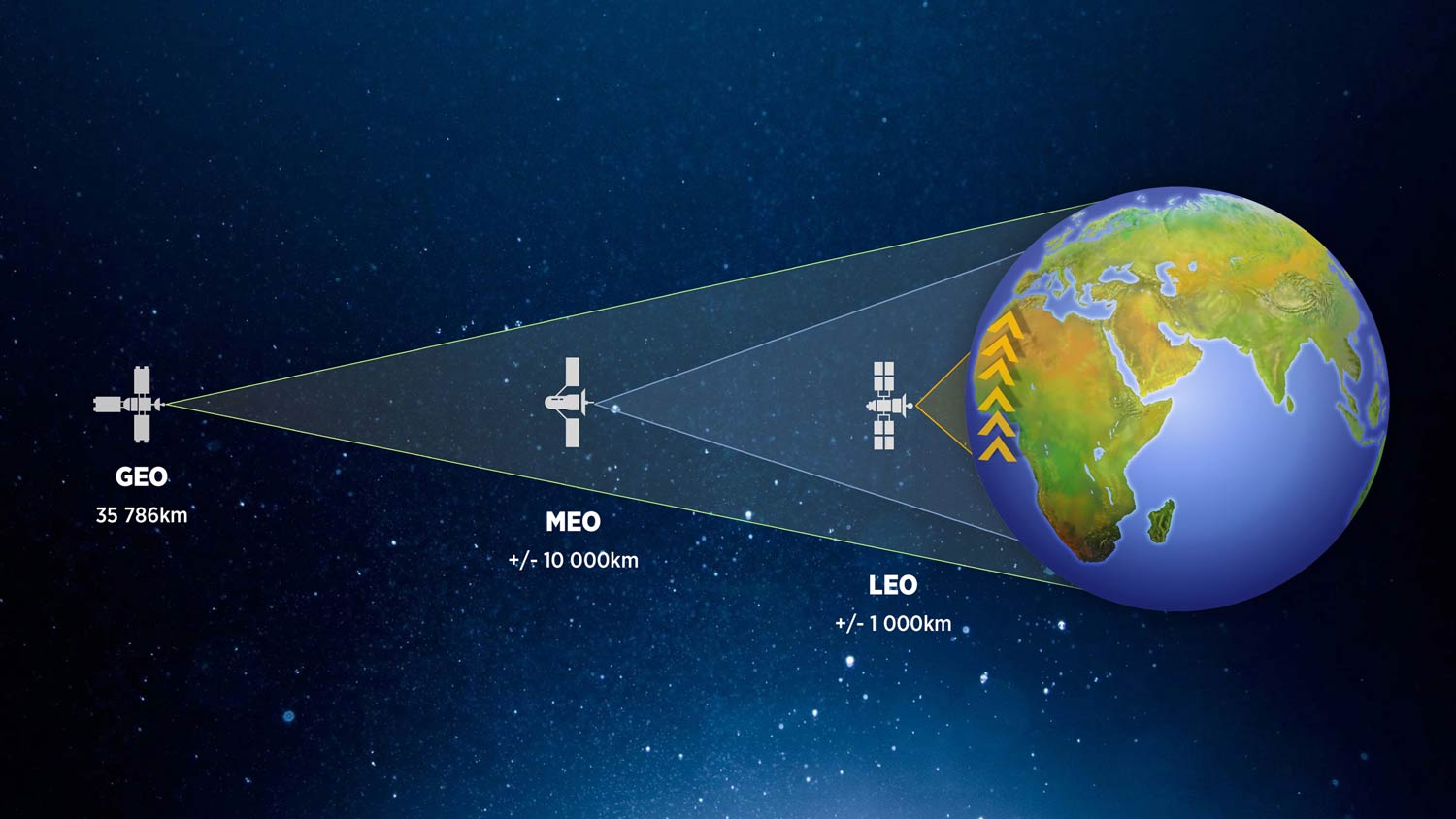
    For reference, many of the current very low-cost equipment and service user advantages quoted here have more to do with business models, industry structures and scale than they do with the fundamentals of Leo services.

    The best of both worlds

    Eutelsat’s history of innovation has continued its merger with OneWeb – a bold step that merges Leo and Geo services and builds on their strong foundations in advancing technology frontiers and service delivery in Africa. In 2005, Eutelsat and Q-Kon partnered to deliver the Eutelsat Opensky service to Africa. This service combined the advantages of direct-to-home satellite technology with ADSL landline transmit networks – a leading-edge solution at the time.

    In 2017, this was followed by the successful launch of the Eutelsat Konnect Africa Geo Ku-band broadband service. In 2022, Q-Kon Africa signed a distribution partnership with OneWeb, which means that following the merger between OneWeb and Eutelsat, Twoobii customers will benefit from access to Leo/Geo connectivity provided by a single satellite service operator.

    Leo-Earth orbit satellites will succeed

    Leo services will be successful in Africa. The massive network capacity, high data transfer rates, lower commercial price points and low latency will deliver tangible business advantages to mobile operators, businesses and retail consumers.

    Global Leo leaders have now clearly demonstrated the feasibility of the technology and the reality of this new era of services. All that remains is to work with Africa to find best-fit, go-to-market models that balance risk and performance, since currently neither the “low touch” nor the “classical distribution” business models appear ideal for sustainably developing and servicing the African market.

    Geostationary will continue to grow

    Many of the innovations in launch and satellite design technologies being leveraged by the Leo industry to deliver savings and improved performance are also available to the designers of next-generation Geo satellite platforms.

    Given that the principal network architecture of Geo services is much simpler than that of Leo networks, there are no material reasons why future Geo satellites cannot also be designed to unlock significant cost reductions and multiple performance improvements.

    The success of global Leo constellations has forever changed the scope of what can and can’t be achieved

    The advantage of low latency will always be exclusive to Leo networks, yet low latency by itself is not a guarantee of market success; nor can it keep a market locked to other solutions such as Geo services. Given the sustained growth of the financial transactions market, the need for highly reliable solutions, coupled with the size of the lower-income broadband market sector, future demand for Geo services is likely to be robust.

    Together with a Geo satellite technology design update to maximise performance and cost benefits, updates to industry structure and business models may also be required. In some cases, current constraints on Geo services relate more to entrenched industry structures than to actual Geo technologies.

    The success of global Leo constellations has forever changed the scope of what can and can’t be achieved in the telecoms industry.

    • The author, Dawie de Wet, is group CEO of Q-Kon Africa and chief engineer for Twoobii, a Southern African-supported satellite broadband service

    Get breaking news alerts from TechCentral on WhatsApp

    Follow TechCentral on Google News Add TechCentral as your preferred source on Google


    Dawie de Wet OneWeb Q-Kon Q-Kon Africa Twoobii
    WhatsApp YouTube
    Share. Facebook Twitter LinkedIn WhatsApp Telegram Email Copy Link
    Previous ArticleMusk, Sunak chat China, killer robots and the meaning of life
    Next Article Skype, Flutterwave founders back R3.8-billion Africa tech fund

    Related Posts

    Africa's internet is about to change forever - thanks to a satellite arms race - Q-KON CEO Dawie de Wet

    Africa’s internet is about to change forever – thanks to a satellite arms race

    8 December 2025
    ICT sector legal expert Dominic Cull

    Starlink risks ceding ground to rivals in South Africa amid licensing battle

    17 November 2025
    From mines to clinics, LEO internet powers Africa's most remote regions - Paratus Group

    From mines to clinics, LEO internet powers Africa’s most remote regions

    22 September 2025
    Company News
    The hidden infrastructure behind AI - Open Access Data Centres OADC

    The hidden infrastructure behind AI

    2 June 2026
    Addressing the 57% blind spot: Kaspersky on measuring SOC effectiveness

    Addressing the 57% blind spot: Kaspersky on measuring SOC effectiveness

    2 June 2026
    Strike48 report: security leaders wary of AI agents - Maidar Secure

    Strike48 report: security leaders wary of AI agents

    2 June 2026
    Opinion
    Treasury's crypto crackdown is a betrayal of Mandela's promise - Duncan McLeod

    Treasury’s crypto crackdown is a betrayal of Mandela’s promise

    22 May 2026
    South Africa is sleepwalking into another AI policy failure - Celeste Labuschagne

    South Africa is sleepwalking into another AI policy failure

    20 May 2026
    AI won't fix your culture - it will expose it - Jackie Kennedy

    AI won’t fix your culture – it will expose it

    19 May 2026

    Subscribe to Updates

    Get the best South African technology news and analysis delivered to your e-mail inbox every morning.

    Latest Posts
    Why Telkom is pouring capex into IT - Serame Taukobong

    Why Telkom is pouring capital spending into IT

    2 June 2026
    Telkom's data growth story still has years to run: CEO

    Telkom’s data growth story still has years to run: CEO

    2 June 2026
    Reserve Bank draws a line on inflation - Lesetja Kganyago. Siphiwe Sibeko/Reuters

    Reserve Bank draws a line on inflation

    2 June 2026
    Astronomers discover exoplanets with magnetic fields

    Strange winds reveal magnetic fields on distant ‘hot Jupiters’

    2 June 2026
    © 2009 - 2026 NewsCentral Media
    • Cookie policy (ZA)
    • TechCentral – privacy and Popia

    Type above and press Enter to search. Press Esc to cancel.

    Manage consent

    TechCentral uses cookies to enhance its offerings. Consenting to these technologies allows us to serve you better. Not consenting or withdrawing consent may adversely affect certain features and functions of the website.

    Functional Always active
    The technical storage or access is strictly necessary for the legitimate purpose of enabling the use of a specific service explicitly requested by the subscriber or user, or for the sole purpose of carrying out the transmission of a communication over an electronic communications network.
    Preferences
    The technical storage or access is necessary for the legitimate purpose of storing preferences that are not requested by the subscriber or user.
    Statistics
    The technical storage or access that is used exclusively for statistical purposes. The technical storage or access that is used exclusively for anonymous statistical purposes. Without a subpoena, voluntary compliance on the part of your Internet Service Provider, or additional records from a third party, information stored or retrieved for this purpose alone cannot usually be used to identify you.
    Marketing
    The technical storage or access is required to create user profiles to send advertising, or to track the user on a website or across several websites for similar marketing purposes.
    • Manage options
    • Manage services
    • Manage {vendor_count} vendors
    • Read more about these purposes
    View preferences
    • {title}
    • {title}
    • {title}