Close Menu
TechCentralTechCentral

    Subscribe to the newsletter

    Get the best South African technology news and analysis delivered to your e-mail inbox every morning.

    Facebook X (Twitter) YouTube LinkedIn
    WhatsApp Facebook X (Twitter) LinkedIn YouTube
    TechCentralTechCentral
    • News
      SA experts split on whether the singularity has begun

      SA experts split on whether the singularity has begun

      3 August 2026
      South Africa's hybrid boom is masking a flat electric car market

      South Africa’s hybrid boom is masking a flat electric car market

      3 August 2026
      SABC+ scales up

      SABC+ scales up

      3 August 2026
      The Post Office has fixed its books but not its business

      The Post Office has fixed its books but not its business

      3 August 2026
      SA companies could face cross-border crypto ban

      SA companies could face cross-border crypto ban

      3 August 2026
    • World
      Meta AI will now tell parents if their teen is in crisis

      Meta AI will now tell parents if their teen is in crisis

      17 July 2026
      IBM shares crash 25% as AI upends software spending - Arvind Krishna

      IBM shares crash 25% as AI upends software spending

      15 July 2026
      Jony Ive's first OpenAI device: an AI smart speaker - Jony Ive and Sam Altman

      Jony Ive’s first OpenAI device: an AI smart speaker

      15 July 2026
      Stripe, Advent in talks to buy PayPal for $53-billion

      Stripe, Advent in talks to buy PayPal for $53-billion

      15 July 2026
      Memory crisis sends smartphone market into steep decline

      Memory crisis sends smartphone market into steep decline

      13 July 2026
    • In-depth
      The plan to stop AI from breaking the world - Google DeepMind CEO Demis Hassabis. Image: John Sears

      The plan to stop AI from breaking the world

      16 July 2026
      The internet has a Strait of Hormuz problem

      The internet has a Strait of Hormuz problem

      15 July 2026
      AI boom sparks rally, frenzy and fear

      AI boom sparks rally, frenzy and fear

      11 June 2026
      Every plug-in hybrid on sale in South Africa, ranked by price - Lamborghini Temerario

      Every plug-in hybrid on sale in South Africa, ranked by price

      7 June 2026
      What Wi-Fi 8 will mean for wireless networks

      What Wi-Fi 8 will mean for wireless networks

      1 June 2026
    • TCS
      TCS+ | Why South African workers must become supervisors of digital labour - Accelera Digital Group Cliff de Wit

      TCS+ | Why South African workers must become supervisors of digital labour

      31 July 2026
      TCS | Rapid deployment rules can't work without municipalities: ACT - Nomvuyiso Batyi

      TCS | Icasa’s rules skip the real bottleneck: ACT

      30 July 2026
      TCS+ | iStore Business on why Apple makes sense for SMEs - Sudesh Pillay and Tamia Nontsikelelo

      TCS+ | iStore Business on why Apple makes sense for SMEs

      30 July 2026
      TCS+ | A smarter approach to cloud for South African businesses - Joel Chacko and Jonathan Oaker

      TCS+ | A smarter approach to cloud for South African businesses

      28 July 2026
      TCS | How Optasia lends billions to people banks can't see - Salvador Anglada

      TCS | How Optasia lends billions to people banks can’t see

      23 July 2026
    • Opinion
      The author, Jannie van Zyl

      Selling vapour is corporate suicide in slow motion

      16 July 2026
      Brazil's online gambling crackdown is a lesson for South Africa

      How Amazon outmanoeuvred Starlink in South Africa

      15 July 2026
      The Popia problem with agentic AI - Herman Haasbroek

      The Popia problem with agentic AI

      14 July 2026
      The author, Fanie van Rooyen

      South Africa can still catch the AI wave – here’s how

      7 July 2026
      The author, Fanie van Rooyen

      The AI utopia South Africa can’t afford

      1 July 2026
    • Company Hubs
      • 1Stream
      • Africa Data Centres
      • AfriGIS
      • Altron Digital Business
      • Altron Document Solutions
      • Altron Group
      • Arctic Wolf
      • Ascent Technology
      • AvertITD
      • BBD
      • Braintree
      • CallMiner
      • CambriLearn
      • CM Telecom
      • Contactable
      • CYBER1 Solutions
      • Digicloud Africa
      • Digimune
      • Domains.co.za
      • ESET
      • Euphoria Telecom
      • HOSTAFRICA
      • Incredible Business
      • iONLINE
      • IQbusiness
      • Iris Network Systems
      • Kaspersky
      • LSD Open
      • Mitel
      • NEC XON
      • Netstar
      • Network Platforms
      • Next DLP
      • Ovations
      • Paracon
      • Paratus
      • Q-KON
      • SevenC
      • SkyWire
      • Solid8 Technologies
      • Telit Cinterion
      • Telviva
      • Tenable
      • Vertiv
      • Videri Digital
      • Vodacom Business
      • Vox
      • Wipro
      • Workday
      • XLink
    • Sections
      • AI and machine learning
      • Banking
      • Broadcasting and Media
      • Cloud services
      • Contact centres and CX
      • Cryptocurrencies
      • Education and skills
      • Electronics and hardware
      • Energy and sustainability
      • Enterprise software
      • Financial services
      • HealthTech
      • Information security
      • Internet and connectivity
      • Internet of Things
      • Investment
      • IT services
      • Lifestyle
      • Policy and regulation
      • Public sector
      • Retail and e-commerce
      • Satellite communications
      • Science
      • SMEs and start-ups
      • Social media
      • Talent and leadership
      • Telecoms
      • Watts & Wheels
    • Events
    • Advertise
    TechCentralTechCentral
    Home » Current affairs » Mbeki’s cynical attempt to recast history

    Mbeki’s cynical attempt to recast history

    By The Conversation2 May 2017
    Twitter LinkedIn Facebook WhatsApp Email Telegram Copy Link
    News Alerts
    WhatsApp
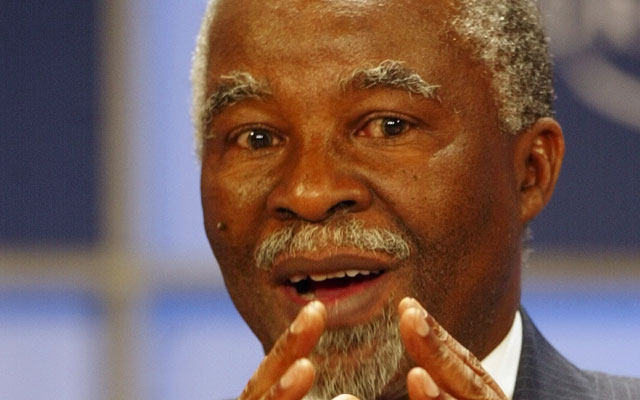
    Former President Thabo Mbeki

    As South Africa’s political climate goes from fractious to feverish, with protests mounting against the embattled president, Jacob Zuma, a former national leader and titan of the ANC has waded into the fray.

    Thabo Mbeki, who led South Africa between 1999 and 2008, recently wrote about the possibility of another no confidence motion against Zuma, now being tabled by the opposition. He argued that should such a vote happen, MPs should vote in the national interest rather than obey orders from their party.

    On one score, this is the latest iteration of Mbeki and Zuma’s bitter, unreconciled feud, which dates back to Zuma’s humiliating defenestration of Mbeki as ANC and state president in 2007/2008. But there’s something more purely self-serving going on here, too.

    Mbeki has always viewed himself as an intellectual titan, not simply another calculating politician looking to land the latest blow. His contributions to the national and international conversation supposedly carry a weight and gravitas that demand deference. This supposedly elevates him above Zuma, an essentially grubby and scheming politician devoid of substance who is incapable of raising his gaze beyond his own immediate political and material interests.

    Given Mbeki’s record in national office, his lofty reputation is not entirely deserved. And whatever his intellectual pretensions at this extraordinary political moment, his position is extremely flimsy — and it may have more to do with rescuing his own reputation than anything else.

    Mbeki’s argument that MPs are principally accountable to “the people” would make more sense if they were directly elected. But they aren’t. Under South Africa’s proportional representation system people vote for parties, not individual representatives. Parliamentary candidates run on lists drawn up by their party leaders, and their ranking on the list is what determines their chance of getting into office.

    This in turn means that whether or not lawmakers intentionally defy the will of the people (whatever that means), their understanding and expression of the people’s interest is filtered through their party affiliation.

    Mbeki’s position has an uncharacteristically populist edge, then, and it doesn’t amount to much of a plan of action. How exactly should MPs determine the will of the people? The size of protest marches? Opinion polls? Radio phone ins? Strict loyalty to a party line is certainly contentious, but it can at least be traced back to a direct electoral mandate, not some nebulous sense of the “mood of the nation”.

    Mbeki’s new-found populism is also a radical about face from his own behaviour as president of both his party and his country. Freedom of conscience and deference to the electorate were not ideals which Mbeki was keen to nurture — quite the opposite, in fact.

    Iron fist

    During his tenure, ANC MPs were regularly corralled, coerced and threatened into line not least by Mbeki’s own attack dog, Essop Pahad. Perhaps the definitive example came in 2000 when Pahad, acting on Mbeki’s behalf, demanded that ANC MPs serving on the standing committee on public accounts back off from their scrutiny of an infamous arms deal and the widespread corruption it allegedly generated. (This incident was detailed in ANC MP Andrew Feinstein’s book After The Party.)

    When Mbeki was in power, no distinction was ever made between “the party” and “the people”: the ANC itself was considered synonymous with “the people”, while opposition parties were all too frequently denounced as “racists” or “enemies of transformation”. Mbeki was a ferocious centraliser who worked hard to concentrate power in his own office. He punished dissent, and imposed his own discipline on party and government from the top down; the ANC’s parliamentary caucus became a rubber stamp, unable to fulfil its constitutional obligation to provide a full and proper oversight of the executive.

    So, when Mbeki argues that the controversy around Zuma has finally “imposed on our country the opportunity and obligation the better to define the constitutional and moral relationship between the people and their elected representatives”, one is compelled to ask: what exactly has changed? What about the many controversies that disfigured Mbeki’s own presidency?

    The arms deal, the spread of corruption, the concentration of presidential power, disastrous HIV/AIDS denialism, the indulgence of Robert Mugabe’s ruinous tenure in Zimbabwe — none of these were extensively debated or scrutinised in parliament, with MPs encouraged to exercise their independent spirit and put the “national interest” ahead of the party. Instead, Mbeki maintained a vice-like grip over all policy areas, forcing MPs do their leaders’ bidding.

    It’s only right that many in South Africa and the ANC should want to end Zuma’s squalid, incompetent and shameful presidency, but that is no reason to recast the Mbeki era as some sort of golden age. It was then that many of the ANC leadership’s worst tendencies first became entrenched — and five years into Mbeki’s tenure, archbishop Desmond Tutu lamented the “sycophantic, obsequious conformity” and “unthinking, uncritical, kow-towing, party line-toeing” which had become the ANC norm.

    This is the same vocabulary Mbeki is now using. As political conversions go, it’s as hypocritical and cynical as they come.The Conversation

    • James Hamill is lecturer in politics & international relations, University of Leicester
    • This article was originally published on The Conversation

    Follow TechCentral on Google News Add TechCentral as your preferred source on Google


    WhatsApp YouTube
    Share. Facebook Twitter LinkedIn WhatsApp Telegram Email Copy Link
    Previous ArticleWatch: SpaceX pulls off textbook launch
    Next Article Radical economic transformation: Zuma vs Ramaphosa

    Related Posts

    SA experts split on whether the singularity has begun

    SA experts split on whether the singularity has begun

    3 August 2026
    South Africa's hybrid boom is masking a flat electric car market

    South Africa’s hybrid boom is masking a flat electric car market

    3 August 2026
    SABC+ scales up

    SABC+ scales up

    3 August 2026
    Company News
    Google Cloud, AI adoption gain momentum in Africa - Digicloud Africa

    Google Cloud, AI adoption gain momentum in Africa

    3 August 2026
    Domains.co.za launches self-hosted n8n VPS hosting

    Domains.co.za launches self-hosted n8n VPS hosting

    31 July 2026
    Smarter.tech '26 shows why smarter technology begins with context - Obsidian Systems

    Context is the missing piece in enterprise AI: Obsidian

    31 July 2026
    Opinion
    The author, Jannie van Zyl

    Selling vapour is corporate suicide in slow motion

    16 July 2026
    Brazil's online gambling crackdown is a lesson for South Africa

    How Amazon outmanoeuvred Starlink in South Africa

    15 July 2026
    The Popia problem with agentic AI - Herman Haasbroek

    The Popia problem with agentic AI

    14 July 2026

    Subscribe to Updates

    Get the best South African technology news and analysis delivered to your e-mail inbox every morning.

    Latest Posts
    SA experts split on whether the singularity has begun

    SA experts split on whether the singularity has begun

    3 August 2026
    South Africa's hybrid boom is masking a flat electric car market

    South Africa’s hybrid boom is masking a flat electric car market

    3 August 2026
    SABC+ scales up

    SABC+ scales up

    3 August 2026
    The Post Office has fixed its books but not its business

    The Post Office has fixed its books but not its business

    3 August 2026
    © 2009 - 2026 NewsCentral Media
    Built and maintained by Chronon
    • Cookie policy (ZA)
    • TechCentral – privacy and Popia

    Type above and press Enter to search. Press Esc to cancel.

    Manage consent

    TechCentral uses cookies to enhance its offerings. Consenting to these technologies allows us to serve you better. Not consenting or withdrawing consent may adversely affect certain features and functions of the website.

    Functional Always active
    The technical storage or access is strictly necessary for the legitimate purpose of enabling the use of a specific service explicitly requested by the subscriber or user, or for the sole purpose of carrying out the transmission of a communication over an electronic communications network.
    Preferences
    The technical storage or access is necessary for the legitimate purpose of storing preferences that are not requested by the subscriber or user.
    Statistics
    The technical storage or access that is used exclusively for statistical purposes. The technical storage or access that is used exclusively for anonymous statistical purposes. Without a subpoena, voluntary compliance on the part of your Internet Service Provider, or additional records from a third party, information stored or retrieved for this purpose alone cannot usually be used to identify you.
    Marketing
    The technical storage or access is required to create user profiles to send advertising, or to track the user on a website or across several websites for similar marketing purposes.
    • Manage options
    • Manage services
    • Manage {vendor_count} vendors
    • Read more about these purposes
    View preferences
    • {title}
    • {title}
    • {title}