
Close Menu
TechCentralTechCentral

    Subscribe to the newsletter

    Get the best South African technology news and analysis delivered to your e-mail inbox every morning.

    Facebook X (Twitter) YouTube LinkedIn
    WhatsApp Facebook X (Twitter) LinkedIn YouTube
    TechCentralTechCentral
    • News
      Australia has banned kids from social media. Should South Africa follow suit?

      Australia has banned kids from social media. Should South Africa follow suit?

      11 December 2025
      South Africa urged to do more to protect kids online

      South Africa urged to do more to protect kids online

      11 December 2025
      OpenAI warns new models pose high cybersecurity risk

      OpenAI warns new models pose high cybersecurity risk

      11 December 2025
      Above-inflation price hikes to hit MTN customers

      Above-inflation price hikes to hit MTN customers

      10 December 2025
      Promise of stability at Sita as agency gets full-time MD

      Promise of stability at Sita as agency gets full-time MD

      10 December 2025
    • World
      Oracle’s AI ambitions face scrutiny on earnings miss

      Oracle’s AI ambitions face scrutiny on earnings miss

      11 December 2025
      China will get Nvidia H200 chips - but not without paying Washington first

      China will get Nvidia H200 chips – but not without paying Washington first

      9 December 2025
      IBM reportedly close to $11-billion deal to buy Confluent - Arvind Krishna

      IBM reportedly close to $11-billion deal to buy Confluent

      8 December 2025
      Amazon and Google launch multi-cloud service for faster connectivity

      Amazon and Google launch multi-cloud service for faster connectivity

      1 December 2025
      Google makes final court plea to stop US breakup

      Google makes final court plea to stop US breakup

      21 November 2025
    • In-depth
      Black Friday goes digital in South Africa as online spending surges to record high

      Black Friday goes digital in South Africa as online spending surges to record high

      4 December 2025
      Canal+ plays hardball - and DStv viewers feel the pain

      Canal+ plays hardball – and DStv viewers feel the pain

      3 December 2025
      Jensen Huang Nvidia

      So, will China really win the AI race?

      14 November 2025
      Valve's Linux console takes aim at Microsoft's gaming empire

      Valve’s Linux console takes aim at Microsoft’s gaming empire

      13 November 2025
      iOCO's extraordinary comeback plan - Rhys Summerton

      iOCO’s extraordinary comeback plan

      28 October 2025
    • TCS
      TCS+ | How Cloud on Demand helps partners thrive in the AWS ecosystem - Odwa Ndyaluvane and Xenia Rhode

      TCS+ | How Cloud On Demand helps partners thrive in the AWS ecosystem

      4 December 2025
      TCS | MTN Group CEO Ralph Mupita on competition, AI and the future of mobile

      TCS | Ralph Mupita on competition, AI and the future of mobile

      28 November 2025
      TCS | Dominic Cull on fixing South Africa's ICT policy bottlenecks

      TCS | Dominic Cull on fixing South Africa’s ICT policy bottlenecks

      21 November 2025
      TCS | BMW CEO Peter van Binsbergen on the future of South Africa's automotive industry

      TCS | BMW CEO Peter van Binsbergen on the future of South Africa’s automotive industry

      6 November 2025
      TCS | Why Altron is building an AI factory - Bongani Andy Mabaso

      TCS | Why Altron is building an AI factory in Johannesburg

      28 October 2025
    • Opinion
      Netflix, Warner Bros deal raises fresh headaches for MultiChoice - Duncan McLeod

      Netflix, Warner Bros deal raises fresh headaches for MultiChoice

      5 December 2025
      BIN scans, DDoS and the next cybercrime wave hitting South Africa's banks - Entersekt Gerhard Oosthuizen

      BIN scans, DDoS and the next cybercrime wave hitting South Africa’s banks

      3 December 2025
      Your data, your hardware: the DIY AI revolution is coming - Duncan McLeod

      Your data, your hardware: the DIY AI revolution is coming

      20 November 2025
      Zero Carbon Charge founder Joubert Roux

      The energy revolution South Africa can’t afford to miss

      20 November 2025
      It's time for a new approach to government IT spend in South Africa - Richard Firth

      It’s time for a new approach to government IT spend in South Africa

      19 November 2025
    • Company Hubs
      • Africa Data Centres
      • AfriGIS
      • Altron Digital Business
      • Altron Document Solutions
      • Altron Group
      • Arctic Wolf
      • AvertITD
      • Braintree
      • CallMiner
      • CambriLearn
      • CYBER1 Solutions
      • Digicloud Africa
      • Digimune
      • Domains.co.za
      • ESET
      • Euphoria Telecom
      • Incredible Business
      • iONLINE
      • IQbusiness
      • Iris Network Systems
      • LSD Open
      • NEC XON
      • Netstar
      • Network Platforms
      • Next DLP
      • Ovations
      • Paracon
      • Paratus
      • Q-KON
      • SevenC
      • SkyWire
      • Solid8 Technologies
      • Telit Cinterion
      • Tenable
      • Vertiv
      • Videri Digital
      • Vodacom Business
      • Wipro
      • Workday
      • XLink
    • Sections
      • AI and machine learning
      • Banking
      • Broadcasting and Media
      • Cloud services
      • Contact centres and CX
      • Cryptocurrencies
      • Education and skills
      • Electronics and hardware
      • Energy and sustainability
      • Enterprise software
      • Financial services
      • Information security
      • Internet and connectivity
      • Internet of Things
      • Investment
      • IT services
      • Lifestyle
      • Motoring
      • Public sector
      • Retail and e-commerce
      • Satellite communications
      • Science
      • SMEs and start-ups
      • Social media
      • Talent and leadership
      • Telecoms
    • Events
    • Advertise
    TechCentralTechCentral
    Home » Opinion » Duncan McLeod » Microsoft’s in danger of becoming cool again

    Microsoft’s in danger of becoming cool again

    By Duncan McLeod25 January 2015
    Twitter LinkedIn Facebook WhatsApp Email Telegram Copy Link
    News Alerts
    WhatsApp

    Duncan-McLeod-180-profileIt was expected to be a fairly routine keynote address, with Microsoft using an event in Seattle on Wednesday to take the wraps off the consumer features of its new operating system, Windows 10. What it turned into was arguably the most exciting technology industry keynote address since Steve Jobs took to a stage in 2007 to introduce the iPhone to the world.

    Much of the early focus of the keynote was indeed on Windows 10, which is expected to debut later this year, so let’s deal with that first.

    Perhaps the biggest surprise about the new software is that it will be free (for a year) for those running Windows 7 and Windows 8.1. The same software will run across desktops, laptops, tablets and smartphones — the Windows Phone name is being abandoned in favour of a uniform “Windows 10” across all device categories.

    Less surprising is the news that it will come with a new lightweight Web browser — code-named Project Spartan — as Microsoft seeks to recover market share lost to rivals, especially Google, by building an alternative to the much-maligned Internet Explorer. Cortana, Microsoft’s equivalent of Apple’s Siri intelligent personal voice assistant, will be built into Spartan and into Windows 10.

    Windows 10 is impressive-looking software. Where Windows 8/8.1 felt like a kludge, the new operating system adapts itself intuitively to the hardware it’s running on.

    There was plenty of other Windows news that flowed at Wednesday’s event — so-called universal applications designed for Windows will also run on the Xbox One gaming console, for example, and there was more information on how the newly reinstated start menu will function — but this was all overshadowed in the final third of the event.

    That’s when the company’s Alex Kipman took to the stage to unveil Windows Holographic augmented reality (AR) technology, which will form a cornerstone of Windows 10 and which Microsoft believes will set the foundation for the future of human-machine interaction.

    The first hardware based on Windows Holographic is the HoloLens wireless AR headgear that resembles something straight out of science-fiction. The HoloLens blends holograms into reality through the transparent lenses on the headgear. Microsoft says the HoloLens “intelligently maps” the room the wearer is in, “blending holograms with the environment”. Users can “pin holograms to physical locations” they choose so that the room they’re in becomes the “canvas” for their holographic projects and games. And it’s powered by movement, vision and voice through a special “holographic processing unit”.

    Words can’t do the technology justice: I strongly recommend looking at YouTube for demonstration videos. Then imagine it being used for gaming, or for video conferencing.
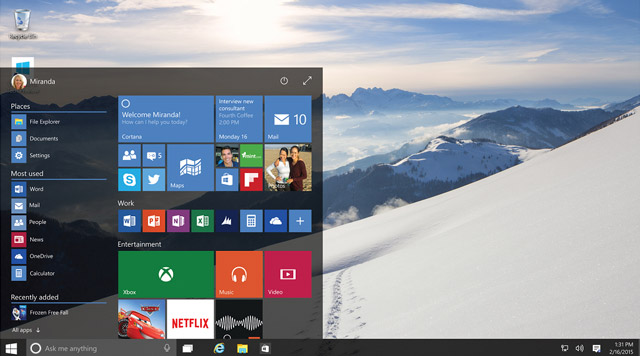
    Windows 10
    Windows 10

    At the very least, Microsoft has leapt ahead of the competition. Google Glass, Google’s attempt at augmented reality, now looks hopelessly dated. And the HoloLens is far less dorky and appears to be much more practical that the Oculus Rift virtual reality goggles from Oculus VR, recently acquired by Facebook for US$2bn.

    The HoloLens and the Windows Holographic software are important not just because they’re innovative, they also symbolise a fundamental change under way at Microsoft.

    The company, which in the eyes of many consumers had become boring, is now in real danger of becoming cool again, of becoming a leader instead of a laggard.

    The foundation for this change was set under former CEO Steve Ballmer, who often doesn’t get the credit he deserves. But his successor, Satya Nadella, is accelerating the change in the company’s corporate culture, putting innovation at the centre of what it does.

    HoloLens could yet fail, the same way Google Glass did. Are people going to be okay with wearing headsets to interact with computers, even if the hardware is comfortable and lightweight? Or will computing be driven in other directions?

    What’s exciting is that Microsoft has not only decided it’s time to find out, but it has quickly sprinted to the front of the race.

    • Duncan McLeod is editor of TechCentral. Find him on Twitter
    • This column was first published in the Sunday Times


    Duncan McLeod Facebook Google HoloLens Microsoft Microsoft HoloLens Oculus VR Satya Nadella Steve Ballmer Windows Holographic
    Subscribe to TechCentral Subscribe to TechCentral
    Share. Facebook Twitter LinkedIn WhatsApp Telegram Email Copy Link
    Previous ArticleDrug smugglers deal in drones
    Next Article Microsoft’s fightback begins

    Related Posts

    Australia has banned kids from social media. Should South Africa follow suit?

    Australia has banned kids from social media. Should South Africa follow suit?

    11 December 2025
    OpenAI warns new models pose high cybersecurity risk

    OpenAI warns new models pose high cybersecurity risk

    11 December 2025
    Australia fires starting gun on global social media reform

    Australia fires starting gun on global social media reform

    10 December 2025
    Company News
    Rewiring productivity: the AI PC shift South African leaders are betting on - Dell Technologies Haidi Nossair

    Rewiring productivity: the AI PC shift South African leaders are betting on

    10 December 2025
    LG lights up Studio V, South Korea's new virtual production powerhouse

    LG lights up Studio V, South Korea’s new virtual production powerhouse

    9 December 2025
    The best seat in the house? It's behind your Samsung Galaxy smartphone

    The best seat in the house? It’s behind your Samsung Galaxy smartphone

    9 December 2025
    Opinion
    Netflix, Warner Bros deal raises fresh headaches for MultiChoice - Duncan McLeod

    Netflix, Warner Bros deal raises fresh headaches for MultiChoice

    5 December 2025
    BIN scans, DDoS and the next cybercrime wave hitting South Africa's banks - Entersekt Gerhard Oosthuizen

    BIN scans, DDoS and the next cybercrime wave hitting South Africa’s banks

    3 December 2025
    Your data, your hardware: the DIY AI revolution is coming - Duncan McLeod

    Your data, your hardware: the DIY AI revolution is coming

    20 November 2025

    Subscribe to Updates

    Get the best South African technology news and analysis delivered to your e-mail inbox every morning.

    Latest Posts
    Oracle’s AI ambitions face scrutiny on earnings miss

    Oracle’s AI ambitions face scrutiny on earnings miss

    11 December 2025
    Australia has banned kids from social media. Should South Africa follow suit?

    Australia has banned kids from social media. Should South Africa follow suit?

    11 December 2025
    South Africa urged to do more to protect kids online

    South Africa urged to do more to protect kids online

    11 December 2025
    OpenAI warns new models pose high cybersecurity risk

    OpenAI warns new models pose high cybersecurity risk

    11 December 2025
    © 2009 - 2025 NewsCentral Media
    • Cookie policy (ZA)
    • TechCentral – privacy and Popia

    Type above and press Enter to search. Press Esc to cancel.

    Manage consent

    TechCentral uses cookies to enhance its offerings. Consenting to these technologies allows us to serve you better. Not consenting or withdrawing consent may adversely affect certain features and functions of the website.

    Functional Always active
    The technical storage or access is strictly necessary for the legitimate purpose of enabling the use of a specific service explicitly requested by the subscriber or user, or for the sole purpose of carrying out the transmission of a communication over an electronic communications network.
    Preferences
    The technical storage or access is necessary for the legitimate purpose of storing preferences that are not requested by the subscriber or user.
    Statistics
    The technical storage or access that is used exclusively for statistical purposes. The technical storage or access that is used exclusively for anonymous statistical purposes. Without a subpoena, voluntary compliance on the part of your Internet Service Provider, or additional records from a third party, information stored or retrieved for this purpose alone cannot usually be used to identify you.
    Marketing
    The technical storage or access is required to create user profiles to send advertising, or to track the user on a website or across several websites for similar marketing purposes.
    • Manage options
    • Manage services
    • Manage {vendor_count} vendors
    • Read more about these purposes
    View preferences
    • {title}
    • {title}
    • {title}