Close Menu
TechCentralTechCentral

    Subscribe to the newsletter

    Get the best South African technology news and analysis delivered to your e-mail inbox every morning.

    Facebook X (Twitter) YouTube LinkedIn
    WhatsApp Facebook X (Twitter) LinkedIn YouTube
    TechCentralTechCentral
    • News
      ICT is becoming the centre of gravity at Reunert - Anthonie de Beer and Rob Godlonton

      ICT is becoming the centre of gravity at Reunert

      6 August 2026
      Why Discovery is going slow on AI coding agents - Derek Wilcocks

      Why Discovery is going slow on AI coding agents

      6 August 2026
      Google's Gemini leadership team has left the building - Demis Hassabis

      Google’s Gemini leadership team has left the building

      6 August 2026
      SpaceX shares keep sliding - Elon Musk

      SpaceX shares keep sliding

      6 August 2026
      Solly Malatsi stakes South Africa's AI future on staying neutral

      Solly Malatsi stakes South Africa’s AI future on staying neutral

      5 August 2026
    • World
      Meta AI will now tell parents if their teen is in crisis

      Meta AI will now tell parents if their teen is in crisis

      17 July 2026
      IBM shares crash 25% as AI upends software spending - Arvind Krishna

      IBM shares crash 25% as AI upends software spending

      15 July 2026
      Jony Ive's first OpenAI device: an AI smart speaker - Jony Ive and Sam Altman

      Jony Ive’s first OpenAI device: an AI smart speaker

      15 July 2026
      Stripe, Advent in talks to buy PayPal for $53-billion

      Stripe, Advent in talks to buy PayPal for $53-billion

      15 July 2026
      Memory crisis sends smartphone market into steep decline

      Memory crisis sends smartphone market into steep decline

      13 July 2026
    • In-depth
      The plan to stop AI from breaking the world - Google DeepMind CEO Demis Hassabis. Image: John Sears

      The plan to stop AI from breaking the world

      16 July 2026
      The internet has a Strait of Hormuz problem

      The internet has a Strait of Hormuz problem

      15 July 2026
      AI boom sparks rally, frenzy and fear

      AI boom sparks rally, frenzy and fear

      11 June 2026
      Every plug-in hybrid on sale in South Africa, ranked by price - Lamborghini Temerario

      Every plug-in hybrid on sale in South Africa, ranked by price

      7 June 2026
      What Wi-Fi 8 will mean for wireless networks

      What Wi-Fi 8 will mean for wireless networks

      1 June 2026
    • TCS
      TCS+ | How AI is turning hardware into a subscription service - Shane van der Merwe Merchant West

      TCS+ | How AI is turning hardware into a subscription service

      6 August 2026
      TCS+ | Why South African workers must become supervisors of digital labour - Accelera Digital Group Cliff de Wit

      TCS+ | Why South African workers must become supervisors of digital labour

      31 July 2026
      TCS | Rapid deployment rules can't work without municipalities: ACT - Nomvuyiso Batyi

      TCS | Icasa’s rules skip the real bottleneck: ACT

      30 July 2026
      TCS+ | iStore Business on why Apple makes sense for SMEs - Sudesh Pillay and Tamia Nontsikelelo

      TCS+ | iStore Business on why Apple makes sense for SMEs

      30 July 2026
      TCS+ | A smarter approach to cloud for South African businesses - Joel Chacko and Jonathan Oaker

      TCS+ | A smarter approach to cloud for South African businesses

      28 July 2026
    • Opinion
      The author, Jannie van Zyl

      Selling vapour is corporate suicide in slow motion

      16 July 2026
      Brazil's online gambling crackdown is a lesson for South Africa

      How Amazon outmanoeuvred Starlink in South Africa

      15 July 2026
      The Popia problem with agentic AI - Herman Haasbroek

      The Popia problem with agentic AI

      14 July 2026
      The author, Fanie van Rooyen

      South Africa can still catch the AI wave – here’s how

      7 July 2026
      The author, Fanie van Rooyen

      The AI utopia South Africa can’t afford

      1 July 2026
    • Company Hubs
      • 1Stream
      • Africa Data Centres
      • AfriGIS
      • Altron Digital Business
      • Altron Document Solutions
      • Altron Group
      • Arctic Wolf
      • Ascent Technology
      • AvertITD
      • BBD
      • Braintree
      • CallMiner
      • CambriLearn
      • CM Telecom
      • Contactable
      • CYBER1 Solutions
      • Digicloud Africa
      • Digimune
      • Domains.co.za
      • ESET
      • Euphoria Telecom
      • HOSTAFRICA
      • Incredible Business
      • iONLINE
      • IQbusiness
      • Iris Network Systems
      • Kaspersky
      • LSD Open
      • Mitel
      • NEC XON
      • Netstar
      • Network Platforms
      • Next DLP
      • Ovations
      • Paracon
      • Paratus
      • Q-KON
      • SevenC
      • SkyWire
      • Solid8 Technologies
      • Telit Cinterion
      • Telviva
      • Tenable
      • Vertiv
      • Videri Digital
      • Vodacom Business
      • Vox
      • Wipro
      • Workday
      • XLink
    • Sections
      • AI and machine learning
      • Banking
      • Broadcasting and Media
      • Cloud services
      • Contact centres and CX
      • Cryptocurrencies
      • Education and skills
      • Electronics and hardware
      • Energy and sustainability
      • Enterprise software
      • Financial services
      • HealthTech
      • Information security
      • Internet and connectivity
      • Internet of Things
      • Investment
      • IT services
      • Lifestyle
      • Policy and regulation
      • Public sector
      • Retail and e-commerce
      • Satellite communications
      • Science
      • SMEs and start-ups
      • Social media
      • Talent and leadership
      • Telecoms
      • Watts & Wheels
    • Events
    • Advertise
    TechCentralTechCentral
    Home » Sections » Cloud services » Photos: Two years on, Microsoft raises its subsea data centre

    Photos: Two years on, Microsoft raises its subsea data centre

    By Duncan McLeod15 September 2020
    Twitter LinkedIn Facebook WhatsApp Email Telegram Copy Link
    News Alerts
    WhatsApp

    Deploying data centres under the sea is not only feasible, it is logistically, environmentally and economically practical. That’s the finding from Microsoft, whose Project Natick has been experimenting with the idea of subsea data centres for several years.

    TechCentral interviewed project head Ben Cutler in September 2018 to find out why the software giant deployed a subsea data centre in the north of Scotland and what it hoped to achieve. Listen to the podcast here.

    The team used the concept to ascertain whether building submarine data centres makes practical and financial sense. Turns out, it does.

    The team hypothesised that a sealed container on the ocean floor could provide ways to improve the overall reliability of data centres

    Earlier this (northern hemisphere) summer, marine specialists brought up the shipping-container-sized data centre from the seafloor off the Orkney Islands. It was coated in algae, barnacles and sea anemones

    The Project Natick team deployed the Northern Isles data centre about 35m underwater, on the seafloor, in the spring of 2018. For the next two years, team members tested and monitored the performance and reliability of the data centre’s servers.

    “The team hypothesised that a sealed container on the ocean floor could provide ways to improve the overall reliability of data centres. On land, corrosion from oxygen and humidity, temperature fluctuations and bumps and jostles from people who replace broken components are all variables that can contribute to equipment failure,” Microsoft said in a statement on Tuesday. “The Northern Isles deployment confirmed their hypothesis, which could have implications for data centres on land.”

    Tactical data centres

    Lessons learned from Project Natick are informing Microsoft’s data centre sustainability strategy around energy, waste and water, said Cutler in the Microsoft statement. “What’s more, the proven reliability of underwater data centres has prompted discussions with a Microsoft team in Azure that’s looking to serve customers who need to deploy and operate tactical and critical data centres anywhere in the world.”

    More than half the world’s population lives within 200km of the coast. By putting data centres underwater near coastal cities, data would have a short distance to travel, leading to batter latency, Microsoft said. The consistently cool subsurface seas also allow for energy-efficient data centre designs. For example, they can leverage heat-exchange plumbing such as that found on submarines.

    “We are now at the point of trying to harness what we have done as opposed to feeling the need to go and prove out some more,” Cutler said. “We have done what we need to do. Natick is a key building block for the company to use if it is appropriate.”
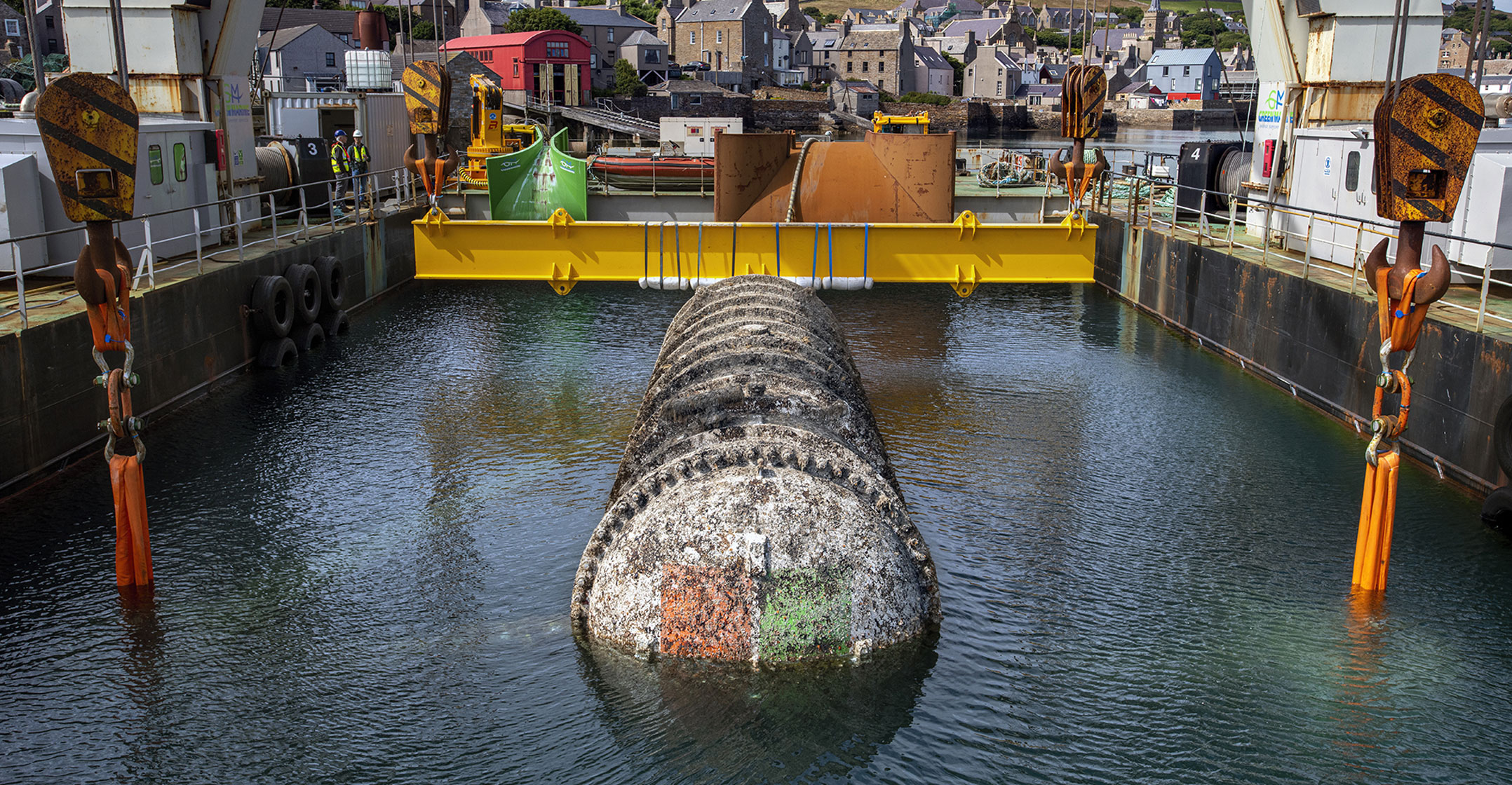
    The Northern Isles data centre was retrieved from the seafloor off Scotland’s Orkney Islands and towed partially submerged between the pontoons of a gantry barge to a dock in Stromness, Orkney. A coat of algae, barnacles and sea anemones grew on the data centre during its two-year deployment. Photo: Jonathan Banks
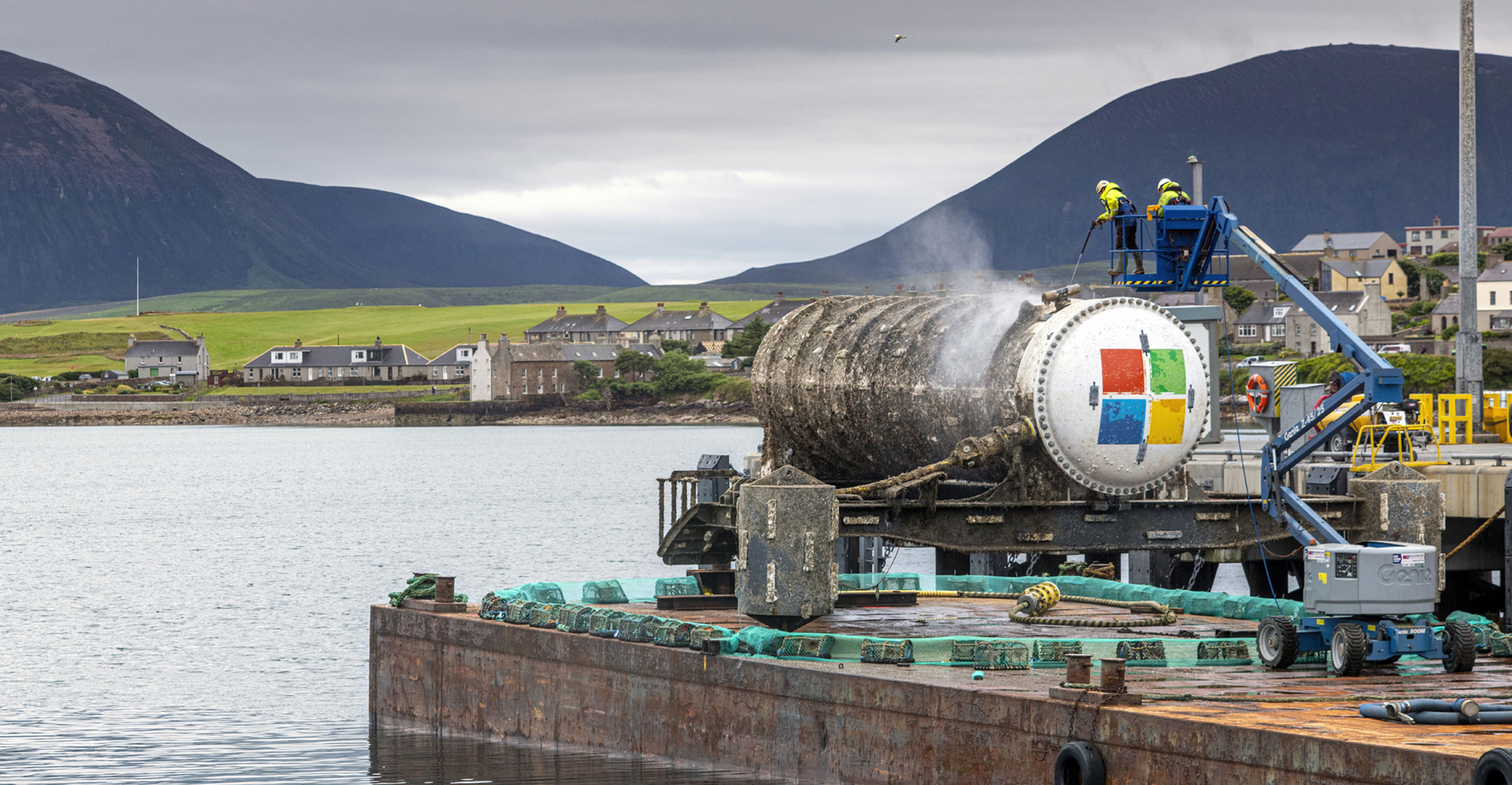
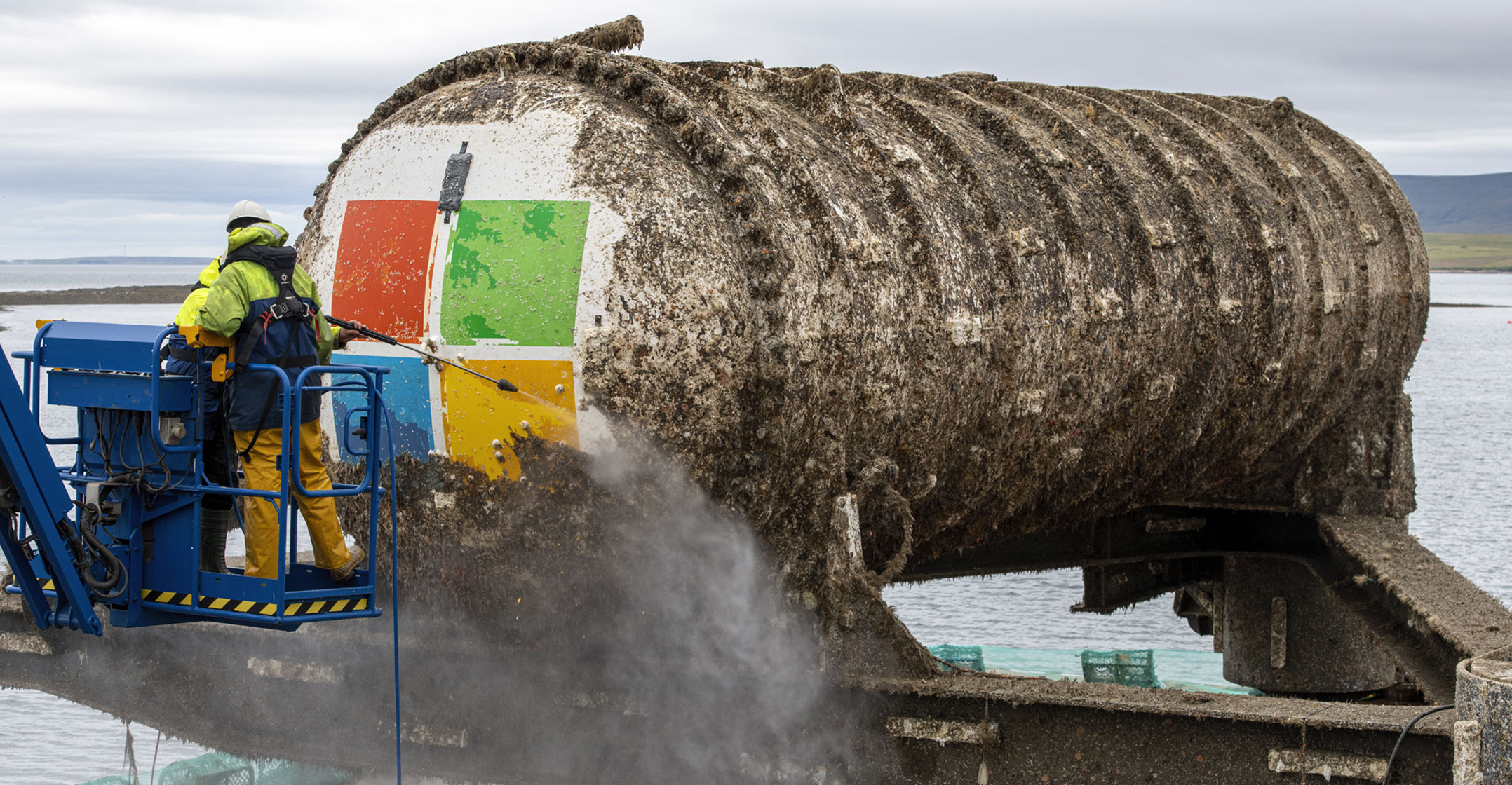
    Members of the Project Natick team power wash the Northern Isles underwater data centre. Photo: Jonathan Banks
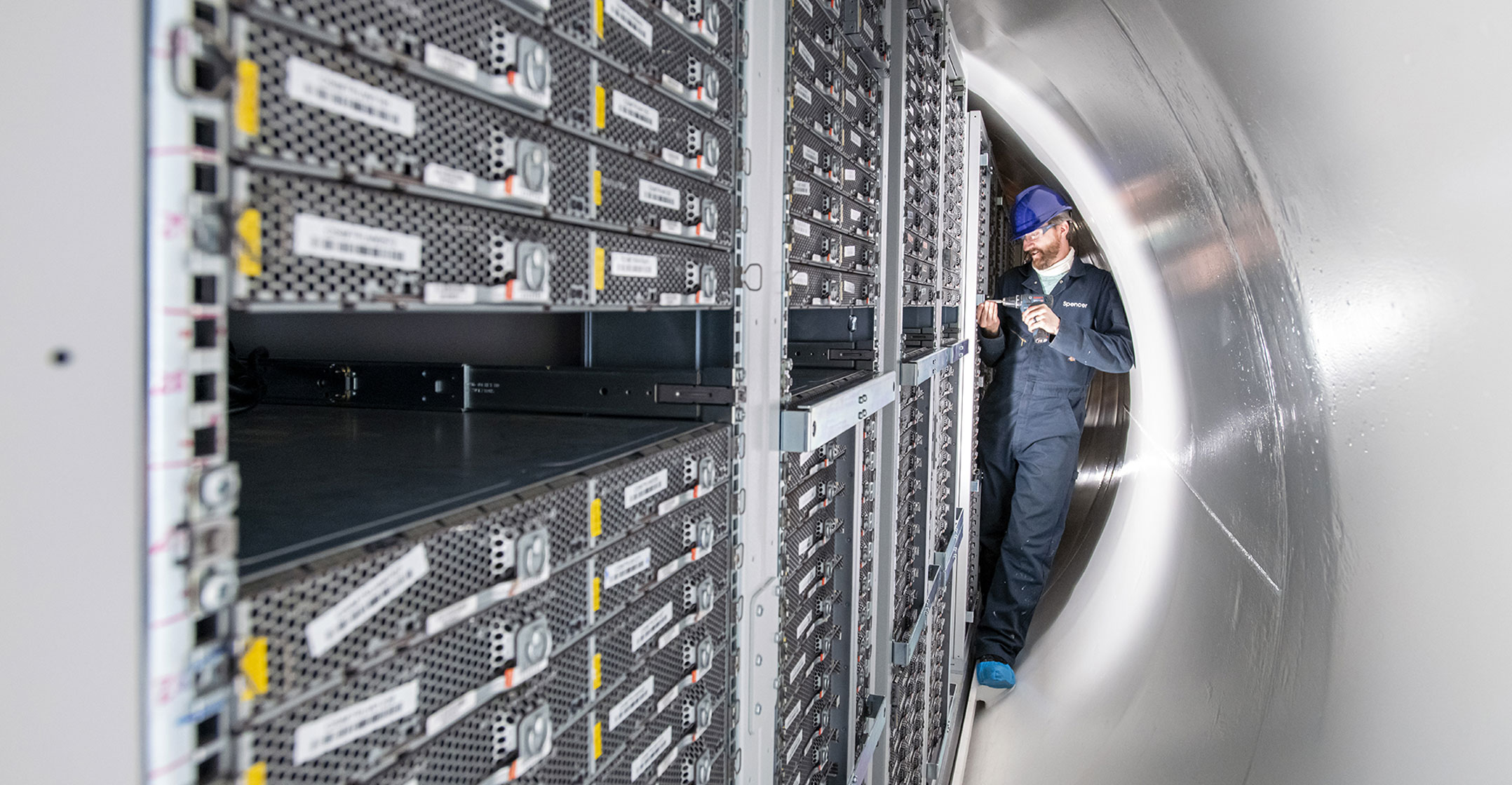
    Spencer Fowers, a principal member of technical staff for Microsoft’s Special Projects research group, removes a server from the Northern Isles data centre. Project Natick researchers will analyse it to help determine why the servers in the underwater data centre were eight times more reliable than those in a replica data centre on land. Photo: Jonathan Banks

    The Northern Isles data centre was retrieved from the seafloor off Scotland’s Orkney Islands and towed partially submerged between the pontoons of a gantry barge to a dock in Stromness, Orkney.

    It was built by Naval Group and its subsidiary Naval Energies, experts in naval defence and marine renewable energy. Green Marine, an Orkney Island-based firm, supported Naval Group and Microsoft on the deployment, maintenance, monitoring and retrieval of the data centre. It was deployed at the European Marine Energy Centre, a test site for tidal turbines and wave energy converters.

    Other sustainability related benefits may include eliminating the need to use replacement parts

    The deployment and retrieval of the Northern Isles underwater data centre required atypically calm seas and a choreographed dance of robots and winches that played out between the pontoons of a gantry barge. The procedure took a full day on each end, Microsoft said.

    Cutler said in the statement that he is already thinking of scenarios such as co-locating an underwater data centre with an offshore wind farm. “Even in light winds, there would likely be enough power for the data centre. As a last resort, a powerline from shore could be bundled with the fibre-optic cabling needed to transport data.”

    Other sustainability related benefits may include eliminating the need to use replacement parts. In a lights-out data centre, all servers would be swapped out about once every five years. “The high reliability of the servers means that the few that fail early are simply taken offline,” Microsoft said.  — © 2020 NewsCentral Media

    Follow TechCentral on Google News Add TechCentral as your preferred source on Google


    Ben Cutler Microsoft Project Natick top
    WhatsApp YouTube
    Share. Facebook Twitter LinkedIn WhatsApp Telegram Email Copy Link
    Previous ArticleSony’s chip problem is ruining its PlayStation buzz
    Next Article Eskom attaches 139 farms as it gets tough on municipal debt

    Related Posts

    Solly Malatsi stakes South Africa's AI future on staying neutral

    Solly Malatsi stakes South Africa’s AI future on staying neutral

    5 August 2026
    Microsoft just had the biggest day in stock market history

    Microsoft just had the biggest day in stock market history

    31 July 2026
    Meta cash flow collapses as AI bill hits $145-billion - Mark Zuckerberg

    Meta cash flow collapses as AI bill hits $145-billion

    30 July 2026
    Company News
    What a cloud review reveals about how a company actually runs - LSD Open

    What a cloud review reveals about how a company actually runs

    6 August 2026
    Manufacturing from a garage is now a realistic business plan - MaxLaser

    Manufacturing from a garage is now a realistic business plan

    6 August 2026
    South Africa agrees on a shared language for location - AfriGIS

    South Africa agrees on a shared language for location

    5 August 2026
    Opinion
    The author, Jannie van Zyl

    Selling vapour is corporate suicide in slow motion

    16 July 2026
    Brazil's online gambling crackdown is a lesson for South Africa

    How Amazon outmanoeuvred Starlink in South Africa

    15 July 2026
    The Popia problem with agentic AI - Herman Haasbroek

    The Popia problem with agentic AI

    14 July 2026

    Subscribe to Updates

    Get the best South African technology news and analysis delivered to your e-mail inbox every morning.

    Latest Posts
    ICT is becoming the centre of gravity at Reunert - Anthonie de Beer and Rob Godlonton

    ICT is becoming the centre of gravity at Reunert

    6 August 2026
    Why Discovery is going slow on AI coding agents - Derek Wilcocks

    Why Discovery is going slow on AI coding agents

    6 August 2026
    Google's Gemini leadership team has left the building - Demis Hassabis

    Google’s Gemini leadership team has left the building

    6 August 2026
    SpaceX shares keep sliding - Elon Musk

    SpaceX shares keep sliding

    6 August 2026
    © 2009 - 2026 NewsCentral Media
    Built and maintained by Chronon
    • Cookie policy (ZA)
    • TechCentral – privacy and Popia

    Type above and press Enter to search. Press Esc to cancel.

    Manage consent

    TechCentral uses cookies to enhance its offerings. Consenting to these technologies allows us to serve you better. Not consenting or withdrawing consent may adversely affect certain features and functions of the website.

    Functional Always active
    The technical storage or access is strictly necessary for the legitimate purpose of enabling the use of a specific service explicitly requested by the subscriber or user, or for the sole purpose of carrying out the transmission of a communication over an electronic communications network.
    Preferences
    The technical storage or access is necessary for the legitimate purpose of storing preferences that are not requested by the subscriber or user.
    Statistics
    The technical storage or access that is used exclusively for statistical purposes. The technical storage or access that is used exclusively for anonymous statistical purposes. Without a subpoena, voluntary compliance on the part of your Internet Service Provider, or additional records from a third party, information stored or retrieved for this purpose alone cannot usually be used to identify you.
    Marketing
    The technical storage or access is required to create user profiles to send advertising, or to track the user on a website or across several websites for similar marketing purposes.
    • Manage options
    • Manage services
    • Manage {vendor_count} vendors
    • Read more about these purposes
    View preferences
    • {title}
    • {title}
    • {title}