Close Menu
TechCentralTechCentral

    Subscribe to the newsletter

    Get the best South African technology news and analysis delivered to your e-mail inbox every morning.

    Facebook X (Twitter) YouTube LinkedIn
    WhatsApp Facebook X (Twitter) LinkedIn YouTube
    TechCentralTechCentral
    • News
      Icasa caught in the political crossfire over Starlink - Elon Musk

      Icasa caught in the political crossfire over Starlink

      24 April 2026
      Malatsi runs out of patience with Icasa on BEE reform - Solly Malatsi

      Malatsi runs out of patience with Icasa on BEE reform

      24 April 2026
      DeepSeek's long-awaited V4 model enters preview

      DeepSeek’s long-awaited V4 model enters preview

      24 April 2026
      South Africa planning big overhaul of public sector IT - State IT Agency Sita

      South Africa planning big overhaul of public sector IT

      23 April 2026
      Usaasa's 30-year run nears its end - Communications minister Solly Malatsi. Image c/o DCDT

      Usaasa’s 30-year run nears its end

      23 April 2026
    • World
      More organic compounds detected on Mars - Nasa Curiosity rover

      More organic compounds detected on Mars

      21 April 2026
      Adobe bets on AI agents to fend off cheaper rivals

      Adobe bets on AI agents to fend off cheaper rivals

      16 April 2026
      Google poised to lose ad crown to Meta

      Google poised to lose ad crown to Meta

      14 April 2026
      Grand Theft Data - hackers hit Rockstar Games - Grand Theft Auto

      Grand Theft Data – hackers hit Rockstar Games

      14 April 2026
      UK PM Keir Starmer declares war on doomscrolling

      UK PM Keir Starmer declares war on doomscrolling

      13 April 2026
    • In-depth
      Africa switches on as Europe dims the lights

      Africa switches on as Europe dims the lights

      9 April 2026
      The biggest untapped EV market on Earth is hiding in plain sight

      The biggest untapped EV market on Earth is hiding in plain sight

      1 April 2026
      The R18-billion tech giant hiding in plain sight - Jens Montanana

      The R16-billion tech giant hiding in plain sight

      26 March 2026
      The last generation of coders

      The last generation of coders

      18 February 2026
      Sentech is in dire straits

      Sentech is in dire straits

      10 February 2026
    • TCS

      TCS+ | ‘The ISP for ISPs’: Vox’s shift to wholesale aggregator

      20 April 2026
      TCS | Werner Lindemann on how AI is rewriting the infosec rulebook

      TCS | Werner Lindemann on how AI is rewriting the infosec rulebook

      15 April 2026
      TCS | Donovan Marsh on AI and the future of filmmaking

      TCS | Donovan Marsh on AI and the future of filmmaking

      7 April 2026
      TCS+ | Vodacom Business moves to crack the SME tech gap - Andrew Fulton, Sannesh Beharie

      TCS+ | Vodacom Business moves to crack the SME tech gap

      7 April 2026
      TCS | MTN's Divysh Joshi on the strategy behind Pi - Divyesh Joshi

      TCS | MTN’s Divyesh Joshi on the strategy behind Pi

      1 April 2026
    • Opinion
      The conflict of interest at the heart of PayShap's slow adoption - Cheslyn Jacobs

      The conflict of interest at the heart of PayShap’s slow adoption

      26 March 2026
      South Africa's energy future hinges on getting wheeling right - Aishah Gire

      South Africa’s energy future hinges on getting wheeling right

      10 March 2026
      Hold the doom: the case for a South African comeback - Duncan McLeod

      Apple just dropped a bomb on the Windows world

      5 March 2026
      R230-million in the bag for Endeavor's third Harvest Fund - Alison Collier

      VC’s centre of gravity is shifting – and South Africa is in the frame

      3 March 2026
      Hold the doom: the case for a South African comeback - Duncan McLeod

      Hold the doom: the case for a South African comeback

      26 February 2026
    • Company Hubs
      • 1Stream
      • Africa Data Centres
      • AfriGIS
      • Altron Digital Business
      • Altron Document Solutions
      • Altron Group
      • Arctic Wolf
      • Ascent Technology
      • AvertITD
      • BBD
      • Braintree
      • CallMiner
      • CambriLearn
      • CYBER1 Solutions
      • Digicloud Africa
      • Digimune
      • Domains.co.za
      • ESET
      • Euphoria Telecom
      • HOSTAFRICA
      • Incredible Business
      • iONLINE
      • IQbusiness
      • Iris Network Systems
      • Kaspersky
      • LSD Open
      • Mitel
      • NEC XON
      • Netstar
      • Network Platforms
      • Next DLP
      • Ovations
      • Paracon
      • Paratus
      • Q-KON
      • SevenC
      • SkyWire
      • Solid8 Technologies
      • Telit Cinterion
      • Telviva
      • Tenable
      • Vertiv
      • Videri Digital
      • Vodacom Business
      • Wipro
      • Workday
      • XLink
    • Sections
      • AI and machine learning
      • Banking
      • Broadcasting and Media
      • Cloud services
      • Contact centres and CX
      • Cryptocurrencies
      • Education and skills
      • Electronics and hardware
      • Energy and sustainability
      • Enterprise software
      • Financial services
      • HealthTech
      • Information security
      • Internet and connectivity
      • Internet of Things
      • Investment
      • IT services
      • Lifestyle
      • Motoring
      • Policy and regulation
      • Public sector
      • Retail and e-commerce
      • Satellite communications
      • Science
      • SMEs and start-ups
      • Social media
      • Talent and leadership
      • Telecoms
    • Events
    • Advertise
    TechCentralTechCentral
    Home » News » Rural E Cape cooperative delivers cheap Internet to residents

    Rural E Cape cooperative delivers cheap Internet to residents

    By The Conversation4 December 2017
    Twitter LinkedIn Facebook WhatsApp Email Telegram Copy Link
    News Alerts
    WhatsApp
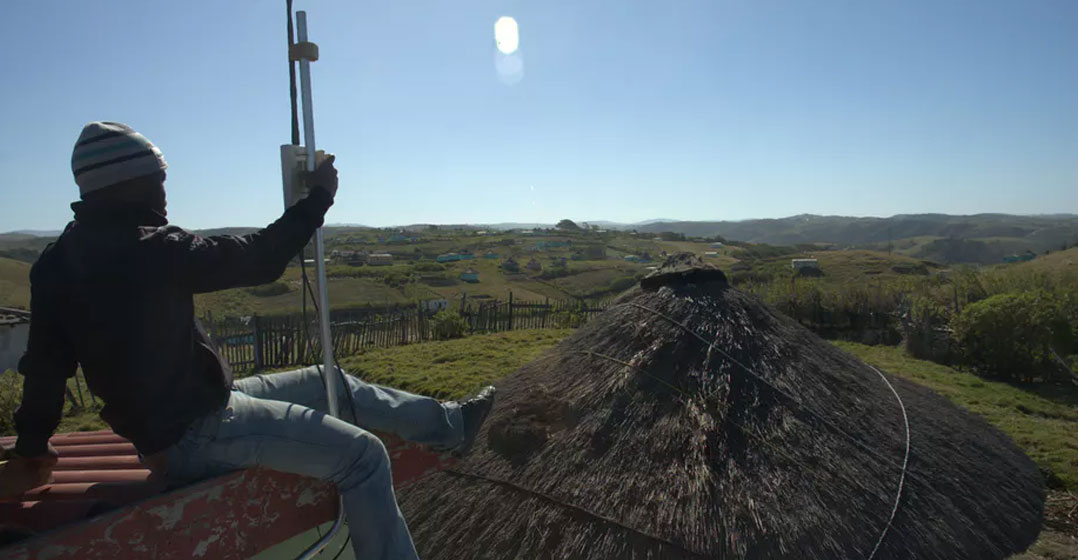
    A Zenzeleni cooperative member carefully aligns some equipment in the village of Mankosi, Eastern Cape. Bill Tucker

    Mankosi is a remote rural community in South Africa’s Eastern Cape province. It is home to almost 6 000 people. The nearest city is Mthatha, about 60km away, as a bird flies.

    Most homes are not connected to the electricity grid; residents charge their cellphones at a local shop or shebeen, for which they must pay. Both data and airtime for those phones also cost a lot: a survey shows that people spend up to 22% of their income on telecommunications. This is money that could be spent on food, education, transport and other needs.

    They’re not alone. South Africa has some of the highest mobile voice and data costs in the world.

    The Zenzeleni Networks project is, as far as we’re aware, the South Africa’s first and only Internet service provider that’s owned and run by a rural cooperative

    Yet, things are changing in Mankosi. A research team at the University of the Western Cape has worked with residents to develop a solar powered wireless community network.

    The Zenzeleni Networks project — Zenzeleni means “do it yourself” in isiXhosa, the Eastern Cape’s most prevalent language — is, as far as we’re aware, the South Africa’s first and only Internet service provider that’s owned and run by a rural cooperative. Just like any ISP, Zenzeleni installs and maintains telecoms infrastructure and also sells services like voice and data.

    Yet what’s special about the project is that it involves a registered not-for-profit company that works with cooperatives in the community to deliver affordable voice and data services. Crucially, the project also keeps money in communities like Mankosi, often beset by high rates of unemployment.

    The community networks model has proven successful elsewhere in the world: the largest is in Spain — the Guifi.net project. Others that have been developed successfully include projects in Zambia and Mexico.

    Local leaders

    The Mankosi project was launched in 2012 and legally registered in 2014. I have done research on ICT for development in the Mankosi area since 2003. Since then, colleagues and postgraduate students, have also worked, even lived, in the area for extensive periods of time.

    To establish the Zenzeleni network, we approached local leaders to help get the community on board and we provided help and mentorship. Ultimately, the residents run the project themselves.

    Zenzeleni constitutes a full-fledged ISP, equipped with an Internet and voice-over-Internet protocol gateway, community managers and a billing system in isiXhosa

    With the local authority’s permission, a cooperative comprising 10 local and respected people was formed. This group designed the network layout, and built and installed a dozen solar-powered mesh network nodes or stations. These are mounted on and inside houses around Mankosi. These are organised in what we call a mesh network and Wi-Fi stations cover an area of 30 square kilometres.

    Zenzeleni constitutes a full-fledged ISP, equipped with an Internet and voice-over-Internet protocol gateway, community managers and a billing system in isiXhosa.

    Communications regulator Icasa, which grants licences to ISPs and collects fees where necessary, granted Zenzeleni a licence exemption; so it costs Zenzeleni nothing in fees to operate infrastructure and sell services. The community only has to pay for the backhaul Internet connectivity, which they can get at wholesale prices from companies like Easttel and Openserve, and for educational use from Tenet.

    Any device — even a low- to midrange smartphone — that’s Wi-Fi-enabled can access the network. There’s a dedicated wireless connection to “point of presence” fibre in Mthatha.

    Zenzeleni’s voice calls and data costs are much cheaper than what’s offered by the big mobile operators. For example, voice calls can cost 20c/minute rather than the standard R1.50 or more, while data costs can be between 20 and 40 times cheaper.

    The solar-powered stations also charge cellphone batteries for R3.50 instead of the R5 usually charged by spaza shops or shebeens. Those shops tend to be some distance from the village, so people save time as well as money.

    A true community project

    Community is at the heart of Zenzeleni’s model. All revenues stay in the community: each cooperative has a bank account, and all residents get together to decide what to do with the money that’s been paid for Zenzeleni services.

    For example, the Mankosi cooperative has provided micro-loans to residents for starting small businesses.

    No one is currently earning a salary from the community network. But when usage grows, as we expect it will do with super cheap data, revenues are likely to grow so much that the cooperative will want to install more nodes and hire people to actively maintain them making the network more resilient. Since March 2014, the project has earned around R33 600.

    On the surface, it may appear that Zenzeleni cannibalises the revenues of big telecoms companies like Telkom. We believe the opposite is true. Firstly, Zenzeleni purchases backhaul Internet connectivity from areas like Mankosi that Telkom and others have failed to connect — so it’s operating in entirely new areas that have been ignored because they’re considered too remote to generate good revenue.

    Secondly, all telecoms companies earn interconnect fees. Calls to mobile and landline numbers across South Africa incur these fees, which are charged when calling from one network to another. This is also true for Zenzeleni, so that’s extra money in the bank for those companies.

    Lastly, and most importantly, most of the money generated by this project stays in Mankosi. This is perhaps the most crucial aspect of the Zenzeleni model, and one we believe will foster economic growth which will benefit people living in and around the village, and enable them to purchase telecommunications, and other goods and services, they currently cannot afford.

    Zenzeleni Networks’ next goal is to build critical mass to support between 20 and 30 communities surrounding Mankosi. When this happens, about 300 000 people will be able to sustainably connect themselves — and their schools, clinics, hospitals and homes — to cheaper voice, data and phone battery charging. This puts telecoms into their own hands, by themselves.The Conversation

    • Written by Bill Tucker, associate professor of computer science, University of the Western Cape
    • This article was originally published on The Conversation

    Follow TechCentral on Google News Add TechCentral as your preferred source on Google


    Bill Tucker Easttel Openserve Telkom top
    WhatsApp YouTube
    Share. Facebook Twitter LinkedIn WhatsApp Telegram Email Copy Link
    Previous ArticleVenezuela eyes crypto as bolivar sinks
    Next Article Bitcoin now worth more than New Zealand

    Related Posts

    Free calls, dead voice and Shameel Joosub's Spanish ghost

    Free calls, dead voice and Shameel Joosub’s Spanish ghost

    22 April 2026
    Specialists leave mobile operators behind on home internet - Vox

    Specialists leave mobile operators behind on home internet

    20 April 2026
    The case for unbundling SuperSport

    The case for unbundling SuperSport

    14 April 2026
    Company News
    Cybersecurity in the age of AI: why speed and trust now define resilience - iqbusiness

    Cybersecurity in the AI age: speed and trust define resilience

    24 April 2026
    Security by design is the channel's strongest pitch - Othelo Vieira

    Security by design is the channel’s strongest pitch

    23 April 2026
    Your brand is invisible to the AI that's choosing your competitor - Michelle Losco

    Your brand is invisible to the AI that’s choosing your competitor

    23 April 2026
    Opinion
    The conflict of interest at the heart of PayShap's slow adoption - Cheslyn Jacobs

    The conflict of interest at the heart of PayShap’s slow adoption

    26 March 2026
    South Africa's energy future hinges on getting wheeling right - Aishah Gire

    South Africa’s energy future hinges on getting wheeling right

    10 March 2026
    Hold the doom: the case for a South African comeback - Duncan McLeod

    Apple just dropped a bomb on the Windows world

    5 March 2026

    Subscribe to Updates

    Get the best South African technology news and analysis delivered to your e-mail inbox every morning.

    Latest Posts
    Icasa caught in the political crossfire over Starlink - Elon Musk

    Icasa caught in the political crossfire over Starlink

    24 April 2026
    Cybersecurity in the age of AI: why speed and trust now define resilience - iqbusiness

    Cybersecurity in the AI age: speed and trust define resilience

    24 April 2026
    Malatsi runs out of patience with Icasa on BEE reform - Solly Malatsi

    Malatsi runs out of patience with Icasa on BEE reform

    24 April 2026
    DeepSeek's long-awaited V4 model enters preview

    DeepSeek’s long-awaited V4 model enters preview

    24 April 2026
    © 2009 - 2026 NewsCentral Media
    • Cookie policy (ZA)
    • TechCentral – privacy and Popia

    Type above and press Enter to search. Press Esc to cancel.

    Manage consent

    TechCentral uses cookies to enhance its offerings. Consenting to these technologies allows us to serve you better. Not consenting or withdrawing consent may adversely affect certain features and functions of the website.

    Functional Always active
    The technical storage or access is strictly necessary for the legitimate purpose of enabling the use of a specific service explicitly requested by the subscriber or user, or for the sole purpose of carrying out the transmission of a communication over an electronic communications network.
    Preferences
    The technical storage or access is necessary for the legitimate purpose of storing preferences that are not requested by the subscriber or user.
    Statistics
    The technical storage or access that is used exclusively for statistical purposes. The technical storage or access that is used exclusively for anonymous statistical purposes. Without a subpoena, voluntary compliance on the part of your Internet Service Provider, or additional records from a third party, information stored or retrieved for this purpose alone cannot usually be used to identify you.
    Marketing
    The technical storage or access is required to create user profiles to send advertising, or to track the user on a website or across several websites for similar marketing purposes.
    • Manage options
    • Manage services
    • Manage {vendor_count} vendors
    • Read more about these purposes
    View preferences
    • {title}
    • {title}
    • {title}