Close Menu
TechCentralTechCentral

    Subscribe to the newsletter

    Get the best South African technology news and analysis delivered to your e-mail inbox every morning.

    Facebook X (Twitter) YouTube LinkedIn
    WhatsApp Facebook X (Twitter) LinkedIn YouTube
    TechCentralTechCentral
    • News
      Home affairs opens visa fast lane - with tech talent a top priority

      Home affairs opens visa fast lane – with tech talent a top priority

      21 July 2026
      Skills authority to probe MICT Seta leadership crisis - Buti Manamela

      Skills authority to probe MICT Seta leadership crisis

      21 July 2026
      Mastercard bets billions on the tech that could eat its lunch - Prakriti Singh

      Mastercard bets billions on the tech that could eat its lunch

      21 July 2026
      From care homes to production lines, the robots are coming

      From care homes to production lines, the robots are coming

      21 July 2026
      Remote work in South Africa hits record high

      Remote work in South Africa hits record high

      21 July 2026
    • World
      Meta AI will now tell parents if their teen is in crisis

      Meta AI will now tell parents if their teen is in crisis

      17 July 2026
      IBM shares crash 25% as AI upends software spending - Arvind Krishna

      IBM shares crash 25% as AI upends software spending

      15 July 2026
      Jony Ive's first OpenAI device: an AI smart speaker - Jony Ive and Sam Altman

      Jony Ive’s first OpenAI device: an AI smart speaker

      15 July 2026
      Stripe, Advent in talks to buy PayPal for $53-billion

      Stripe, Advent in talks to buy PayPal for $53-billion

      15 July 2026
      Memory crisis sends smartphone market into steep decline

      Memory crisis sends smartphone market into steep decline

      13 July 2026
    • In-depth
      The plan to stop AI from breaking the world - Google DeepMind CEO Demis Hassabis. Image: John Sears

      The plan to stop AI from breaking the world

      16 July 2026
      The internet has a Strait of Hormuz problem

      The internet has a Strait of Hormuz problem

      15 July 2026
      AI boom sparks rally, frenzy and fear

      AI boom sparks rally, frenzy and fear

      11 June 2026
      Every plug-in hybrid on sale in South Africa, ranked by price - Lamborghini Temerario

      Every plug-in hybrid on sale in South Africa, ranked by price

      7 June 2026
      What Wi-Fi 8 will mean for wireless networks

      What Wi-Fi 8 will mean for wireless networks

      1 June 2026
    • TCS
      Watts & Wheels S1E7: 'Ferrari's EV breaks the internet'

      Watts & Wheels S1E7: ‘Ferrari’s EV breaks the internet’

      8 July 2026
      TCS+ | How Tracker is turning vehicle data into business strategy - Silvia Schollenberger

      TCS+ | How Tracker is turning vehicle data into business strategy

      1 July 2026
      TCS+ | IBM Bob: an AI-powered 'development partner' for the enterprise - David Spurway

      TCS+ | IBM Bob: an AI-powered development partner for the enterprise

      30 June 2026
      Watts & Wheels S1E6: 'A flawless Alfa and a bakkie that divides'

      Watts & Wheels S1E6: ‘A flawless Alfa and a bakkie that divides’

      17 June 2026
      Watts & Wheels S1E6: 'A flawless Alfa and a bakkie that divides'

      Watts & Wheels S1E5: ‘A Bentley of the bush and a car that swims’

      8 June 2026
    • Opinion
      Selling vapour is corporate suicide in slow motion - Jannie van Zyl

      Selling vapour is corporate suicide in slow motion

      16 July 2026
      Brazil's online gambling crackdown is a lesson for South Africa

      How Amazon outmanoeuvred Starlink in South Africa

      15 July 2026
      The Popia problem with agentic AI - Herman Haasbroek

      The Popia problem with agentic AI

      14 July 2026
      The author, Fanie van Rooyen

      South Africa can still catch the AI wave – here’s how

      7 July 2026
      The author, Fanie van Rooyen

      The AI utopia South Africa can’t afford

      1 July 2026
    • Company Hubs
      • 1Stream
      • Africa Data Centres
      • AfriGIS
      • Altron Digital Business
      • Altron Document Solutions
      • Altron Group
      • Arctic Wolf
      • Ascent Technology
      • AvertITD
      • BBD
      • Braintree
      • CallMiner
      • CambriLearn
      • CM Telecom
      • Contactable
      • CYBER1 Solutions
      • Digicloud Africa
      • Digimune
      • Domains.co.za
      • ESET
      • Euphoria Telecom
      • HOSTAFRICA
      • Incredible Business
      • iONLINE
      • IQbusiness
      • Iris Network Systems
      • Kaspersky
      • LSD Open
      • Mitel
      • NEC XON
      • Netstar
      • Network Platforms
      • Next DLP
      • Ovations
      • Paracon
      • Paratus
      • Q-KON
      • SevenC
      • SkyWire
      • Solid8 Technologies
      • Telit Cinterion
      • Telviva
      • Tenable
      • Vertiv
      • Videri Digital
      • Vodacom Business
      • Wipro
      • Workday
      • XLink
    • Sections
      • AI and machine learning
      • Banking
      • Broadcasting and Media
      • Cloud services
      • Contact centres and CX
      • Cryptocurrencies
      • Education and skills
      • Electronics and hardware
      • Energy and sustainability
      • Enterprise software
      • Financial services
      • HealthTech
      • Information security
      • Internet and connectivity
      • Internet of Things
      • Investment
      • IT services
      • Lifestyle
      • Policy and regulation
      • Public sector
      • Retail and e-commerce
      • Satellite communications
      • Science
      • SMEs and start-ups
      • Social media
      • Talent and leadership
      • Telecoms
      • Watts & Wheels
    • Events
    • Advertise
    TechCentralTechCentral
    Home » Science » Something weird is happening on Venus

    Something weird is happening on Venus

    By The Conversation17 January 2017
    Twitter LinkedIn Facebook WhatsApp Email Telegram Copy Link
    News Alerts
    WhatsApp

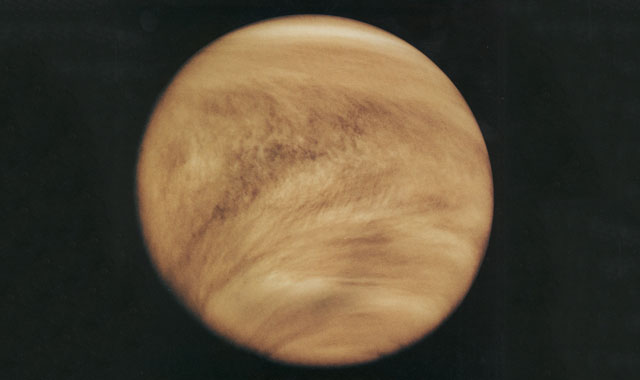
    Venus is known both as the “planet of love” and the Earth’s “evil twin”. And although research suggests its environment is more hellish than romantic, there’s actually a lot we don’t know about our celestial neighbour. Now Japanese scientists have made a surprising discovery: an enormous, bow-shaped feature in the planet’s cloud region which seems fixed to the slowly rotating planet. Clouds around it, on the other hand, whizz by at about 100m/s. So, what is it?

    Venus is almost as large as Earth but orbits closer to the sun. A spacecraft approaching the planet would see chevron-shaped structures in the clouds, due to the rapid “super-rotation” of its thick atmosphere well above the surface.

    Before the space age, it was thought that Venus would be somewhat similar to Earth. Indeed, the expectation in science fiction was that the planet may support life, with thick vegetation under water-rich clouds. But spacecraft have shown us that Venus is lifeless and very different to our own planet — and the clouds are sulphuric acid. It has the hottest planetary surface in the solar system (447°C — hot enough to melt lead), a thick atmosphere (92 times Earth’s atmospheric pressure) and no protective magnetic field. Its rotation is slow — and the wrong way around (243 Earth days) — and it has hurricane force winds and strange vortices near the poles.

    Although early Venus may have had some surface water, this gradually evaporated into the atmosphere due to the close distance to the sun. This led to a greenhouse effect in which the atmosphere got thicker, the surface got hotter, more water evaporated into the atmosphere and so forth. The water broke up in the high atmosphere rather than condensing onto the warm surface as oceans. Unlike Earth, carbon dioxide in the atmosphere could not be dissolved into the oceans, settling on the ocean floor as carbonates and cycled as carbon dioxide gas by volcanism. Instead, volcanism continued pumping gases into the atmosphere, building up the atmospheric pressure. The atmosphere of Venus now is principally carbon dioxide, which is the reason the surface is extremely hot.

    The early missions, including Mariner, Venera and Pioneer Venus determined the composition of the clouds and measured the atmospheric structure. The Russian Venera landers, the only craft so far to have landed in the harsh Venus environment, showed images of lava plains and volcanic terrain. Later the Magellan mission, which used radar to peer under the clouds, allowed mapping of the volcanoes and lava channels in detail — revealing a young surface with relatively few craters. This shows that the planet was resurfaced by volcanic activity about 500m years ago. More recently, Venus Express has shown possible signs of some volcanism within the last 100 to 10 000 years.

    The super-rotation of Venus’s atmosphere makes it very different from Earth. At the cloud level of 50-65km, where the atmospheric pressure varies between the Earth’s surface pressure to 10% of that, the speed of rotation is up to 100m/s — about 60 times the speed of the planet’s rotation. This is higher than a hurricane force on Earth. By contrast, Earth’s fastest winds are only about 10-20% of the planet’s rotation speed. Although the super-rotation is not fully understood, Pioneer Venus showed that the high speed reduces through the lower atmosphere, eventually rotating with the planet at the surface.

    Perplexing planet

    Enter the Japanese spacecraft Akatsuki, which was launched on 20 May 2010. The spacecraft is designed to study the structure and activity of the Venus atmosphere. After a difficult journey , it was successfully inserted into orbit at the second attempt in 2015. This, along with the first few results, were a huge achievement.

    The new study reporting the discovery of the bow-shaped structure, just published in Nature Geoscience, is the most recent result of the mission. The wave was caught by Akatsuki’s imaging instruments — looking in the infrared and ultraviolet parts of the electromagnetic spectrum. The astronomers analysing the data noted that the structure extended 10 000 km through the Venus cloud tops and persisted for a few days, then suddenly disappeared.

    Remarkably, the shape seems tied to the slowly rotating terrain below, particularly a high region called Aphrodite Terra, which is up to 5km high and the size of Africa near the equator. The structure persists in the rapidly moving, super-rotating winds at the cloud level. This is a bit like the flow of water flow around a submerged stone in a stream.

    The researchers suggest that a stationary “gravity wave” (which is different from a gravitational wave) in the atmosphere might cause the effect. Gravity waves are generated at the boundary between the atmosphere and a surface, or between horizontal layers in the atmosphere, when the force of gravity opposes buoyancy (ability to float). An example on Earth is the wind waves on the sea — just between the atmosphere and the ocean. There are also gravity waves over mountainous terrain, which form when air ripples move over a bumpy surface. Gravity waves on a larger scale can also be seen in the upper atmosphere between different layers.
    Gravity waves seen by Venus Express (image: Nasa)

    Although smaller scale gravity waves have been seen near to ground level on Venus before, the scale of this new feature seems to be extremely large, probably the largest in the solar system. In fact, it is unclear whether it is even possible for gravity waves to cause such a big effect.

    The discovery illustrates that, although we can explain some of the features of the thick, fast Venus atmosphere, it appears that low-altitude atmospheric dynamics are not fully understood yet. But we are slowly uncovering the planet’s secrets and the latest study is certainly making waves.The Conversation

    • Andrew Coates is professor of physics and deputy director (solar system) at the Mullard Space Science Laboratory
    • This article was originally published on The Conversation

    Follow TechCentral on Google News Add TechCentral as your preferred source on Google


    WhatsApp YouTube
    Share. Facebook Twitter LinkedIn WhatsApp Telegram Email Copy Link
    Previous ArticleAbsa parent attracts potential new suitor
    Next Article Samsung succession in disarray

    Related Posts

    Home affairs opens visa fast lane - with tech talent a top priority

    Home affairs opens visa fast lane – with tech talent a top priority

    21 July 2026
    Skills authority to probe MICT Seta leadership crisis - Buti Manamela

    Skills authority to probe MICT Seta leadership crisis

    21 July 2026
    Mastercard bets billions on the tech that could eat its lunch - Prakriti Singh

    Mastercard bets billions on the tech that could eat its lunch

    21 July 2026
    Company News
    Cloud adoption is done. Execution is the new frontier - Cloud on Demand

    Cloud adoption is done. Execution is the new frontier

    21 July 2026
    Data poisoning in AI models: what businesses need to know - Domains.co.za

    Data poisoning in AI models: what businesses need to know

    21 July 2026
    The AI-led industrial revolution has begun - CallMiner Bruce McMahon

    The AI-led industrial revolution has begun

    20 July 2026
    Opinion
    Selling vapour is corporate suicide in slow motion - Jannie van Zyl

    Selling vapour is corporate suicide in slow motion

    16 July 2026
    Brazil's online gambling crackdown is a lesson for South Africa

    How Amazon outmanoeuvred Starlink in South Africa

    15 July 2026
    The Popia problem with agentic AI - Herman Haasbroek

    The Popia problem with agentic AI

    14 July 2026

    Subscribe to Updates

    Get the best South African technology news and analysis delivered to your e-mail inbox every morning.

    Latest Posts
    Home affairs opens visa fast lane - with tech talent a top priority

    Home affairs opens visa fast lane – with tech talent a top priority

    21 July 2026
    Skills authority to probe MICT Seta leadership crisis - Buti Manamela

    Skills authority to probe MICT Seta leadership crisis

    21 July 2026
    Mastercard bets billions on the tech that could eat its lunch - Prakriti Singh

    Mastercard bets billions on the tech that could eat its lunch

    21 July 2026
    From care homes to production lines, the robots are coming

    From care homes to production lines, the robots are coming

    21 July 2026
    © 2009 - 2026 NewsCentral Media
    Built and maintained by Chronon
    • Cookie policy (ZA)
    • TechCentral – privacy and Popia

    Type above and press Enter to search. Press Esc to cancel.

    Manage consent

    TechCentral uses cookies to enhance its offerings. Consenting to these technologies allows us to serve you better. Not consenting or withdrawing consent may adversely affect certain features and functions of the website.

    Functional Always active
    The technical storage or access is strictly necessary for the legitimate purpose of enabling the use of a specific service explicitly requested by the subscriber or user, or for the sole purpose of carrying out the transmission of a communication over an electronic communications network.
    Preferences
    The technical storage or access is necessary for the legitimate purpose of storing preferences that are not requested by the subscriber or user.
    Statistics
    The technical storage or access that is used exclusively for statistical purposes. The technical storage or access that is used exclusively for anonymous statistical purposes. Without a subpoena, voluntary compliance on the part of your Internet Service Provider, or additional records from a third party, information stored or retrieved for this purpose alone cannot usually be used to identify you.
    Marketing
    The technical storage or access is required to create user profiles to send advertising, or to track the user on a website or across several websites for similar marketing purposes.
    • Manage options
    • Manage services
    • Manage {vendor_count} vendors
    • Read more about these purposes
    View preferences
    • {title}
    • {title}
    • {title}