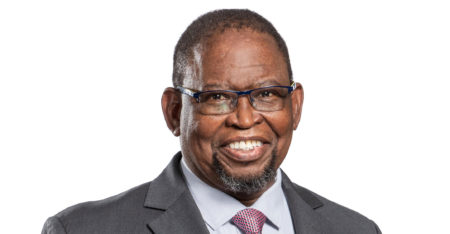
Home affairs minister Leon Schreiber on Thursday unveiled what he said was South Africa’s first working digital ID, using his own credential on his smartphone in a live demonstration in Johannesburg.
“What you are about to see is not only a real working digital identity credential that has been formally issued through the population register and securely bound to the chip on the smartphone I will soon use,” Schreiber said. “What you are about to see is my own real digital identity credential.”
The demonstration was the centrepiece of a speech marking the halfway point of the government of national unity’s term, in which Schreiber also set a date for the end of the green ID book and laid out new plans for passports, birth registration and visas.
On screens either side of the stage, Schreiber opened the MyMzansi digital ID app and confirmed his identity with his thumbprint. The photograph displayed was his own image on the population register, not a model photo, he said.
Director-general Tommy Makhode, whom Schreiber introduced as the country’s most senior immigration officer, then played the part of an official checking his citizenship. Using a verifier app, Makhode requested the population register details linked to Schreiber’s ID. Schreiber generated a QR code on his phone, which Makhode scanned.
Before approving the request, Schreiber switched off his ID number and shared the remaining fields, including nationality, which appeared on Makhode’s phone seconds later. When Makhode tried again, Schreiber declined, and the verifier was denied access.
“Digital ID cannot and will not be a photograph of your ID card on your phone,” Schreiber said, describing it instead as “a remote verification tool” linked to the user’s biometrics “that enables you to confirm who you are, without anyone having the ability to interfere with that”.
No launch date
The app also has a wallet that will hold other home affairs credentials, including birth and marriage certificates. A mock-up of the wallet was shown instead of his own, which holds his real personal information.
Schreiber did not say when the public will be able to get a digital ID. Home affairs’ annual performance plan, tabled in March, targets completion of the hosting infrastructure, which is being built in the South African Revenue Service’s IT environment, by 31 March 2027, with citizens to be issued credentials through a mobile wallet in the 2027/2028 financial year. The department is still processing public comments on the draft regulations published in May, which identity specialists criticised for, among other things, relying on 2D selfies for liveness checks.
Schreiber said use of digital ID will be voluntary and that the final regulations will impose “hard limits” on what people’s data may be used for. The physical smart ID card will remain available to anyone who prefers it, and digital ID users will be able to see every time their data is accessed.
He likened the pairing of the two to the digital bank cards many South Africans carry on their phones alongside a physical one, and said digital ID would be secured with the same biometrics used to unlock a smartphone or confirm a mobile payment.
“Surveillance is the state watching the citizen. What we are building is the opposite: the citizen watching the state and other users of their data,” he said.
Digital ID could also remove the need to apply for some documents at all, he said. A citizen who has opted in would be contacted six months before their passport expires, with a renewal application already prepared.
“You verify it with your face, make payment and your new passport is delivered directly to your door. No queue, no form and now not even an application,” Schreiber said. No new information would be needed, only the expiry date of a document the department had issued, “put to work in your service through the latest agentic technology”.
Passports
Passport applications and first-time smart ID applications will “shortly” be available at bank branches, 515 of which already offer walk-in smart ID replacements, along with courier delivery to applicants’ homes.
Home affairs and the Government Printing Works are also working on a biometrically secured e-passport. The department has introduced technology that biometrically verifies the photo that ends up in a passport, which Schreiber called “a direct blow against the fraud known as photo swapping”.
Once the application process is fully automated, home affairs will take a proposal to cabinet for an e-passport with a chip containing the holder’s biometrics, making South African passports readable by electronic gates at airports around the world for the first time. With the systems and hardware in place, the government will then seek visa-free access to more countries for holders of the new passport, Schreiber said.
Births, marriages and deaths
Before the term ends in 2029, home affairs plans to automate applications for birth, marriage and death certificates and make them available at more than a thousand bank branches. In the new year, it will turn to automating the registration of births, marriages and deaths.
Working with public and private healthcare providers, the department wants to use the same biometric technology behind the bank partnership “to enable every parent to securely register their child’s birth without filling in a form or standing in a queue”. Schreiber said he had “bitterly complained” when he recently had to do this himself.
Visas and borders
The electronic travel authorisation (ETA) system, launched by President Cyril Ramaphosa on 12 August, is live for short-stay visa applications from 53 countries, with more added weekly, Schreiber said. Study and work visas will follow in early 2027 as part of a plan to move all visa processing online, and the system will be extended from the four international airports it covers now to all ports of entry.
Once the ETA is fully rolled out, the Border Management Authority (BMA) will pursue automated gates at all ports of entry that open only when a foreign traveller’s biometrics match those on their ETA. “You cannot bribe a computer,” Schreiber said.
The R12.5-billion public-private partnership to rebuild the country’s six busiest land ports of entry as no-stop border posts aims to have at least one fully operational by the end of the administration.
Documenting every citizen
Schreiber described his last announcement as the “capstone” of the reforms: preparations for a national campaign in the 2028/2029 financial year to document every undocumented South African citizen. It will include a review of late birth registration requirements and processes, and will use mobile biometric technology, with officials freed up by digital self-service sent into communities. The aim is for every citizen to be documented by 2029.
He credited the department’s partnership with Sars, now led by commissioner Johnstone Makhubu, with much of the progress. “Home affairs and Sars are twins,” Schreiber said, adding that the department was ready to make the relationship “a two-way street”.
He also cited 144 dismissals, 73 arrests and 10 convictions across home affairs and the BMA since July 2024 as evidence of a culture that “mercilessly punishes delinquency”. — © 2026 NewsCentral Media